 Add to Chrome
 Add to Firefox
 Add to Edge
ICD-LM: Configuring Vision-Language In-Context Demonstrations by Language Modeling
Dec 22, 2023
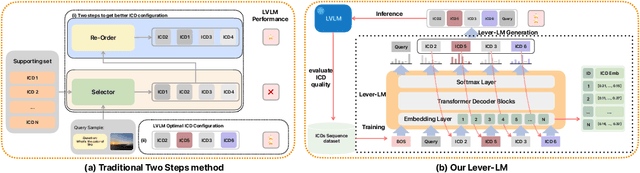
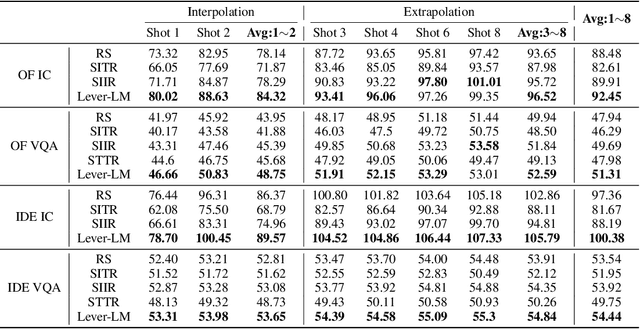
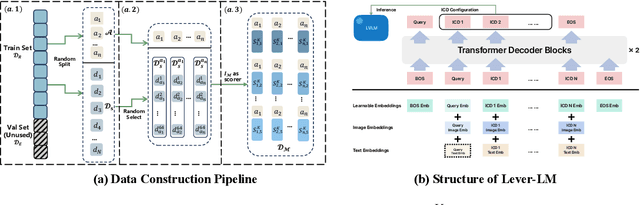
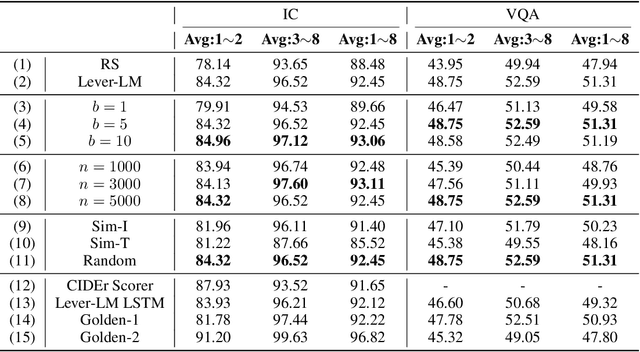
This paper studies how to configure powerful In-Context Demonstration (ICD) sequences for a Large Vision-Language Model (LVLM) to solve Vision-Language tasks through In-Context Learning (ICL). After observing that configuring an ICD sequence is a mirror process of composing a sentence, i.e., just as a sentence can be composed word by word via a Language Model, an ICD sequence can also be configured one by one. Consequently, we introduce an ICD Language Model (ICD-LM) specifically designed to generate effective ICD sequences. This involves creating a dataset of hand-crafted ICD sequences for various query samples and using it to train the ICD-LM. Our approach, diverging from traditional methods in NLP that select and order ICDs separately, enables to simultaneously learn how to select and order ICDs, enhancing the effect of the sequences. Moreover, during data construction, we use the LVLM intended for ICL implementation to validate the strength of each ICD sequence, resulting in a model-specific dataset and the ICD-LM trained by this dataset is also model-specific. We validate our methodology through experiments in Visual Question Answering and Image Captioning, confirming the viability of using a Language Model for ICD configuration. Our comprehensive ablation studies further explore the impact of various dataset construction and ICD-LM development settings on the outcomes. The code is given in https://github.com/ForJadeForest/ICD-LM.

ChartLlama: A Multimodal LLM for Chart Understanding and Generation
Nov 27, 2023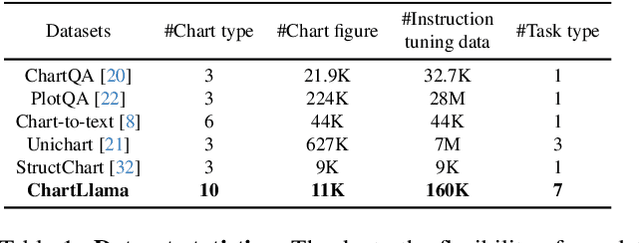
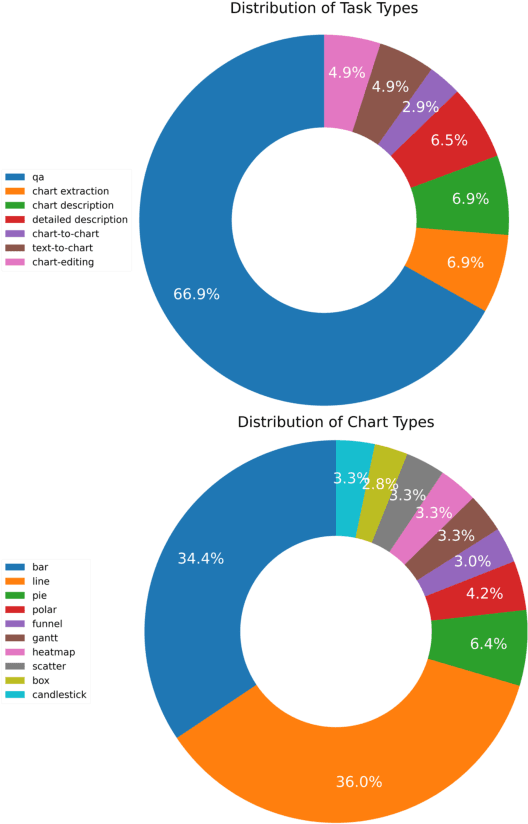

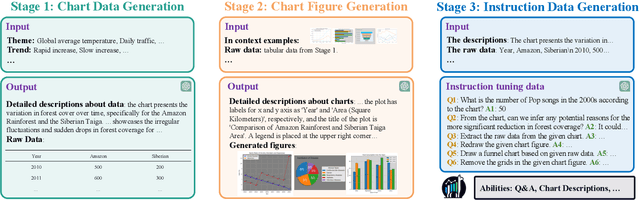
Multi-modal large language models have demonstrated impressive performances on most vision-language tasks. However, the model generally lacks the understanding capabilities for specific domain data, particularly when it comes to interpreting chart figures. This is mainly due to the lack of relevant multi-modal instruction tuning datasets. In this article, we create a high-quality instruction-tuning dataset leveraging GPT-4. We develop a multi-step data generation process in which different steps are responsible for generating tabular data, creating chart figures, and designing instruction tuning data separately. Our method's flexibility enables us to generate diverse, high-quality instruction-tuning data consistently and efficiently while maintaining a low resource expenditure. Additionally, it allows us to incorporate a wider variety of chart and task types not yet featured in existing datasets. Next, we introduce ChartLlama, a multi-modal large language model that we've trained using our created dataset. ChartLlama outperforms all prior methods in ChartQA, Chart-to-text, and Chart-extraction evaluation benchmarks. Additionally, ChartLlama significantly improves upon the baseline in our specially compiled chart dataset, which includes new chart and task types. The results of ChartLlama confirm the value and huge potential of our proposed data generation method in enhancing chart comprehension.
Invariant Feature Regularization for Fair Face Recognition
Oct 23, 2023


Fair face recognition is all about learning invariant feature that generalizes to unseen faces in any demographic group. Unfortunately, face datasets inevitably capture the imbalanced demographic attributes that are ubiquitous in real-world observations, and the model learns biased feature that generalizes poorly in the minority group. We point out that the bias arises due to the confounding demographic attributes, which mislead the model to capture the spurious demographic-specific feature. The confounding effect can only be removed by causal intervention, which requires the confounder annotations. However, such annotations can be prohibitively expensive due to the diversity of the demographic attributes. To tackle this, we propose to generate diverse data partitions iteratively in an unsupervised fashion. Each data partition acts as a self-annotated confounder, enabling our Invariant Feature Regularization (INV-REG) to deconfound. INV-REG is orthogonal to existing methods, and combining INV-REG with two strong baselines (Arcface and CIFP) leads to new state-of-the-art that improves face recognition on a variety of demographic groups. Code is available at https://github.com/PanasonicConnect/InvReg.
Generalized Logit Adjustment: Calibrating Fine-tuned Models by Removing Label Bias in Foundation Models
Oct 12, 2023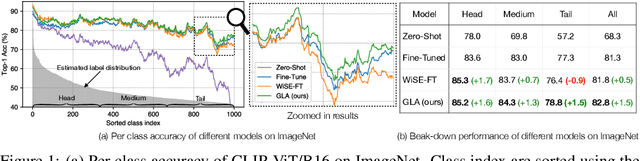
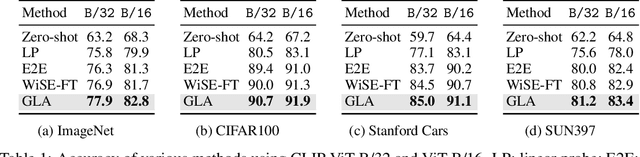
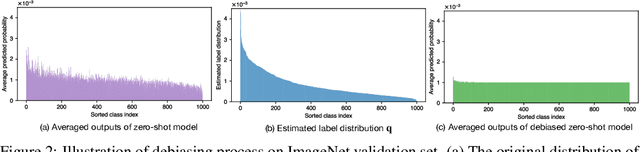
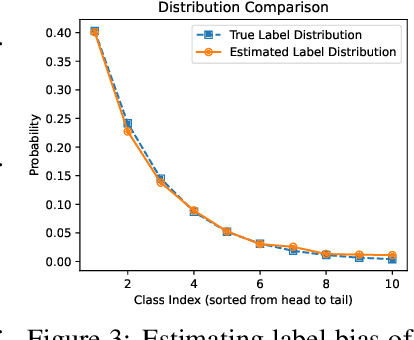
Foundation models like CLIP allow zero-shot transfer on various tasks without additional training data. Yet, the zero-shot performance is less competitive than a fully supervised one. Thus, to enhance the performance, fine-tuning and ensembling are also commonly adopted to better fit the downstream tasks. However, we argue that such prior work has overlooked the inherent biases in foundation models. Due to the highly imbalanced Web-scale training set, these foundation models are inevitably skewed toward frequent semantics, and thus the subsequent fine-tuning or ensembling is still biased. In this study, we systematically examine the biases in foundation models and demonstrate the efficacy of our proposed Generalized Logit Adjustment (GLA) method. Note that bias estimation in foundation models is challenging, as most pre-train data cannot be explicitly accessed like in traditional long-tailed classification tasks. To this end, GLA has an optimization-based bias estimation approach for debiasing foundation models. As our work resolves a fundamental flaw in the pre-training, the proposed GLA demonstrates significant improvements across a diverse range of tasks: it achieves 1.5 pp accuracy gains on ImageNet, an large average improvement (1.4-4.6 pp) on 11 few-shot datasets, 2.4 pp gains on long-tailed classification. Codes are in \url{https://github.com/BeierZhu/GLA}.
Tuning Multi-mode Token-level Prompt Alignment across Modalities
Sep 25, 2023
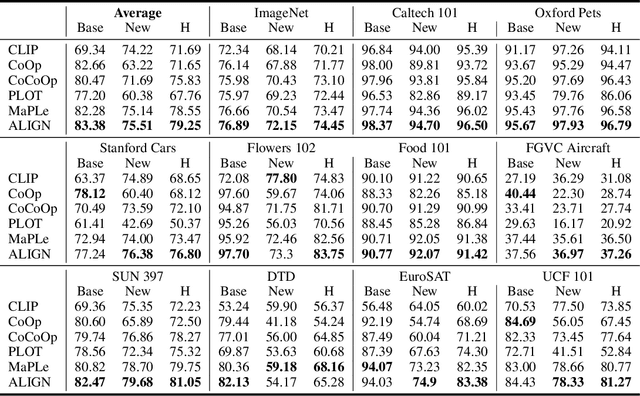
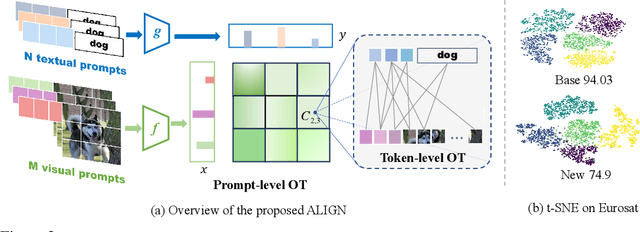
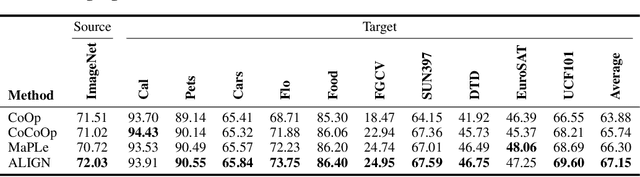
Prompt tuning pre-trained vision-language models have demonstrated significant potential in improving open-world visual concept understanding. However, prior works only primarily focus on single-mode (only one prompt for each modality) and holistic level (image or sentence) semantic alignment, which fails to capture the sample diversity, leading to sub-optimal prompt discovery. To address the limitation, we propose a multi-mode token-level tuning framework that leverages the optimal transportation to learn and align a set of prompt tokens across modalities. Specifically, we rely on two essential factors: 1) multi-mode prompts discovery, which guarantees diverse semantic representations, and 2) token-level alignment, which helps explore fine-grained similarity. Thus, the similarity can be calculated as a hierarchical transportation problem between the modality-specific sets. Extensive experiments on popular image recognition benchmarks show the superior generalization and few-shot abilities of our approach. The qualitative analysis demonstrates that the learned prompt tokens have the ability to capture diverse visual concepts.
Make the U in UDA Matter: Invariant Consistency Learning for Unsupervised Domain Adaptation
Sep 22, 2023Domain Adaptation (DA) is always challenged by the spurious correlation between domain-invariant features (e.g., class identity) and domain-specific features (e.g., environment) that does not generalize to the target domain. Unfortunately, even enriched with additional unsupervised target domains, existing Unsupervised DA (UDA) methods still suffer from it. This is because the source domain supervision only considers the target domain samples as auxiliary data (e.g., by pseudo-labeling), yet the inherent distribution in the target domain -- where the valuable de-correlation clues hide -- is disregarded. We propose to make the U in UDA matter by giving equal status to the two domains. Specifically, we learn an invariant classifier whose prediction is simultaneously consistent with the labels in the source domain and clusters in the target domain, hence the spurious correlation inconsistent in the target domain is removed. We dub our approach "Invariant CONsistency learning" (ICON). Extensive experiments show that ICON achieves the state-of-the-art performance on the classic UDA benchmarks: Office-Home and VisDA-2017, and outperforms all the conventional methods on the challenging WILDS 2.0 benchmark. Codes are in https://github.com/yue-zhongqi/ICON.
Towards Debiasing Frame Length Bias in Text-Video Retrieval via Causal Intervention
Sep 17, 2023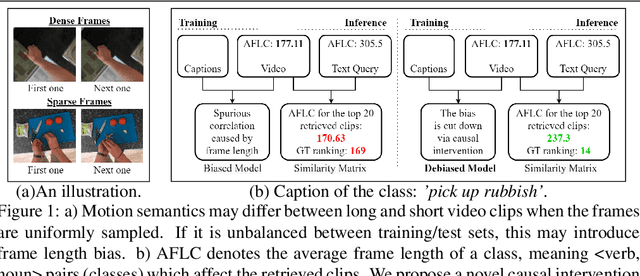
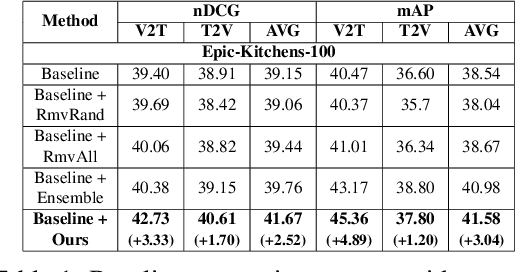
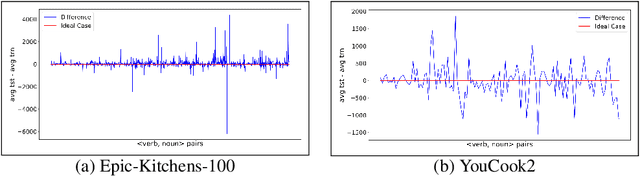
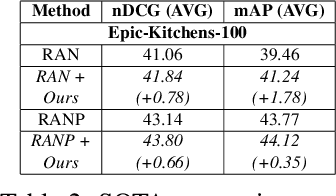
Many studies focus on improving pretraining or developing new backbones in text-video retrieval. However, existing methods may suffer from the learning and inference bias issue, as recent research suggests in other text-video-related tasks. For instance, spatial appearance features on action recognition or temporal object co-occurrences on video scene graph generation could induce spurious correlations. In this work, we present a unique and systematic study of a temporal bias due to frame length discrepancy between training and test sets of trimmed video clips, which is the first such attempt for a text-video retrieval task, to the best of our knowledge. We first hypothesise and verify the bias on how it would affect the model illustrated with a baseline study. Then, we propose a causal debiasing approach and perform extensive experiments and ablation studies on the Epic-Kitchens-100, YouCook2, and MSR-VTT datasets. Our model overpasses the baseline and SOTA on nDCG, a semantic-relevancy-focused evaluation metric which proves the bias is mitigated, as well as on the other conventional metrics.
Empowering Dynamics-aware Text-to-Video Diffusion with Large Language Models
Aug 26, 2023Text-to-video (T2V) synthesis has gained increasing attention in the community, in which the recently emerged diffusion models (DMs) have promisingly shown stronger performance than the past approaches. While existing state-of-the-art DMs are competent to achieve high-resolution video generation, they may largely suffer from key limitations (e.g., action occurrence disorders, crude video motions) with respect to the intricate temporal dynamics modeling, one of the crux of video synthesis. In this work, we investigate strengthening the awareness of video dynamics for DMs, for high-quality T2V generation. Inspired by human intuition, we design an innovative dynamic scene manager (dubbed as Dysen) module, which includes (step-1) extracting from input text the key actions with proper time-order arrangement, (step-2) transforming the action schedules into the dynamic scene graph (DSG) representations, and (step-3) enriching the scenes in the DSG with sufficient and reasonable details. Taking advantage of the existing powerful LLMs (e.g., ChatGPT) via in-context learning, Dysen realizes (nearly) human-level temporal dynamics understanding. Finally, the resulting video DSG with rich action scene details is encoded as fine-grained spatio-temporal features, integrated into the backbone T2V DM for video generating. Experiments on popular T2V datasets suggest that our framework consistently outperforms prior arts with significant margins, especially in the scenario with complex actions. Project page at https://haofei.vip/Dysen-VDM
Invariant Training 2D-3D Joint Hard Samples for Few-Shot Point Cloud Recognition
Aug 18, 2023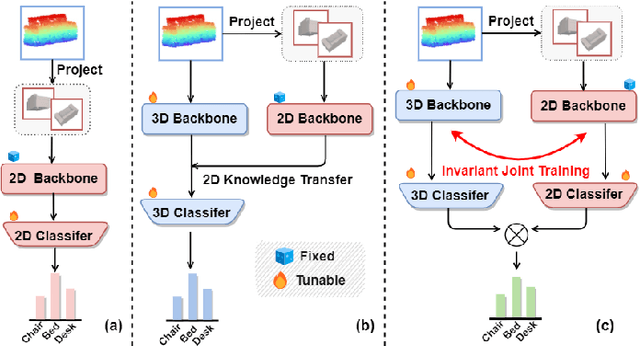
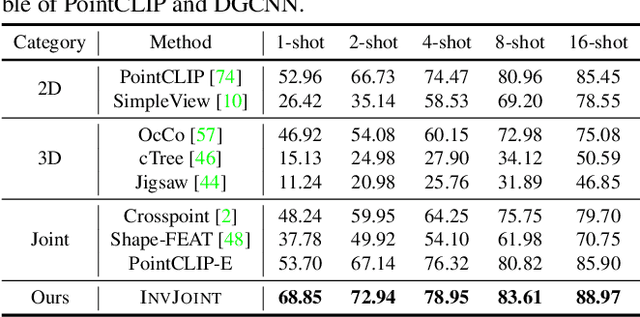
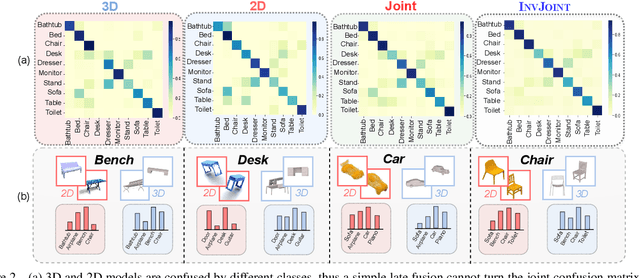
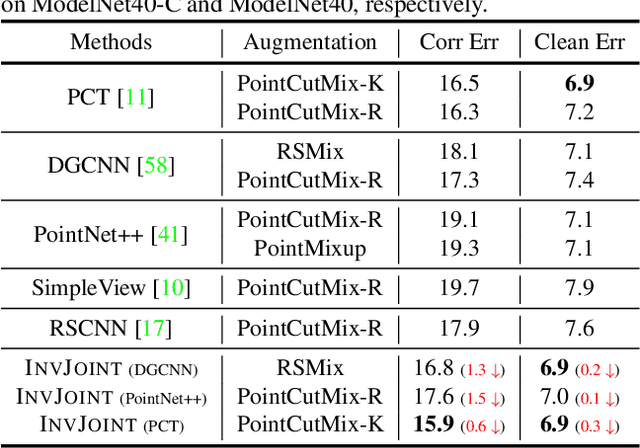
We tackle the data scarcity challenge in few-shot point cloud recognition of 3D objects by using a joint prediction from a conventional 3D model and a well-trained 2D model. Surprisingly, such an ensemble, though seems trivial, has hardly been shown effective in recent 2D-3D models. We find out the crux is the less effective training for the ''joint hard samples'', which have high confidence prediction on different wrong labels, implying that the 2D and 3D models do not collaborate well. To this end, our proposed invariant training strategy, called InvJoint, does not only emphasize the training more on the hard samples, but also seeks the invariance between the conflicting 2D and 3D ambiguous predictions. InvJoint can learn more collaborative 2D and 3D representations for better ensemble. Extensive experiments on 3D shape classification with widely adopted ModelNet10/40, ScanObjectNN and Toys4K, and shape retrieval with ShapeNet-Core validate the superiority of our InvJoint.
Empowering Vision-Language Models to Follow Interleaved Vision-Language Instructions
Aug 10, 2023
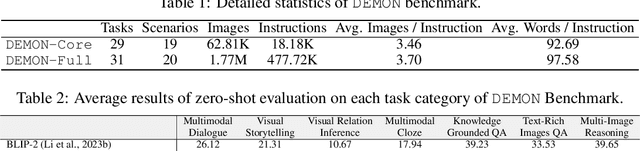
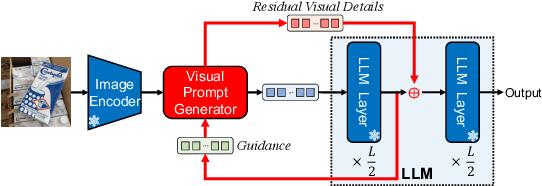
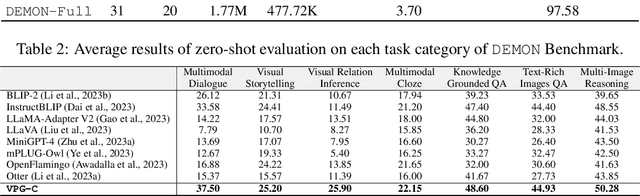
Multimodal Large Language Models (MLLMs) have recently sparked significant interest, which demonstrates emergent capabilities to serve as a general-purpose model for various vision-language tasks. However, existing methods mainly focus on limited types of instructions with a single image as visual context, which hinders the widespread availability of MLLMs. In this paper, we introduce the I4 benchmark to comprehensively evaluate the instruction following ability on complicated interleaved vision-language instructions, which involve intricate image-text sequential context, covering a diverse range of scenarios (e.g., visually-rich webpages/textbooks, lecture slides, embodied dialogue). Systematic evaluation on our I4 benchmark reveals a common defect of existing methods: the Visual Prompt Generator (VPG) trained on image-captioning alignment objective tends to attend to common foreground information for captioning but struggles to extract specific information required by particular tasks. To address this issue, we propose a generic and lightweight controllable knowledge re-injection module, which utilizes the sophisticated reasoning ability of LLMs to control the VPG to conditionally extract instruction-specific visual information and re-inject it into the LLM. Further, we introduce an annotation-free cross-attention guided counterfactual image training strategy to methodically learn the proposed module by collaborating a cascade of foundation models. Enhanced by the proposed module and training strategy, we present Cheetor, a Transformer-based MLLM that can effectively handle a wide variety of interleaved vision-language instructions and achieves state-of-the-art zero-shot performance across all tasks of I4, without high-quality multimodal instruction tuning data. Cheetor also exhibits competitive performance compared with state-of-the-art instruction tuned models on MME benchmark.