 Add to Chrome
 Add to Firefox
 Add to Edge
An Agentic Framework for Autonomous Materials Computation
Dec 22, 2025
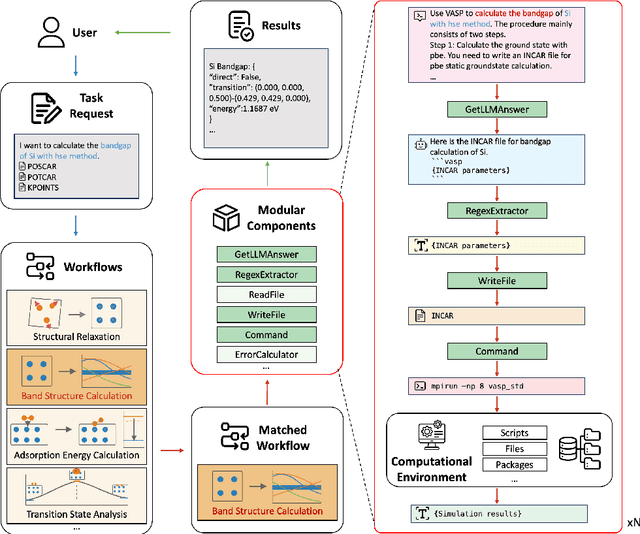
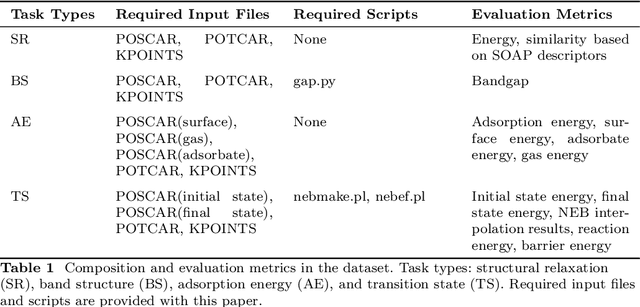
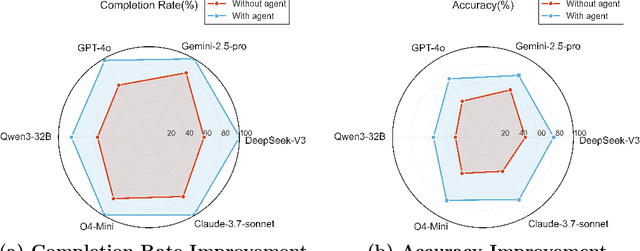
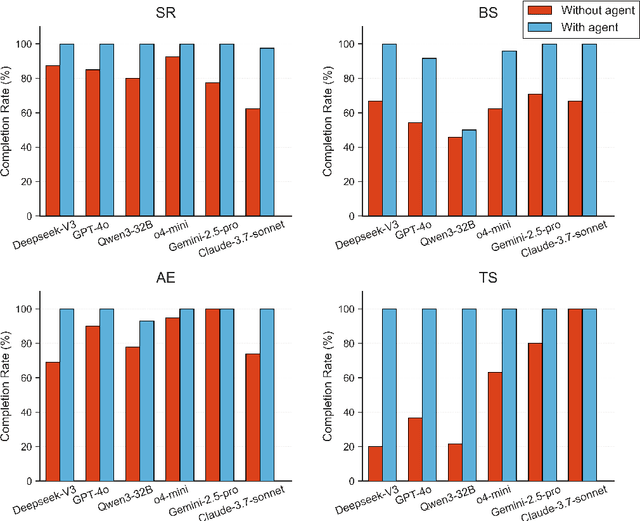
Large Language Models (LLMs) have emerged as powerful tools for accelerating scientific discovery, yet their static knowledge and hallucination issues hinder autonomous research applications. Recent advances integrate LLMs into agentic frameworks, enabling retrieval, reasoning, and tool use for complex scientific workflows. Here, we present a domain-specialized agent designed for reliable automation of first-principles materials computations. By embedding domain expertise, the agent ensures physically coherent multi-step workflows and consistently selects convergent, well-posed parameters, thereby enabling reliable end-to-end computational execution. A new benchmark of diverse computational tasks demonstrates that our system significantly outperforms standalone LLMs in both accuracy and robustness. This work establishes a verifiable foundation for autonomous computational experimentation and represents a key step toward fully automated scientific discovery.

Vidarc: Embodied Video Diffusion Model for Closed-loop Control
Dec 19, 2025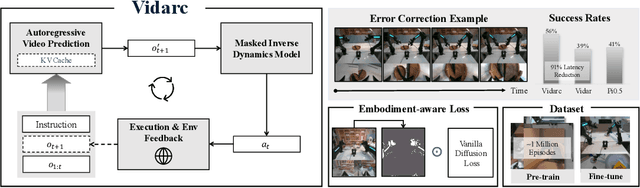
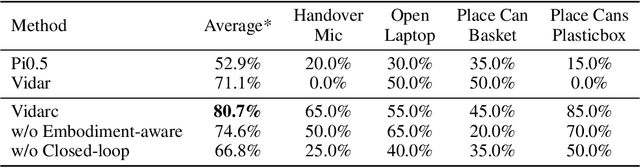
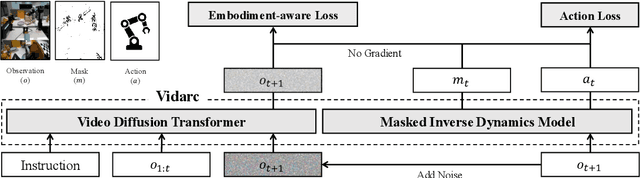
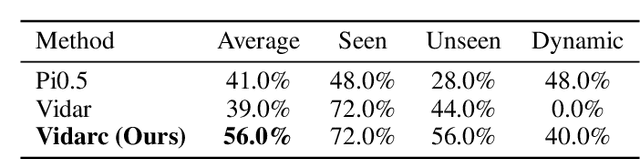
Robotic arm manipulation in data-scarce settings is a highly challenging task due to the complex embodiment dynamics and diverse contexts. Recent video-based approaches have shown great promise in capturing and transferring the temporal and physical interactions by pre-training on Internet-scale video data. However, such methods are often not optimized for the embodiment-specific closed-loop control, typically suffering from high latency and insufficient grounding. In this paper, we present Vidarc (Video Diffusion for Action Reasoning and Closed-loop Control), a novel autoregressive embodied video diffusion approach augmented by a masked inverse dynamics model. By grounding video predictions with action-relevant masks and incorporating real-time feedback through cached autoregressive generation, Vidarc achieves fast, accurate closed-loop control. Pre-trained on one million cross-embodiment episodes, Vidarc surpasses state-of-the-art baselines, achieving at least a 15% higher success rate in real-world deployment and a 91% reduction in latency. We also highlight its robust generalization and error correction capabilities across previously unseen robotic platforms.
Motus: A Unified Latent Action World Model
Dec 15, 2025While a general embodied agent must function as a unified system, current methods are built on isolated models for understanding, world modeling, and control. This fragmentation prevents unifying multimodal generative capabilities and hinders learning from large-scale, heterogeneous data. In this paper, we propose Motus, a unified latent action world model that leverages existing general pretrained models and rich, sharable motion information. Motus introduces a Mixture-of-Transformer (MoT) architecture to integrate three experts (i.e., understanding, video generation, and action) and adopts a UniDiffuser-style scheduler to enable flexible switching between different modeling modes (i.e., world models, vision-language-action models, inverse dynamics models, video generation models, and video-action joint prediction models). Motus further leverages the optical flow to learn latent actions and adopts a recipe with three-phase training pipeline and six-layer data pyramid, thereby extracting pixel-level "delta action" and enabling large-scale action pretraining. Experiments show that Motus achieves superior performance against state-of-the-art methods in both simulation (a +15% improvement over X-VLA and a +45% improvement over Pi0.5) and real-world scenarios(improved by +11~48%), demonstrating unified modeling of all functionalities and priors significantly benefits downstream robotic tasks.
KG-DF: A Black-box Defense Framework against Jailbreak Attacks Based on Knowledge Graphs
Nov 09, 2025With the widespread application of large language models (LLMs) in various fields, the security challenges they face have become increasingly prominent, especially the issue of jailbreak. These attacks induce the model to generate erroneous or uncontrolled outputs through crafted inputs, threatening the generality and security of the model. Although existing defense methods have shown some effectiveness, they often struggle to strike a balance between model generality and security. Excessive defense may limit the normal use of the model, while insufficient defense may lead to security vulnerabilities. In response to this problem, we propose a Knowledge Graph Defense Framework (KG-DF). Specifically, because of its structured knowledge representation and semantic association capabilities, Knowledge Graph(KG) can be searched by associating input content with safe knowledge in the knowledge base, thus identifying potentially harmful intentions and providing safe reasoning paths. However, traditional KG methods encounter significant challenges in keyword extraction, particularly when confronted with diverse and evolving attack strategies. To address this issue, we introduce an extensible semantic parsing module, whose core task is to transform the input query into a set of structured and secure concept representations, thereby enhancing the relevance of the matching process. Experimental results show that our framework enhances defense performance against various jailbreak attack methods, while also improving the response quality of the LLM in general QA scenarios by incorporating domain-general knowledge.
MDSEval: A Meta-Evaluation Benchmark for Multimodal Dialogue Summarization
Oct 02, 2025Multimodal Dialogue Summarization (MDS) is a critical task with wide-ranging applications. To support the development of effective MDS models, robust automatic evaluation methods are essential for reducing both cost and human effort. However, such methods require a strong meta-evaluation benchmark grounded in human annotations. In this work, we introduce MDSEval, the first meta-evaluation benchmark for MDS, consisting image-sharing dialogues, corresponding summaries, and human judgments across eight well-defined quality aspects. To ensure data quality and richfulness, we propose a novel filtering framework leveraging Mutually Exclusive Key Information (MEKI) across modalities. Our work is the first to identify and formalize key evaluation dimensions specific to MDS. We benchmark state-of-the-art modal evaluation methods, revealing their limitations in distinguishing summaries from advanced MLLMs and their susceptibility to various bias.
Thinking in cocktail party: Chain-of-Thought and reinforcement learning for target speaker automatic speech recognition
Sep 19, 2025Target Speaker Automatic Speech Recognition (TS-ASR) aims to transcribe the speech of a specified target speaker from multi-speaker mixtures in cocktail party scenarios. Recent advancement of Large Audio-Language Models (LALMs) has already brought some new insights to TS-ASR. However, significant room for optimization remains for the TS-ASR task within the LALMs architecture. While Chain of Thoughts (CoT) and Reinforcement Learning (RL) have proven effective in certain speech tasks, TS-ASR, which requires the model to deeply comprehend speech signals, differentiate various speakers, and handle overlapping utterances is particularly well-suited to a reasoning-guided approach. Therefore, we propose a novel framework that incorporates CoT and RL training into TS-ASR for performance improvement. A novel CoT dataset of TS-ASR is constructed, and the TS-ASR model is first trained on regular data and then fine-tuned on CoT data. Finally, the model is further trained with RL using selected data to enhance generalized reasoning capabilities. Experiment results demonstrate a significant improvement of TS-ASR performance with CoT and RL training, establishing a state-of-the-art performance compared with previous works of TS-ASR on comparable datasets.
DiffusionNFT: Online Diffusion Reinforcement with Forward Process
Sep 19, 2025Online reinforcement learning (RL) has been central to post-training language models, but its extension to diffusion models remains challenging due to intractable likelihoods. Recent works discretize the reverse sampling process to enable GRPO-style training, yet they inherit fundamental drawbacks, including solver restrictions, forward-reverse inconsistency, and complicated integration with classifier-free guidance (CFG). We introduce Diffusion Negative-aware FineTuning (DiffusionNFT), a new online RL paradigm that optimizes diffusion models directly on the forward process via flow matching. DiffusionNFT contrasts positive and negative generations to define an implicit policy improvement direction, naturally incorporating reinforcement signals into the supervised learning objective. This formulation enables training with arbitrary black-box solvers, eliminates the need for likelihood estimation, and requires only clean images rather than sampling trajectories for policy optimization. DiffusionNFT is up to $25\times$ more efficient than FlowGRPO in head-to-head comparisons, while being CFG-free. For instance, DiffusionNFT improves the GenEval score from 0.24 to 0.98 within 1k steps, while FlowGRPO achieves 0.95 with over 5k steps and additional CFG employment. By leveraging multiple reward models, DiffusionNFT significantly boosts the performance of SD3.5-Medium in every benchmark tested.
Controllable Conversational Theme Detection Track at DSTC 12
Aug 26, 2025Conversational analytics has been on the forefront of transformation driven by the advances in Speech and Natural Language Processing techniques. Rapid adoption of Large Language Models (LLMs) in the analytics field has taken the problems that can be automated to a new level of complexity and scale. In this paper, we introduce Theme Detection as a critical task in conversational analytics, aimed at automatically identifying and categorizing topics within conversations. This process can significantly reduce the manual effort involved in analyzing expansive dialogs, particularly in domains like customer support or sales. Unlike traditional dialog intent detection, which often relies on a fixed set of intents for downstream system logic, themes are intended as a direct, user-facing summary of the conversation's core inquiry. This distinction allows for greater flexibility in theme surface forms and user-specific customizations. We pose Controllable Conversational Theme Detection problem as a public competition track at Dialog System Technology Challenge (DSTC) 12 -- it is framed as joint clustering and theme labeling of dialog utterances, with the distinctive aspect being controllability of the resulting theme clusters' granularity achieved via the provided user preference data. We give an overview of the problem, the associated dataset and the evaluation metrics, both automatic and human. Finally, we discuss the participant teams' submissions and provide insights from those. The track materials (data and code) are openly available in the GitHub repository.
From reactive to cognitive: brain-inspired spatial intelligence for embodied agents
Aug 24, 2025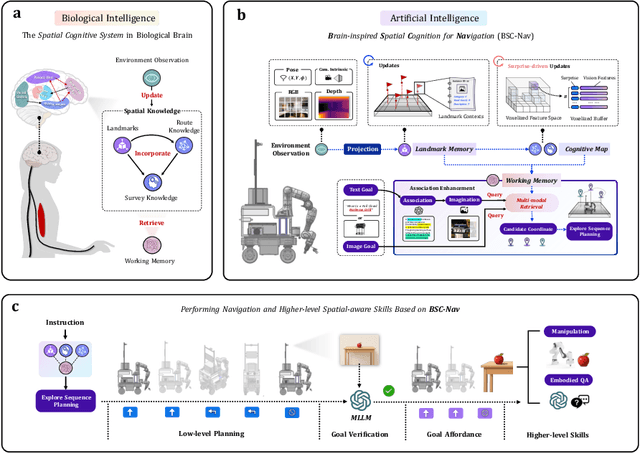
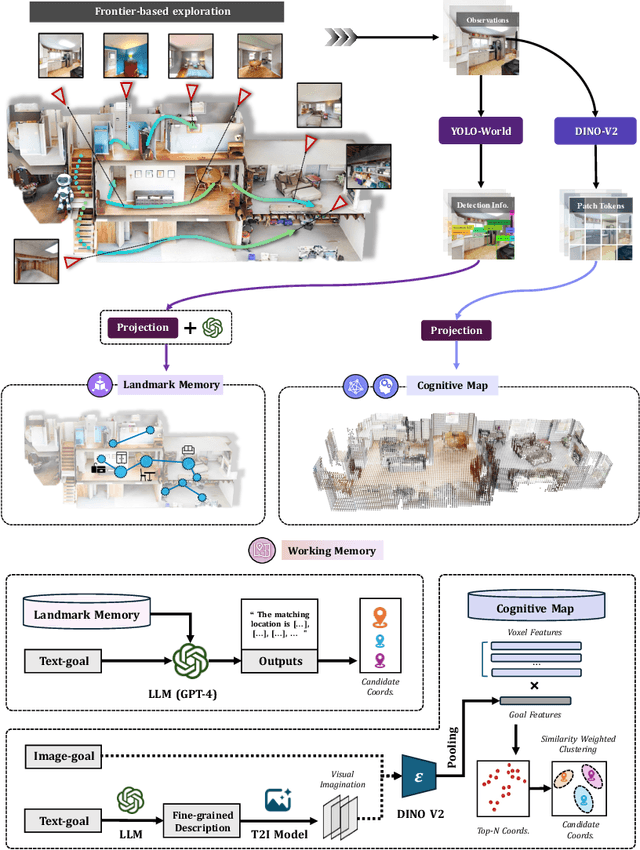
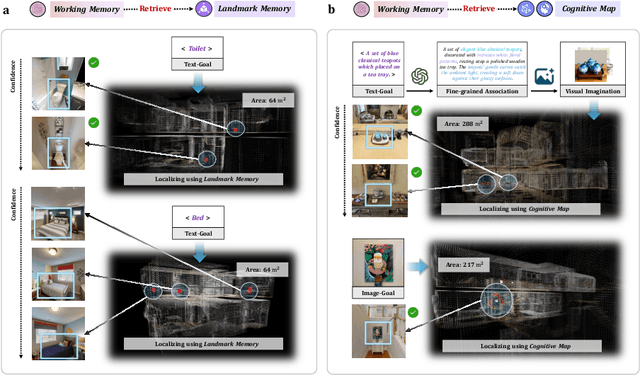
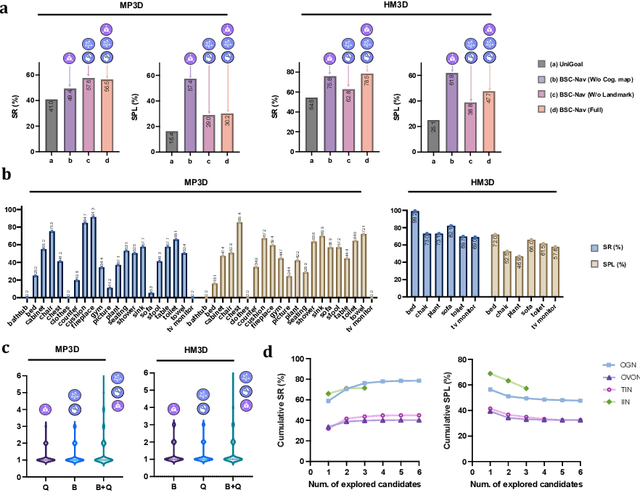
Spatial cognition enables adaptive goal-directed behavior by constructing internal models of space. Robust biological systems consolidate spatial knowledge into three interconnected forms: \textit{landmarks} for salient cues, \textit{route knowledge} for movement trajectories, and \textit{survey knowledge} for map-like representations. While recent advances in multi-modal large language models (MLLMs) have enabled visual-language reasoning in embodied agents, these efforts lack structured spatial memory and instead operate reactively, limiting their generalization and adaptability in complex real-world environments. Here we present Brain-inspired Spatial Cognition for Navigation (BSC-Nav), a unified framework for constructing and leveraging structured spatial memory in embodied agents. BSC-Nav builds allocentric cognitive maps from egocentric trajectories and contextual cues, and dynamically retrieves spatial knowledge aligned with semantic goals. Integrated with powerful MLLMs, BSC-Nav achieves state-of-the-art efficacy and efficiency across diverse navigation tasks, demonstrates strong zero-shot generalization, and supports versatile embodied behaviors in the real physical world, offering a scalable and biologically grounded path toward general-purpose spatial intelligence.
RCR-AF: Enhancing Model Generalization via Rademacher Complexity Reduction Activation Function
Jul 30, 2025Despite their widespread success, deep neural networks remain critically vulnerable to adversarial attacks, posing significant risks in safety-sensitive applications. This paper investigates activation functions as a crucial yet underexplored component for enhancing model robustness. We propose a Rademacher Complexity Reduction Activation Function (RCR-AF), a novel activation function designed to improve both generalization and adversarial resilience. RCR-AF uniquely combines the advantages of GELU (including smoothness, gradient stability, and negative information retention) with ReLU's desirable monotonicity, while simultaneously controlling both model sparsity and capacity through built-in clipping mechanisms governed by two hyperparameters, $\alpha$ and $\gamma$. Our theoretical analysis, grounded in Rademacher complexity, demonstrates that these parameters directly modulate the model's Rademacher complexity, offering a principled approach to enhance robustness. Comprehensive empirical evaluations show that RCR-AF consistently outperforms widely-used alternatives (ReLU, GELU, and Swish) in both clean accuracy under standard training and in adversarial robustness within adversarial training paradigms.