 Add to Chrome
 Add to Firefox
 Add to Edge
Commercial Vehicle Braking Optimization: A Robust SIFT-Trajectory Approach
Dec 21, 2025
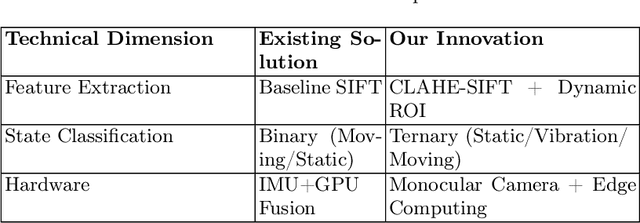
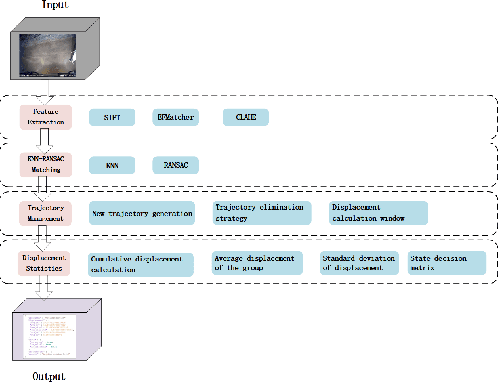
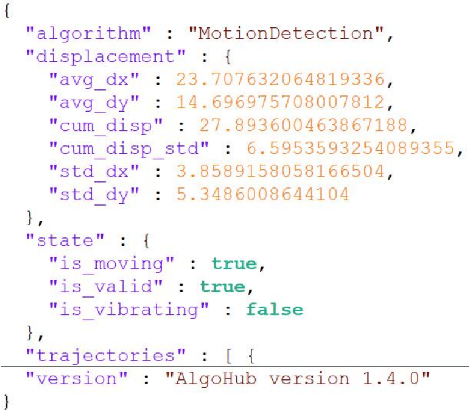
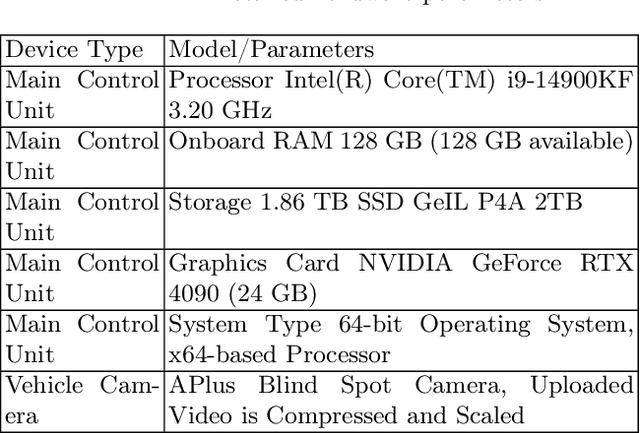
A vision-based trajectory analysis solution is proposed to address the "zero-speed braking" issue caused by inaccurate Controller Area Network (CAN) signals in commercial vehicle Automatic Emergency Braking (AEB) systems during low-speed operation. The algorithm utilizes the NVIDIA Jetson AGX Xavier platform to process sequential video frames from a blind spot camera, employing self-adaptive Contrast Limited Adaptive Histogram Equalization (CLAHE)-enhanced Scale-Invariant Feature Transform (SIFT) feature extraction and K-Nearest Neighbors (KNN)-Random Sample Consensus (RANSAC) matching. This allows for precise classification of the vehicle's motion state (static, vibration, moving). Key innovations include 1) multiframe trajectory displacement statistics (5-frame sliding window), 2) a dual-threshold state decision matrix, and 3) OBD-II driven dynamic Region of Interest (ROI) configuration. The system effectively suppresses environmental interference and false detection of dynamic objects, directly addressing the challenge of low-speed false activation in commercial vehicle safety systems. Evaluation in a real-world dataset (32,454 video segments from 1,852 vehicles) demonstrates an F1-score of 99.96% for static detection, 97.78% for moving state recognition, and a processing delay of 14.2 milliseconds (resolution 704x576). The deployment on-site shows an 89% reduction in false braking events, a 100% success rate in emergency braking, and a fault rate below 5%.

KG-DF: A Black-box Defense Framework against Jailbreak Attacks Based on Knowledge Graphs
Nov 09, 2025With the widespread application of large language models (LLMs) in various fields, the security challenges they face have become increasingly prominent, especially the issue of jailbreak. These attacks induce the model to generate erroneous or uncontrolled outputs through crafted inputs, threatening the generality and security of the model. Although existing defense methods have shown some effectiveness, they often struggle to strike a balance between model generality and security. Excessive defense may limit the normal use of the model, while insufficient defense may lead to security vulnerabilities. In response to this problem, we propose a Knowledge Graph Defense Framework (KG-DF). Specifically, because of its structured knowledge representation and semantic association capabilities, Knowledge Graph(KG) can be searched by associating input content with safe knowledge in the knowledge base, thus identifying potentially harmful intentions and providing safe reasoning paths. However, traditional KG methods encounter significant challenges in keyword extraction, particularly when confronted with diverse and evolving attack strategies. To address this issue, we introduce an extensible semantic parsing module, whose core task is to transform the input query into a set of structured and secure concept representations, thereby enhancing the relevance of the matching process. Experimental results show that our framework enhances defense performance against various jailbreak attack methods, while also improving the response quality of the LLM in general QA scenarios by incorporating domain-general knowledge.