 Add to Chrome
 Add to Firefox
 Add to Edge
M3DBench: Let's Instruct Large Models with Multi-modal 3D Prompts
Dec 17, 2023

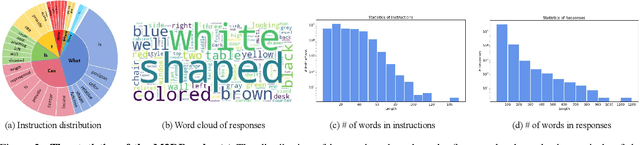
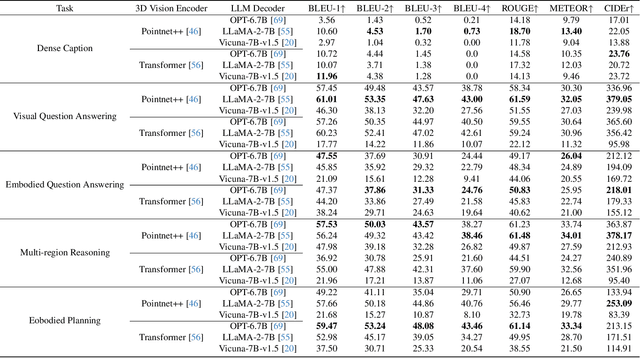

Recently, 3D understanding has become popular to facilitate autonomous agents to perform further decisionmaking. However, existing 3D datasets and methods are often limited to specific tasks. On the other hand, recent progress in Large Language Models (LLMs) and Multimodal Language Models (MLMs) have demonstrated exceptional general language and imagery tasking performance. Therefore, it is interesting to unlock MLM's potential to be 3D generalist for wider tasks. However, current MLMs' research has been less focused on 3D tasks due to a lack of large-scale 3D instruction-following datasets. In this work, we introduce a comprehensive 3D instructionfollowing dataset called M3DBench, which possesses the following characteristics: 1) It supports general multimodal instructions interleaved with text, images, 3D objects, and other visual prompts. 2) It unifies diverse 3D tasks at both region and scene levels, covering a variety of fundamental abilities in real-world 3D environments. 3) It is a large-scale 3D instruction-following dataset with over 320k instruction-response pairs. Furthermore, we establish a new benchmark for assessing the performance of large models in understanding multi-modal 3D prompts. Extensive experiments demonstrate the effectiveness of our dataset and baseline, supporting general 3D-centric tasks, which can inspire future research.

FaceStudio: Put Your Face Everywhere in Seconds
Dec 06, 2023This study investigates identity-preserving image synthesis, an intriguing task in image generation that seeks to maintain a subject's identity while adding a personalized, stylistic touch. Traditional methods, such as Textual Inversion and DreamBooth, have made strides in custom image creation, but they come with significant drawbacks. These include the need for extensive resources and time for fine-tuning, as well as the requirement for multiple reference images. To overcome these challenges, our research introduces a novel approach to identity-preserving synthesis, with a particular focus on human images. Our model leverages a direct feed-forward mechanism, circumventing the need for intensive fine-tuning, thereby facilitating quick and efficient image generation. Central to our innovation is a hybrid guidance framework, which combines stylized images, facial images, and textual prompts to guide the image generation process. This unique combination enables our model to produce a variety of applications, such as artistic portraits and identity-blended images. Our experimental results, including both qualitative and quantitative evaluations, demonstrate the superiority of our method over existing baseline models and previous works, particularly in its remarkable efficiency and ability to preserve the subject's identity with high fidelity.
ShapeGPT: 3D Shape Generation with A Unified Multi-modal Language Model
Dec 01, 2023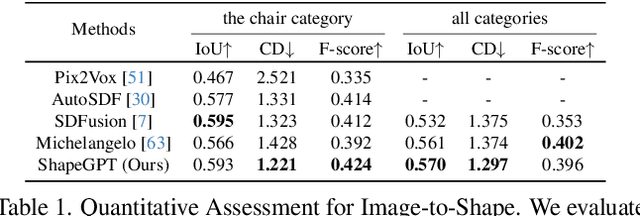
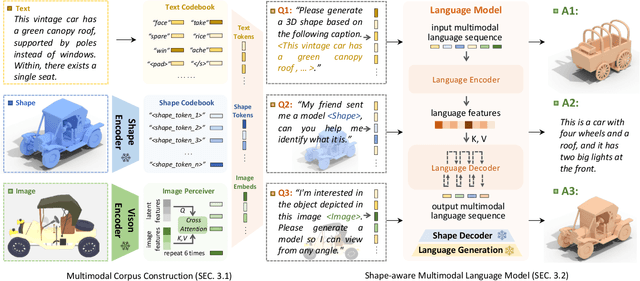
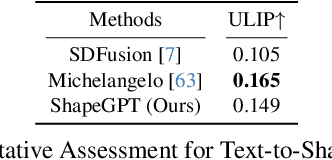
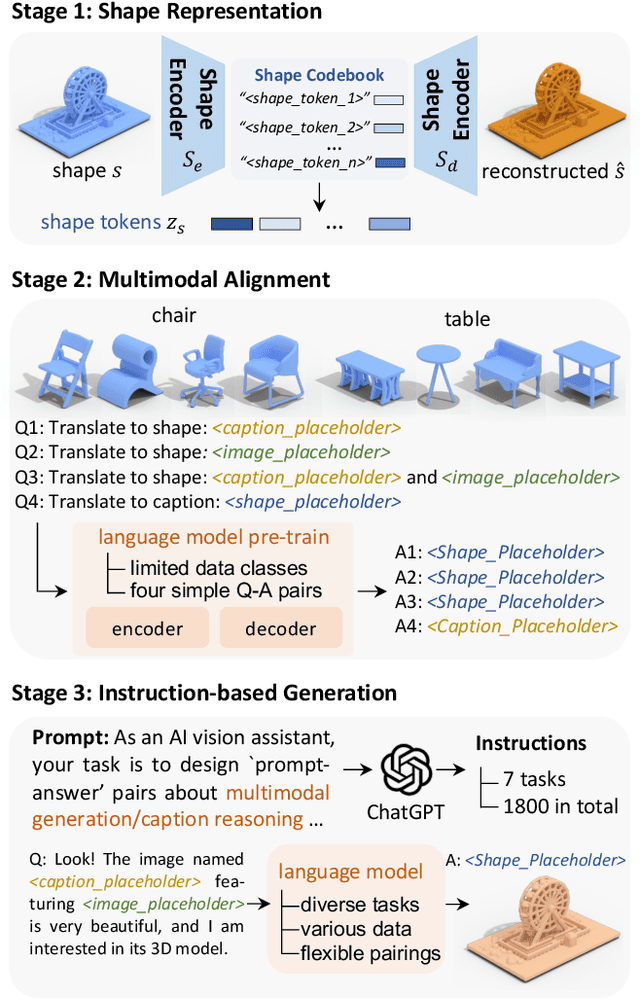
The advent of large language models, enabling flexibility through instruction-driven approaches, has revolutionized many traditional generative tasks, but large models for 3D data, particularly in comprehensively handling 3D shapes with other modalities, are still under-explored. By achieving instruction-based shape generations, versatile multimodal generative shape models can significantly benefit various fields like 3D virtual construction and network-aided design. In this work, we present ShapeGPT, a shape-included multi-modal framework to leverage strong pre-trained language models to address multiple shape-relevant tasks. Specifically, ShapeGPT employs a word-sentence-paragraph framework to discretize continuous shapes into shape words, further assembles these words for shape sentences, as well as integrates shape with instructional text for multi-modal paragraphs. To learn this shape-language model, we use a three-stage training scheme, including shape representation, multimodal alignment, and instruction-based generation, to align shape-language codebooks and learn the intricate correlations among these modalities. Extensive experiments demonstrate that ShapeGPT achieves comparable performance across shape-relevant tasks, including text-to-shape, shape-to-text, shape completion, and shape editing.
LL3DA: Visual Interactive Instruction Tuning for Omni-3D Understanding, Reasoning, and Planning
Nov 30, 2023
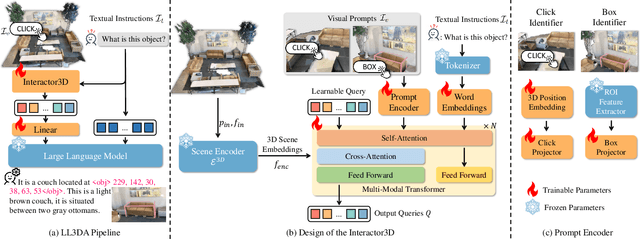


Recent advances in Large Multimodal Models (LMM) have made it possible for various applications in human-machine interactions. However, developing LMMs that can comprehend, reason, and plan in complex and diverse 3D environments remains a challenging topic, especially considering the demand for understanding permutation-invariant point cloud 3D representations of the 3D scene. Existing works seek help from multi-view images, and project 2D features to 3D space as 3D scene representations. This, however, leads to huge computational overhead and performance degradation. In this paper, we present LL3DA, a Large Language 3D Assistant that takes point cloud as direct input and respond to both textual-instructions and visual-prompts. This help LMMs better comprehend human interactions and further help to remove the ambiguities in cluttered 3D scenes. Experiments show that LL3DA achieves remarkable results, and surpasses various 3D vision-language models on both 3D Dense Captioning and 3D Question Answering.
ChartLlama: A Multimodal LLM for Chart Understanding and Generation
Nov 27, 2023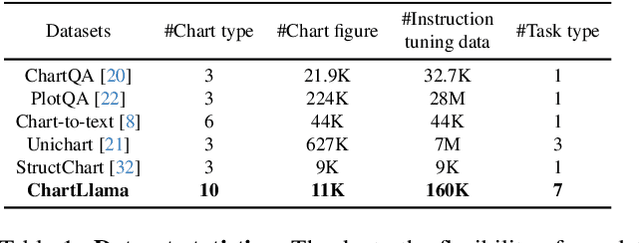
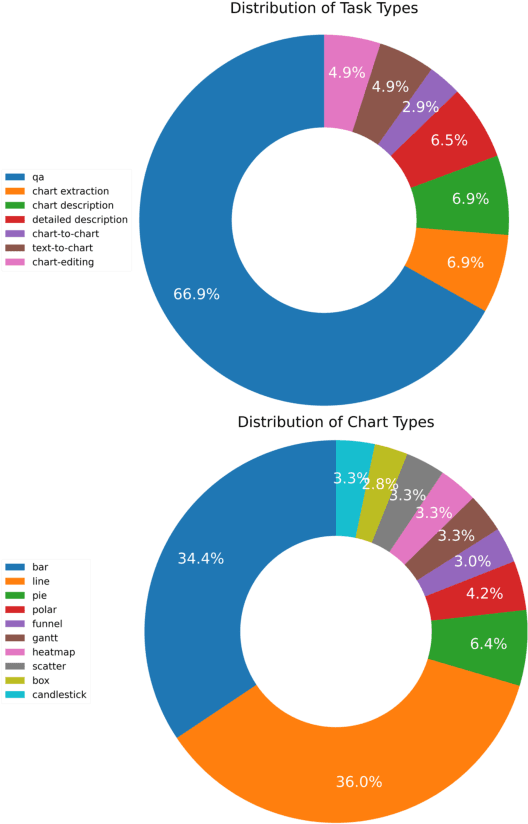

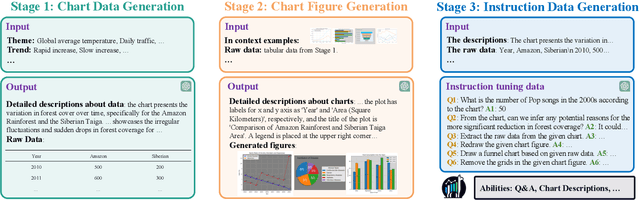
Multi-modal large language models have demonstrated impressive performances on most vision-language tasks. However, the model generally lacks the understanding capabilities for specific domain data, particularly when it comes to interpreting chart figures. This is mainly due to the lack of relevant multi-modal instruction tuning datasets. In this article, we create a high-quality instruction-tuning dataset leveraging GPT-4. We develop a multi-step data generation process in which different steps are responsible for generating tabular data, creating chart figures, and designing instruction tuning data separately. Our method's flexibility enables us to generate diverse, high-quality instruction-tuning data consistently and efficiently while maintaining a low resource expenditure. Additionally, it allows us to incorporate a wider variety of chart and task types not yet featured in existing datasets. Next, we introduce ChartLlama, a multi-modal large language model that we've trained using our created dataset. ChartLlama outperforms all prior methods in ChartQA, Chart-to-text, and Chart-extraction evaluation benchmarks. Additionally, ChartLlama significantly improves upon the baseline in our specially compiled chart dataset, which includes new chart and task types. The results of ChartLlama confirm the value and huge potential of our proposed data generation method in enhancing chart comprehension.
VQ-NeRF: Vector Quantization Enhances Implicit Neural Representations
Oct 23, 2023


Recent advancements in implicit neural representations have contributed to high-fidelity surface reconstruction and photorealistic novel view synthesis. However, the computational complexity inherent in these methodologies presents a substantial impediment, constraining the attainable frame rates and resolutions in practical applications. In response to this predicament, we propose VQ-NeRF, an effective and efficient pipeline for enhancing implicit neural representations via vector quantization. The essence of our method involves reducing the sampling space of NeRF to a lower resolution and subsequently reinstating it to the original size utilizing a pre-trained VAE decoder, thereby effectively mitigating the sampling time bottleneck encountered during rendering. Although the codebook furnishes representative features, reconstructing fine texture details of the scene remains challenging due to high compression rates. To overcome this constraint, we design an innovative multi-scale NeRF sampling scheme that concurrently optimizes the NeRF model at both compressed and original scales to enhance the network's ability to preserve fine details. Furthermore, we incorporate a semantic loss function to improve the geometric fidelity and semantic coherence of our 3D reconstructions. Extensive experiments demonstrate the effectiveness of our model in achieving the optimal trade-off between rendering quality and efficiency. Evaluation on the DTU, BlendMVS, and H3DS datasets confirms the superior performance of our approach.
TapMo: Shape-aware Motion Generation of Skeleton-free Characters
Oct 19, 2023Previous motion generation methods are limited to the pre-rigged 3D human model, hindering their applications in the animation of various non-rigged characters. In this work, we present TapMo, a Text-driven Animation Pipeline for synthesizing Motion in a broad spectrum of skeleton-free 3D characters. The pivotal innovation in TapMo is its use of shape deformation-aware features as a condition to guide the diffusion model, thereby enabling the generation of mesh-specific motions for various characters. Specifically, TapMo comprises two main components - Mesh Handle Predictor and Shape-aware Diffusion Module. Mesh Handle Predictor predicts the skinning weights and clusters mesh vertices into adaptive handles for deformation control, which eliminates the need for traditional skeletal rigging. Shape-aware Motion Diffusion synthesizes motion with mesh-specific adaptations. This module employs text-guided motions and mesh features extracted during the first stage, preserving the geometric integrity of the animations by accounting for the character's shape and deformation. Trained in a weakly-supervised manner, TapMo can accommodate a multitude of non-human meshes, both with and without associated text motions. We demonstrate the effectiveness and generalizability of TapMo through rigorous qualitative and quantitative experiments. Our results reveal that TapMo consistently outperforms existing auto-animation methods, delivering superior-quality animations for both seen or unseen heterogeneous 3D characters.
Robust Geometry-Preserving Depth Estimation Using Differentiable Rendering
Sep 18, 2023In this study, we address the challenge of 3D scene structure recovery from monocular depth estimation. While traditional depth estimation methods leverage labeled datasets to directly predict absolute depth, recent advancements advocate for mix-dataset training, enhancing generalization across diverse scenes. However, such mixed dataset training yields depth predictions only up to an unknown scale and shift, hindering accurate 3D reconstructions. Existing solutions necessitate extra 3D datasets or geometry-complete depth annotations, constraints that limit their versatility. In this paper, we propose a learning framework that trains models to predict geometry-preserving depth without requiring extra data or annotations. To produce realistic 3D structures, we render novel views of the reconstructed scenes and design loss functions to promote depth estimation consistency across different views. Comprehensive experiments underscore our framework's superior generalization capabilities, surpassing existing state-of-the-art methods on several benchmark datasets without leveraging extra training information. Moreover, our innovative loss functions empower the model to autonomously recover domain-specific scale-and-shift coefficients using solely unlabeled images.
Vote2Cap-DETR++: Decoupling Localization and Describing for End-to-End 3D Dense Captioning
Sep 06, 2023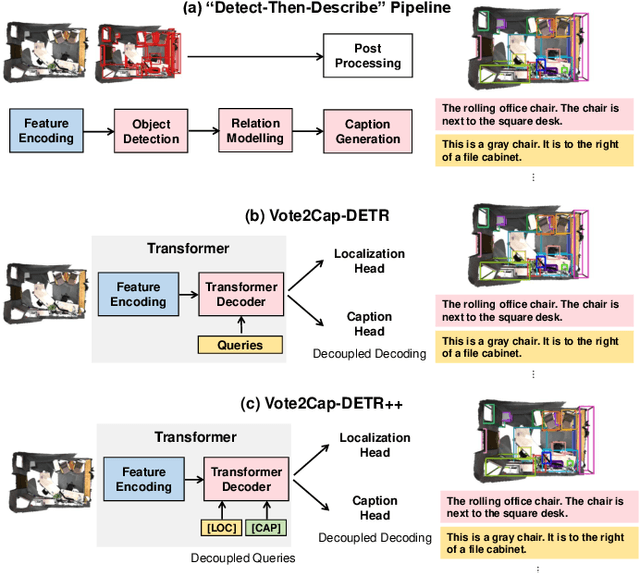
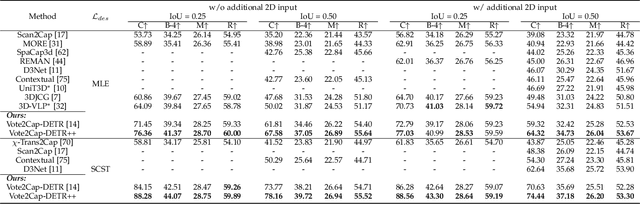
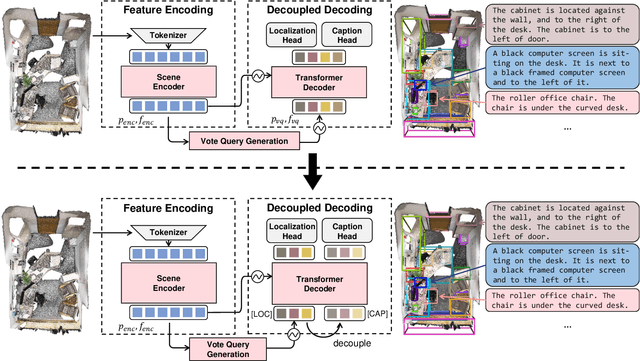
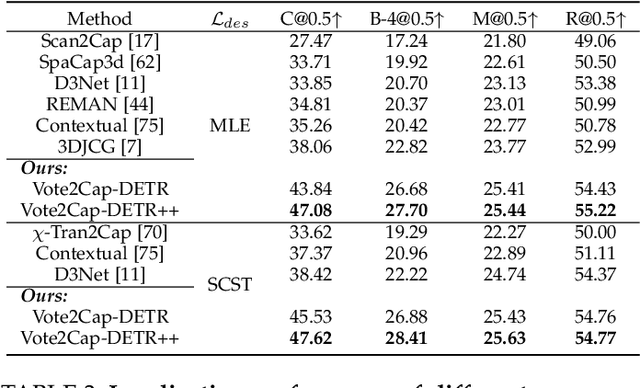
3D dense captioning requires a model to translate its understanding of an input 3D scene into several captions associated with different object regions. Existing methods adopt a sophisticated "detect-then-describe" pipeline, which builds explicit relation modules upon a 3D detector with numerous hand-crafted components. While these methods have achieved initial success, the cascade pipeline tends to accumulate errors because of duplicated and inaccurate box estimations and messy 3D scenes. In this paper, we first propose Vote2Cap-DETR, a simple-yet-effective transformer framework that decouples the decoding process of caption generation and object localization through parallel decoding. Moreover, we argue that object localization and description generation require different levels of scene understanding, which could be challenging for a shared set of queries to capture. To this end, we propose an advanced version, Vote2Cap-DETR++, which decouples the queries into localization and caption queries to capture task-specific features. Additionally, we introduce the iterative spatial refinement strategy to vote queries for faster convergence and better localization performance. We also insert additional spatial information to the caption head for more accurate descriptions. Without bells and whistles, extensive experiments on two commonly used datasets, ScanRefer and Nr3D, demonstrate Vote2Cap-DETR and Vote2Cap-DETR++ surpass conventional "detect-then-describe" methods by a large margin. Codes will be made available at https://github.com/ch3cook-fdu/Vote2Cap-DETR.
IT3D: Improved Text-to-3D Generation with Explicit View Synthesis
Aug 22, 2023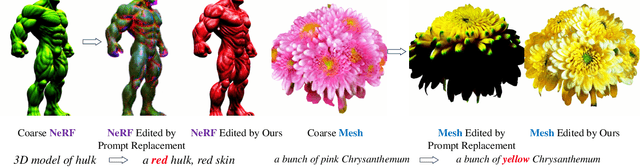
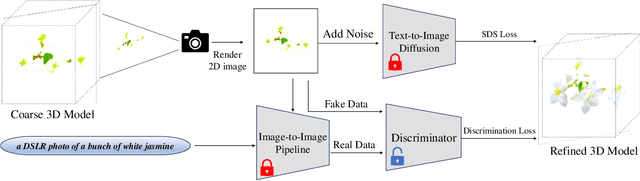
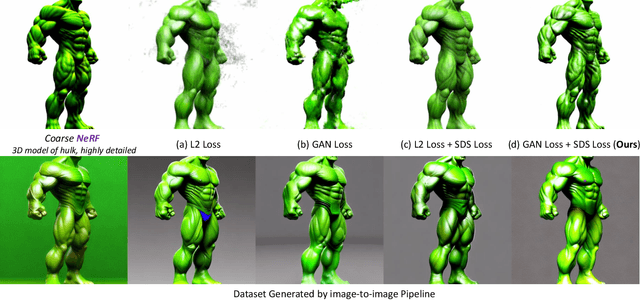
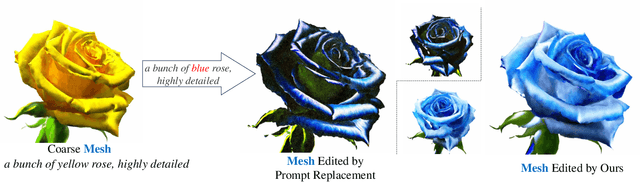
Recent strides in Text-to-3D techniques have been propelled by distilling knowledge from powerful large text-to-image diffusion models (LDMs). Nonetheless, existing Text-to-3D approaches often grapple with challenges such as over-saturation, inadequate detailing, and unrealistic outputs. This study presents a novel strategy that leverages explicitly synthesized multi-view images to address these issues. Our approach involves the utilization of image-to-image pipelines, empowered by LDMs, to generate posed high-quality images based on the renderings of coarse 3D models. Although the generated images mostly alleviate the aforementioned issues, challenges such as view inconsistency and significant content variance persist due to the inherent generative nature of large diffusion models, posing extensive difficulties in leveraging these images effectively. To overcome this hurdle, we advocate integrating a discriminator alongside a novel Diffusion-GAN dual training strategy to guide the training of 3D models. For the incorporated discriminator, the synthesized multi-view images are considered real data, while the renderings of the optimized 3D models function as fake data. We conduct a comprehensive set of experiments that demonstrate the effectiveness of our method over baseline approaches.