 Add to Chrome
 Add to Firefox
 Add to Edge
RCL-Mamba: A Dual-domain State Space Model for Measurement-oriented Image Restoration in Rotational Sparse-View Scanning Computed Laminography
Jun 30, 2026
Rotational Scanning Computed Laminography (RCL) is widely utilized for the Non-Destructive Testing(NDT) of large planar components. However, to facilitate rapid inspection, continuous sparse-view scanning is often employed, where the angular integration effect during exposure induces rotational blur in the projection domain. Furthermore, the data incompleteness inherent in sparse sampling manifests as sparse artifacts in the reconstructed image domain. To address these cross-domain degradations, this paper proposes RCL-Mamba, a measurement-oriented dual-domain State Space Model (SSM)-based image restoration network. The framework adopts a cascaded joint processing strategy: it first corrects the rotational blur in the projection domain and subsequently suppresses the sparse artifacts in the image domain. Additionally, we design a Mamba-CNN dual-branch module to adaptively balance large-scale blur correction with local detail recovery. Evaluations on both simulated datasets and real-world Printed Circuit Board (PCB) scans demonstrate that RCL-Mamba outperforms existing baselines in blur removal, artifact suppression, and structural preservation. Line-profile-based structural measurement further verifies that the proposed method better preserves via/pad boundaries and slender trace profiles. Crucially, by reducing the required scanning views from 512 to 64, our method enhances inspection efficiency by approximately 8-fold without compromising reconstruction quality, offering a robust measurement-oriented restoration solution for high-throughput RCL inspection with improved structural measurement fidelity.

Wavelet-Optimized Pseudo-3D Accelerated Diffusion Model for Truncated Computed Laminography
Jun 30, 2026Computed Laminography (CL) is a key technology for the nondestructive testing of large plate-shaped objects. However, field-of-view (FOV) limitations inevitably lead to truncation of projected data, an ill-posed inverse problem that causes severe reconstruction artifacts. Existing deep learning methods typically rely on 2D architectures that lack rigorous data consistency constraints. Furthermore, they conventionally confine artifact removal strictly to the FOV, discarding potentially recoverable information outside it. To overcome these limitations, we first introduce a comprehensive CL FOV analysis, categorizing the space into data-complete, data-incomplete, and data-free regions. By extending our reconstruction target to encompass the data-incomplete region, we significantly expand the effective imaging range and enhance scanning efficiency. To achieve this, we propose a novel wavelet-optimized pseudo-3D accelerated diffusion model for CL truncation reconstruction (CL-DM). Our method utilizes a standard 2D diffusion model for slice aggregation, combined with a 3D model-based iterative reconstruction (MBIR) method to ensure strict data consistency. To mitigate inter-slice discontinuities, we introduce wavelet regularization along the z-direction, paired with a translation-invariant (TI) mechanism and a low-frequency preservation strategy. Finally, we introduce a 3D fast sampling architecture, significantly accelerating inference speed. Extensive simulations and real-world experiments demonstrate that CL-DM is superior in effectively eliminating truncation artifacts and restoring high-fidelity, continuous 3D structures.
Quantum CT via Dynamic Interval Encoding and Prior-Balanced QUBO Reconstruction
Jun 23, 2026Quadratic unconstrained binary optimization (QUBO)-based quantum computed tomography (CT) casts reconstruction as a binary quadratic problem for quantum annealing and hybrid quantum--classical solvers. For grayscale CT, however, image encoding is constrained by the binary-variable budget: fixed global bit-plane encodings increase QUBO size and coupling complexity as gray-level precision improves, whereas low-bit encodings introduce quantization error. We propose a QUBO-based grayscale CT reconstruction framework that combines dynamic interval encoding with prior-balanced optimization. Each refinement round encodes active pixels only within local gray-level intervals around the current estimate, and a boundary-hit-guided update rule adaptively switches between search expansion and local refinement. To improve optimization stability, the method balances projection-domain data consistency and an edge-preserving quadratic prior before forming the final QUBO. Sparse-view and limited-angle fan-beam CT experiments show that the proposed method recovers structures and gray-level distributions more faithfully than the evaluated analytic, iterative, variational, and representation-based baselines. Expressivity analysis and ablation studies further indicate that the improvement mainly arises from effective gray-level representation through dynamic local encoding and more stable data-fidelity--prior coupling. Experiments on the D-Wave hybrid binary quadratic model (BQM) solver further demonstrate that the formulation is executable on a hardware-backed hybrid quantum--classical backend.
Measuring Epistemic Resilience of LLMs Under Misleading Medical Context
Jun 10, 2026Large language models (LLMs) now reach expert-level scores on medical licensing exams, encouraging the assumption that high scores imply safe medical judgment while patients increasingly use them for health advice. We show this assumption is fragile: when misleading context is injected into questions that LLMs originally answer correctly, they abandon the correct answer. We call the ability to maintain correct judgment under adversarial context epistemic resilience, and introduce MedMisBench to measure it. MedMisBench contains 10,932 medical question items and 48,889 misleading context-option pairs spanning medical reasoning, agentic capability, and patient-journey evaluation. Across 11 model configurations, mean accuracy falls from 71.1% on original questions to 38.0% under focused misleading context, with 51.5% attack success. The most damaging injections are formal, rule-like fabrications: authority-framed falsehoods reach 69.5% attack success and exception-poisoning claims reach 64.1%. A 14-member clinical panel from 7 countries identified serious potential harm in 38.2% of reviewed cases. MedMisBench exposes a structural blind spot in LLM evaluation in medical settings: existing benchmarks measure what models know, but not whether they preserve correct medical judgment under misleading context.
Texture-preserving implicit neural representation for Cone beam CT truncated reconstruction
Jun 04, 2026Cone-beam computed tomography (CBCT) frequently suffers from data truncation, which introduces severe artifacts and limits the effective field of view (FOV). Existing deep learning methods for truncated cone-beam computed tomography (CBCT) reconstruction suffer from serious limitations, including a strict reliance on supervised ground truth and a failure to account for continuous 3D spatial truncation variations. To address these challenges, we introduce a self-supervised 3D reconstruction framework based on neural scene representations. By directly mapping spatial coordinates to radiodensity under projection supervision, our approach inherently bypasses traditional filtering and backprojection operations, thereby fundamentally eliminating truncation-induced ring artifacts while enabling robust continuous 3D data extrapolation. However, coordinate networks are susceptible to an inherent spectral bias, which leads to a severe loss of clinically vital high-frequency textures. To resolve this bottleneck, we further incorporate a physics-based iterative refinement module into the neural scene representation architecture. Leveraging the artifact-free, extrapolated volume from the coordinate network as an optimal initialization, this module progressively re-extracts and injects high-frequency structural information from the original projections back into the volume. Extensive experiments on both simulated and real-world datasets demonstrate that our method successfully unifies the exceptional artifact suppression and extrapolation capabilities of neural networks with the high-fidelity detail preservation of iterative algorithms.
Biosignal Fingerprinting: A Cross-Modal PPG-ECG Foundation Model
May 10, 2026Cardiovascular disease remains the leading cause of global mortality, yet scalable cardiac monitoring is hindered by the gap between diagnostic-rich ECG and ubiquitous wearable PPG. Bridging this gap requires representations that are compact, transferable across modalities and devices, and deployable without task-specific retraining. Here we introduce biosignal fingerprints: compact latent representations of cardiovascular state derived from a cross-modal foundation model, the Multi-modal Masked Autoencoder (M2AE), trained on over 3.4 million paired ECG and PPG signals. M2AE integrates modality-specific encoders with a shared bottleneck and dual decoders, jointly optimized using reconstruction and cross-modal contrastive objectives, yielding generalizable fingerprints that retain intra- and inter-modality features. Like a biometric fingerprint, these representations uniquely encode an individual's cardiovascular state in a modality-agnostic, privacy-preserving form reusable across clinical tasks without exposing raw waveform data or requiring model retraining. Across 7 downstream tasks, spanning cross-modal reconstruction, cardiovascular disease classification, hypertension detection, mortality prediction, and demographic inference, biosignal fingerprints achieve competitive or superior performance compared to leading domain-specialist foundation models in frozen settings, including an AUROC of 0.974 for five-class CVD classification and 0.877 for hypertension detection, with a maximum improvement of 27.7% in AUROC across 5 classification tasks. Critically, strong performance is maintained with only a single modality, enabling deployment in resource-constrained, single-sensor environments typical of real-world wearable monitoring, with direct implications for continuous cardiovascular monitoring across clinical and consumer health settings.
BioMedArena: An Open-source Toolkit for Building and Evaluating Biomedical Deep Research Agents
May 07, 2026Building a deep research agent today is an exercise in glue code: the same backbone evaluated on the same benchmark can report different accuracies in different papers because harness and tool registry all differ, and integrating a new foundation model into a comparable evaluation surface costs weeks of model-specific engineering. We call this the per-paper engineering tax and release BioMedArena, an open-source toolkit that not only alleviates it but also provides an arena for fair comparison of different foundation models when evaluating them as deep-research agents. BioMedArena decouples six layers of biomedical agent evaluation -- benchmark loading, tool exposure, tool selection, execution mode, context management, and scoring -- and exposes 147 biomedical benchmarks and 75 biomedical tools across 9 functional families. Adding a new model, benchmark, or tool reduces to registering a few-line provider adapter. We further provide 6 agent harnesses with 6 context-management strategies, which provide 12 backbones with competitive research capabilities and significantly improved performance, achieving state-of-the-art (SOTA) results on 8 representative biomedical benchmarks, with an average lift of +15.03 percentage points over prior SOTA. The toolkit, configurations, and per-task traces are available at https://github.com/AI-in-Health/BioMedArena
Structure-constrained Language-informed Diffusion Model for Unpaired Low-dose Computed Tomography Angiography Reconstruction
Jan 28, 2026The application of iodinated contrast media (ICM) improves the sensitivity and specificity of computed tomography (CT) for a wide range of clinical indications. However, overdose of ICM can cause problems such as kidney damage and life-threatening allergic reactions. Deep learning methods can generate CT images of normal-dose ICM from low-dose ICM, reducing the required dose while maintaining diagnostic power. However, existing methods are difficult to realize accurate enhancement with incompletely paired images, mainly because of the limited ability of the model to recognize specific structures. To overcome this limitation, we propose a Structure-constrained Language-informed Diffusion Model (SLDM), a unified medical generation model that integrates structural synergy and spatial intelligence. First, the structural prior information of the image is effectively extracted to constrain the model inference process, thus ensuring structural consistency in the enhancement process. Subsequently, semantic supervision strategy with spatial intelligence is introduced, which integrates the functions of visual perception and spatial reasoning, thus prompting the model to achieve accurate enhancement. Finally, the subtraction angiography enhancement module is applied, which serves to improve the contrast of the ICM agent region to suitable interval for observation. Qualitative analysis of visual comparison and quantitative results of several metrics demonstrate the effectiveness of our method in angiographic reconstruction for low-dose contrast medium CT angiography.
RiskAgent: Autonomous Medical AI Copilot for Generalist Risk Prediction
Mar 05, 2025The application of Large Language Models (LLMs) to various clinical applications has attracted growing research attention. However, real-world clinical decision-making differs significantly from the standardized, exam-style scenarios commonly used in current efforts. In this paper, we present the RiskAgent system to perform a broad range of medical risk predictions, covering over 387 risk scenarios across diverse complex diseases, e.g., cardiovascular disease and cancer. RiskAgent is designed to collaborate with hundreds of clinical decision tools, i.e., risk calculators and scoring systems that are supported by evidence-based medicine. To evaluate our method, we have built the first benchmark MedRisk specialized for risk prediction, including 12,352 questions spanning 154 diseases, 86 symptoms, 50 specialties, and 24 organ systems. The results show that our RiskAgent, with 8 billion model parameters, achieves 76.33% accuracy, outperforming the most recent commercial LLMs, o1, o3-mini, and GPT-4.5, and doubling the 38.39% accuracy of GPT-4o. On rare diseases, e.g., Idiopathic Pulmonary Fibrosis (IPF), RiskAgent outperforms o1 and GPT-4.5 by 27.27% and 45.46% accuracy, respectively. Finally, we further conduct a generalization evaluation on an external evidence-based diagnosis benchmark and show that our RiskAgent achieves the best results. These encouraging results demonstrate the great potential of our solution for diverse diagnosis domains. To improve the adaptability of our model in different scenarios, we have built and open-sourced a family of models ranging from 1 billion to 70 billion parameters. Our code, data, and models are all available at https://github.com/AI-in-Health/RiskAgent.
MedVLM-R1: Incentivizing Medical Reasoning Capability of Vision-Language Models (VLMs) via Reinforcement Learning
Feb 26, 2025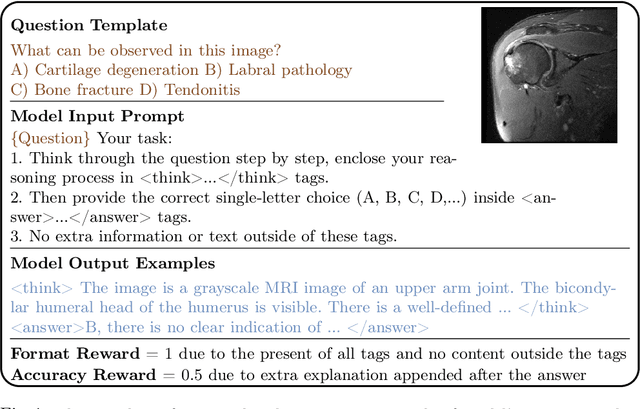
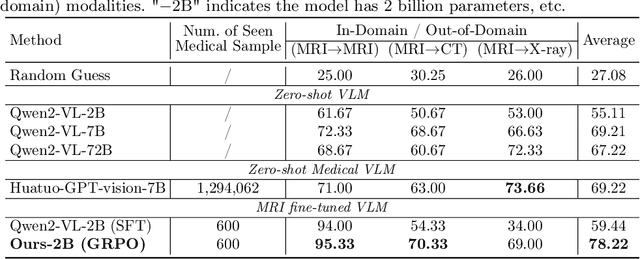
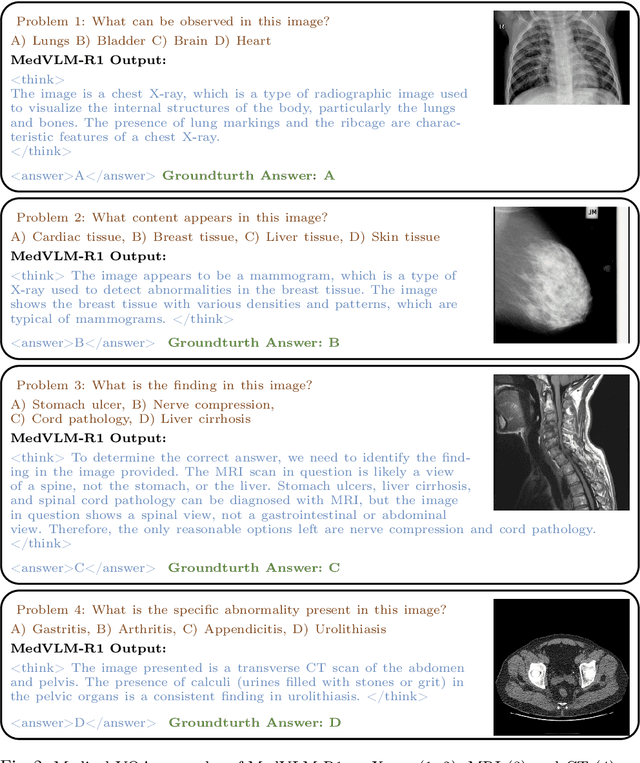
Reasoning is a critical frontier for advancing medical image analysis, where transparency and trustworthiness play a central role in both clinician trust and regulatory approval. Although Medical Visual Language Models (VLMs) show promise for radiological tasks, most existing VLMs merely produce final answers without revealing the underlying reasoning. To address this gap, we introduce MedVLM-R1, a medical VLM that explicitly generates natural language reasoning to enhance transparency and trustworthiness. Instead of relying on supervised fine-tuning (SFT), which often suffers from overfitting to training distributions and fails to foster genuine reasoning, MedVLM-R1 employs a reinforcement learning framework that incentivizes the model to discover human-interpretable reasoning paths without using any reasoning references. Despite limited training data (600 visual question answering samples) and model parameters (2B), MedVLM-R1 boosts accuracy from 55.11% to 78.22% across MRI, CT, and X-ray benchmarks, outperforming larger models trained on over a million samples. It also demonstrates robust domain generalization under out-of-distribution tasks. By unifying medical image analysis with explicit reasoning, MedVLM-R1 marks a pivotal step toward trustworthy and interpretable AI in clinical practice.