 Add to Chrome
 Add to Firefox
 Add to Edge
CRUISE: Vision-Language Model-Guided Uncertainty-Aware Cross-Modal Sensor Fusion for Robust Autonomous Driving
Aug 10, 2026
Modern autonomous vehicles are equipped with multiple sensors, such as cameras, LiDAR, and radar, for comprehensive environmental perception. However, robust cross-modal feature fusion remains a critical challenge, as the reliability of each sensor varies significantly across diverse real-world driving conditions, including poor visibility and adverse weather. While uncertainty quantification (UQ) mitigates this issue by allowing models to prioritize reliable signals, existing uncertainty-aware fusion methods typically rely on simple feature-level uncertainty estimates and thus often fail to generalize effectively in complex, out-of-distribution scenarios. To address this limitation, we propose CRUISE, a novel uncertainty-aware cross-modal sensor fusion framework. CRUISE integrates a vision-language model (VLM)-guided UQ module that generates fine-grained, pixel-level uncertainty estimates. By leveraging the VLM's rich prior knowledge and superior contextual reasoning, our approach provides a highly informative guide for the fusion process. Furthermore, we introduce a dynamic adaptive mechanism that explicitly models and captures cross-modal dependencies, ensuring the framework fully exploits the inherent complementary nature of multi-sensor inputs.

RCL-Mamba: A Dual-domain State Space Model for Measurement-oriented Image Restoration in Rotational Sparse-View Scanning Computed Laminography
Jun 30, 2026Rotational Scanning Computed Laminography (RCL) is widely utilized for the Non-Destructive Testing(NDT) of large planar components. However, to facilitate rapid inspection, continuous sparse-view scanning is often employed, where the angular integration effect during exposure induces rotational blur in the projection domain. Furthermore, the data incompleteness inherent in sparse sampling manifests as sparse artifacts in the reconstructed image domain. To address these cross-domain degradations, this paper proposes RCL-Mamba, a measurement-oriented dual-domain State Space Model (SSM)-based image restoration network. The framework adopts a cascaded joint processing strategy: it first corrects the rotational blur in the projection domain and subsequently suppresses the sparse artifacts in the image domain. Additionally, we design a Mamba-CNN dual-branch module to adaptively balance large-scale blur correction with local detail recovery. Evaluations on both simulated datasets and real-world Printed Circuit Board (PCB) scans demonstrate that RCL-Mamba outperforms existing baselines in blur removal, artifact suppression, and structural preservation. Line-profile-based structural measurement further verifies that the proposed method better preserves via/pad boundaries and slender trace profiles. Crucially, by reducing the required scanning views from 512 to 64, our method enhances inspection efficiency by approximately 8-fold without compromising reconstruction quality, offering a robust measurement-oriented restoration solution for high-throughput RCL inspection with improved structural measurement fidelity.
Wavelet-Optimized Pseudo-3D Accelerated Diffusion Model for Truncated Computed Laminography
Jun 30, 2026Computed Laminography (CL) is a key technology for the nondestructive testing of large plate-shaped objects. However, field-of-view (FOV) limitations inevitably lead to truncation of projected data, an ill-posed inverse problem that causes severe reconstruction artifacts. Existing deep learning methods typically rely on 2D architectures that lack rigorous data consistency constraints. Furthermore, they conventionally confine artifact removal strictly to the FOV, discarding potentially recoverable information outside it. To overcome these limitations, we first introduce a comprehensive CL FOV analysis, categorizing the space into data-complete, data-incomplete, and data-free regions. By extending our reconstruction target to encompass the data-incomplete region, we significantly expand the effective imaging range and enhance scanning efficiency. To achieve this, we propose a novel wavelet-optimized pseudo-3D accelerated diffusion model for CL truncation reconstruction (CL-DM). Our method utilizes a standard 2D diffusion model for slice aggregation, combined with a 3D model-based iterative reconstruction (MBIR) method to ensure strict data consistency. To mitigate inter-slice discontinuities, we introduce wavelet regularization along the z-direction, paired with a translation-invariant (TI) mechanism and a low-frequency preservation strategy. Finally, we introduce a 3D fast sampling architecture, significantly accelerating inference speed. Extensive simulations and real-world experiments demonstrate that CL-DM is superior in effectively eliminating truncation artifacts and restoring high-fidelity, continuous 3D structures.
Texture-preserving implicit neural representation for Cone beam CT truncated reconstruction
Jun 04, 2026Cone-beam computed tomography (CBCT) frequently suffers from data truncation, which introduces severe artifacts and limits the effective field of view (FOV). Existing deep learning methods for truncated cone-beam computed tomography (CBCT) reconstruction suffer from serious limitations, including a strict reliance on supervised ground truth and a failure to account for continuous 3D spatial truncation variations. To address these challenges, we introduce a self-supervised 3D reconstruction framework based on neural scene representations. By directly mapping spatial coordinates to radiodensity under projection supervision, our approach inherently bypasses traditional filtering and backprojection operations, thereby fundamentally eliminating truncation-induced ring artifacts while enabling robust continuous 3D data extrapolation. However, coordinate networks are susceptible to an inherent spectral bias, which leads to a severe loss of clinically vital high-frequency textures. To resolve this bottleneck, we further incorporate a physics-based iterative refinement module into the neural scene representation architecture. Leveraging the artifact-free, extrapolated volume from the coordinate network as an optimal initialization, this module progressively re-extracts and injects high-frequency structural information from the original projections back into the volume. Extensive experiments on both simulated and real-world datasets demonstrate that our method successfully unifies the exceptional artifact suppression and extrapolation capabilities of neural networks with the high-fidelity detail preservation of iterative algorithms.
Hyperdimensional Uncertainty Quantification for Multimodal Uncertainty Fusion in Autonomous Vehicles Perception
Mar 25, 2025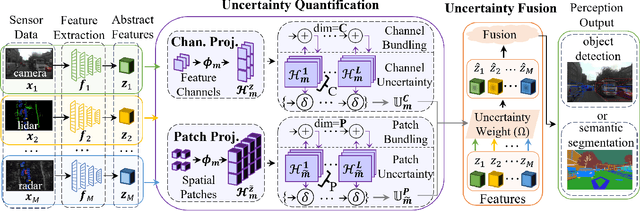
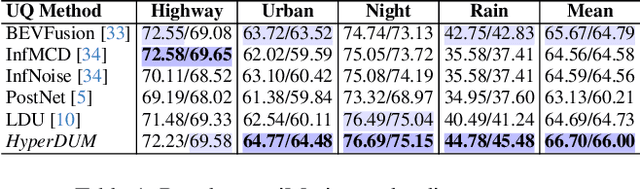
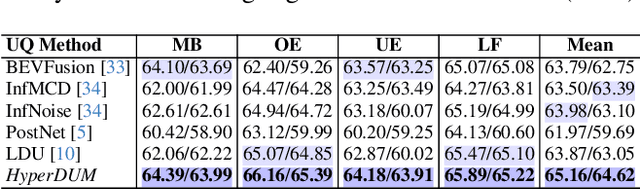
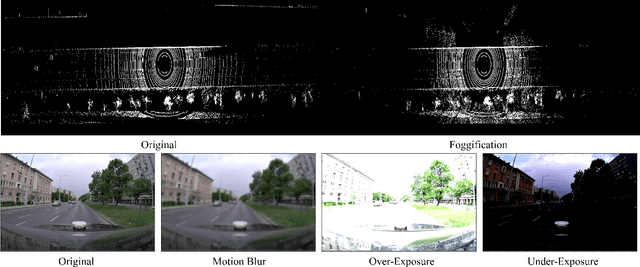
Uncertainty Quantification (UQ) is crucial for ensuring the reliability of machine learning models deployed in real-world autonomous systems. However, existing approaches typically quantify task-level output prediction uncertainty without considering epistemic uncertainty at the multimodal feature fusion level, leading to sub-optimal outcomes. Additionally, popular uncertainty quantification methods, e.g., Bayesian approximations, remain challenging to deploy in practice due to high computational costs in training and inference. In this paper, we propose HyperDUM, a novel deterministic uncertainty method (DUM) that efficiently quantifies feature-level epistemic uncertainty by leveraging hyperdimensional computing. Our method captures the channel and spatial uncertainties through channel and patch -wise projection and bundling techniques respectively. Multimodal sensor features are then adaptively weighted to mitigate uncertainty propagation and improve feature fusion. Our evaluations show that HyperDUM on average outperforms the state-of-the-art (SOTA) algorithms by up to 2.01%/1.27% in 3D Object Detection and up to 1.29% improvement over baselines in semantic segmentation tasks under various types of uncertainties. Notably, HyperDUM requires 2.36x less Floating Point Operations and up to 38.30x less parameters than SOTA methods, providing an efficient solution for real-world autonomous systems.
Transformer-Based Contrastive Meta-Learning For Low-Resource Generalizable Activity Recognition
Dec 28, 2024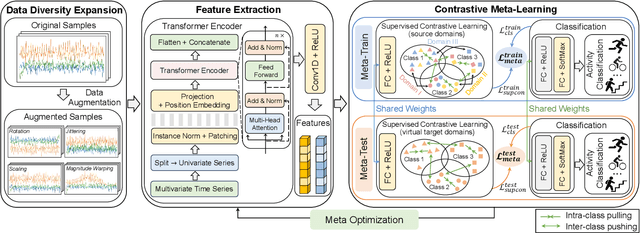
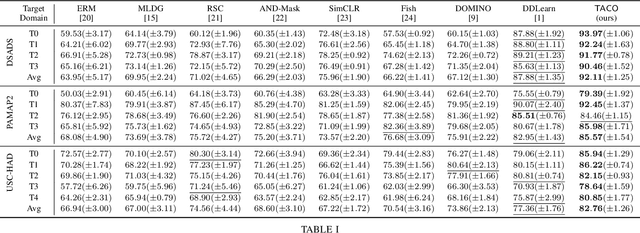
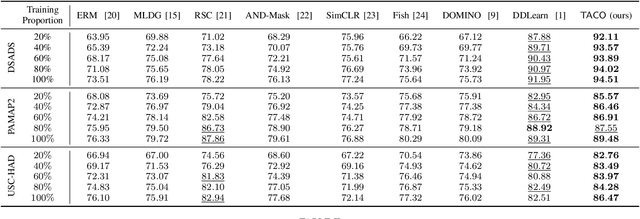
Deep learning has been widely adopted for human activity recognition (HAR) while generalizing a trained model across diverse users and scenarios remains challenging due to distribution shifts. The inherent low-resource challenge in HAR, i.e., collecting and labeling adequate human-involved data can be prohibitively costly, further raising the difficulty of tackling DS. We propose TACO, a novel transformer-based contrastive meta-learning approach for generalizable HAR. TACO addresses DS by synthesizing virtual target domains in training with explicit consideration of model generalizability. Additionally, we extract expressive feature with the attention mechanism of Transformer and incorporate the supervised contrastive loss function within our meta-optimization to enhance representation learning. Our evaluation demonstrates that TACO achieves notably better performance across various low-resource DS scenarios.
SMORE: Similarity-based Hyperdimensional Domain Adaptation for Multi-Sensor Time Series Classification
Feb 27, 2024
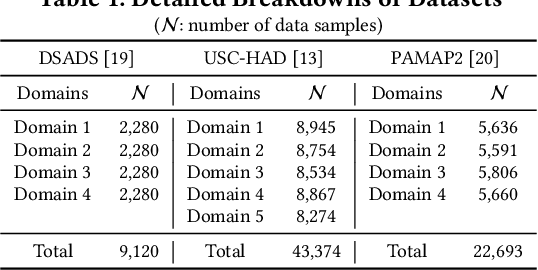
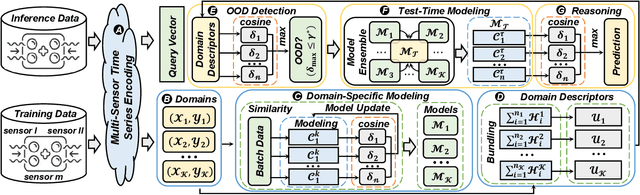
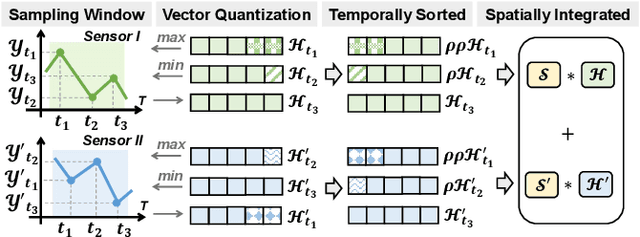
Many real-world applications of the Internet of Things (IoT) employ machine learning (ML) algorithms to analyze time series information collected by interconnected sensors. However, distribution shift, a fundamental challenge in data-driven ML, arises when a model is deployed on a data distribution different from the training data and can substantially degrade model performance. Additionally, increasingly sophisticated deep neural networks (DNNs) are required to capture intricate spatial and temporal dependencies in multi-sensor time series data, often exceeding the capabilities of today's edge devices. In this paper, we propose SMORE, a novel resource-efficient domain adaptation (DA) algorithm for multi-sensor time series classification, leveraging the efficient and parallel operations of hyperdimensional computing. SMORE dynamically customizes test-time models with explicit consideration of the domain context of each sample to mitigate the negative impacts of domain shifts. Our evaluation on a variety of multi-sensor time series classification tasks shows that SMORE achieves on average 1.98% higher accuracy than state-of-the-art (SOTA) DNN-based DA algorithms with 18.81x faster training and 4.63x faster inference.
Robust and Scalable Hyperdimensional Computing With Brain-Like Neural Adaptations
Nov 13, 2023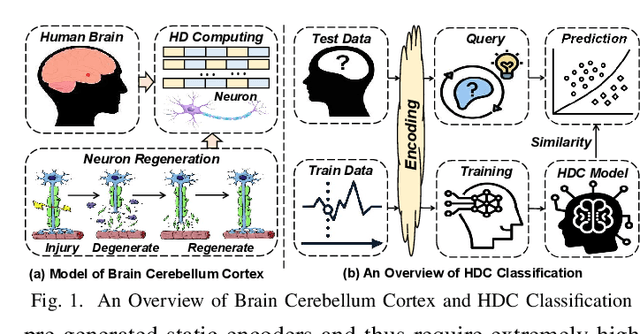
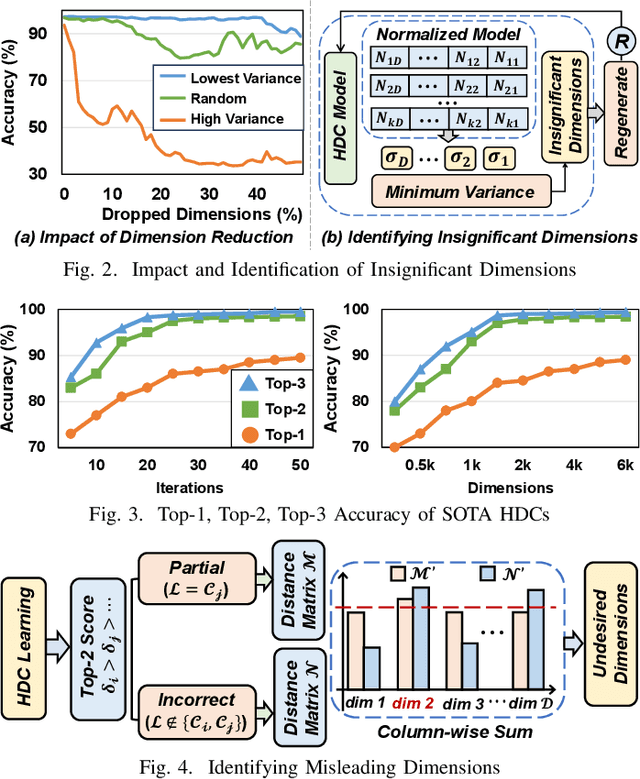
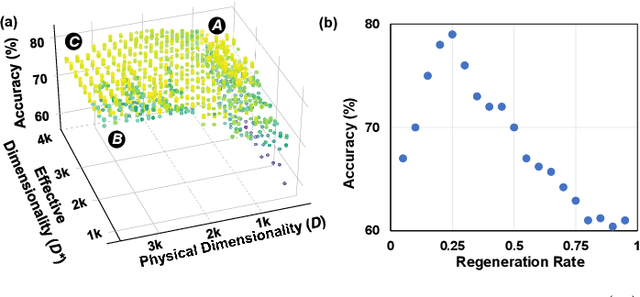
The Internet of Things (IoT) has facilitated many applications utilizing edge-based machine learning (ML) methods to analyze locally collected data. Unfortunately, popular ML algorithms often require intensive computations beyond the capabilities of today's IoT devices. Brain-inspired hyperdimensional computing (HDC) has been introduced to address this issue. However, existing HDCs use static encoders, requiring extremely high dimensionality and hundreds of training iterations to achieve reasonable accuracy. This results in a huge efficiency loss, severely impeding the application of HDCs in IoT systems. We observed that a main cause is that the encoding module of existing HDCs lacks the capability to utilize and adapt to information learned during training. In contrast, neurons in human brains dynamically regenerate all the time and provide more useful functionalities when learning new information. While the goal of HDC is to exploit the high-dimensionality of randomly generated base hypervectors to represent the information as a pattern of neural activity, it remains challenging for existing HDCs to support a similar behavior as brain neural regeneration. In this work, we present dynamic HDC learning frameworks that identify and regenerate undesired dimensions to provide adequate accuracy with significantly lowered dimensionalities, thereby accelerating both the training and inference.
DOMINO: Domain-invariant Hyperdimensional Classification for Multi-Sensor Time Series Data
Aug 18, 2023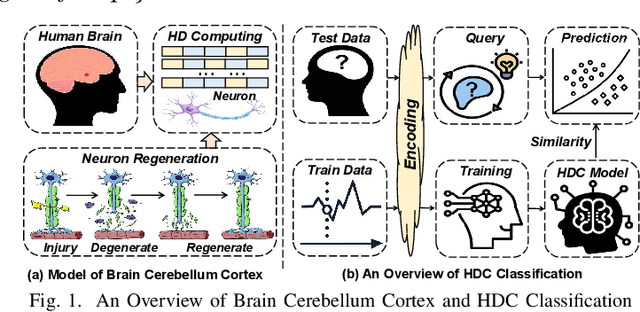
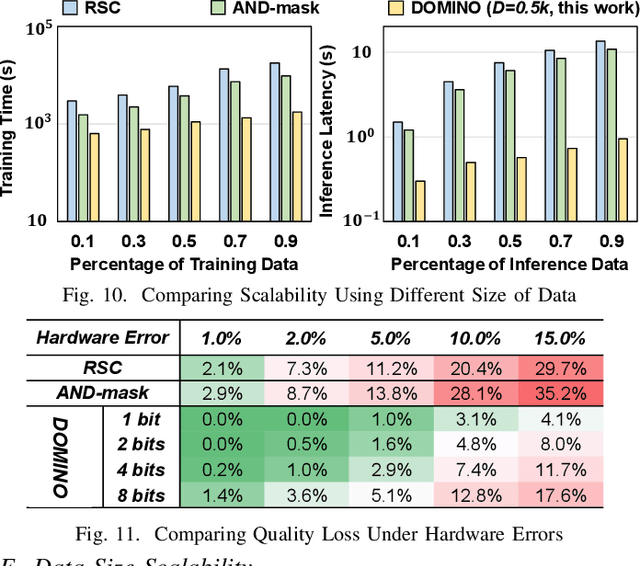

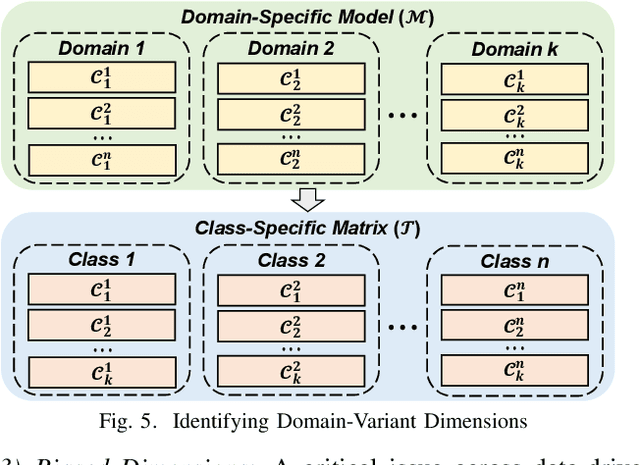
With the rapid evolution of the Internet of Things, many real-world applications utilize heterogeneously connected sensors to capture time-series information. Edge-based machine learning (ML) methodologies are often employed to analyze locally collected data. However, a fundamental issue across data-driven ML approaches is distribution shift. It occurs when a model is deployed on a data distribution different from what it was trained on, and can substantially degrade model performance. Additionally, increasingly sophisticated deep neural networks (DNNs) have been proposed to capture spatial and temporal dependencies in multi-sensor time series data, requiring intensive computational resources beyond the capacity of today's edge devices. While brain-inspired hyperdimensional computing (HDC) has been introduced as a lightweight solution for edge-based learning, existing HDCs are also vulnerable to the distribution shift challenge. In this paper, we propose DOMINO, a novel HDC learning framework addressing the distribution shift problem in noisy multi-sensor time-series data. DOMINO leverages efficient and parallel matrix operations on high-dimensional space to dynamically identify and filter out domain-variant dimensions. Our evaluation on a wide range of multi-sensor time series classification tasks shows that DOMINO achieves on average 2.04% higher accuracy than state-of-the-art (SOTA) DNN-based domain generalization techniques, and delivers 16.34x faster training and 2.89x faster inference. More importantly, DOMINO performs notably better when learning from partially labeled and highly imbalanced data, providing 10.93x higher robustness against hardware noises than SOTA DNNs.
RS2G: Data-Driven Scene-Graph Extraction and Embedding for Robust Autonomous Perception and Scenario Understanding
Apr 17, 2023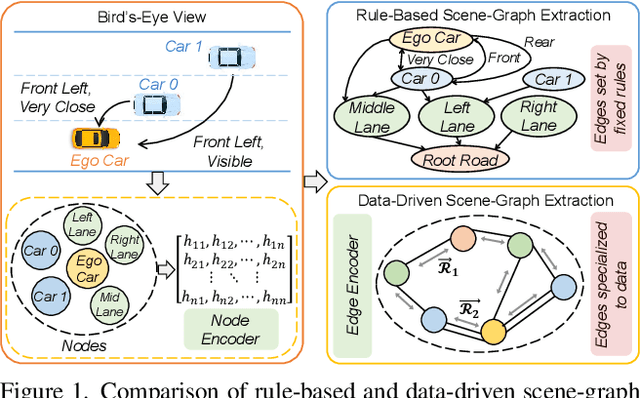
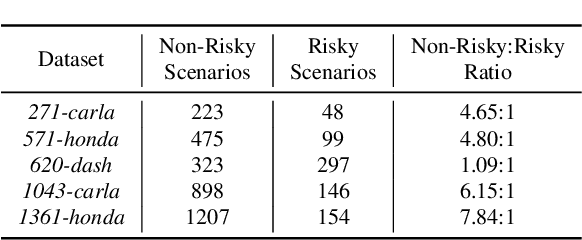
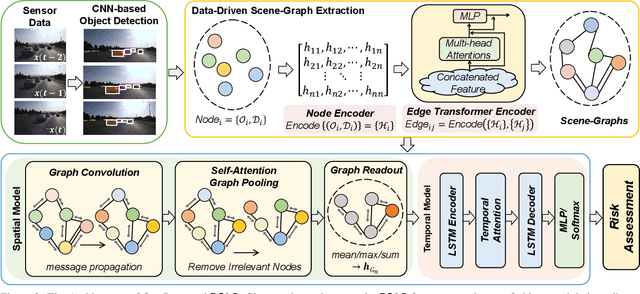
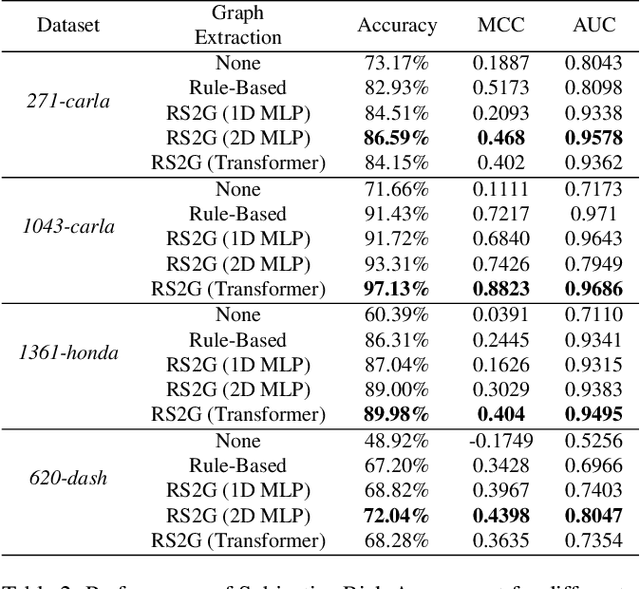
Human drivers naturally reason about interactions between road users to understand and safely navigate through traffic. Thus, developing autonomous vehicles necessitates the ability to mimic such knowledge and model interactions between road users to understand and navigate unpredictable, dynamic environments. However, since real-world scenarios often differ from training datasets, effectively modeling the behavior of various road users in an environment remains a significant research challenge. This reality necessitates models that generalize to a broad range of domains and explicitly model interactions between road users and the environment to improve scenario understanding. Graph learning methods address this problem by modeling interactions using graph representations of scenarios. However, existing methods cannot effectively transfer knowledge gained from the training domain to real-world scenarios. This constraint is caused by the domain-specific rules used for graph extraction that can vary in effectiveness across domains, limiting generalization ability. To address these limitations, we propose RoadScene2Graph (RS2G): a data-driven graph extraction and modeling approach that learns to extract the best graph representation of a road scene for solving autonomous scene understanding tasks. We show that RS2G enables better performance at subjective risk assessment than rule-based graph extraction methods and deep-learning-based models. RS2G also improves generalization and Sim2Real transfer learning, which denotes the ability to transfer knowledge gained from simulation datasets to unseen real-world scenarios. We also present ablation studies showing how RS2G produces a more useful graph representation for downstream classifiers. Finally, we show how RS2G can identify the relative importance of rule-based graph edges and enables intelligent graph sparsity tuning.