 Add to Chrome
 Add to Firefox
 Add to Edge
Agentic Autoresearch for CT Reconstruction
Jul 24, 2026
Comparing CT reconstruction methods fairly is labor-intensive and largely manual, and many benchmarks use idealized data. We ask whether a large language model (LLM) agent can do the labor of reconstruction research on its own, and whether a ranking measured on ideal data predicts behavior under realistic noise. We built an agentic loop: the agent edits a solver, runs a short cluster job, reads one frozen metric, and revises. The metric is a calibrated headroom score against the FBP baseline, inside the field of view; every method shares the same differentiable fan-beam projector. We benchmarked 26 methods on Mayo low-dose CT (noise-limited) and a 128-view sparse-view breast task from the noiseless DL-Sparse-View Challenge, with validation-selected iterations scored on a held-out test set. Every trained breast model was then re-scored on noisy inputs (I_0 = 10^5 photons) without retraining, and separately retrained on matched noise. The agent independently implemented, tuned, and benchmarked all 26 methods, and recombined them into a compact solver of 969 parameters that ties the top Mayo tier at the 1% level using 0.4% of the champion's parameters. Benchmarking gives a tier of statistically indistinguishable top methods, not one winner. Mild input noise nearly inverts the breast ranking: the noiseless champion (a supervised image denoiser, hr 0.89) collapses to 0.00, while a learned primal-dual method rises to champion (0.72 to 0.93). An ideal-data leaderboard therefore does not predict robustness. The inversion is a transfer effect, not a permanent deficit: retraining on matched noise restores much of the clean ranking (Spearman rho 0.04 to 0.61). Noise is only the easiest confounder in an open-ended set (beam hardening, scatter, anatomy, disease), so no single-factor challenge certifies generality. Benchmarks should model a broad spectrum of realistic factors at once.

Quantum Compressed Sensing CT Reconstruction Algorithm Based on Penalized Weighted Least Squares and Guided Total Variation
Jul 12, 2026Objective. Existing quadratic unconstrained binary optimization (QUBO)-based sparse-view computed tomography (CT) reconstruction neglects photon-counting statistics and anatomical heterogeneity. We address both limitations within the QUBO framework.Approach. We propose a quantum compressed-sensing CT method combining penalized weighted least squares (PWLS) and guided total variation (GTV). PWLS weights projection residuals by photon-count reliability, whereas GTV uses gradients from a prior image reconstructed by the simultaneous algebraic reconstruction technique (SART) to preserve edges and suppress noise in homogeneous regions. After binary encoding, both terms form a unified QUBO model. Experiments used four 40 times 40 CT images under a 10-view fan-beam geometry with Poisson noise. Comparisons included conventional reconstruction methods, QUBO variants, gradient descent, simulated annealing, and a D-Wave hybrid quantum-classical solver.Main results. PWLS-GTV achieved the best reconstruction quality across all cases. In the representative chest case, it reached a peak signal-to-noise ratio (PSNR) of 36.64 dB, compared with 22.48 dB for SART, the best conventional baseline. GTV consistently outperformed conventional total variation. Simulated annealing and the D-Wave hybrid solver produced similar reconstructions, whereas gradient descent was ineffective. Repeated hybrid-solver runs showed stable performance.Significance. The framework incorporates photon-statistical weighting and structure-guided regularization into QUBO-based CT reconstruction without changing its quadratic form, providing a proof of concept for quantum-assisted sparse-view CT reconstruction.
WING: A Window-Prior-Based Generative Network with Gated Inception for Cross-Modality CT Synthesis
Jul 07, 2026Generating CT volumes from MRI and CBCT can improve treatment planning in adaptive radiotherapy while avoiding additional radiation exposure. However, direct regression of CT intensities is challenged by the inherently high dynamic range and long-tailed distributions, thereby averaging out sparse yet clinically important structures. To alleviate this issue, we reformulate the regression target into multiple windowed representations, leveraging the inductive prior that CT intensities are structure-deterministic and window-separable. These windowed views exhibit smoother distributions and admit structured fusion back to the full-range CT. Building on this reformulation, we introduce WING, a WINdow-prior-based Generative network comprising: 1) a new Gated Inception Generator to produce multi-window predictions, enabling multi-shape kernel interactions to capture cross-modality correspondence; 2) a Fuse-and-Refine Transformer to aggregate the windowed outputs and learn residuals for detail refinement; and 3) a joint adversarial training objective to enhance window-conditioned realism. Extensive experiments demonstrate that our compact WING achieves state-of-the-art performance on the MRI-to-CT and CBCT-to-CT benchmarks, while supporting multi-anatomy synthesis with a single model.
Quantum CT via Dynamic Interval Encoding and Prior-Balanced QUBO Reconstruction
Jun 23, 2026Quadratic unconstrained binary optimization (QUBO)-based quantum computed tomography (CT) casts reconstruction as a binary quadratic problem for quantum annealing and hybrid quantum--classical solvers. For grayscale CT, however, image encoding is constrained by the binary-variable budget: fixed global bit-plane encodings increase QUBO size and coupling complexity as gray-level precision improves, whereas low-bit encodings introduce quantization error. We propose a QUBO-based grayscale CT reconstruction framework that combines dynamic interval encoding with prior-balanced optimization. Each refinement round encodes active pixels only within local gray-level intervals around the current estimate, and a boundary-hit-guided update rule adaptively switches between search expansion and local refinement. To improve optimization stability, the method balances projection-domain data consistency and an edge-preserving quadratic prior before forming the final QUBO. Sparse-view and limited-angle fan-beam CT experiments show that the proposed method recovers structures and gray-level distributions more faithfully than the evaluated analytic, iterative, variational, and representation-based baselines. Expressivity analysis and ablation studies further indicate that the improvement mainly arises from effective gray-level representation through dynamic local encoding and more stable data-fidelity--prior coupling. Experiments on the D-Wave hybrid binary quadratic model (BQM) solver further demonstrate that the formulation is executable on a hardware-backed hybrid quantum--classical backend.
Projection-Volume Fidelity Divergence: Diagnosing and Controlling Optimization Drift in Sparse-View 3D Gaussian Tomography
Jun 21, 2026Sparse-view computed tomography is a severely ill-posed inverse problem, where recent 3D Gaussian Splatting methods offer an efficient explicit representation for tomographic reconstruction. However, we find that projection-domain optimization can be misleading in this setting: the rendered projections may continue to improve while the reconstructed volume deteriorates. We identify this failure mode as Projection-Volume Fidelity Divergence (PVFD), a representation-level optimization drift caused by anisotropic Gaussian deformation and view-specific primitive co-adaptation under sparse Radon constraints. To characterize this behavior, we introduce geometry- and volume-level diagnostics that measure needle-like Gaussian degeneration and the stability of the voxelized density field. Based on these observations, we propose LADES, a ground-truth-free optimization controller for sparse-view Gaussian tomography. LADES combines Linearly Annealed Dropout, which applies strong stochastic masking in early training to disrupt premature primitive co-adaptation and gradually restores full capacity for structural consolidation, with Structure-Aware Early Stopping, which terminates densification according to the saturation of Gaussian population growth rather than validation PSNR. Experiments on sparse-view CT reconstruction show that LADES improves volumetric fidelity, suppresses structural degeneration, and substantially reduces training time while maintaining competitive projection accuracy. These results suggest that robust Gaussian-based tomography requires monitoring and controlling volumetric structure, rather than optimizing projection fit alone.
Improving Deep Learning-Based Target Volume Auto-Delineation for Adaptive MR-Guided Radiotherapy in Head and Neck Cancer: Impact of a Volume-Aware Dice Loss
Apr 11, 2026Background: Manual delineation of target volumes in head and neck cancer (HNC) remains a significant bottleneck in radiotherapy planning, characterized by high inter-observer variability and time consumption. This study evaluates the integration of a Volume-Aware (VA) Dice loss function into a self-configuring deep learning framework to enhance the auto-segmentation of primary tumors (PT) and metastatic lymph nodes (LN) for adaptive MR-guided radiotherapy. We investigate how volume-sensitive weighting affects the detection of small, anatomically complex nodal metastases compared to conventional loss functions. Methods: Utilizing the HNTS-MRG 2024 dataset, we implemented an nnU-Net ResEnc M architecture. We conducted a multi-label segmentation task, comparing a standard Dice loss baseline against two Volume-Aware configurations: a "Dual Mask" setup (VA loss on both PT and LN) and a "Selective LN Mask" setup (VA loss on LN only). Evaluation metrics included volumetric Dice scores, surface-based metrics (SDS, MSD, HD95), and lesion-wise binary detection sensitivity and precision. Results: The Selective LN Mask configuration achieved the highest LN Volumetric Dice Score (0.758 vs. 0.734 baseline) and significantly improved LN Lesion-Wise Detection Sensitivity (84.93% vs. 81.80%). However, a critical trade-off was observed; PT detection precision declined significantly in the selective setup (63.65% vs. 81.27%). The Dual Mask configuration provided the most balanced performance across both targets, maintaining primary tumor precision at 82.04% while improving LN sensitivity to 83.46%. Conclusions: A volume-sensitive loss function mitigated the under-representation of small metastatic lesions in HNC. While selective weighting yielded the best nodal detection, a dual-mask approach is required in multi-label tasks to maintain segmentation accuracy for larger primary tumor volumes.
Improving Generalization of Deep Learning for Brain Metastases Segmentation Across Institutions
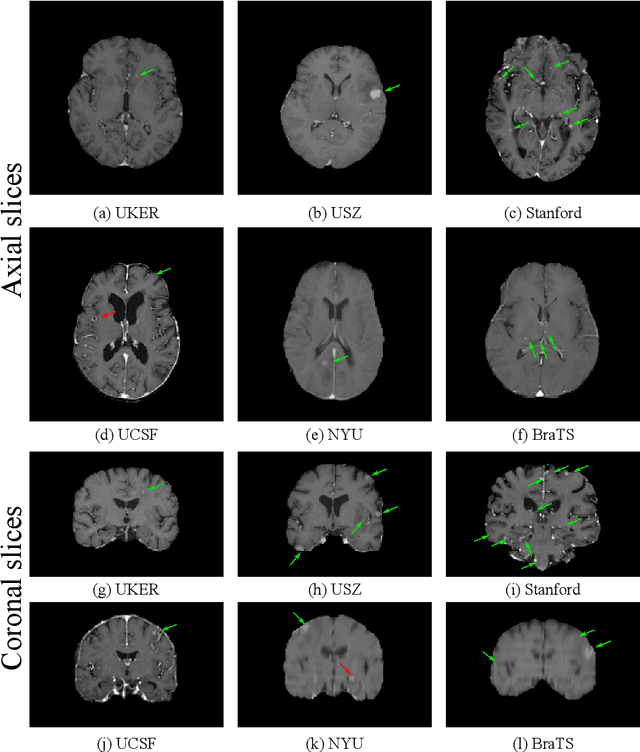
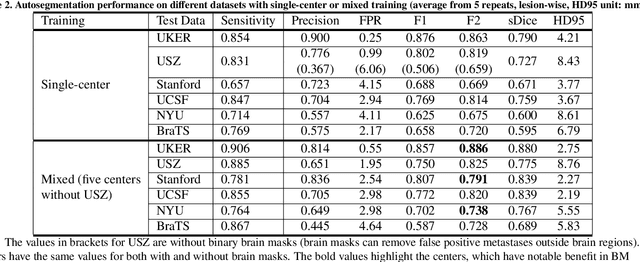
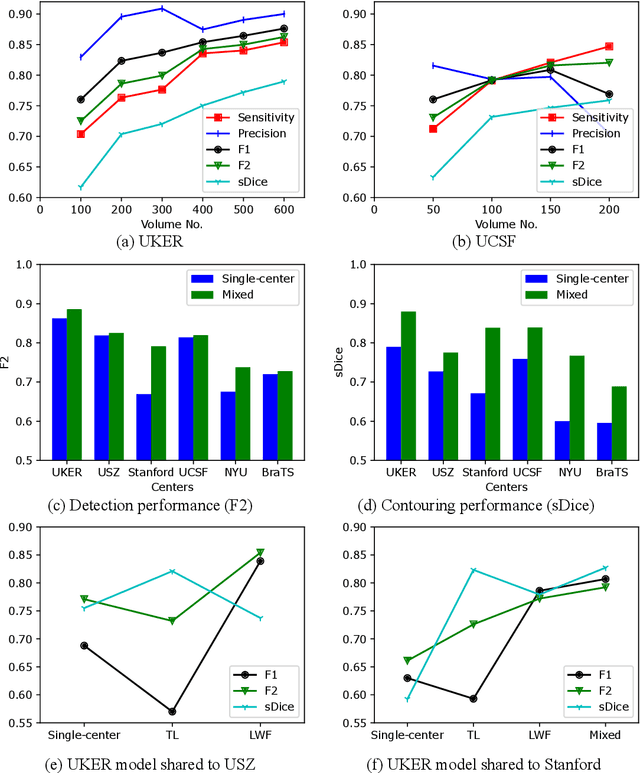
Apr 01, 2026Background: Deep learning has demonstrated significant potential for automated brain metastases (BM) segmentation; however, models trained at a singular institution often exhibit suboptimal performance at various sites due to disparities in scanner hardware, imaging protocols, and patient demographics. The goal of this work is to create a domain adaptation framework that will allow for BM segmentation to be used across multiple institutions. Methods: We propose a VAE-MMD preprocessing pipeline that combines variational autoencoders (VAE) with maximum mean discrepancy (MMD) loss, incorporating skip connections and self-attention mechanisms alongside nnU-Net segmentation. The method was tested on 740 patients from four public databases: Stanford, UCSF, UCLM, and PKG, evaluated by domain classifier's accuracy, sensitivity, precision, F1/F2 scores, surface Dice (sDice), and 95th percentile Hausdorff distance (HD95). Results: VAE-MMD reduced domain classifier accuracy from 0.91 to 0.50, indicating successful feature alignment across institutions. Reconstructed volumes attained a PSNR greater than 36 dB, maintaining anatomical accuracy. The combined method raised the mean F1 by 11.1% (0.700 to 0.778), the mean sDice by 7.93% (0.7121 to 0.7686), and reduced the mean HD95 by 65.5% (11.33 to 3.91 mm) across all four centers compared to the baseline nnU-Net. Conclusions: VAE-MMD effectively diminishes cross-institutional data heterogeneity and enhances BM segmentation generalization across volumetric, detection, and boundary-level metrics without necessitating target-domain labels, thereby overcoming a significant obstacle to the clinical implementation of AI-assisted segmentation.
A Self-supervised Multimodal Deep Learning Approach to Differentiate Post-radiotherapy Progression from Pseudoprogression in Glioblastoma
Feb 06, 2025
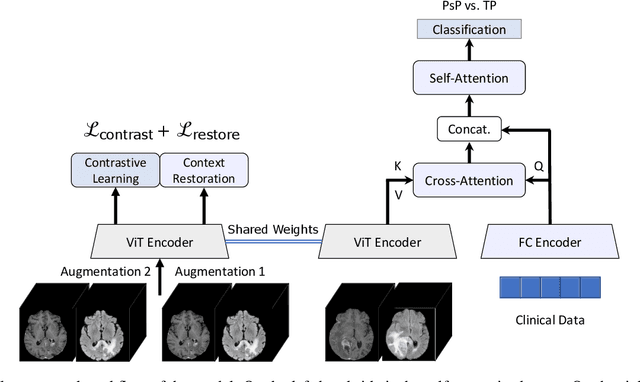


Accurate differentiation of pseudoprogression (PsP) from True Progression (TP) following radiotherapy (RT) in glioblastoma (GBM) patients is crucial for optimal treatment planning. However, this task remains challenging due to the overlapping imaging characteristics of PsP and TP. This study therefore proposes a multimodal deep-learning approach utilizing complementary information from routine anatomical MR images, clinical parameters, and RT treatment planning information for improved predictive accuracy. The approach utilizes a self-supervised Vision Transformer (ViT) to encode multi-sequence MR brain volumes to effectively capture both global and local context from the high dimensional input. The encoder is trained in a self-supervised upstream task on unlabeled glioma MRI datasets from the open BraTS2021, UPenn-GBM, and UCSF-PDGM datasets to generate compact, clinically relevant representations from FLAIR and T1 post-contrast sequences. These encoded MR inputs are then integrated with clinical data and RT treatment planning information through guided cross-modal attention, improving progression classification accuracy. This work was developed using two datasets from different centers: the Burdenko Glioblastoma Progression Dataset (n = 59) for training and validation, and the GlioCMV progression dataset from the University Hospital Erlangen (UKER) (n = 20) for testing. The proposed method achieved an AUC of 75.3%, outperforming the current state-of-the-art data-driven approaches. Importantly, the proposed approach relies on readily available anatomical MRI sequences, clinical data, and RT treatment planning information, enhancing its clinical feasibility. The proposed approach addresses the challenge of limited data availability for PsP and TP differentiation and could allow for improved clinical decision-making and optimized treatment plans for GBM patients.
Exploring the Capabilities and Limitations of Large Language Models for Radiation Oncology Decision Support
Jan 04, 2025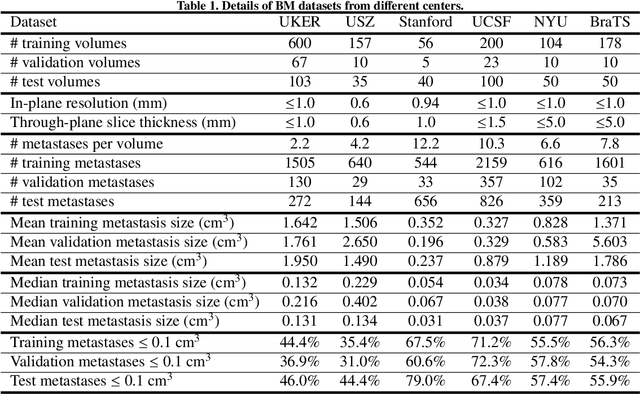
Thanks to the rapidly evolving integration of LLMs into decision-support tools, a significant transformation is happening across large-scale systems. Like other medical fields, the use of LLMs such as GPT-4 is gaining increasing interest in radiation oncology as well. An attempt to assess GPT-4's performance in radiation oncology was made via a dedicated 100-question examination on the highly specialized topic of radiation oncology physics, revealing GPT-4's superiority over other LLMs. GPT-4's performance on a broader field of clinical radiation oncology is further benchmarked by the ACR Radiation Oncology In-Training (TXIT) exam where GPT-4 achieved a high accuracy of 74.57%. Its performance on re-labelling structure names in accordance with the AAPM TG-263 report has also been benchmarked, achieving above 96% accuracies. Such studies shed light on the potential of LLMs in radiation oncology. As interest in the potential and constraints of LLMs in general healthcare applications continues to rise5, the capabilities and limitations of LLMs in radiation oncology decision support have not yet been fully explored.
* Officially published in the Red Journal
Task-Specific Data Preparation for Deep Learning to Reconstruct Structures of Interest from Severely Truncated CBCT Data
Sep 13, 2024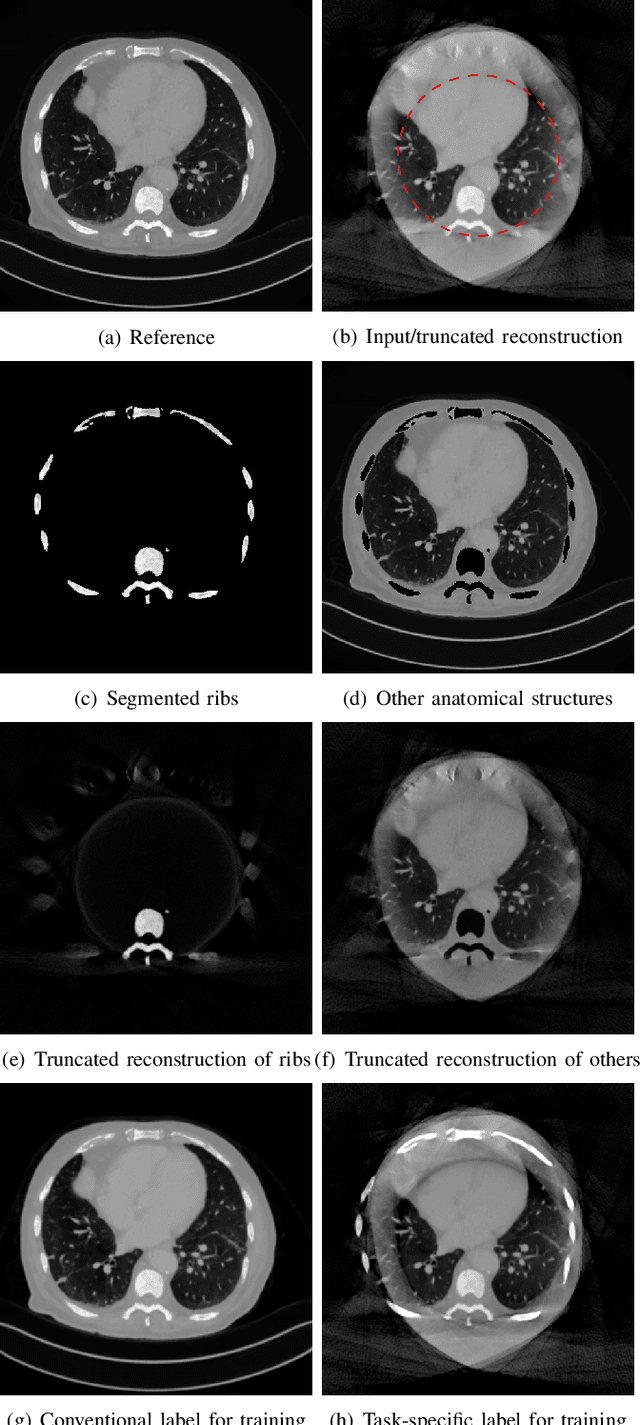

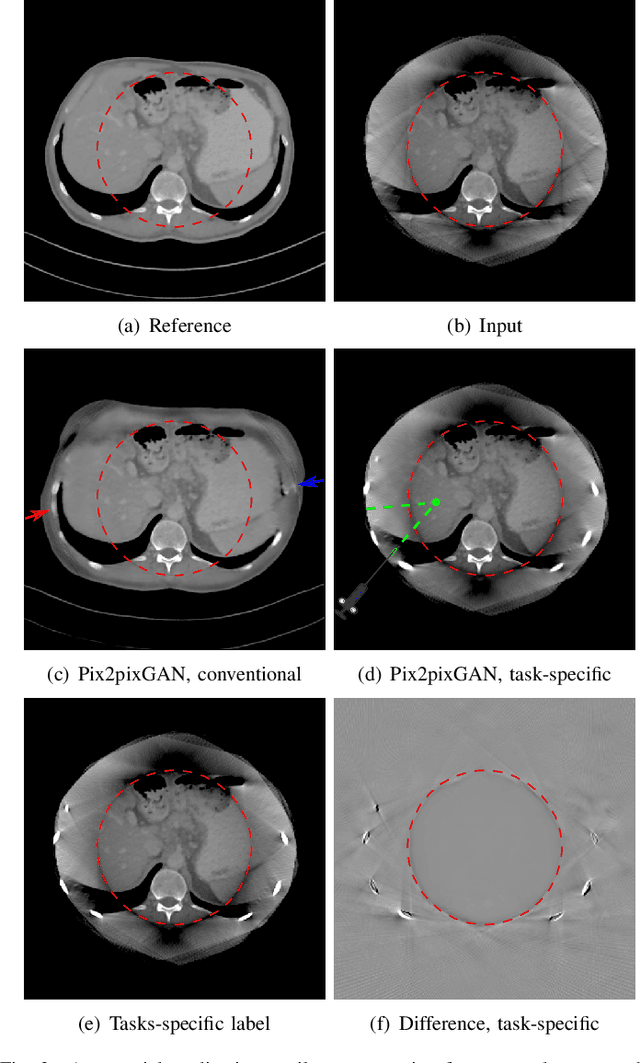
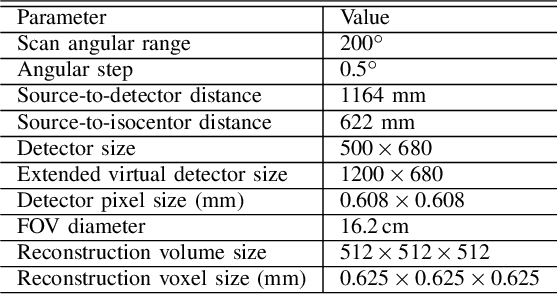
Cone-beam computed tomography (CBCT) is widely used in interventional surgeries and radiation oncology. Due to the limited size of flat-panel detectors, anatomical structures might be missing outside the limited field-of-view (FOV), which restricts the clinical applications of CBCT systems. Recently, deep learning methods have been proposed to extend the FOV for multi-slice CT systems. However, in mobile CBCT system with a smaller FOV size, projection data is severely truncated and it is challenging for a network to restore all missing structures outside the FOV. In some applications, only certain structures outside the FOV are of interest, e.g., ribs in needle path planning for liver/lung cancer diagnosis. Therefore, a task-specific data preparation method is proposed in this work, which automatically let the network focus on structures of interest instead of all the structures. Our preliminary experiment shows that Pix2pixGAN with a conventional training has the risk to reconstruct false positive and false negative rib structures from severely truncated CBCT data, whereas Pix2pixGAN with the proposed task-specific training can reconstruct all the ribs reliably. The proposed method is promising to empower CBCT with more clinical applications.