 Add to Chrome
 Add to Firefox
 Add to Edge
RCL-Mamba: A Dual-domain State Space Model for Measurement-oriented Image Restoration in Rotational Sparse-View Scanning Computed Laminography
Jun 30, 2026
Rotational Scanning Computed Laminography (RCL) is widely utilized for the Non-Destructive Testing(NDT) of large planar components. However, to facilitate rapid inspection, continuous sparse-view scanning is often employed, where the angular integration effect during exposure induces rotational blur in the projection domain. Furthermore, the data incompleteness inherent in sparse sampling manifests as sparse artifacts in the reconstructed image domain. To address these cross-domain degradations, this paper proposes RCL-Mamba, a measurement-oriented dual-domain State Space Model (SSM)-based image restoration network. The framework adopts a cascaded joint processing strategy: it first corrects the rotational blur in the projection domain and subsequently suppresses the sparse artifacts in the image domain. Additionally, we design a Mamba-CNN dual-branch module to adaptively balance large-scale blur correction with local detail recovery. Evaluations on both simulated datasets and real-world Printed Circuit Board (PCB) scans demonstrate that RCL-Mamba outperforms existing baselines in blur removal, artifact suppression, and structural preservation. Line-profile-based structural measurement further verifies that the proposed method better preserves via/pad boundaries and slender trace profiles. Crucially, by reducing the required scanning views from 512 to 64, our method enhances inspection efficiency by approximately 8-fold without compromising reconstruction quality, offering a robust measurement-oriented restoration solution for high-throughput RCL inspection with improved structural measurement fidelity.

Cascaded LSTMs based Deep Reinforcement Learning for Goal-driven Dialogue
Oct 31, 2019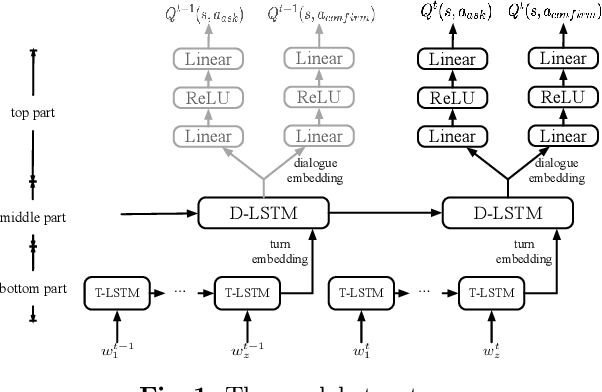
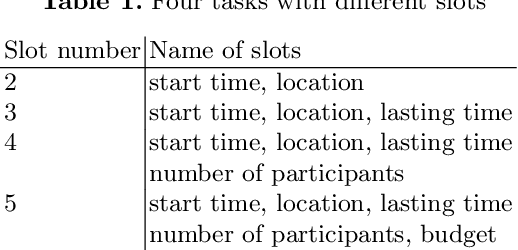
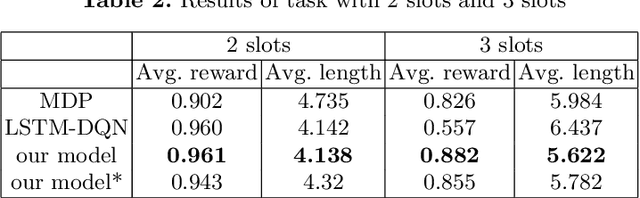
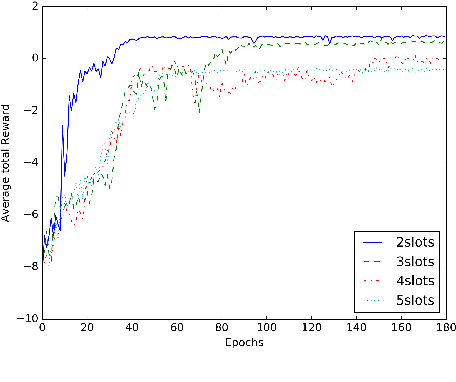
This paper proposes a deep neural network model for joint modeling Natural Language Understanding (NLU) and Dialogue Management (DM) in goal-driven dialogue systems. There are three parts in this model. A Long Short-Term Memory (LSTM) at the bottom of the network encodes utterances in each dialogue turn into a turn embedding. Dialogue embeddings are learned by a LSTM at the middle of the network, and updated by the feeding of all turn embeddings. The top part is a forward Deep Neural Network which converts dialogue embeddings into the Q-values of different dialogue actions. The cascaded LSTMs based reinforcement learning network is jointly optimized by making use of the rewards received at each dialogue turn as the only supervision information. There is no explicit NLU and dialogue states in the network. Experimental results show that our model outperforms both traditional Markov Decision Process (MDP) model and single LSTM with Deep Q-Network on meeting room booking tasks. Visualization of dialogue embeddings illustrates that the model can learn the representation of dialogue states.