 Add to Chrome
 Add to Firefox
 Add to Edge
CardioLens: Revealing the Clinical Reality Gap of MLLMs via Multi-Sequence Cardiac MRI Evaluations
May 28, 2026
Multimodal Large Language Models (MLLMs) have shown strong performance on public medical benchmarks, yet existing evaluations often remain weak proxies for clinical use, relying on isolated inputs and simplified recognition-style tasks. We introduce CardioLens, a leakage-resistant evaluation testbed for multi-sequence Cardiovascular Magnetic Resonance (CMR), constructed from private hospital archives through a rigorous report-to-QA construction and verification pipeline. CardioLens contains 473,896 slices and 13,494 verified QA pairs across 4D Cine, LGE, perfusion, and T2-weighted imaging, and evaluates three stages of CMR interpretation: image understanding, report generation, and disease diagnosis. Across 24 state-of-the-art MLLMs, CardioLens reveals a substantial clinical reality gap: models perform poorly overall, with performance degrading along the real CMR workflow. Confusion analysis further shows a category-collapse failure mode, where models default to frequent abnormal categories rather than distinguishing clinically distinct findings. To rule out MLLM-compatible input construction as the primary cause, we compare random, clinically motivated, and data-driven slice selection protocols under different slice budgets; performance changes only marginally, typically by about 1%. Explicit reasoning prompts also fail to rescue performance, often making models more conservative rather than improving visual evidence use. These results show that current MLLMs remain far from reliable CMR interpretation, where clinical decisions require integrating distributed evidence across sequences, views, and temporal phases. CardioLens provides a clinically grounded testbed for developing next-generation MLLMs toward real-world clinical deployment.

BAAI Cardiac Agent: An intelligent multimodal agent for automated reasoning and diagnosis of cardiovascular diseases from cardiac magnetic resonance imaging
Apr 05, 2026Cardiac magnetic resonance (CMR) is a cornerstone for diagnosing cardiovascular disease. However, it remains underutilized due to complex, time-consuming interpretation across multi-sequences, phases, quantitative measures that heavily reliant on specialized expertise. Here, we present BAAI Cardiac Agent, a multimodal intelligent system designed for end-to-end CMR interpretation. The agent integrates specialized cardiac expert models to perform automated segmentation of cardiac structures, functional quantification, tissue characterization and disease diagnosis, and generates structured clinical reports within a unified workflow. Evaluated on CMR datasets from two hospitals (2413 patients) spanning 7-types of major cardiovascular diseases, the agent achieved an area under the receiver-operating-characteristic curve exceeding 0.93 internally and 0.81 externally. In the task of estimating left ventricular function indices, the results generated by this system for core parameters such as ejection fraction, stroke volume, and left ventricular mass are highly consistent with clinical reports, with Pearson correlation coefficients all exceeding 0.90. The agent outperformed state-of-the-art models in segmentation and diagnostic tasks, and generated clinical reports showing high concordance with expert radiologists (six readers across three experience levels). By dynamically orchestrating expert models for coordinated multimodal analysis, this agent framework enables accurate, efficient CMR interpretation and highlights its potentials for complex clinical imaging workflows. Code is available at https://github.com/plantain-herb/Cardiac-Agent.
DeepFAN, a transformer-based deep learning model for human-artificial intelligence collaborative assessment of incidental pulmonary nodules in CT scans: a multi-reader, multi-case trial
Mar 26, 2026The widespread adoption of CT has notably increased the number of detected lung nodules. However, current deep learning methods for classifying benign and malignant nodules often fail to comprehensively integrate global and local features, and most of them have not been validated through clinical trials. To address this, we developed DeepFAN, a transformer-based model trained on over 10K pathology-confirmed nodules and further conducted a multi-reader, multi-case clinical trial to evaluate its efficacy in assisting junior radiologists. DeepFAN achieved diagnostic area under the curve (AUC) of 0.939 (95% CI 0.930-0.948) on an internal test set and 0.954 (95% CI 0.934-0.973) on the clinical trial dataset involving 400 cases across three independent medical institutions. Explainability analysis indicated higher contributions from global than local features. Twelve readers' average performance significantly improved by 10.9% (95% CI 8.3%-13.5%) in AUC, 10.0% (95% CI 8.9%-11.1%) in accuracy, 7.6% (95% CI 6.1%-9.2%) in sensitivity, and 12.6% (95% CI 10.9%-14.3%) in specificity (P<0.001 for all). Nodule-level inter-reader diagnostic consistency improved from fair to moderate (overall k: 0.313 vs. 0.421; P=0.019). In conclusion, DeepFAN effectively assisted junior radiologists and may help homogenize diagnostic quality and reduce unnecessary follow-up of indeterminate pulmonary nodules. Chinese Clinical Trial Registry: ChiCTR2400084624.
Mesh-Pro: Asynchronous Advantage-guided Ranking Preference Optimization for Artist-style Quadrilateral Mesh Generation
Feb 28, 2026Reinforcement learning (RL) has demonstrated remarkable success in text and image generation, yet its potential in 3D generation remains largely unexplored. Existing attempts typically rely on offline direct preference optimization (DPO) method, which suffers from low training efficiency and limited generalization. In this work, we aim to enhance both the training efficiency and generation quality of RL in 3D mesh generation. Specifically, (1) we design the first asynchronous online RL framework tailored for 3D mesh generation post-training efficiency improvement, which is 3.75$\times$ faster than synchronous RL. (2) We propose Advantage-guided Ranking Preference Optimization (ARPO), a novel RL algorithm that achieves a better trade-off between training efficiency and generalization than current RL algorithms designed for 3D mesh generation, such as DPO and group relative policy optimization (GRPO). (3) Based on asynchronous ARPO, we propose Mesh-Pro, which additionally introduces a novel diagonal-aware mixed triangular-quadrilateral tokenization for mesh representation and a ray-based reward for geometric integrity. Mesh-Pro achieves state-of-the-art performance on artistic and dense meshes.
Silent Inconsistency in Data-Parallel Full Fine-Tuning: Diagnosing Worker-Level Optimization Misalignment
Feb 16, 2026Data-parallel (DP) training with synchronous all-reduce is a dominant paradigm for full-parameter fine-tuning of large language models (LLMs). While parameter synchronization guarantees numerical equivalence of model weights after each iteration, it does not necessarily imply alignment of worker-level optimization dynamics before gradient aggregation. This paper identifies and studies this latent mismatch, termed \emph{silent inconsistency}, where cross-worker divergence in losses and gradients can remain invisible under conventional aggregated monitoring signals. We propose a lightweight, model-agnostic diagnostic framework that quantifies worker-level consistency using training signals readily available in standard pipelines. Specifically, we introduce three complementary metrics: loss dispersion, gradient-norm dispersion, and gradient-direction consistency measured by inter-worker cosine similarity. The proposed metrics incur negligible overhead and require no modification to model architecture, synchronization mechanisms, or optimization algorithms. We validate the framework by fully fine-tuning the 1B-parameter \texttt{openPangu-Embedded-1B-V1.1} model on the \texttt{tatsu-lab/alpaca} dataset using an 8-NPU DP setup, under controlled perturbations of cross-rank stochasticity. Experimental results show that progressively desynchronized data shuffling and random seeds lead to substantial increases in loss/gradient dispersion and reduced directional alignment, despite smooth globally averaged loss curves. These findings demonstrate that the proposed indicators provide actionable visibility into hidden instability modes in large-scale DP fine-tuning, enabling more reliable diagnosis and configuration assessment.
Let Experts Feel Uncertainty: A Multi-Expert Label Distribution Approach to Probabilistic Time Series Forecasting
Feb 04, 2026Time series forecasting in real-world applications requires both high predictive accuracy and interpretable uncertainty quantification. Traditional point prediction methods often fail to capture the inherent uncertainty in time series data, while existing probabilistic approaches struggle to balance computational efficiency with interpretability. We propose a novel Multi-Expert Learning Distributional Labels (LDL) framework that addresses these challenges through mixture-of-experts architectures with distributional learning capabilities. Our approach introduces two complementary methods: (1) Multi-Expert LDL, which employs multiple experts with different learned parameters to capture diverse temporal patterns, and (2) Pattern-Aware LDL-MoE, which explicitly decomposes time series into interpretable components (trend, seasonality, changepoints, volatility) through specialized sub-experts. Both frameworks extend traditional point prediction to distributional learning, enabling rich uncertainty quantification through Maximum Mean Discrepancy (MMD). We evaluate our methods on aggregated sales data derived from the M5 dataset, demonstrating superior performance compared to baseline approaches. The continuous Multi-Expert LDL achieves the best overall performance, while the Pattern-Aware LDL-MoE provides enhanced interpretability through component-wise analysis. Our frameworks successfully balance predictive accuracy with interpretability, making them suitable for real-world forecasting applications where both performance and actionable insights are crucial.
Structure-constrained Language-informed Diffusion Model for Unpaired Low-dose Computed Tomography Angiography Reconstruction
Jan 28, 2026The application of iodinated contrast media (ICM) improves the sensitivity and specificity of computed tomography (CT) for a wide range of clinical indications. However, overdose of ICM can cause problems such as kidney damage and life-threatening allergic reactions. Deep learning methods can generate CT images of normal-dose ICM from low-dose ICM, reducing the required dose while maintaining diagnostic power. However, existing methods are difficult to realize accurate enhancement with incompletely paired images, mainly because of the limited ability of the model to recognize specific structures. To overcome this limitation, we propose a Structure-constrained Language-informed Diffusion Model (SLDM), a unified medical generation model that integrates structural synergy and spatial intelligence. First, the structural prior information of the image is effectively extracted to constrain the model inference process, thus ensuring structural consistency in the enhancement process. Subsequently, semantic supervision strategy with spatial intelligence is introduced, which integrates the functions of visual perception and spatial reasoning, thus prompting the model to achieve accurate enhancement. Finally, the subtraction angiography enhancement module is applied, which serves to improve the contrast of the ICM agent region to suitable interval for observation. Qualitative analysis of visual comparison and quantitative results of several metrics demonstrate the effectiveness of our method in angiographic reconstruction for low-dose contrast medium CT angiography.
Hunyuan3D Studio: End-to-End AI Pipeline for Game-Ready 3D Asset Generation
Sep 16, 2025
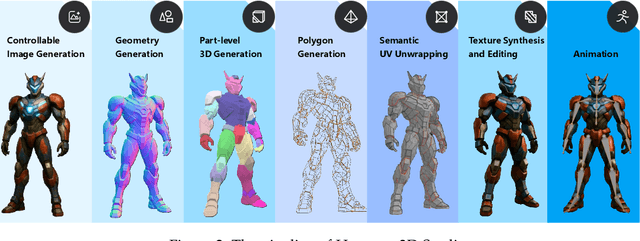

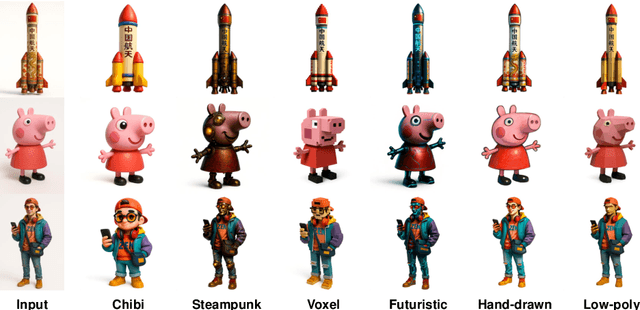
The creation of high-quality 3D assets, a cornerstone of modern game development, has long been characterized by labor-intensive and specialized workflows. This paper presents Hunyuan3D Studio, an end-to-end AI-powered content creation platform designed to revolutionize the game production pipeline by automating and streamlining the generation of game-ready 3D assets. At its core, Hunyuan3D Studio integrates a suite of advanced neural modules (such as Part-level 3D Generation, Polygon Generation, Semantic UV, etc.) into a cohesive and user-friendly system. This unified framework allows for the rapid transformation of a single concept image or textual description into a fully-realized, production-quality 3D model complete with optimized geometry and high-fidelity PBR textures. We demonstrate that assets generated by Hunyuan3D Studio are not only visually compelling but also adhere to the stringent technical requirements of contemporary game engines, significantly reducing iteration time and lowering the barrier to entry for 3D content creation. By providing a seamless bridge from creative intent to technical asset, Hunyuan3D Studio represents a significant leap forward for AI-assisted workflows in game development and interactive media.
HAD: Hybrid Architecture Distillation Outperforms Teacher in Genomic Sequence Modeling
May 27, 2025Inspired by the great success of Masked Language Modeling (MLM) in the natural language domain, the paradigm of self-supervised pre-training and fine-tuning has also achieved remarkable progress in the field of DNA sequence modeling. However, previous methods often relied on massive pre-training data or large-scale base models with huge parameters, imposing a significant computational burden. To address this, many works attempted to use more compact models to achieve similar outcomes but still fell short by a considerable margin. In this work, we propose a Hybrid Architecture Distillation (HAD) approach, leveraging both distillation and reconstruction tasks for more efficient and effective pre-training. Specifically, we employ the NTv2-500M as the teacher model and devise a grouping masking strategy to align the feature embeddings of visible tokens while concurrently reconstructing the invisible tokens during MLM pre-training. To validate the effectiveness of our proposed method, we conducted comprehensive experiments on the Nucleotide Transformer Benchmark and Genomic Benchmark. Compared to models with similar parameters, our model achieved excellent performance. More surprisingly, it even surpassed the distillation ceiling-teacher model on some sub-tasks, which is more than 500 $\times$ larger. Lastly, we utilize t-SNE for more intuitive visualization, which shows that our model can gain a sophisticated understanding of the intrinsic representation pattern in genomic sequences.
EPRecon: An Efficient Framework for Real-Time Panoptic 3D Reconstruction from Monocular Video
Sep 03, 2024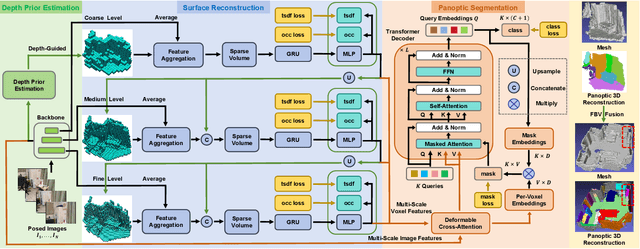
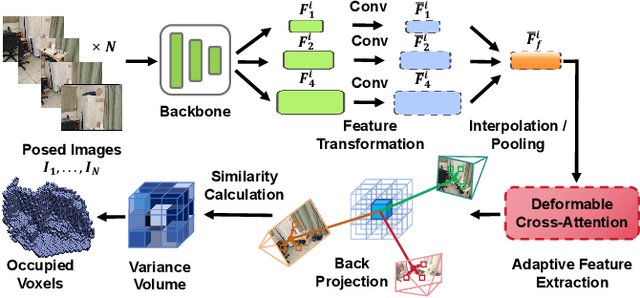
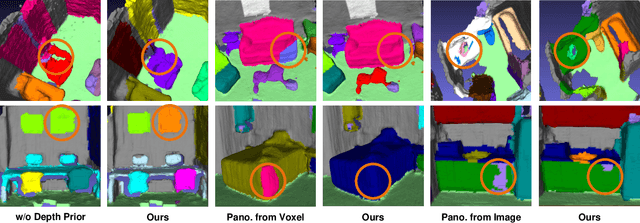

Panoptic 3D reconstruction from a monocular video is a fundamental perceptual task in robotic scene understanding. However, existing efforts suffer from inefficiency in terms of inference speed and accuracy, limiting their practical applicability. We present EPRecon, an efficient real-time panoptic 3D reconstruction framework. Current volumetric-based reconstruction methods usually utilize multi-view depth map fusion to obtain scene depth priors, which is time-consuming and poses challenges to real-time scene reconstruction. To end this, we propose a lightweight module to directly estimate scene depth priors in a 3D volume for reconstruction quality improvement by generating occupancy probabilities of all voxels. In addition, to infer richer panoptic features from occupied voxels, EPRecon extracts panoptic features from both voxel features and corresponding image features, obtaining more detailed and comprehensive instance-level semantic information and achieving more accurate segmentation results. Experimental results on the ScanNetV2 dataset demonstrate the superiority of EPRecon over current state-of-the-art methods in terms of both panoptic 3D reconstruction quality and real-time inference. Code is available at https://github.com/zhen6618/EPRecon.