 Add to Chrome
 Add to Firefox
 Add to Edge
Biosignal Fingerprinting: A Cross-Modal PPG-ECG Foundation Model
May 10, 2026
Cardiovascular disease remains the leading cause of global mortality, yet scalable cardiac monitoring is hindered by the gap between diagnostic-rich ECG and ubiquitous wearable PPG. Bridging this gap requires representations that are compact, transferable across modalities and devices, and deployable without task-specific retraining. Here we introduce biosignal fingerprints: compact latent representations of cardiovascular state derived from a cross-modal foundation model, the Multi-modal Masked Autoencoder (M2AE), trained on over 3.4 million paired ECG and PPG signals. M2AE integrates modality-specific encoders with a shared bottleneck and dual decoders, jointly optimized using reconstruction and cross-modal contrastive objectives, yielding generalizable fingerprints that retain intra- and inter-modality features. Like a biometric fingerprint, these representations uniquely encode an individual's cardiovascular state in a modality-agnostic, privacy-preserving form reusable across clinical tasks without exposing raw waveform data or requiring model retraining. Across 7 downstream tasks, spanning cross-modal reconstruction, cardiovascular disease classification, hypertension detection, mortality prediction, and demographic inference, biosignal fingerprints achieve competitive or superior performance compared to leading domain-specialist foundation models in frozen settings, including an AUROC of 0.974 for five-class CVD classification and 0.877 for hypertension detection, with a maximum improvement of 27.7% in AUROC across 5 classification tasks. Critically, strong performance is maintained with only a single modality, enabling deployment in resource-constrained, single-sensor environments typical of real-world wearable monitoring, with direct implications for continuous cardiovascular monitoring across clinical and consumer health settings.

Retrieve, Reason, and Refine: Generating Accurate and Faithful Patient Instructions
Oct 23, 2022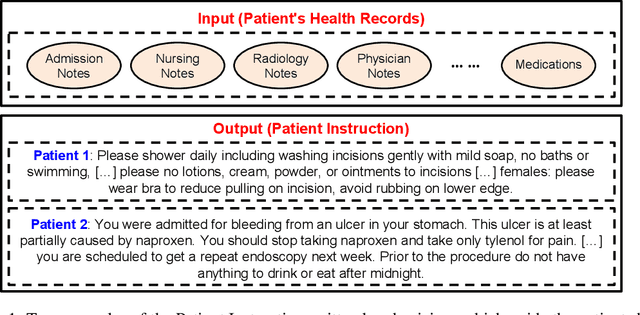
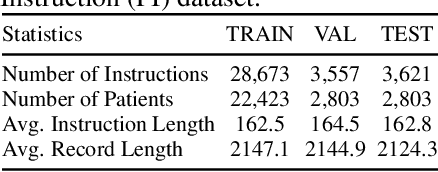
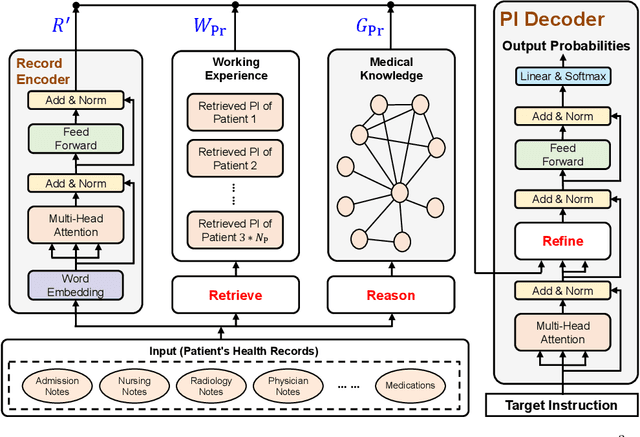
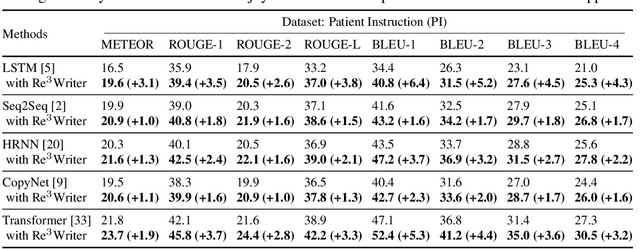
The "Patient Instruction" (PI), which contains critical instructional information provided both to carers and to the patient at the time of discharge, is essential for the patient to manage their condition outside hospital. An accurate and easy-to-follow PI can improve the self-management of patients which can in turn reduce hospital readmission rates. However, writing an appropriate PI can be extremely time-consuming for physicians, and is subject to being incomplete or error-prone for (potentially overworked) physicians. Therefore, we propose a new task that can provide an objective means of avoiding incompleteness, while reducing clinical workload: the automatic generation of the PI, which is imagined as being a document that the clinician can review, modify, and approve as necessary (rather than taking the human "out of the loop"). We build a benchmark clinical dataset and propose the Re3Writer, which imitates the working patterns of physicians to first retrieve related working experience from historical PIs written by physicians, then reason related medical knowledge. Finally, it refines the retrieved working experience and reasoned medical knowledge to extract useful information, which is used to generate the PI for previously-unseen patient according to their health records during hospitalization. Our experiments show that, using our method, the performance of five different models can be substantially boosted across all metrics, with up to 20%, 11%, and 19% relative improvements in BLEU-4, ROUGE-L, and METEOR, respectively. Meanwhile, we show results from human evaluations to measure the effectiveness in terms of its usefulness for clinical practice. The code is available at https://github.com/AI-in-Hospitals/Patient-Instructions