 Add to Chrome
 Add to Firefox
 Add to Edge
RemoCap: Disentangled Representation Learning for Motion Capture
May 21, 2024

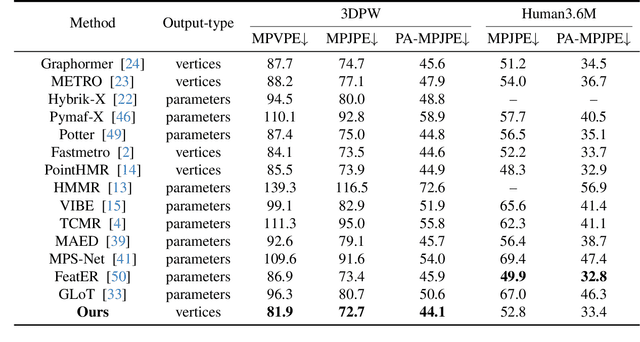
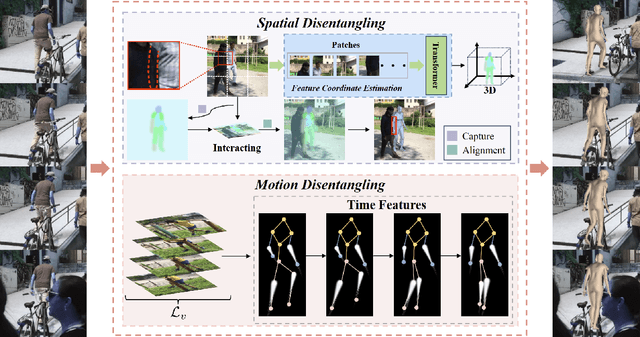
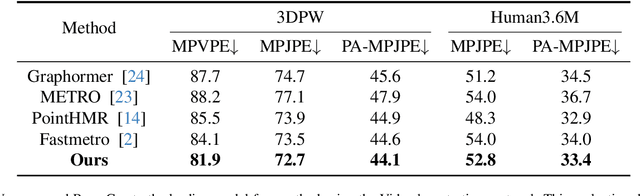
Reconstructing 3D human bodies from realistic motion sequences remains a challenge due to pervasive and complex occlusions. Current methods struggle to capture the dynamics of occluded body parts, leading to model penetration and distorted motion. RemoCap leverages Spatial Disentanglement (SD) and Motion Disentanglement (MD) to overcome these limitations. SD addresses occlusion interference between the target human body and surrounding objects. It achieves this by disentangling target features along the dimension axis. By aligning features based on their spatial positions in each dimension, SD isolates the target object's response within a global window, enabling accurate capture despite occlusions. The MD module employs a channel-wise temporal shuffling strategy to simulate diverse scene dynamics. This process effectively disentangles motion features, allowing RemoCap to reconstruct occluded parts with greater fidelity. Furthermore, this paper introduces a sequence velocity loss that promotes temporal coherence. This loss constrains inter-frame velocity errors, ensuring the predicted motion exhibits realistic consistency. Extensive comparisons with state-of-the-art (SOTA) methods on benchmark datasets demonstrate RemoCap's superior performance in 3D human body reconstruction. On the 3DPW dataset, RemoCap surpasses all competitors, achieving the best results in MPVPE (81.9), MPJPE (72.7), and PA-MPJPE (44.1) metrics. Codes are available at https://wanghongsheng01.github.io/RemoCap/.

Non-confusing Generation of Customized Concepts in Diffusion Models
May 11, 2024We tackle the common challenge of inter-concept visual confusion in compositional concept generation using text-guided diffusion models (TGDMs). It becomes even more pronounced in the generation of customized concepts, due to the scarcity of user-provided concept visual examples. By revisiting the two major stages leading to the success of TGDMs -- 1) contrastive image-language pre-training (CLIP) for text encoder that encodes visual semantics, and 2) training TGDM that decodes the textual embeddings into pixels -- we point that existing customized generation methods only focus on fine-tuning the second stage while overlooking the first one. To this end, we propose a simple yet effective solution called CLIF: contrastive image-language fine-tuning. Specifically, given a few samples of customized concepts, we obtain non-confusing textual embeddings of a concept by fine-tuning CLIP via contrasting a concept and the over-segmented visual regions of other concepts. Experimental results demonstrate the effectiveness of CLIF in preventing the confusion of multi-customized concept generation.
MetaCoCo: A New Few-Shot Classification Benchmark with Spurious Correlation
Apr 30, 2024Out-of-distribution (OOD) problems in few-shot classification (FSC) occur when novel classes sampled from testing distributions differ from base classes drawn from training distributions, which considerably degrades the performance of deep learning models deployed in real-world applications. Recent studies suggest that the OOD problems in FSC mainly including: (a) cross-domain few-shot classification (CD-FSC) and (b) spurious-correlation few-shot classification (SC-FSC). Specifically, CD-FSC occurs when a classifier learns transferring knowledge from base classes drawn from seen training distributions but recognizes novel classes sampled from unseen testing distributions. In contrast, SC-FSC arises when a classifier relies on non-causal features (or contexts) that happen to be correlated with the labels (or concepts) in base classes but such relationships no longer hold during the model deployment. Despite CD-FSC has been extensively studied, SC-FSC remains understudied due to lack of the corresponding evaluation benchmarks. To this end, we present Meta Concept Context (MetaCoCo), a benchmark with spurious-correlation shifts collected from real-world scenarios. Moreover, to quantify the extent of spurious-correlation shifts of the presented MetaCoCo, we further propose a metric by using CLIP as a pre-trained vision-language model. Extensive experiments on the proposed benchmark are performed to evaluate the state-of-the-art methods in FSC, cross-domain shifts, and self-supervised learning. The experimental results show that the performance of the existing methods degrades significantly in the presence of spurious-correlation shifts. We open-source all codes of our benchmark and hope that the proposed MetaCoCo can facilitate future research on spurious-correlation shifts problems in FSC. The code is available at: https://github.com/remiMZ/MetaCoCo-ICLR24.
GaussianTalker: Speaker-specific Talking Head Synthesis via 3D Gaussian Splatting
Apr 28, 2024


Recent works on audio-driven talking head synthesis using Neural Radiance Fields (NeRF) have achieved impressive results. However, due to inadequate pose and expression control caused by NeRF implicit representation, these methods still have some limitations, such as unsynchronized or unnatural lip movements, and visual jitter and artifacts. In this paper, we propose GaussianTalker, a novel method for audio-driven talking head synthesis based on 3D Gaussian Splatting. With the explicit representation property of 3D Gaussians, intuitive control of the facial motion is achieved by binding Gaussians to 3D facial models. GaussianTalker consists of two modules, Speaker-specific Motion Translator and Dynamic Gaussian Renderer. Speaker-specific Motion Translator achieves accurate lip movements specific to the target speaker through universalized audio feature extraction and customized lip motion generation. Dynamic Gaussian Renderer introduces Speaker-specific BlendShapes to enhance facial detail representation via a latent pose, delivering stable and realistic rendered videos. Extensive experimental results suggest that GaussianTalker outperforms existing state-of-the-art methods in talking head synthesis, delivering precise lip synchronization and exceptional visual quality. Our method achieves rendering speeds of 130 FPS on NVIDIA RTX4090 GPU, significantly exceeding the threshold for real-time rendering performance, and can potentially be deployed on other hardware platforms.
Detecting and Mitigating Hallucination in Large Vision Language Models via Fine-Grained AI Feedback
Apr 22, 2024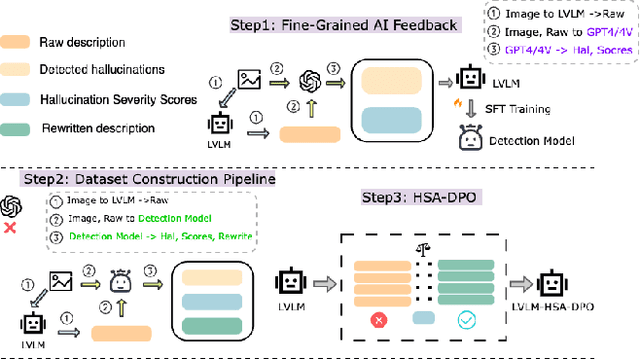
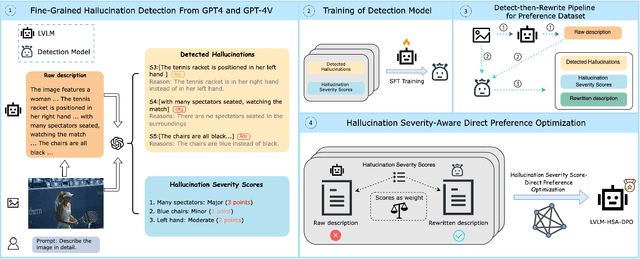
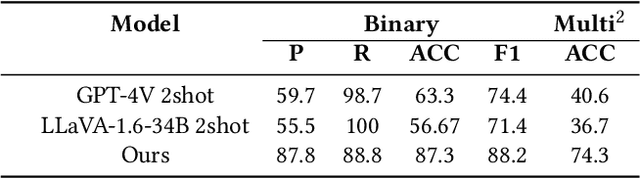
The rapidly developing Large Vision Language Models (LVLMs) have shown notable capabilities on a range of multi-modal tasks, but still face the hallucination phenomena where the generated texts do not align with the given contexts, significantly restricting the usages of LVLMs. Most previous work detects and mitigates hallucination at the coarse-grained level or requires expensive annotation (e.g., labeling by proprietary models or human experts). To address these issues, we propose detecting and mitigating hallucinations in LVLMs via fine-grained AI feedback. The basic idea is that we generate a small-size sentence-level hallucination annotation dataset by proprietary models, whereby we train a hallucination detection model which can perform sentence-level hallucination detection, covering primary hallucination types (i.e., object, attribute, and relationship). Then, we propose a detect-then-rewrite pipeline to automatically construct preference dataset for training hallucination mitigating model. Furthermore, we propose differentiating the severity of hallucinations, and introducing a Hallucination Severity-Aware Direct Preference Optimization (HSA-DPO) for mitigating hallucination in LVLMs by incorporating the severity of hallucinations into preference learning. Extensive experiments demonstrate the effectiveness of our method.
MergeNet: Knowledge Migration across Heterogeneous Models, Tasks, and Modalities
Apr 20, 2024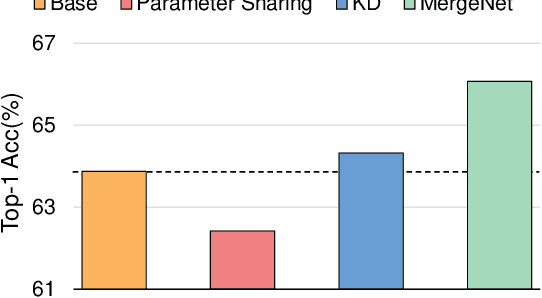
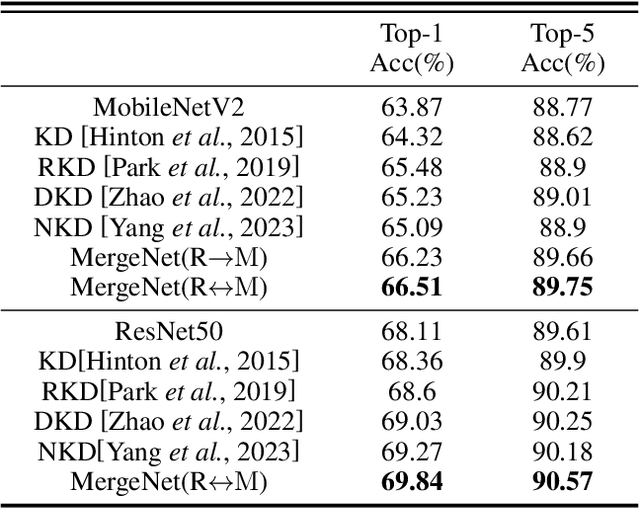
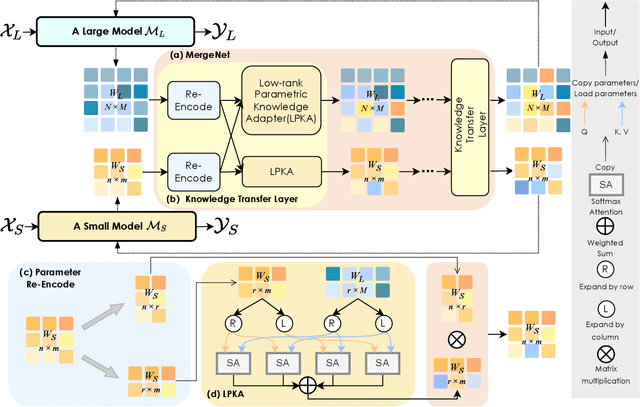
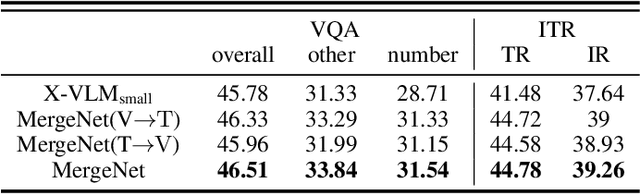
In this study, we focus on heterogeneous knowledge transfer across entirely different model architectures, tasks, and modalities. Existing knowledge transfer methods (e.g., backbone sharing, knowledge distillation) often hinge on shared elements within model structures or task-specific features/labels, limiting transfers to complex model types or tasks. To overcome these challenges, we present MergeNet, which learns to bridge the gap of parameter spaces of heterogeneous models, facilitating the direct interaction, extraction, and application of knowledge within these parameter spaces. The core mechanism of MergeNet lies in the parameter adapter, which operates by querying the source model's low-rank parameters and adeptly learning to identify and map parameters into the target model. MergeNet is learned alongside both models, allowing our framework to dynamically transfer and adapt knowledge relevant to the current stage, including the training trajectory knowledge of the source model. Extensive experiments on heterogeneous knowledge transfer demonstrate significant improvements in challenging settings, where representative approaches may falter or prove less applicable.
An Expert is Worth One Token: Synergizing Multiple Expert LLMs as Generalist via Expert Token Routing
Mar 25, 2024


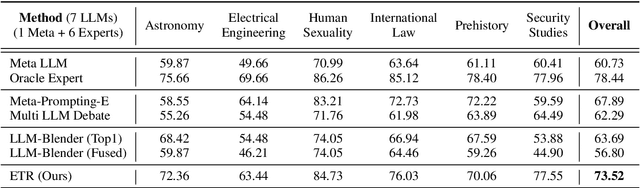
We present Expert-Token-Routing, a unified generalist framework that facilitates seamless integration of multiple expert LLMs. Our framework represents expert LLMs as special expert tokens within the vocabulary of a meta LLM. The meta LLM can route to an expert LLM like generating new tokens. Expert-Token-Routing not only supports learning the implicit expertise of expert LLMs from existing instruction dataset but also allows for dynamic extension of new expert LLMs in a plug-and-play manner. It also conceals the detailed collaboration process from the user's perspective, facilitating interaction as though it were a singular LLM. Our framework outperforms various existing multi-LLM collaboration paradigms across benchmarks that incorporate six diverse expert domains, demonstrating effectiveness and robustness in building generalist LLM system via synergizing multiple expert LLMs.
Contrastive Balancing Representation Learning for Heterogeneous Dose-Response Curves Estimation
Mar 21, 2024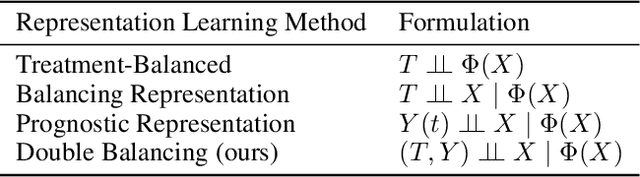
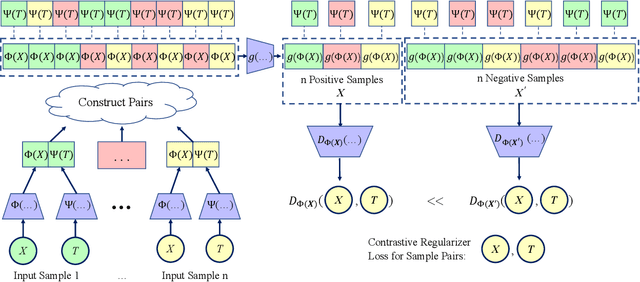
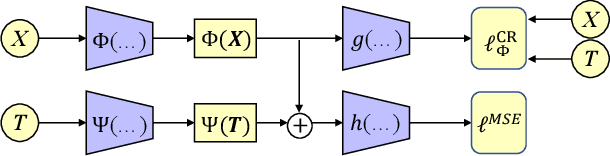
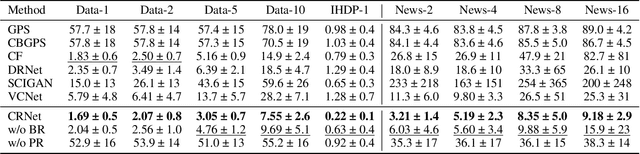
Estimating the individuals' potential response to varying treatment doses is crucial for decision-making in areas such as precision medicine and management science. Most recent studies predict counterfactual outcomes by learning a covariate representation that is independent of the treatment variable. However, such independence constraints neglect much of the covariate information that is useful for counterfactual prediction, especially when the treatment variables are continuous. To tackle the above issue, in this paper, we first theoretically demonstrate the importance of the balancing and prognostic representations for unbiased estimation of the heterogeneous dose-response curves, that is, the learned representations are constrained to satisfy the conditional independence between the covariates and both of the treatment variables and the potential responses. Based on this, we propose a novel Contrastive balancing Representation learning Network using a partial distance measure, called CRNet, for estimating the heterogeneous dose-response curves without losing the continuity of treatments. Extensive experiments are conducted on synthetic and real-world datasets demonstrating that our proposal significantly outperforms previous methods.
AuG-KD: Anchor-Based Mixup Generation for Out-of-Domain Knowledge Distillation
Mar 18, 2024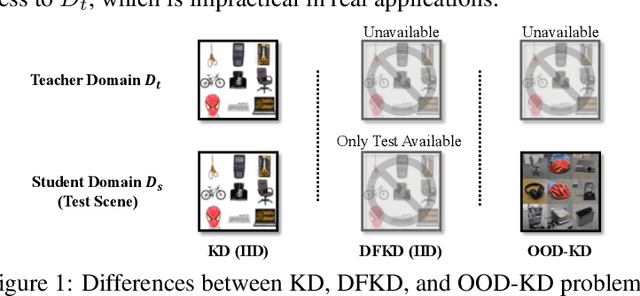
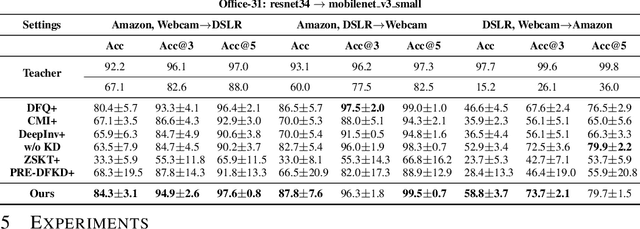
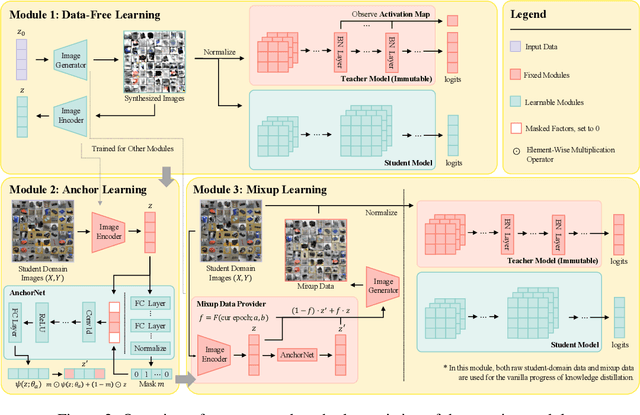
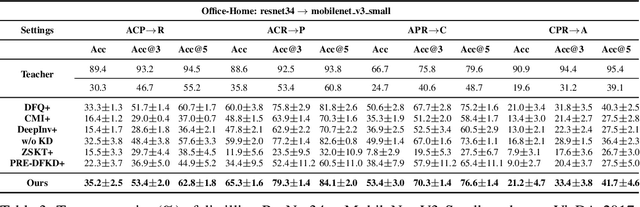
Due to privacy or patent concerns, a growing number of large models are released without granting access to their training data, making transferring their knowledge inefficient and problematic. In response, Data-Free Knowledge Distillation (DFKD) methods have emerged as direct solutions. However, simply adopting models derived from DFKD for real-world applications suffers significant performance degradation, due to the discrepancy between teachers' training data and real-world scenarios (student domain). The degradation stems from the portions of teachers' knowledge that are not applicable to the student domain. They are specific to the teacher domain and would undermine students' performance. Hence, selectively transferring teachers' appropriate knowledge becomes the primary challenge in DFKD. In this work, we propose a simple but effective method AuG-KD. It utilizes an uncertainty-guided and sample-specific anchor to align student-domain data with the teacher domain and leverages a generative method to progressively trade off the learning process between OOD knowledge distillation and domain-specific information learning via mixup learning. Extensive experiments in 3 datasets and 8 settings demonstrate the stability and superiority of our approach. Code available at https://github.com/IshiKura-a/AuG-KD .
From Graph to Word Bag: Introducing Domain Knowledge to Confusing Charge Prediction
Mar 14, 2024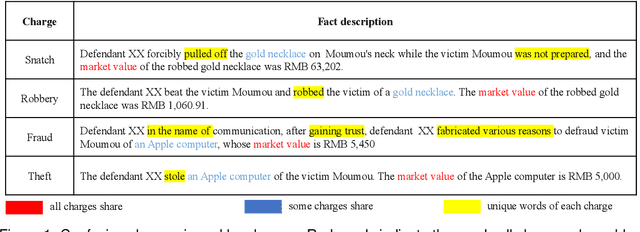

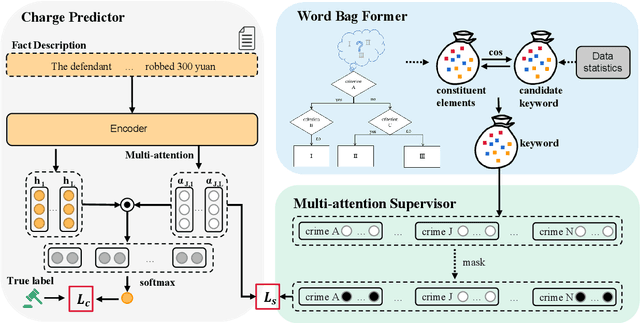

Confusing charge prediction is a challenging task in legal AI, which involves predicting confusing charges based on fact descriptions. While existing charge prediction methods have shown impressive performance, they face significant challenges when dealing with confusing charges, such as Snatch and Robbery. In the legal domain, constituent elements play a pivotal role in distinguishing confusing charges. Constituent elements are fundamental behaviors underlying criminal punishment and have subtle distinctions among charges. In this paper, we introduce a novel From Graph to Word Bag (FWGB) approach, which introduces domain knowledge regarding constituent elements to guide the model in making judgments on confusing charges, much like a judge's reasoning process. Specifically, we first construct a legal knowledge graph containing constituent elements to help select keywords for each charge, forming a word bag. Subsequently, to guide the model's attention towards the differentiating information for each charge within the context, we expand the attention mechanism and introduce a new loss function with attention supervision through words in the word bag. We construct the confusing charges dataset from real-world judicial documents. Experiments demonstrate the effectiveness of our method, especially in maintaining exceptional performance in imbalanced label distributions.