 Add to Chrome
 Add to Firefox
 Add to Edge
Fast Iterative Region Inflation for Computing Large 2-D/3-D Convex Regions of Obstacle-Free Space
Mar 05, 2024
1) Restrictive Inflation is designed to ensure the managibility of the generated convex polytope. Based on its characteristic of few variables but rich constraints, an efficient and numerically stable solver is designed. 2) A novel method that formulates the MVIE problem into SOCP formulation is proposed, which avoids directly confronting the positive definite constraints and improves the computational efficiency. 3) Especially for 2-D MVIE, a linear-time exact algorithm is introduced for the first time, filling a gap that existed for several decades and further enabling ultra-fast computational performance. 4) Building upon the above methods, a reliable convex polytope generation algorithm FIRI is proposed. Extensive experiments verify its superior comprehensive performance in terms of quality, efficiency, and managibility. High-performance implementation of FIRI will be open-sourced for the reference of the community.

Skater: A Novel Bi-modal Bi-copter Robot for Adaptive Locomotion in Air and Diverse Terrain
Mar 04, 2024


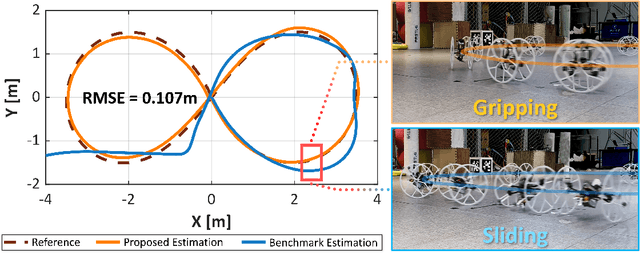
In this letter, we present a novel bi-modal bi-copter robot called Skater, which is adaptable to air and various ground surfaces. Skater consists of a bi-copter moving along its longitudinal direction with two passive wheels on both sides. Using longitudinally arranged bi-copter as the unified actuation system for both aerial and ground modes, this robot not only keeps concise and lightweight mechanism, but also possesses exceptional terrain traversing capability and strong steering capacity. Moreover, leveraging the vectored thrust characteristic of bi-copters, Skater can actively generate the centripetal force needed for steering, enabling it to achieve stable movement even on slippery surfaces. Furthermore, we model the comprehensive dynamics of Skater, analyze its differential flatness and introduce a controller using nonlinear model predictive control for trajectory tracking. The outstanding performance of the system is verified by extensive real-world experiments and benchmark comparisons.
Model-Based Planning and Control for Terrestrial-Aerial Bimodal Vehicles with Passive Wheels
Mar 01, 2024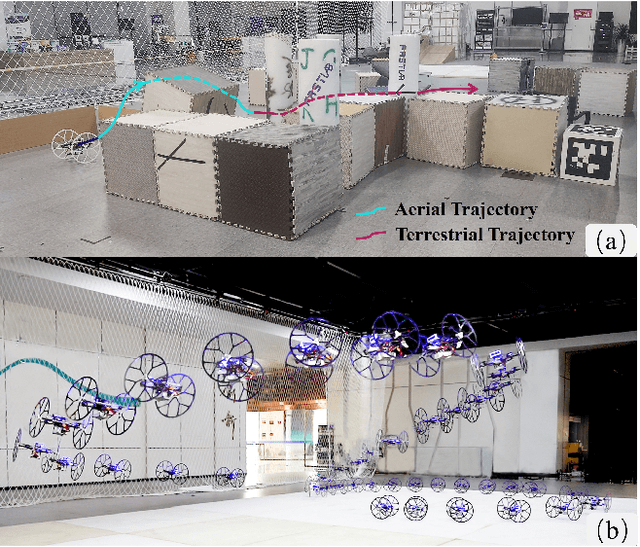
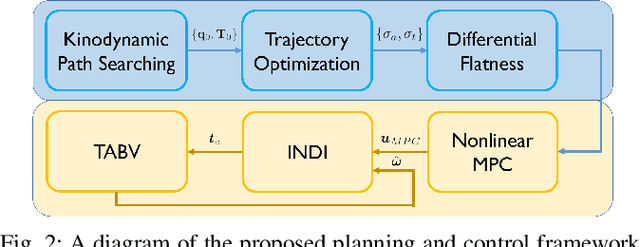
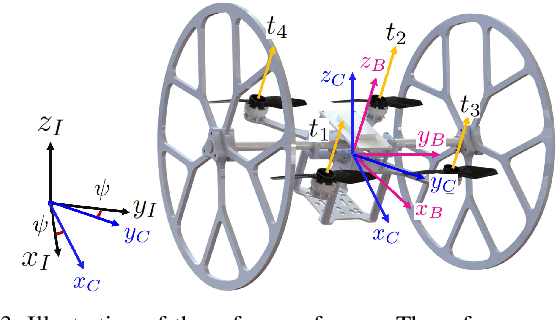
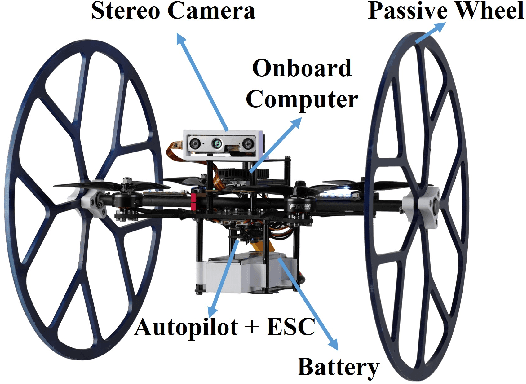
Terrestrial and aerial bimodal vehicles have gained widespread attention due to their cross-domain maneuverability. Nevertheless, their bimodal dynamics significantly increase the complexity of motion planning and control, thus hindering robust and efficient autonomous navigation in unknown environments. To resolve this issue, we develop a model-based planning and control framework for terrestrial aerial bi-modal vehicles. This work begins by deriving a unified dynamic model and the corresponding differential flatness. Leveraging differential flatness, an optimization-based trajectory planner is proposed, which takes into account both solution quality and computational efficiency. Moreover, we design a tracking controller using nonlinear model predictive control based on the proposed unified dynamic model to achieve accurate trajectory tracking and smooth mode transition. We validate our framework through extensive benchmark comparisons and experiments, demonstrating its effectiveness in terms of planning quality and control performance.
Star-Searcher: A Complete and Efficient Aerial System for Autonomous Target Search in Complex Unknown Environments
Feb 26, 2024This paper tackles the challenge of autonomous target search using unmanned aerial vehicles (UAVs) in complex unknown environments. To fill the gap in systematic approaches for this task, we introduce Star-Searcher, an aerial system featuring specialized sensor suites, mapping, and planning modules to optimize searching. Path planning challenges due to increased inspection requirements are addressed through a hierarchical planner with a visibility-based viewpoint clustering method. This simplifies planning by breaking it into global and local sub-problems, ensuring efficient global and local path coverage in real-time. Furthermore, our global path planning employs a history-aware mechanism to reduce motion inconsistency from frequent map changes, significantly enhancing search efficiency. We conduct comparisons with state-of-the-art methods in both simulation and the real world, demonstrating shorter flight paths, reduced time, and higher target search completeness. Our approach will be open-sourced for community benefit at https://github.com/SYSU-STAR/STAR-Searcher.
Certifiable Mutual Localization and Trajectory Planning for Bearing-Based Robot Swarm
Jan 15, 2024Bearing measurements,as the most common modality in nature, have recently gained traction in multi-robot systems to enhance mutual localization and swarm collaboration. Despite their advantages, challenges such as sensory noise, obstacle occlusion, and uncoordinated swarm motion persist in real-world scenarios, potentially leading to erroneous state estimation and undermining the system's flexibility, practicality, and robustness.In response to these challenges, in this paper we address theoretical and practical problem related to both mutual localization and swarm planning.Firstly, we propose a certifiable mutual localization algorithm.It features a concise problem formulation coupled with lossless convex relaxation, enabling independence from initial values and globally optimal relative pose recovery.Then, to explore how detection noise and swarm motion influence estimation optimality, we conduct a comprehensive analysis on the interplay between robots' mutual spatial relationship and mutual localization. We develop a differentiable metric correlated with swarm trajectories to explicitly evaluate the noise resistance of optimal estimation.By establishing a finite and pre-computable threshold for this metric and accordingly generating swarm trajectories, the estimation optimality can be strictly guaranteed under arbitrary noise. Based on these findings, an optimization-based swarm planner is proposed to generate safe and smooth trajectories, with consideration of both inter-robot visibility and estimation optimality.Through numerical simulations, we evaluate the optimality and certifiablity of our estimator, and underscore the significance of our planner in enhancing estimation performance.The results exhibit considerable potential of our methods to pave the way for advanced closed-loop intelligence in swarm systems.
Adaptive Tracking and Perching for Quadrotor in Dynamic Scenarios
Dec 19, 2023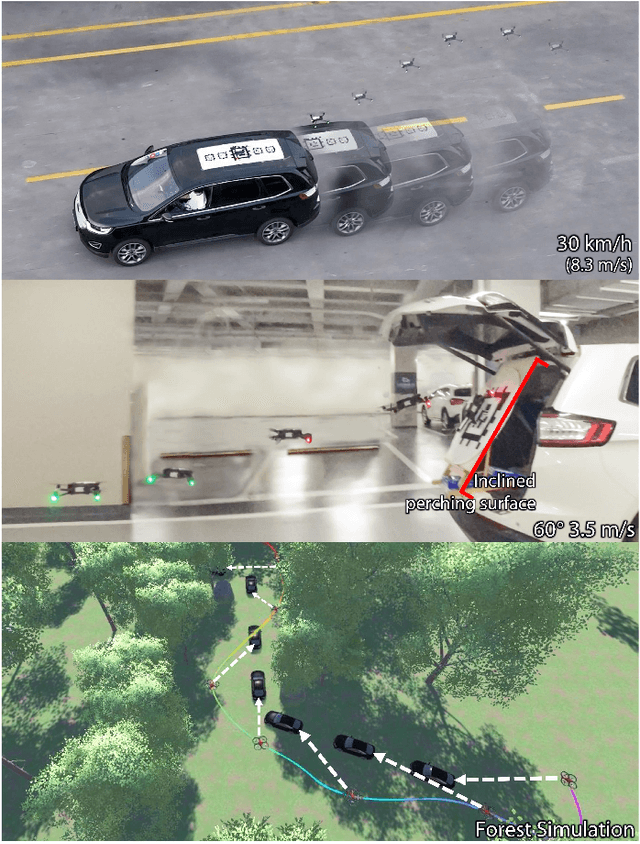
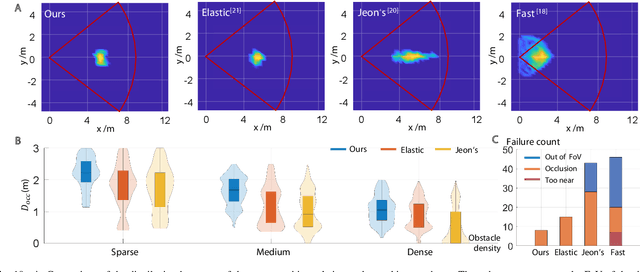

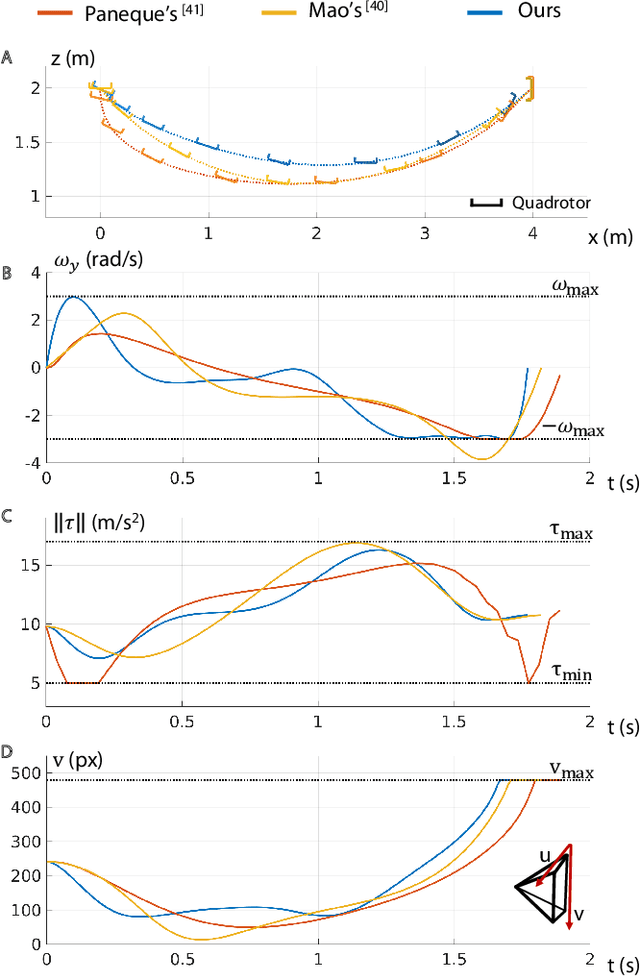
Perching on the moving platforms is a promising solution to enhance the endurance and operational range of quadrotors, which could benefit the efficiency of a variety of air-ground cooperative tasks. To ensure robust perching, tracking with a steady relative state and reliable perception is a prerequisite. This paper presents an adaptive dynamic tracking and perching scheme for autonomous quadrotors to achieve tight integration with moving platforms. For reliable perception of dynamic targets, we introduce elastic visibility-aware planning to actively avoid occlusion and target loss. Additionally, we propose a flexible terminal adjustment method that adapts the changes in flight duration and the coupled terminal states, ensuring full-state synchronization with the time-varying perching surface at various angles. A relaxation strategy is developed by optimizing the tangential relative speed to address the dynamics and safety violations brought by hard boundary conditions. Moreover, we take SE(3) motion planning into account to ensure no collision between the quadrotor and the platform until the contact moment. Furthermore, we propose an efficient spatiotemporal trajectory optimization framework considering full state dynamics for tracking and perching. The proposed method is extensively tested through benchmark comparisons and ablation studies. To facilitate the application of academic research to industry and to validate the efficiency of our scheme under strictly limited computational resources, we deploy our system on a commercial drone (DJI-MAVIC3) with a full-size sport-utility vehicle (SUV). We conduct extensive real-world experiments, where the drone successfully tracks and perches at 30~km/h (8.3~m/s) on the top of the SUV, and at 3.5~m/s with 60{\deg} inclined into the trunk of the SUV.
Edge Accelerated Robot Navigation with Hierarchical Motion Planning
Nov 15, 2023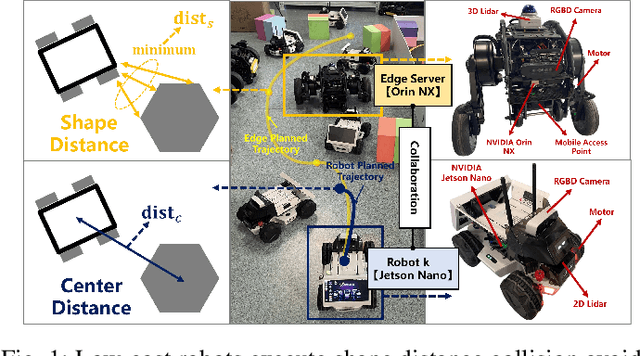
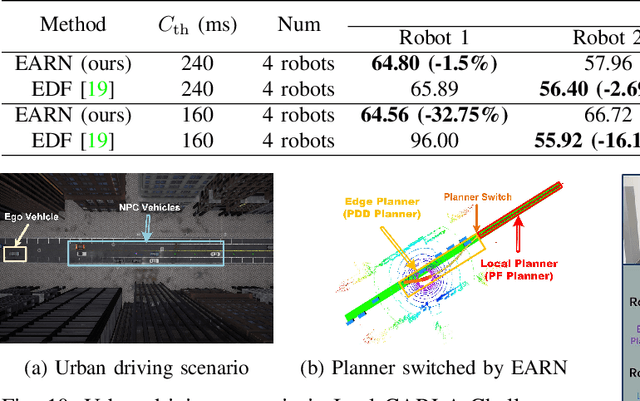
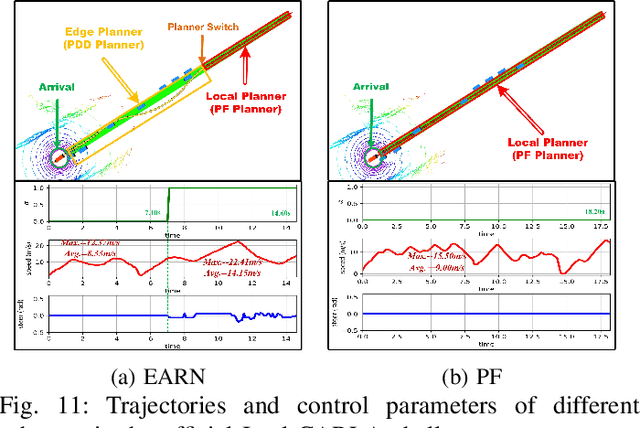
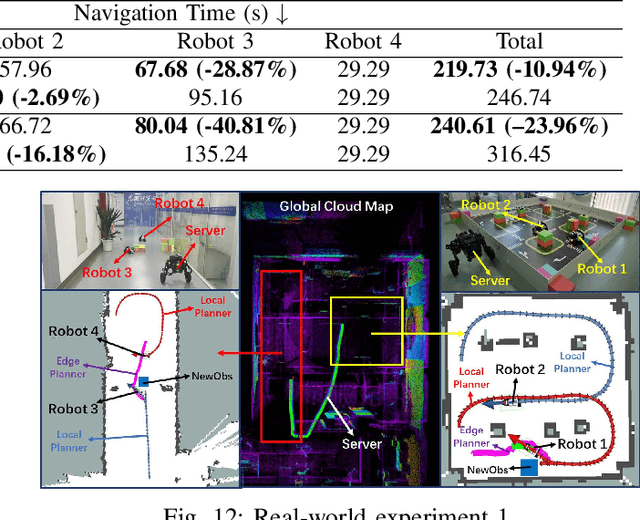
Low-cost autonomous robots suffer from limited onboard computing power, resulting in excessive computation time when navigating in cluttered environments. This paper presents Edge Accelerated Robot Navigation, or EARN for short, to achieve real-time collision avoidance by adopting hierarchical motion planning (HMP). In contrast to existing local or edge motion planning solutions that ignore the interdependency between low-level motion planning and high-level resource allocation, EARN adopts model predictive switching (MPS) that maximizes the expected switching gain w.r.t. robot states and actions under computation and communication resource constraints. As such, each robot can dynamically switch between a point-mass motion planner executed locally to guarantee safety (e.g., path-following) and a full-shape motion planner executed non-locally to guarantee efficiency (e.g., overtaking). The crux to EARN is a two-time scale integrated decision-planning algorithm based on bilevel mixed-integer optimization, and a fast conditional collision avoidance algorithm based on penalty dual decomposition. We validate the performance of EARN in indoor simulation, outdoor simulation, and real-world environments. Experiments show that EARN achieves significantly smaller navigation time and collision ratios than state-of-the-art navigation approaches.
Collaborative Planning for Catching and Transporting Objects in Unstructured Environments
Nov 13, 2023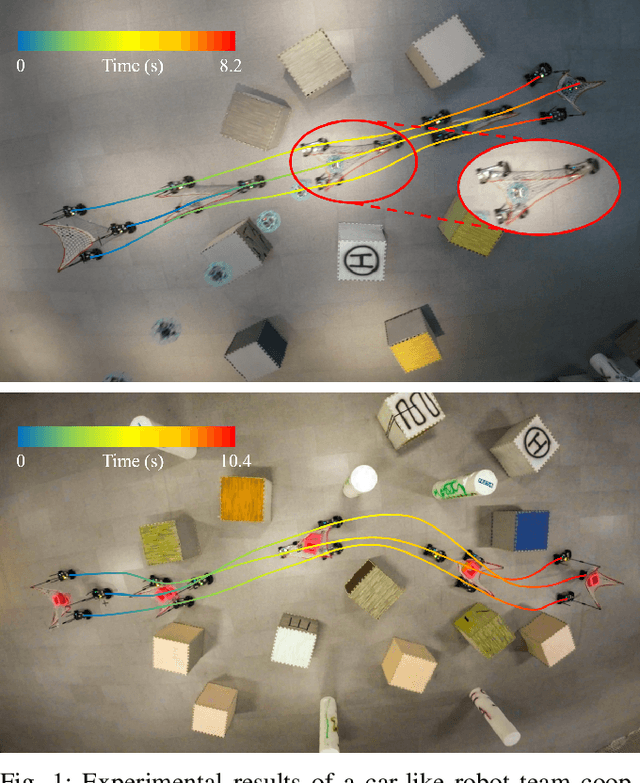
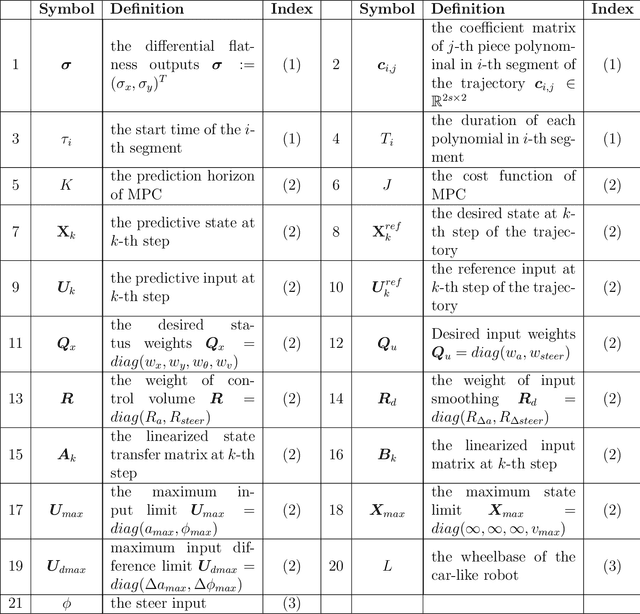
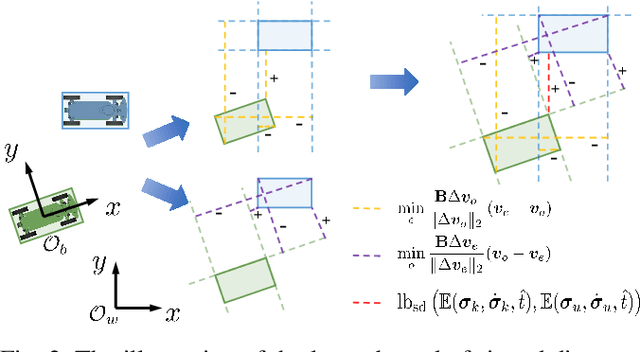
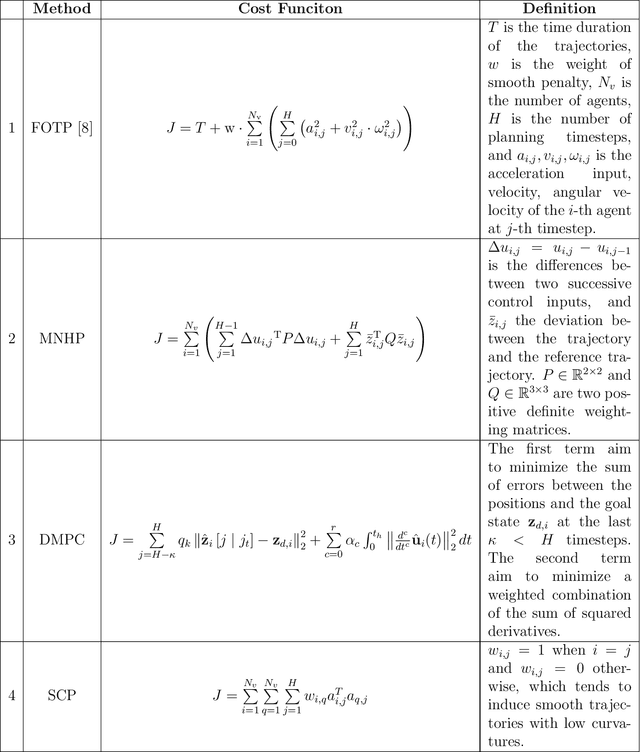
Multi-robot teams have attracted attention from industry and academia for their ability to perform collaborative tasks in unstructured environments, such as wilderness rescue and collaborative transportation.In this paper, we propose a trajectory planning method for a non-holonomic robotic team with collaboration in unstructured environments.For the adaptive state collaboration of a robot team to catch and transport targets to be rescued using a net, we model the process of catching the falling target with a net in a continuous and differentiable form.This enables the robot team to fully exploit the kinematic potential, thereby adaptively catching the target in an appropriate state.Furthermore, the size safety and topological safety of the net, resulting from the collaborative support of the robots, are guaranteed through geometric constraints.We integrate our algorithm on a car-like robot team and test it in simulations and real-world experiments to validate our performance.Our method is compared to state-of-the-art multi-vehicle trajectory planning methods, demonstrating significant performance in efficiency and trajectory quality.
Simultaneous Time Synchronization and Mutual Localization for Multi-robot System
Nov 06, 2023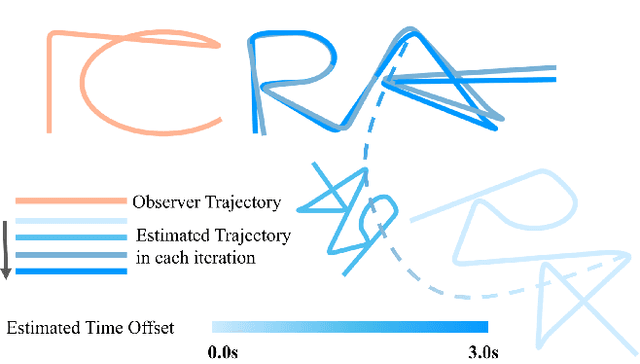
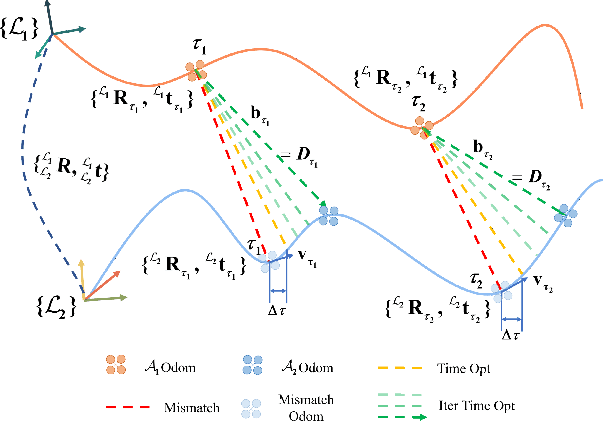
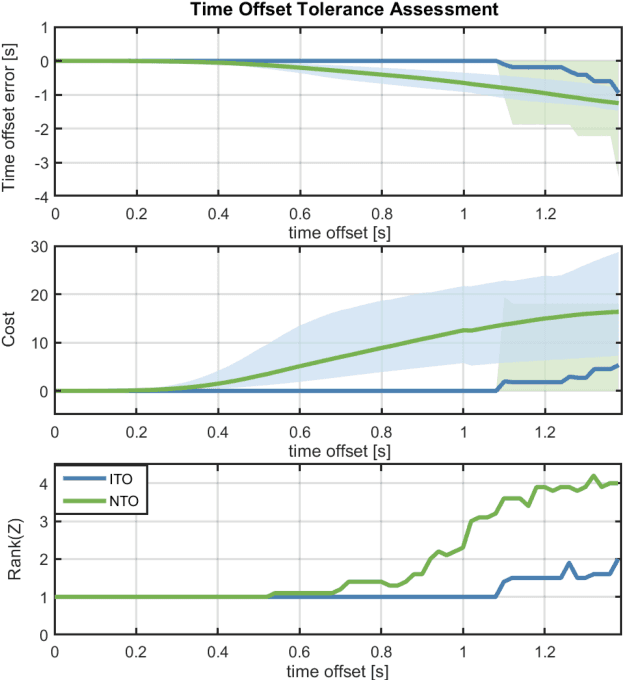
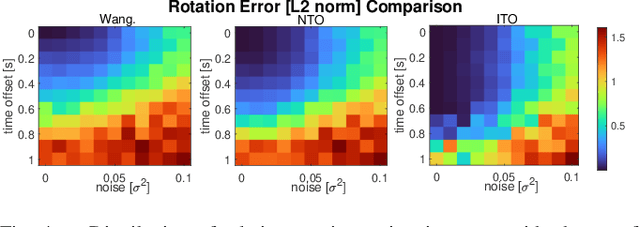
Mutual localization stands as a foundational component within various domains of multi-robot systems. Nevertheless, in relative pose estimation, time synchronization is usually underappreciated and rarely addressed, although it significantly influences estimation accuracy. In this paper, we introduce time synchronization into mutual localization to recover the time offset and relative poses between robots simultaneously. Under a constant velocity assumption in a short time, we fuse time offset estimation with our previous bearing-based mutual localization by a novel error representation. Based on the error model, we formulate a joint optimization problem and utilize semi-definite relaxation (SDR) to furnish a lossless relaxation. By solving the relaxed problem, time synchronization and relative pose estimation can be achieved when time drift between robots is limited. To enhance the application range of time offset estimation, we further propose an iterative method to recover the time offset from coarse to fine. Comparisons between the proposed method and the existing ones through extensive simulation tests present prominent benefits of time synchronization on mutual localization. Moreover, real-world experiments are conducted to show the practicality and robustness.
AutoTrans: A Complete Planning and Control Framework for Autonomous UAV Payload Transportation
Oct 23, 2023The robotics community is increasingly interested in autonomous aerial transportation. Unmanned aerial vehicles with suspended payloads have advantages over other systems, including mechanical simplicity and agility, but pose great challenges in planning and control. To realize fully autonomous aerial transportation, this paper presents a systematic solution to address these difficulties. First, we present a real-time planning method that generates smooth trajectories considering the time-varying shape and non-linear dynamics of the system, ensuring whole-body safety and dynamic feasibility. Additionally, an adaptive NMPC with a hierarchical disturbance compensation strategy is designed to overcome unknown external perturbations and inaccurate model parameters. Extensive experiments show that our method is capable of generating high-quality trajectories online, even in highly constrained environments, and tracking aggressive flight trajectories accurately, even under significant uncertainty. We plan to release our code to benefit the community.