 Add to Chrome
 Add to Firefox
 Add to Edge
DMT: Comprehensive Distillation with Multiple Self-supervised Teachers
Dec 19, 2023
Numerous self-supervised learning paradigms, such as contrastive learning and masked image modeling, have been proposed to acquire powerful and general representations from unlabeled data. However, these models are commonly pretrained within their specific framework alone, failing to consider the complementary nature of visual representations. To tackle this issue, we introduce Comprehensive Distillation with Multiple Self-supervised Teachers (DMT) for pretrained model compression, which leverages the strengths of multiple off-the-shelf self-supervised models. Our experimental results on prominent benchmark datasets exhibit that the proposed method significantly surpasses state-of-the-art competitors while retaining favorable efficiency metrics. On classification tasks, our DMT framework utilizing three different self-supervised ViT-Base teachers enhances the performance of both small/tiny models and the base model itself. For dense tasks, DMT elevates the AP/mIoU of standard SSL models on MS-COCO and ADE20K datasets by 4.0%.

CL2CM: Improving Cross-Lingual Cross-Modal Retrieval via Cross-Lingual Knowledge Transfer
Dec 14, 2023
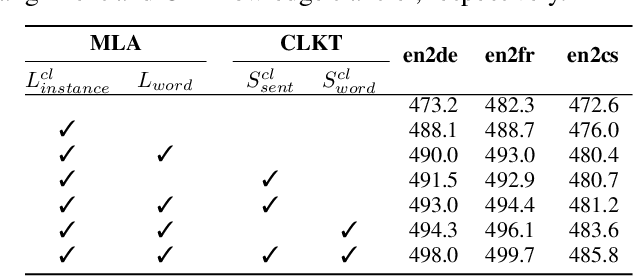
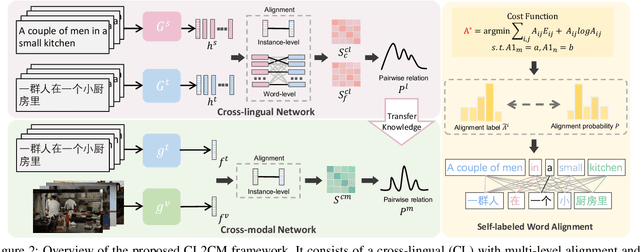
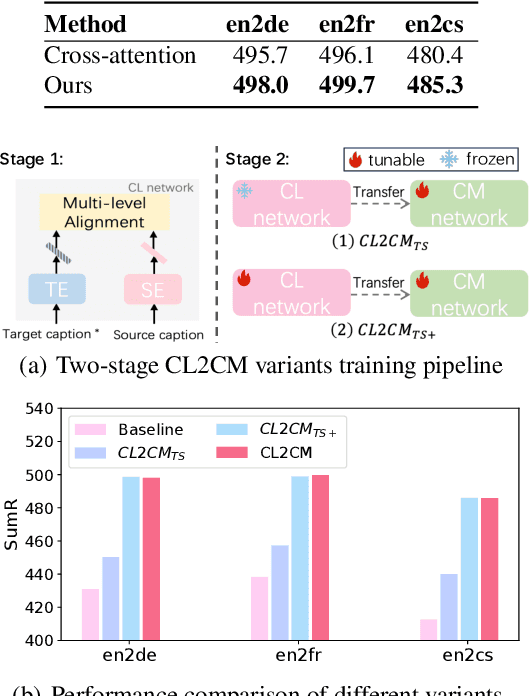
Cross-lingual cross-modal retrieval has garnered increasing attention recently, which aims to achieve the alignment between vision and target language (V-T) without using any annotated V-T data pairs. Current methods employ machine translation (MT) to construct pseudo-parallel data pairs, which are then used to learn a multi-lingual and multi-modal embedding space that aligns visual and target-language representations. However, the large heterogeneous gap between vision and text, along with the noise present in target language translations, poses significant challenges in effectively aligning their representations. To address these challenges, we propose a general framework, Cross-Lingual to Cross-Modal (CL2CM), which improves the alignment between vision and target language using cross-lingual transfer. This approach allows us to fully leverage the merits of multi-lingual pre-trained models (e.g., mBERT) and the benefits of the same modality structure, i.e., smaller gap, to provide reliable and comprehensive semantic correspondence (knowledge) for the cross-modal network. We evaluate our proposed approach on two multilingual image-text datasets, Multi30K and MSCOCO, and one video-text dataset, VATEX. The results clearly demonstrate the effectiveness of our proposed method and its high potential for large-scale retrieval.
Towards a Psychological Generalist AI: A Survey of Current Applications of Large Language Models and Future Prospects
Dec 01, 2023The complexity of psychological principles underscore a significant societal challenge, given the vast social implications of psychological problems. Bridging the gap between understanding these principles and their actual clinical and real-world applications demands rigorous exploration and adept implementation. In recent times, the swift advancement of highly adaptive and reusable artificial intelligence (AI) models has emerged as a promising way to unlock unprecedented capabilities in the realm of psychology. This paper emphasizes the importance of performance validation for these large-scale AI models, emphasizing the need to offer a comprehensive assessment of their verification from diverse perspectives. Moreover, we review the cutting-edge advancements and practical implementations of these expansive models in psychology, highlighting pivotal work spanning areas such as social media analytics, clinical nursing insights, vigilant community monitoring, and the nuanced exploration of psychological theories. Based on our review, we project an acceleration in the progress of psychological fields, driven by these large-scale AI models. These future generalist AI models harbor the potential to substantially curtail labor costs and alleviate social stress. However, this forward momentum will not be without its set of challenges, especially when considering the paradigm changes and upgrades required for medical instrumentation and related applications.
Language-guided Few-shot Semantic Segmentation
Nov 23, 2023Few-shot learning is a promising way for reducing the label cost in new categories adaptation with the guidance of a small, well labeled support set. But for few-shot semantic segmentation, the pixel-level annotations of support images are still expensive. In this paper, we propose an innovative solution to tackle the challenge of few-shot semantic segmentation using only language information, i.e.image-level text labels. Our approach involves a vision-language-driven mask distillation scheme, which contains a vision-language pretraining (VLP) model and a mask refiner, to generate high quality pseudo-semantic masks from text prompts. We additionally introduce a distributed prototype supervision method and complementary correlation matching module to guide the model in digging precise semantic relations among support and query images. The experiments on two benchmark datasets demonstrate that our method establishes a new baseline for language-guided few-shot semantic segmentation and achieves competitive results to recent vision-guided methods.
OmniSeg3D: Omniversal 3D Segmentation via Hierarchical Contrastive Learning
Nov 20, 2023


Towards holistic understanding of 3D scenes, a general 3D segmentation method is needed that can segment diverse objects without restrictions on object quantity or categories, while also reflecting the inherent hierarchical structure. To achieve this, we propose OmniSeg3D, an omniversal segmentation method aims for segmenting anything in 3D all at once. The key insight is to lift multi-view inconsistent 2D segmentations into a consistent 3D feature field through a hierarchical contrastive learning framework, which is accomplished by two steps. Firstly, we design a novel hierarchical representation based on category-agnostic 2D segmentations to model the multi-level relationship among pixels. Secondly, image features rendered from the 3D feature field are clustered at different levels, which can be further drawn closer or pushed apart according to the hierarchical relationship between different levels. In tackling the challenges posed by inconsistent 2D segmentations, this framework yields a global consistent 3D feature field, which further enables hierarchical segmentation, multi-object selection, and global discretization. Extensive experiments demonstrate the effectiveness of our method on high-quality 3D segmentation and accurate hierarchical structure understanding. A graphical user interface further facilitates flexible interaction for omniversal 3D segmentation.
Data Pruning via Moving-one-Sample-out
Oct 25, 2023In this paper, we propose a novel data-pruning approach called moving-one-sample-out (MoSo), which aims to identify and remove the least informative samples from the training set. The core insight behind MoSo is to determine the importance of each sample by assessing its impact on the optimal empirical risk. This is achieved by measuring the extent to which the empirical risk changes when a particular sample is excluded from the training set. Instead of using the computationally expensive leaving-one-out-retraining procedure, we propose an efficient first-order approximator that only requires gradient information from different training stages. The key idea behind our approximation is that samples with gradients that are consistently aligned with the average gradient of the training set are more informative and should receive higher scores, which could be intuitively understood as follows: if the gradient from a specific sample is consistent with the average gradient vector, it implies that optimizing the network using the sample will yield a similar effect on all remaining samples. Experimental results demonstrate that MoSo effectively mitigates severe performance degradation at high pruning ratios and achieves satisfactory performance across various settings.
Pre-Training on Large-Scale Generated Docking Conformations with HelixDock to Unlock the Potential of Protein-ligand Structure Prediction Models
Oct 21, 2023Molecular docking, a pivotal computational tool for drug discovery, predicts the binding interactions between small molecules (ligands) and target proteins (receptors). Conventional physics-based docking tools, though widely used, face limitations in precision due to restricted conformational sampling and imprecise scoring functions. Recent endeavors have employed deep learning techniques to enhance docking accuracy, but their generalization remains a concern due to limited training data. Leveraging the success of extensive and diverse data in other domains, we introduce HelixDock, a novel approach for site-specific molecular docking. Hundreds of millions of binding poses are generated by traditional docking tools, encompassing diverse protein targets and small molecules. Our deep learning-based docking model, a SE(3)-equivariant network, is pre-trained with this large-scale dataset and then fine-tuned with a small number of precise receptor-ligand complex structures. Comparative analyses against physics-based and deep learning-based baseline methods highlight HelixDock's superiority, especially on challenging test sets. Our study elucidates the scaling laws of the pre-trained molecular docking models, showcasing consistent improvements with increased model parameters and pre-train data quantities. Harnessing the power of extensive and diverse generated data holds promise for advancing AI-driven drug discovery.
SingleInsert: Inserting New Concepts from a Single Image into Text-to-Image Models for Flexible Editing
Oct 12, 2023Recent progress in text-to-image (T2I) models enables high-quality image generation with flexible textual control. To utilize the abundant visual priors in the off-the-shelf T2I models, a series of methods try to invert an image to proper embedding that aligns with the semantic space of the T2I model. However, these image-to-text (I2T) inversion methods typically need multiple source images containing the same concept or struggle with the imbalance between editing flexibility and visual fidelity. In this work, we point out that the critical problem lies in the foreground-background entanglement when learning an intended concept, and propose a simple and effective baseline for single-image I2T inversion, named SingleInsert. SingleInsert adopts a two-stage scheme. In the first stage, we regulate the learned embedding to concentrate on the foreground area without being associated with the irrelevant background. In the second stage, we finetune the T2I model for better visual resemblance and devise a semantic loss to prevent the language drift problem. With the proposed techniques, SingleInsert excels in single concept generation with high visual fidelity while allowing flexible editing. Additionally, SingleInsert can perform single-image novel view synthesis and multiple concepts composition without requiring joint training. To facilitate evaluation, we design an editing prompt list and introduce a metric named Editing Success Rate (ESR) for quantitative assessment of editing flexibility. Our project page is: https://jarrentwu1031.github.io/SingleInsert-web/
SCT: A Simple Baseline for Parameter-Efficient Fine-Tuning via Salient Channels
Sep 18, 2023

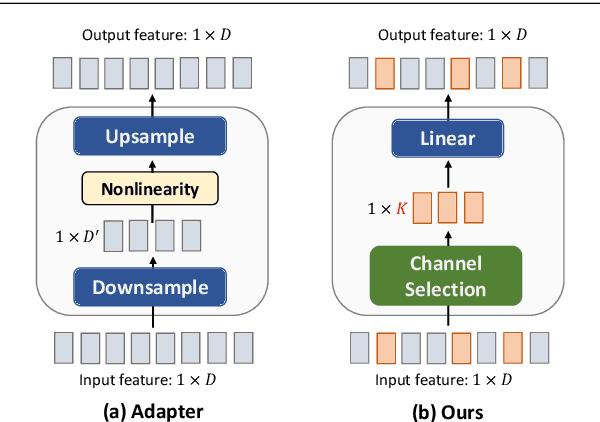

Pre-trained vision transformers have strong representation benefits to various downstream tasks. Recently, many parameter-efficient fine-tuning (PEFT) methods have been proposed, and their experiments demonstrate that tuning only 1% of extra parameters could surpass full fine-tuning in low-data resource scenarios. However, these methods overlook the task-specific information when fine-tuning diverse downstream tasks. In this paper, we propose a simple yet effective method called "Salient Channel Tuning" (SCT) to leverage the task-specific information by forwarding the model with the task images to select partial channels in a feature map that enables us to tune only 1/8 channels leading to significantly lower parameter costs. Experiments outperform full fine-tuning on 18 out of 19 tasks in the VTAB-1K benchmark by adding only 0.11M parameters of the ViT-B, which is 780$\times$ fewer than its full fine-tuning counterpart. Furthermore, experiments on domain generalization and few-shot learning surpass other PEFT methods with lower parameter costs, demonstrating our proposed tuning technique's strong capability and effectiveness in the low-data regime.
Viewpoint Integration and Registration with Vision Language Foundation Model for Image Change Understanding
Sep 15, 2023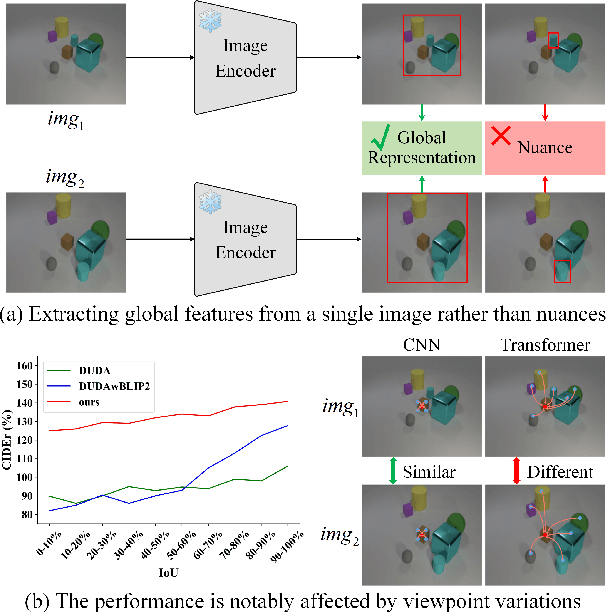
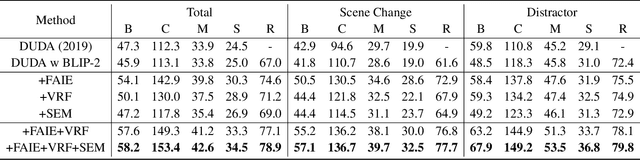

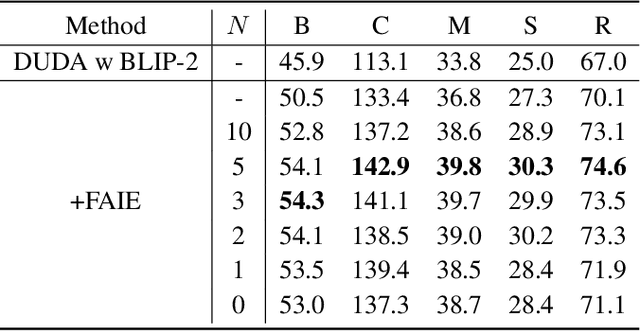
Recently, the development of pre-trained vision language foundation models (VLFMs) has led to remarkable performance in many tasks. However, these models tend to have strong single-image understanding capability but lack the ability to understand multiple images. Therefore, they cannot be directly applied to cope with image change understanding (ICU), which requires models to capture actual changes between multiple images and describe them in language. In this paper, we discover that existing VLFMs perform poorly when applied directly to ICU because of the following problems: (1) VLFMs generally learn the global representation of a single image, while ICU requires capturing nuances between multiple images. (2) The ICU performance of VLFMs is significantly affected by viewpoint variations, which is caused by the altered relationships between objects when viewpoint changes. To address these problems, we propose a Viewpoint Integration and Registration method. Concretely, we introduce a fused adapter image encoder that fine-tunes pre-trained encoders by inserting designed trainable adapters and fused adapters, to effectively capture nuances between image pairs. Additionally, a viewpoint registration flow and a semantic emphasizing module are designed to reduce the performance degradation caused by viewpoint variations in the visual and semantic space, respectively. Experimental results on CLEVR-Change and Spot-the-Diff demonstrate that our method achieves state-of-the-art performance in all metrics.