 Add to Chrome
 Add to Firefox
 Add to Edge
Diffusion Auto-regressive Transformer for Effective Self-supervised Time Series Forecasting
Oct 08, 2024
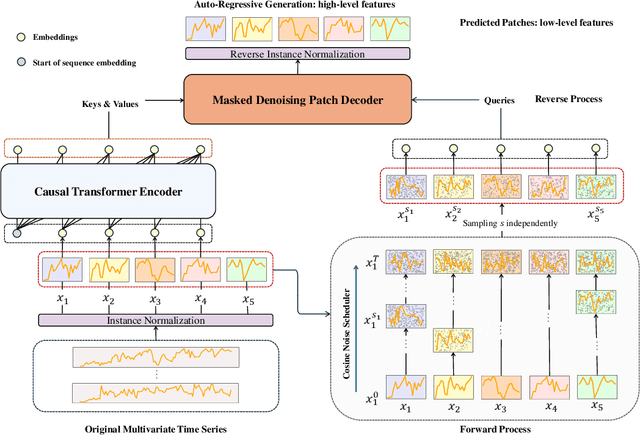


Self-supervised learning has become a popular and effective approach for enhancing time series forecasting, enabling models to learn universal representations from unlabeled data. However, effectively capturing both the global sequence dependence and local detail features within time series data remains challenging. To address this, we propose a novel generative self-supervised method called TimeDART, denoting Diffusion Auto-regressive Transformer for Time series forecasting. In TimeDART, we treat time series patches as basic modeling units. Specifically, we employ an self-attention based Transformer encoder to model the dependencies of inter-patches. Additionally, we introduce diffusion and denoising mechanisms to capture the detail locality features of intra-patch. Notably, we design a cross-attention-based denoising decoder that allows for adjustable optimization difficulty in the self-supervised task, facilitating more effective self-supervised pre-training. Furthermore, the entire model is optimized in an auto-regressive manner to obtain transferable representations. Extensive experiments demonstrate that TimeDART achieves state-of-the-art fine-tuning performance compared to the most advanced competitive methods in forecasting tasks. Our code is publicly available at https://github.com/Melmaphother/TimeDART.

MDAP: A Multi-view Disentangled and Adaptive Preference Learning Framework for Cross-Domain Recommendation
Oct 08, 2024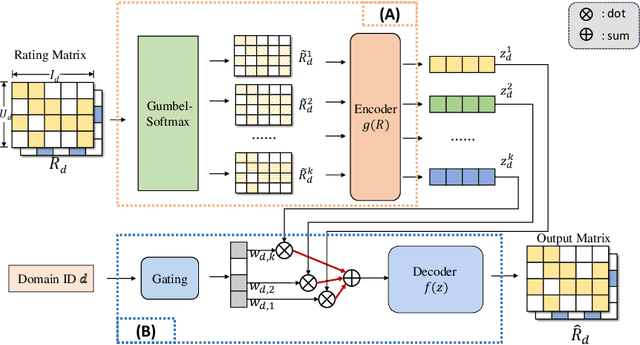
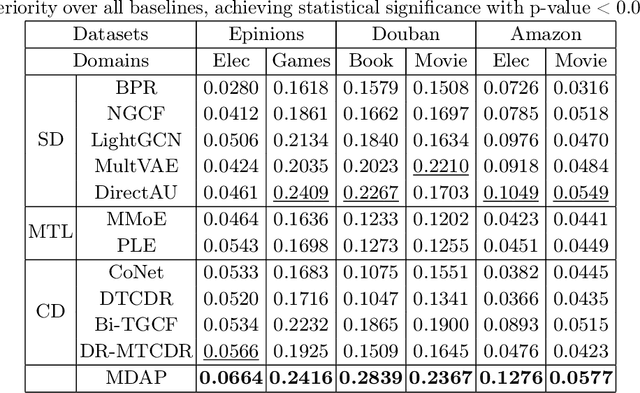
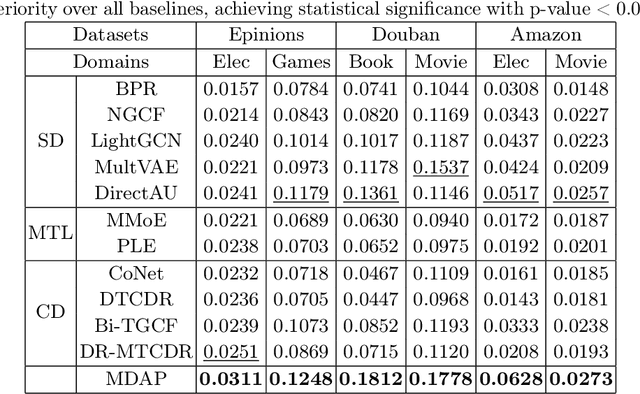
Cross-domain Recommendation systems leverage multi-domain user interactions to improve performance, especially in sparse data or new user scenarios. However, CDR faces challenges such as effectively capturing user preferences and avoiding negative transfer. To address these issues, we propose the Multi-view Disentangled and Adaptive Preference Learning (MDAP) framework. Our MDAP framework uses a multiview encoder to capture diverse user preferences. The framework includes a gated decoder that adaptively combines embeddings from different views to generate a comprehensive user representation. By disentangling representations and allowing adaptive feature selection, our model enhances adaptability and effectiveness. Extensive experiments on benchmark datasets demonstrate that our method significantly outperforms state-of-the-art CDR and single-domain models, providing more accurate recommendations and deeper insights into user behavior across different domains.
ChemEval: A Comprehensive Multi-Level Chemical Evaluation for Large Language Models
Sep 21, 2024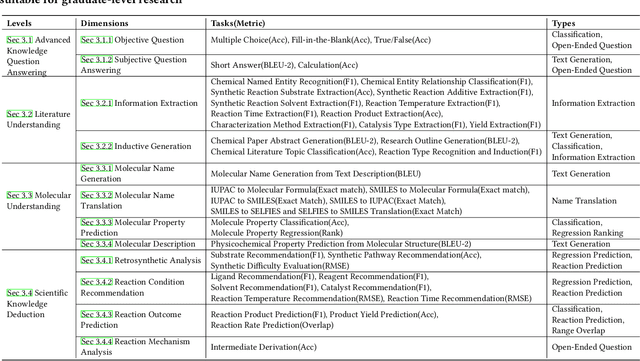


There is a growing interest in the role that LLMs play in chemistry which lead to an increased focus on the development of LLMs benchmarks tailored to chemical domains to assess the performance of LLMs across a spectrum of chemical tasks varying in type and complexity. However, existing benchmarks in this domain fail to adequately meet the specific requirements of chemical research professionals. To this end, we propose \textbf{\textit{ChemEval}}, which provides a comprehensive assessment of the capabilities of LLMs across a wide range of chemical domain tasks. Specifically, ChemEval identified 4 crucial progressive levels in chemistry, assessing 12 dimensions of LLMs across 42 distinct chemical tasks which are informed by open-source data and the data meticulously crafted by chemical experts, ensuring that the tasks have practical value and can effectively evaluate the capabilities of LLMs. In the experiment, we evaluate 12 mainstream LLMs on ChemEval under zero-shot and few-shot learning contexts, which included carefully selected demonstration examples and carefully designed prompts. The results show that while general LLMs like GPT-4 and Claude-3.5 excel in literature understanding and instruction following, they fall short in tasks demanding advanced chemical knowledge. Conversely, specialized LLMs exhibit enhanced chemical competencies, albeit with reduced literary comprehension. This suggests that LLMs have significant potential for enhancement when tackling sophisticated tasks in the field of chemistry. We believe our work will facilitate the exploration of their potential to drive progress in chemistry. Our benchmark and analysis will be available at {\color{blue} \url{https://github.com/USTC-StarTeam/ChemEval}}.
Generating Event-oriented Attribution for Movies via Two-Stage Prefix-Enhanced Multimodal LLM
Sep 14, 2024The prosperity of social media platforms has raised the urgent demand for semantic-rich services, e.g., event and storyline attribution. However, most existing research focuses on clip-level event understanding, primarily through basic captioning tasks, without analyzing the causes of events across an entire movie. This is a significant challenge, as even advanced multimodal large language models (MLLMs) struggle with extensive multimodal information due to limited context length. To address this issue, we propose a Two-Stage Prefix-Enhanced MLLM (TSPE) approach for event attribution, i.e., connecting associated events with their causal semantics, in movie videos. In the local stage, we introduce an interaction-aware prefix that guides the model to focus on the relevant multimodal information within a single clip, briefly summarizing the single event. Correspondingly, in the global stage, we strengthen the connections between associated events using an inferential knowledge graph, and design an event-aware prefix that directs the model to focus on associated events rather than all preceding clips, resulting in accurate event attribution. Comprehensive evaluations of two real-world datasets demonstrate that our framework outperforms state-of-the-art methods.
ToolACE: Winning the Points of LLM Function Calling
Sep 02, 2024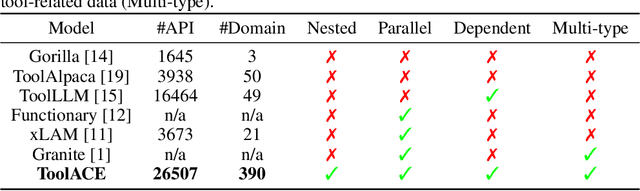
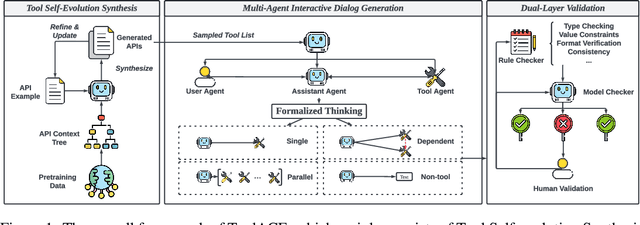
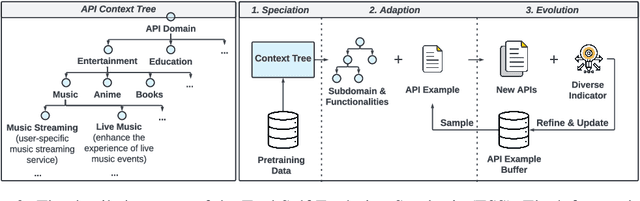

Function calling significantly extends the application boundary of large language models, where high-quality and diverse training data is critical for unlocking this capability. However, real function-calling data is quite challenging to collect and annotate, while synthetic data generated by existing pipelines tends to lack coverage and accuracy. In this paper, we present ToolACE, an automatic agentic pipeline designed to generate accurate, complex, and diverse tool-learning data. ToolACE leverages a novel self-evolution synthesis process to curate a comprehensive API pool of 26,507 diverse APIs. Dialogs are further generated through the interplay among multiple agents, guided by a formalized thinking process. To ensure data accuracy, we implement a dual-layer verification system combining rule-based and model-based checks. We demonstrate that models trained on our synthesized data, even with only 8B parameters, achieve state-of-the-art performance on the Berkeley Function-Calling Leaderboard, rivaling the latest GPT-4 models. Our model and a subset of the data are publicly available at https://huggingface.co/Team-ACE.
VideoLLM-MoD: Efficient Video-Language Streaming with Mixture-of-Depths Vision Computation
Aug 29, 2024


A well-known dilemma in large vision-language models (e.g., GPT-4, LLaVA) is that while increasing the number of vision tokens generally enhances visual understanding, it also significantly raises memory and computational costs, especially in long-term, dense video frame streaming scenarios. Although learnable approaches like Q-Former and Perceiver Resampler have been developed to reduce the vision token burden, they overlook the context causally modeled by LLMs (i.e., key-value cache), potentially leading to missed visual cues when addressing user queries. In this paper, we introduce a novel approach to reduce vision compute by leveraging redundant vision tokens "skipping layers" rather than decreasing the number of vision tokens. Our method, VideoLLM-MoD, is inspired by mixture-of-depths LLMs and addresses the challenge of numerous vision tokens in long-term or streaming video. Specifically, for each transformer layer, we learn to skip the computation for a high proportion (e.g., 80\%) of vision tokens, passing them directly to the next layer. This approach significantly enhances model efficiency, achieving approximately \textasciitilde42\% time and \textasciitilde30\% memory savings for the entire training. Moreover, our method reduces the computation in the context and avoid decreasing the vision tokens, thus preserving or even improving performance compared to the vanilla model. We conduct extensive experiments to demonstrate the effectiveness of VideoLLM-MoD, showing its state-of-the-art results on multiple benchmarks, including narration, forecasting, and summarization tasks in COIN, Ego4D, and Ego-Exo4D datasets.
Denoising Pre-Training and Customized Prompt Learning for Efficient Multi-Behavior Sequential Recommendation
Aug 21, 2024


In the realm of recommendation systems, users exhibit a diverse array of behaviors when interacting with items. This phenomenon has spurred research into learning the implicit semantic relationships between these behaviors to enhance recommendation performance. However, these methods often entail high computational complexity. To address concerns regarding efficiency, pre-training presents a viable solution. Its objective is to extract knowledge from extensive pre-training data and fine-tune the model for downstream tasks. Nevertheless, previous pre-training methods have primarily focused on single-behavior data, while multi-behavior data contains significant noise. Additionally, the fully fine-tuning strategy adopted by these methods still imposes a considerable computational burden. In response to this challenge, we propose DPCPL, the first pre-training and prompt-tuning paradigm tailored for Multi-Behavior Sequential Recommendation. Specifically, in the pre-training stage, we commence by proposing a novel Efficient Behavior Miner (EBM) to filter out the noise at multiple time scales, thereby facilitating the comprehension of the contextual semantics of multi-behavior sequences. Subsequently, we propose to tune the pre-trained model in a highly efficient manner with the proposed Customized Prompt Learning (CPL) module, which generates personalized, progressive, and diverse prompts to fully exploit the potential of the pre-trained model effectively. Extensive experiments on three real-world datasets have unequivocally demonstrated that DPCPL not only exhibits high efficiency and effectiveness, requiring minimal parameter adjustments but also surpasses the state-of-the-art performance across a diverse range of downstream tasks.
Deep Tree-based Retrieval for Efficient Recommendation: Theory and Method
Aug 21, 2024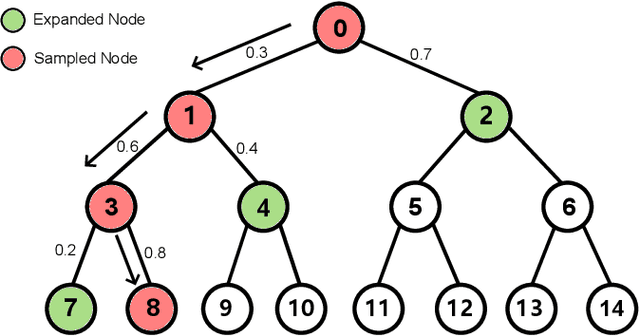


With the development of deep learning techniques, deep recommendation models also achieve remarkable improvements in terms of recommendation accuracy. However, due to the large number of candidate items in practice and the high cost of preference computation, these methods also suffer from low efficiency of recommendation. The recently proposed tree-based deep recommendation models alleviate the problem by directly learning tree structure and representations under the guidance of recommendation objectives. However, such models have shortcomings. The max-heap assumption in the hierarchical tree, in which the preference for a parent node should be the maximum between the preferences for its children, is difficult to satisfy in their binary classification objectives. To this end, we propose Tree-based Deep Retrieval (TDR for short) for efficient recommendation. In TDR, all the trees generated during the training process are retained to form the forest. When learning the node representation of each tree, we have to satisfy the max-heap assumption as much as possible and mimic beam search behavior over the tree in the training stage. This is achieved by TDR to regard the training task as multi-classification over tree nodes at the same level. However, the number of tree nodes grows exponentially with levels, making us train the preference model with the guidance of the sampled-softmax technique. The experiments are conducted on real-world datasets, validating the effectiveness of the proposed preference model learning method and tree learning method.
Multi-agent Multi-armed Bandits with Stochastic Sharable Arm Capacities
Aug 20, 2024
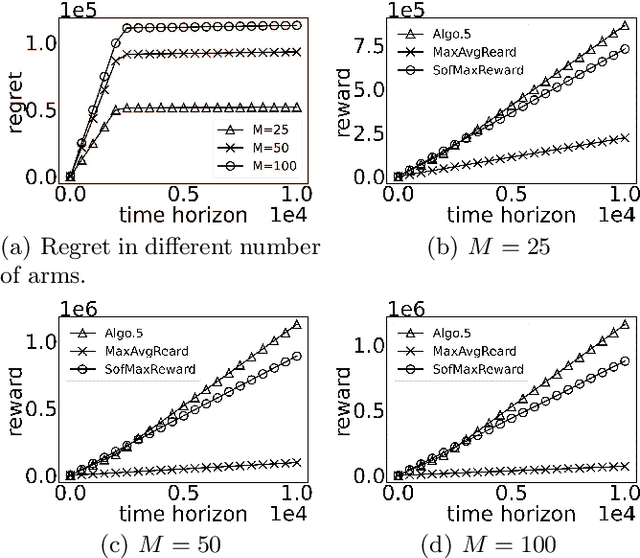

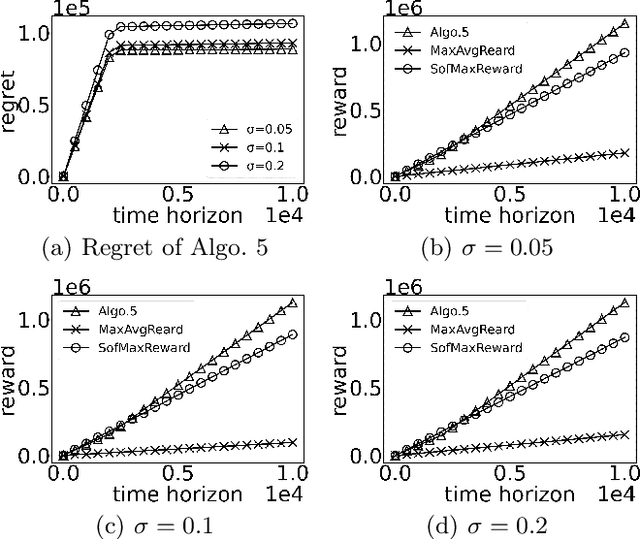
Motivated by distributed selection problems, we formulate a new variant of multi-player multi-armed bandit (MAB) model, which captures stochastic arrival of requests to each arm, as well as the policy of allocating requests to players. The challenge is how to design a distributed learning algorithm such that players select arms according to the optimal arm pulling profile (an arm pulling profile prescribes the number of players at each arm) without communicating to each other. We first design a greedy algorithm, which locates one of the optimal arm pulling profiles with a polynomial computational complexity. We also design an iterative distributed algorithm for players to commit to an optimal arm pulling profile with a constant number of rounds in expectation. We apply the explore then commit (ETC) framework to address the online setting when model parameters are unknown. We design an exploration strategy for players to estimate the optimal arm pulling profile. Since such estimates can be different across different players, it is challenging for players to commit. We then design an iterative distributed algorithm, which guarantees that players can arrive at a consensus on the optimal arm pulling profile in only M rounds. We conduct experiments to validate our algorithm.
Analytical and Empirical Study of Herding Effects in Recommendation Systems
Aug 20, 2024


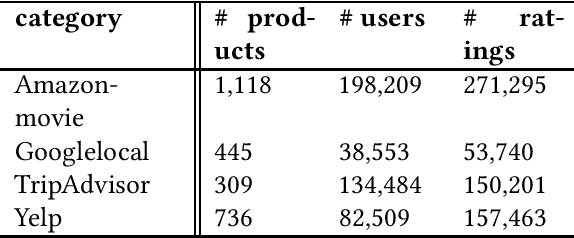
Online rating systems are often used in numerous web or mobile applications, e.g., Amazon and TripAdvisor, to assess the ground-truth quality of products. Due to herding effects, the aggregation of historical ratings (or historical collective opinion) can significantly influence subsequent ratings, leading to misleading and erroneous assessments. We study how to manage product ratings via rating aggregation rules and shortlisted representative reviews, for the purpose of correcting the assessment error. We first develop a mathematical model to characterize important factors of herding effects in product ratings. We then identify sufficient conditions (via the stochastic approximation theory), under which the historical collective opinion converges to the ground-truth collective opinion of the whole user population. These conditions identify a class of rating aggregation rules and review selection mechanisms that can reveal the ground-truth product quality. We also quantify the speed of convergence (via the martingale theory), which reflects the efficiency of rating aggregation rules and review selection mechanisms. We prove that the herding effects slow down the speed of convergence while an accurate review selection mechanism can speed it up. We also study the speed of convergence numerically and reveal trade-offs in selecting rating aggregation rules and review selection mechanisms. To show the utility of our framework, we design a maximum likelihood algorithm to infer model parameters from ratings, and conduct experiments on rating datasets from Amazon and TripAdvisor. We show that proper recency aware rating aggregation rules can improve the speed of convergence in Amazon and TripAdvisor by 41% and 62% respectively.