 Add to Chrome
 Add to Firefox
 Add to Edge
The Next Paradigm Is User-Centric Agent, Not Platform-Centric Service
Feb 17, 2026
Modern digital services have evolved into indispensable tools, driving the present large-scale information systems. Yet, the prevailing platform-centric model, where services are optimized for platform-driven metrics such as engagement and conversion, often fails to align with users' true needs. While platform technologies have advanced significantly-especially with the integration of large language models (LLMs)-we argue that improvements in platform service quality do not necessarily translate to genuine user benefit. Instead, platform-centric services prioritize provider objectives over user welfare, resulting in conflicts against user interests. This paper argues that the future of digital services should shift from a platform-centric to a user-centric agent. These user-centric agents prioritize privacy, align with user-defined goals, and grant users control over their preferences and actions. With advancements in LLMs and on-device intelligence, the realization of this vision is now feasible. This paper explores the opportunities and challenges in transitioning to user-centric intelligence, presents a practical device-cloud pipeline for its implementation, and discusses the necessary governance and ecosystem structures for its adoption.

Scaling New Frontiers: Insights into Large Recommendation Models
Dec 01, 2024
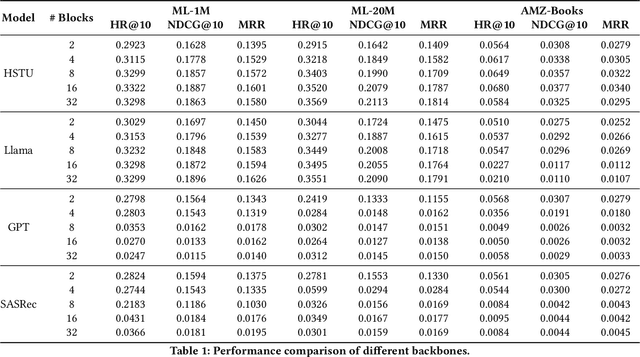
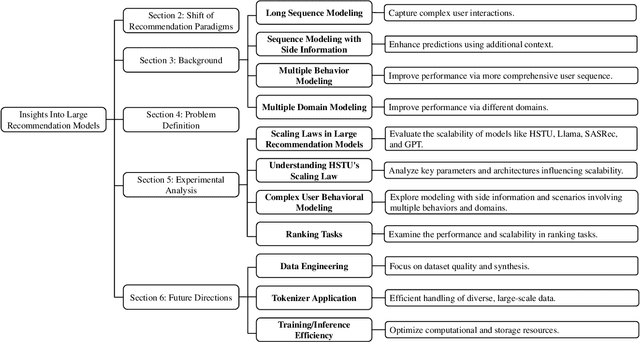
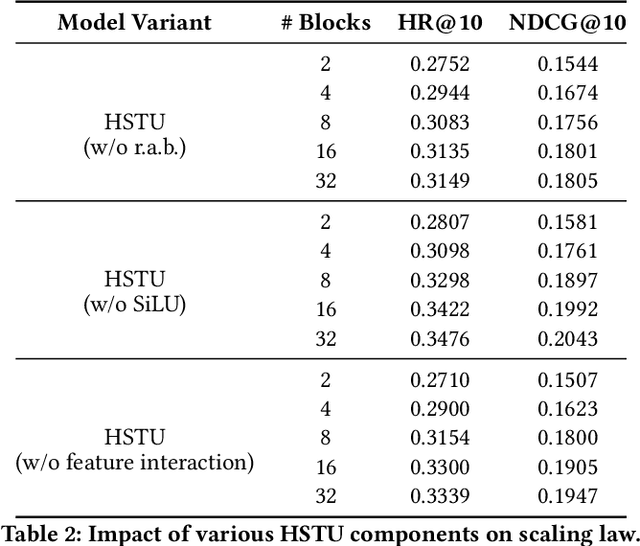
Recommendation systems are essential for filtering data and retrieving relevant information across various applications. Recent advancements have seen these systems incorporate increasingly large embedding tables, scaling up to tens of terabytes for industrial use. However, the expansion of network parameters in traditional recommendation models has plateaued at tens of millions, limiting further benefits from increased embedding parameters. Inspired by the success of large language models (LLMs), a new approach has emerged that scales network parameters using innovative structures, enabling continued performance improvements. A significant development in this area is Meta's generative recommendation model HSTU, which illustrates the scaling laws of recommendation systems by expanding parameters to thousands of billions. This new paradigm has achieved substantial performance gains in online experiments. In this paper, we aim to enhance the understanding of scaling laws by conducting comprehensive evaluations of large recommendation models. Firstly, we investigate the scaling laws across different backbone architectures of the large recommendation models. Secondly, we conduct comprehensive ablation studies to explore the origins of these scaling laws. We then further assess the performance of HSTU, as the representative of large recommendation models, on complex user behavior modeling tasks to evaluate its applicability. Notably, we also analyze its effectiveness in ranking tasks for the first time. Finally, we offer insights into future directions for large recommendation models. Supplementary materials for our research are available on GitHub at https://github.com/USTC-StarTeam/Large-Recommendation-Models.
MDAP: A Multi-view Disentangled and Adaptive Preference Learning Framework for Cross-Domain Recommendation
Oct 08, 2024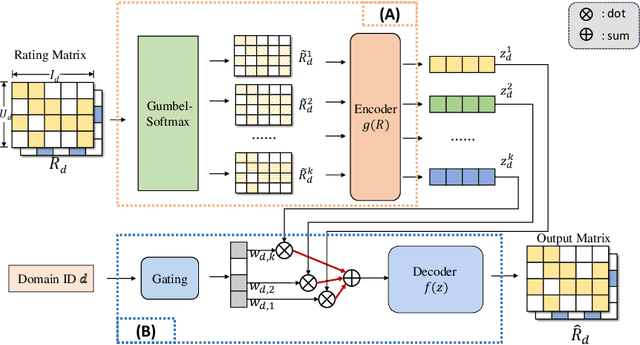
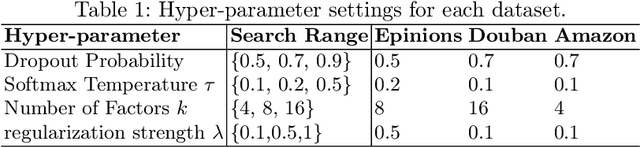
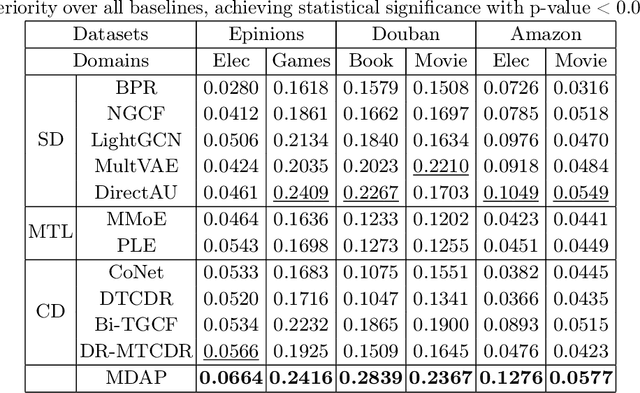
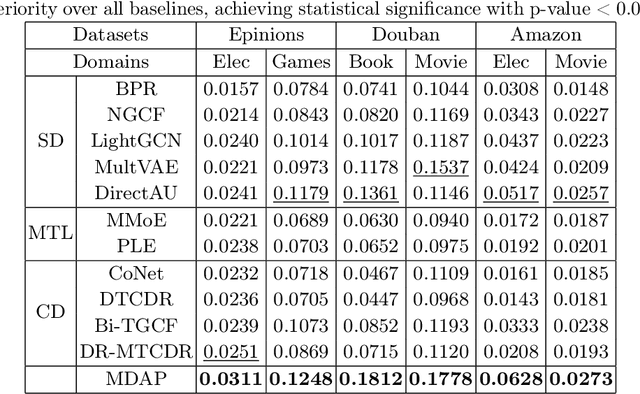
Cross-domain Recommendation systems leverage multi-domain user interactions to improve performance, especially in sparse data or new user scenarios. However, CDR faces challenges such as effectively capturing user preferences and avoiding negative transfer. To address these issues, we propose the Multi-view Disentangled and Adaptive Preference Learning (MDAP) framework. Our MDAP framework uses a multiview encoder to capture diverse user preferences. The framework includes a gated decoder that adaptively combines embeddings from different views to generate a comprehensive user representation. By disentangling representations and allowing adaptive feature selection, our model enhances adaptability and effectiveness. Extensive experiments on benchmark datasets demonstrate that our method significantly outperforms state-of-the-art CDR and single-domain models, providing more accurate recommendations and deeper insights into user behavior across different domains.