 Add to Chrome
 Add to Firefox
 Add to Edge
RePlan: Reasoning-guided Region Planning for Complex Instruction-based Image Editing
Dec 18, 2025


Instruction-based image editing enables natural-language control over visual modifications, yet existing models falter under Instruction-Visual Complexity (IV-Complexity), where intricate instructions meet cluttered or ambiguous scenes. We introduce RePlan (Region-aligned Planning), a plan-then-execute framework that couples a vision-language planner with a diffusion editor. The planner decomposes instructions via step-by-step reasoning and explicitly grounds them to target regions; the editor then applies changes using a training-free attention-region injection mechanism, enabling precise, parallel multi-region edits without iterative inpainting. To strengthen planning, we apply GRPO-based reinforcement learning using 1K instruction-only examples, yielding substantial gains in reasoning fidelity and format reliability. We further present IV-Edit, a benchmark focused on fine-grained grounding and knowledge-intensive edits. Across IV-Complex settings, RePlan consistently outperforms strong baselines trained on far larger datasets, improving regional precision and overall fidelity. Our project page: https://replan-iv-edit.github.io

Can LLMs Guide Their Own Exploration? Gradient-Guided Reinforcement Learning for LLM Reasoning
Dec 17, 2025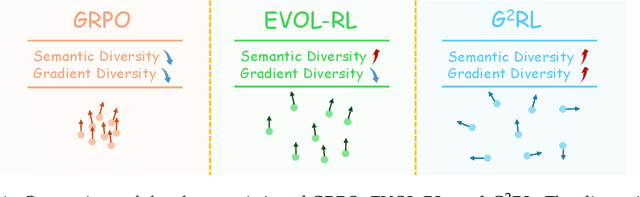
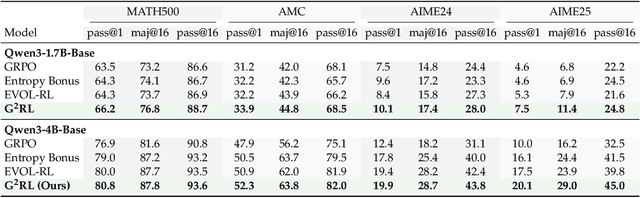
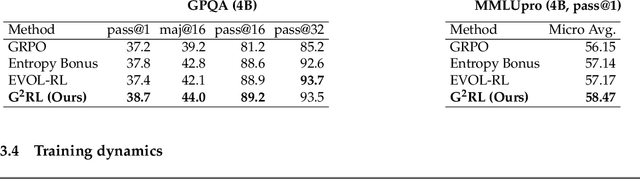
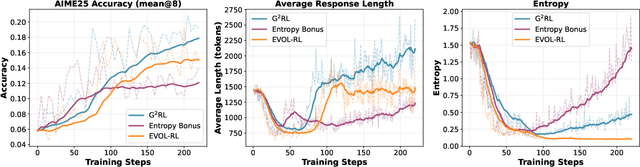
Reinforcement learning has become essential for strengthening the reasoning abilities of large language models, yet current exploration mechanisms remain fundamentally misaligned with how these models actually learn. Entropy bonuses and external semantic comparators encourage surface level variation but offer no guarantee that sampled trajectories differ in the update directions that shape optimization. We propose G2RL, a gradient guided reinforcement learning framework in which exploration is driven not by external heuristics but by the model own first order update geometry. For each response, G2RL constructs a sequence level feature from the model final layer sensitivity, obtainable at negligible cost from a standard forward pass, and measures how each trajectory would reshape the policy by comparing these features within a sampled group. Trajectories that introduce novel gradient directions receive a bounded multiplicative reward scaler, while redundant or off manifold updates are deemphasized, yielding a self referential exploration signal that is naturally aligned with PPO style stability and KL control. Across math and general reasoning benchmarks (MATH500, AMC, AIME24, AIME25, GPQA, MMLUpro) on Qwen3 base 1.7B and 4B models, G2RL consistently improves pass@1, maj@16, and pass@k over entropy based GRPO and external embedding methods. Analyzing the induced geometry, we find that G2RL expands exploration into substantially more orthogonal and often opposing gradient directions while maintaining semantic coherence, revealing that a policy own update space provides a far more faithful and effective basis for guiding exploration in large language model reinforcement learning.
MotionEdit: Benchmarking and Learning Motion-Centric Image Editing
Dec 14, 2025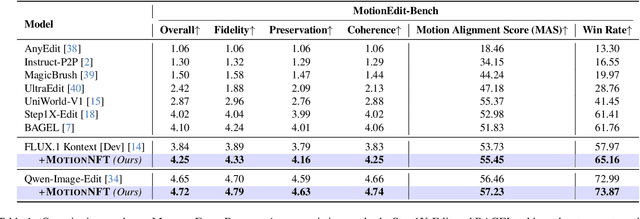
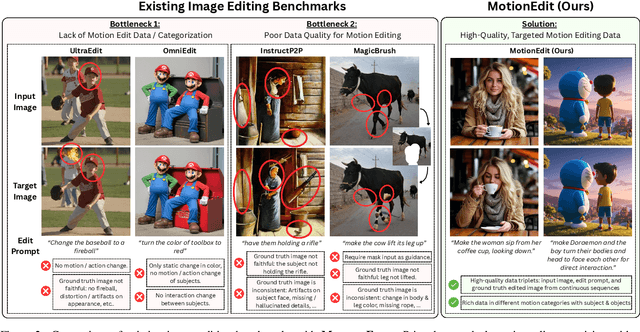
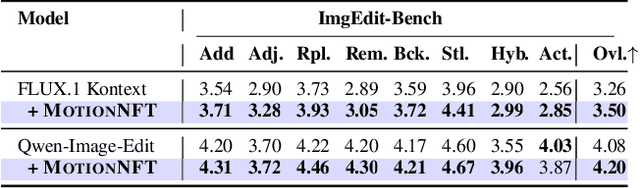
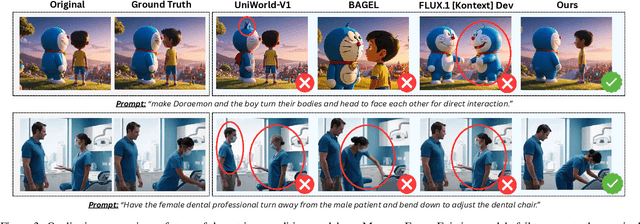
We introduce MotionEdit, a novel dataset for motion-centric image editing-the task of modifying subject actions and interactions while preserving identity, structure, and physical plausibility. Unlike existing image editing datasets that focus on static appearance changes or contain only sparse, low-quality motion edits, MotionEdit provides high-fidelity image pairs depicting realistic motion transformations extracted and verified from continuous videos. This new task is not only scientifically challenging but also practically significant, powering downstream applications such as frame-controlled video synthesis and animation. To evaluate model performance on the novel task, we introduce MotionEdit-Bench, a benchmark that challenges models on motion-centric edits and measures model performance with generative, discriminative, and preference-based metrics. Benchmark results reveal that motion editing remains highly challenging for existing state-of-the-art diffusion-based editing models. To address this gap, we propose MotionNFT (Motion-guided Negative-aware Fine Tuning), a post-training framework that computes motion alignment rewards based on how well the motion flow between input and model-edited images matches the ground-truth motion, guiding models toward accurate motion transformations. Extensive experiments on FLUX.1 Kontext and Qwen-Image-Edit show that MotionNFT consistently improves editing quality and motion fidelity of both base models on the motion editing task without sacrificing general editing ability, demonstrating its effectiveness. Our code is at https://github.com/elainew728/motion-edit/.
Auden-Voice: General-Purpose Voice Encoder for Speech and Language Understanding
Nov 19, 2025Human voice encodes both identity and paralinguistic cues, yet encoders in large audio-language models (LALMs) rarely balance both aspects. In this work, we present a study toward building a general-purpose voice encoder that captures nuanced voice cues. Through a comprehensive evaluation, we find that multi-task training yields the most balanced representations, whereas contrastive language-audio pretraining (CLAP) primarily improves retrieval without enhancing paralinguistic understanding. Our final encoder, Auden-Voice, also demonstrates strong performance when integrated with LLMs. The code and training recipes will be released with the audio understanding toolkit Auden.
TTA: Transcribe, Translate and Alignment for Cross-lingual Speech Representation
Nov 18, 2025Speech-LLM models have demonstrated great performance in multi-modal and multi-task speech understanding. A typical speech-LLM paradigm is integrating speech modality with a large language model (LLM). While the Whisper encoder was frequently adopted in previous studies for speech input, it shows limitations regarding input format, model scale, and semantic performance. To this end, we propose a lightweight TTA model specialized in speech semantics for more effective LLM integration. With large-scale training of 358k hours of speech data on multilingual speech recognition (ASR), speech translation (ST) and speech-text alignment tasks, TTA is capable of producing robust cross-lingual speech representations. Extensive evaluations across diverse benchmarks, including ASR/ST, speech retrieval, and ASR-LLM performance assessments, demonstrate TTA's superiority over Whisper. Furthermore, we rigorously validate the interplay between cross-lingual capabilities and ASR/ST performance. The model weights and training recipes of TTA will be released as part of an audio understanding toolkit Auden.
DeepCompress: A Dual Reward Strategy for Dynamically Exploring and Compressing Reasoning Chains
Oct 31, 2025Large Reasoning Models (LRMs) have demonstrated impressive capabilities but suffer from cognitive inefficiencies like ``overthinking'' simple problems and ``underthinking'' complex ones. While existing methods that use supervised fine-tuning~(SFT) or reinforcement learning~(RL) with token-length rewards can improve efficiency, they often do so at the cost of accuracy. This paper introduces \textbf{DeepCompress}, a novel framework that simultaneously enhances both the accuracy and efficiency of LRMs. We challenge the prevailing approach of consistently favoring shorter reasoning paths, showing that longer responses can contain a broader range of correct solutions for difficult problems. DeepCompress employs an adaptive length reward mechanism that dynamically classifies problems as ``Simple'' or ``Hard'' in real-time based on the model's evolving capability. It encourages shorter, more efficient reasoning for ``Simple'' problems while promoting longer, more exploratory thought chains for ``Hard'' problems. This dual-reward strategy enables the model to autonomously adjust its Chain-of-Thought (CoT) length, compressing reasoning for well-mastered problems and extending it for those it finds challenging. Experimental results on challenging mathematical benchmarks show that DeepCompress consistently outperforms baseline methods, achieving superior accuracy while significantly improving token efficiency.
Understanding and Enhancing Mamba-Transformer Hybrids for Memory Recall and Language Modeling
Oct 30, 2025Hybrid models that combine state space models (SSMs) with attention mechanisms have shown strong performance by leveraging the efficiency of SSMs and the high recall ability of attention. However, the architectural design choices behind these hybrid models remain insufficiently understood. In this work, we analyze hybrid architectures through the lens of memory utilization and overall performance, and propose a complementary method to further enhance their effectiveness. We first examine the distinction between sequential and parallel integration of SSM and attention layers. Our analysis reveals several interesting findings, including that sequential hybrids perform better on shorter contexts, whereas parallel hybrids are more effective for longer contexts. We also introduce a data-centric approach of continually training on datasets augmented with paraphrases, which further enhances recall while preserving other capabilities. It generalizes well across different base models and outperforms architectural modifications aimed at enhancing recall. Our findings provide a deeper understanding of hybrid SSM-attention models and offer practical guidance for designing architectures tailored to various use cases. Our findings provide a deeper understanding of hybrid SSM-attention models and offer practical guidance for designing architectures tailored to various use cases.
Explore to Evolve: Scaling Evolved Aggregation Logic via Proactive Online Exploration for Deep Research Agents
Oct 16, 2025Deep research web agents not only retrieve information from diverse sources such as web environments, files, and multimodal inputs, but more importantly, they need to rigorously analyze and aggregate knowledge for insightful research. However, existing open-source deep research agents predominantly focus on enhancing information-seeking capabilities of web agents to locate specific information, while overlooking the essential need for information aggregation, which would limit their ability to support in-depth research. We propose an Explore to Evolve paradigm to scalably construct verifiable training data for web agents. Begins with proactive online exploration, an agent sources grounded information by exploring the real web. Using the collected evidence, the agent then self-evolves an aggregation program by selecting, composing, and refining operations from 12 high-level logical types to synthesize a verifiable QA pair. This evolution from high-level guidance to concrete operations allowed us to scalably produce WebAggregatorQA, a dataset of 10K samples across 50K websites and 11 domains. Based on an open-source agent framework, SmolAgents, we collect supervised fine-tuning trajectories to develop a series of foundation models, WebAggregator. WebAggregator-8B matches the performance of GPT-4.1, while the 32B variant surpasses GPT-4.1 by more than 10% on GAIA-text and closely approaches Claude-3.7-sonnet. Moreover, given the limited availability of benchmarks that evaluate web agents' information aggregation abilities, we construct a human-annotated evaluation split of WebAggregatorQA as a challenging test set. On this benchmark, Claude-3.7-sonnet only achieves 28%, and GPT-4.1 scores 25.8%. Even when agents manage to retrieve all references, they still struggle on WebAggregatorQA, highlighting the need to strengthen the information aggregation capabilities of web agent foundations.
CLUE: Non-parametric Verification from Experience via Hidden-State Clustering
Oct 02, 2025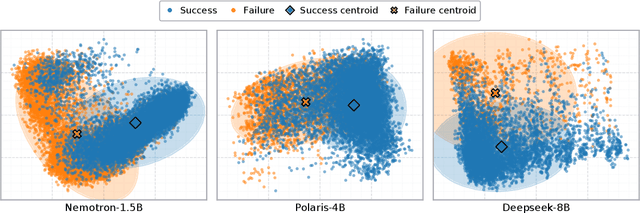
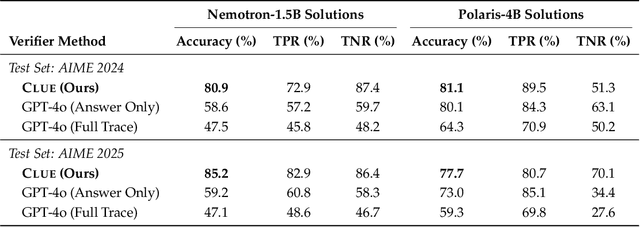
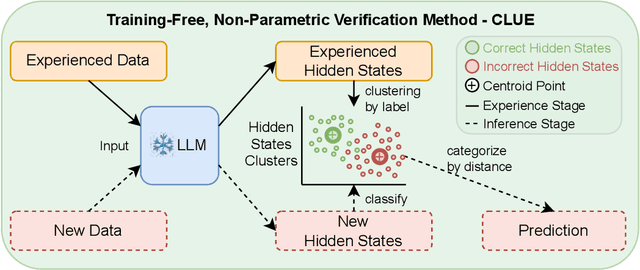
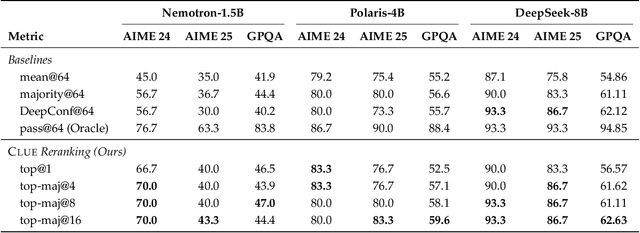
Assessing the quality of Large Language Model (LLM) outputs presents a critical challenge. Previous methods either rely on text-level information (e.g., reward models, majority voting), which can overfit to superficial cues, or on calibrated confidence from token probabilities, which would fail on less-calibrated models. Yet both of these signals are, in fact, partial projections of a richer source of information: the model's internal hidden states. Early layers, closer to token embeddings, preserve semantic and lexical features that underpin text-based judgments, while later layers increasingly align with output logits, embedding confidence-related information. This paper explores hidden states directly as a unified foundation for verification. We show that the correctness of a solution is encoded as a geometrically separable signature within the trajectory of hidden activations. To validate this, we present Clue (Clustering and Experience-based Verification), a deliberately minimalist, non-parametric verifier. With no trainable parameters, CLUE only summarizes each reasoning trace by an hidden state delta and classifies correctness via nearest-centroid distance to ``success'' and ``failure'' clusters formed from past experience. The simplicity of this method highlights the strength of the underlying signal. Empirically, CLUE consistently outperforms LLM-as-a-judge baselines and matches or exceeds modern confidence-based methods in reranking candidates, improving both top-1 and majority-vote accuracy across AIME 24/25 and GPQA. As a highlight, on AIME 24 with a 1.5B model, CLUE boosts accuracy from 56.7% (majority@64) to 70.0% (top-maj@16).
VOGUE: Guiding Exploration with Visual Uncertainty Improves Multimodal Reasoning
Oct 01, 2025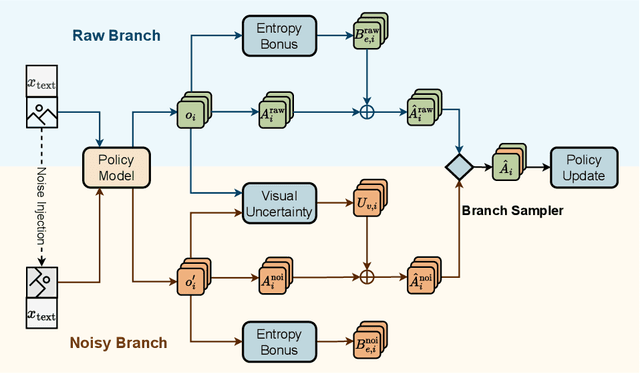
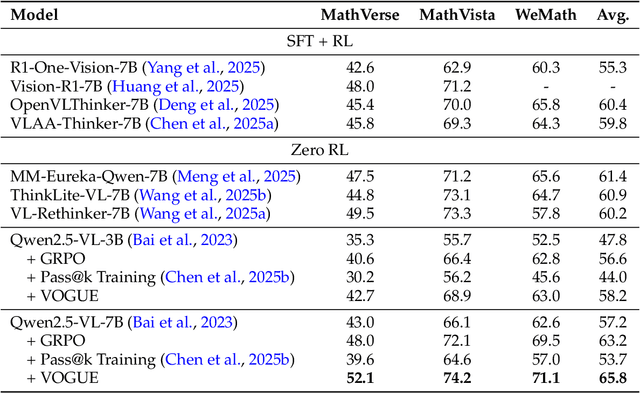
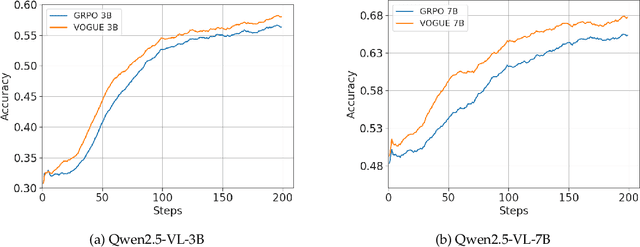
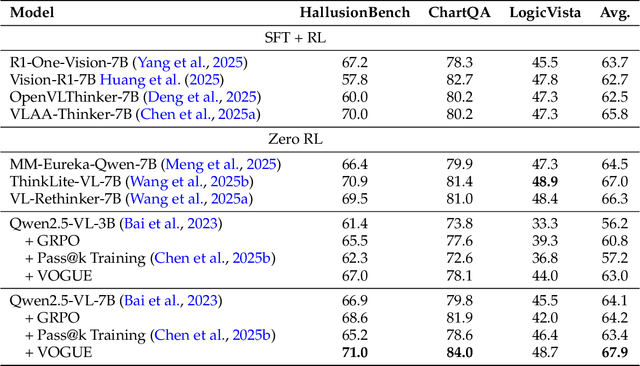
Reinforcement learning with verifiable rewards (RLVR) improves reasoning in large language models (LLMs) but struggles with exploration, an issue that still persists for multimodal LLMs (MLLMs). Current methods treat the visual input as a fixed, deterministic condition, overlooking a critical source of ambiguity and struggling to build policies robust to plausible visual variations. We introduce $\textbf{VOGUE (Visual Uncertainty Guided Exploration)}$, a novel method that shifts exploration from the output (text) to the input (visual) space. By treating the image as a stochastic context, VOGUE quantifies the policy's sensitivity to visual perturbations using the symmetric KL divergence between a "raw" and "noisy" branch, creating a direct signal for uncertainty-aware exploration. This signal shapes the learning objective via an uncertainty-proportional bonus, which, combined with a token-entropy bonus and an annealed sampling schedule, effectively balances exploration and exploitation. Implemented within GRPO on two model scales (Qwen2.5-VL-3B/7B), VOGUE boosts pass@1 accuracy by an average of 2.6% on three visual math benchmarks and 3.7% on three general-domain reasoning benchmarks, while simultaneously increasing pass@4 performance and mitigating the exploration decay commonly observed in RL fine-tuning. Our work shows that grounding exploration in the inherent uncertainty of visual inputs is an effective strategy for improving multimodal reasoning.