 Add to Chrome
 Add to Firefox
 Add to Edge
Can LLMs Generate Human-Like Wayfinding Instructions? Towards Platform-Agnostic Embodied Instruction Synthesis
Mar 31, 2024
We present a novel approach to automatically synthesize "wayfinding instructions" for an embodied robot agent. In contrast to prior approaches that are heavily reliant on human-annotated datasets designed exclusively for specific simulation platforms, our algorithm uses in-context learning to condition an LLM to generate instructions using just a few references. Using an LLM-based Visual Question Answering strategy, we gather detailed information about the environment which is used by the LLM for instruction synthesis. We implement our approach on multiple simulation platforms including Matterport3D, AI Habitat and ThreeDWorld, thereby demonstrating its platform-agnostic nature. We subjectively evaluate our approach via a user study and observe that 83.3% of users find the synthesized instructions accurately capture the details of the environment and show characteristics similar to those of human-generated instructions. Further, we conduct zero-shot navigation with multiple approaches on the REVERIE dataset using the generated instructions, and observe very close correlation with the baseline on standard success metrics (< 1% change in SR), quantifying the viability of generated instructions in replacing human-annotated data. We finally discuss the applicability of our approach in enabling a generalizable evaluation of embodied navigation policies. To the best of our knowledge, ours is the first LLM-driven approach capable of generating "human-like" instructions in a platform-agnostic manner, without training.

CoDa: Constrained Generation based Data Augmentation for Low-Resource NLP
Mar 30, 2024We present CoDa (Constrained Generation based Data Augmentation), a controllable, effective, and training-free data augmentation technique for low-resource (data-scarce) NLP. Our approach is based on prompting off-the-shelf instruction-following Large Language Models (LLMs) for generating text that satisfies a set of constraints. Precisely, we extract a set of simple constraints from every instance in the low-resource dataset and verbalize them to prompt an LLM to generate novel and diverse training instances. Our findings reveal that synthetic data that follows simple constraints in the downstream dataset act as highly effective augmentations, and CoDa can achieve this without intricate decoding-time constrained generation techniques or fine-tuning with complex algorithms that eventually make the model biased toward the small number of training instances. Additionally, CoDa is the first framework that provides users explicit control over the augmentation generation process, thereby also allowing easy adaptation to several domains. We demonstrate the effectiveness of CoDa across 11 datasets spanning 3 tasks and 3 low-resource settings. CoDa outperforms all our baselines, qualitatively and quantitatively, with improvements of 0.12%-7.19%. Code is available here: https://github.com/Sreyan88/CoDa
Socially Aware Robot Navigation through Scoring Using Vision-Language Models
Mar 30, 2024We propose VLM-Social-Nav, a novel Vision-Language Model (VLM) based navigation approach to compute a robot's trajectory in human-centered environments. Our goal is to make real-time decisions on robot actions that are socially compliant with human expectations. We utilize a perception model to detect important social entities and prompt a VLM to generate guidance for socially compliant robot behavior. VLM-Social-Nav uses a VLM-based scoring module that computes a cost term that ensures socially appropriate and effective robot actions generated by the underlying planner. Our overall approach reduces reliance on large datasets (for training) and enhances adaptability in decision-making. In practice, it results in improved socially compliant navigation in human-shared environments. We demonstrate and evaluate our system in four different real-world social navigation scenarios with a Turtlebot robot. We observe at least 36.37% improvement in average success rate and 20.00% improvement in average collision rate in the four social navigation scenarios. The user study score shows that VLM-Social-Nav generates the most socially compliant navigation behavior.
Do Vision-Language Models Understand Compound Nouns?
Mar 30, 2024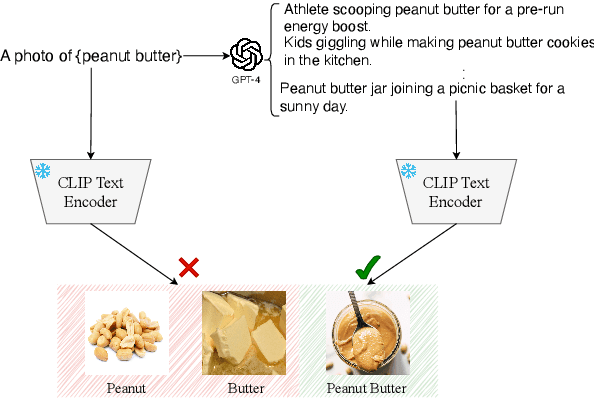
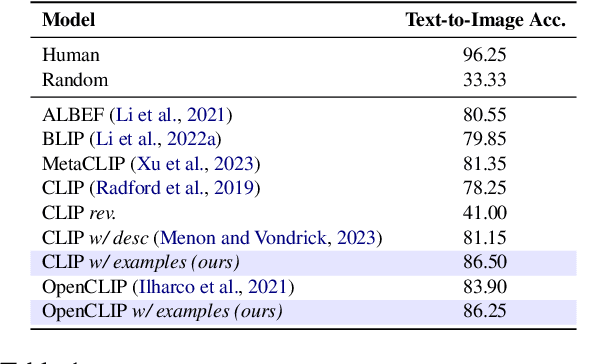

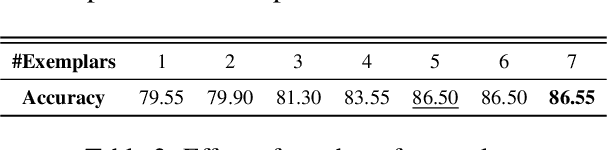
Open-vocabulary vision-language models (VLMs) like CLIP, trained using contrastive loss, have emerged as a promising new paradigm for text-to-image retrieval. However, do VLMs understand compound nouns (CNs) (e.g., lab coat) as well as they understand nouns (e.g., lab)? We curate Compun, a novel benchmark with 400 unique and commonly used CNs, to evaluate the effectiveness of VLMs in interpreting CNs. The Compun benchmark challenges a VLM for text-to-image retrieval where, given a text prompt with a CN, the task is to select the correct image that shows the CN among a pair of distractor images that show the constituent nouns that make up the CN. Next, we perform an in-depth analysis to highlight CLIPs' limited understanding of certain types of CNs. Finally, we present an alternative framework that moves beyond hand-written templates for text prompts widely used by CLIP-like models. We employ a Large Language Model to generate multiple diverse captions that include the CN as an object in the scene described by the caption. Our proposed method improves CN understanding of CLIP by 8.25% on Compun. Code and benchmark are available at: https://github.com/sonalkum/Compun
DTG : Diffusion-based Trajectory Generation for Mapless Global Navigation
Mar 25, 2024We present a novel end-to-end diffusion-based trajectory generation method, DTG, for mapless global navigation in challenging outdoor scenarios with occlusions and unstructured off-road features like grass, buildings, bushes, etc. Given a distant goal, our approach computes a trajectory that satisfies the following goals: (1) minimize the travel distance to the goal; (2) maximize the traversability by choosing paths that do not lie in undesirable areas. Specifically, we present a novel Conditional RNN(CRNN) for diffusion models to efficiently generate trajectories. Furthermore, we propose an adaptive training method that ensures that the diffusion model generates more traversable trajectories. We evaluate our methods in various outdoor scenes and compare the performance with other global navigation algorithms on a Husky robot. In practice, we observe at least a 15% improvement in traveling distance and around a 7% improvement in traversability.
CoNVOI: Context-aware Navigation using Vision Language Models in Outdoor and Indoor Environments
Mar 22, 2024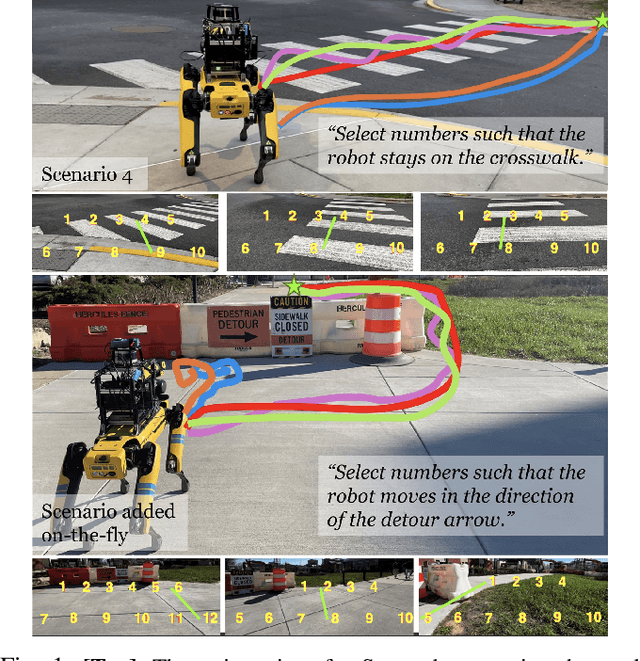
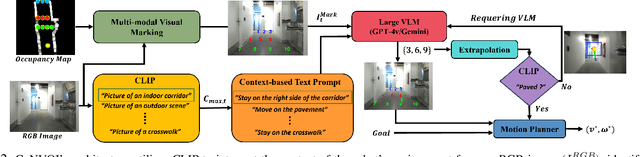
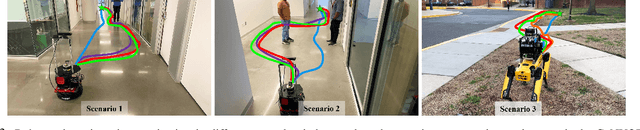
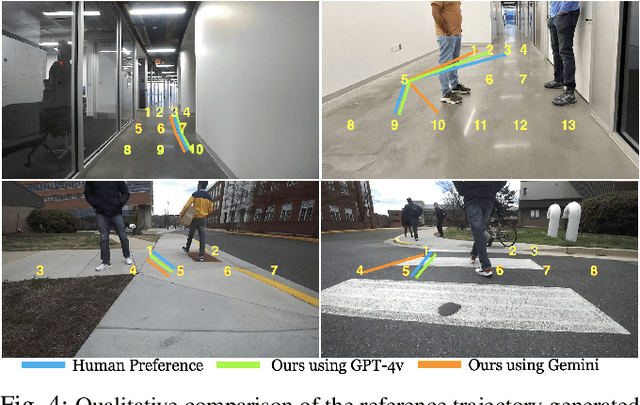
We present ConVOI, a novel method for autonomous robot navigation in real-world indoor and outdoor environments using Vision Language Models (VLMs). We employ VLMs in two ways: first, we leverage their zero-shot image classification capability to identify the context or scenario (e.g., indoor corridor, outdoor terrain, crosswalk, etc) of the robot's surroundings, and formulate context-based navigation behaviors as simple text prompts (e.g. ``stay on the pavement"). Second, we utilize their state-of-the-art semantic understanding and logical reasoning capabilities to compute a suitable trajectory given the identified context. To this end, we propose a novel multi-modal visual marking approach to annotate the obstacle-free regions in the RGB image used as input to the VLM with numbers, by correlating it with a local occupancy map of the environment. The marked numbers ground image locations in the real-world, direct the VLM's attention solely to navigable locations, and elucidate the spatial relationships between them and terrains depicted in the image to the VLM. Next, we query the VLM to select numbers on the marked image that satisfy the context-based behavior text prompt, and construct a reference path using the selected numbers. Finally, we propose a method to extrapolate the reference trajectory when the robot's environmental context has not changed to prevent unnecessary VLM queries. We use the reference trajectory to guide a motion planner, and demonstrate that it leads to human-like behaviors (e.g. not cutting through a group of people, using crosswalks, etc.) in various real-world indoor and outdoor scenarios.
AMCO: Adaptive Multimodal Coupling of Vision and Proprioception for Quadruped Robot Navigation in Outdoor Environments
Mar 20, 2024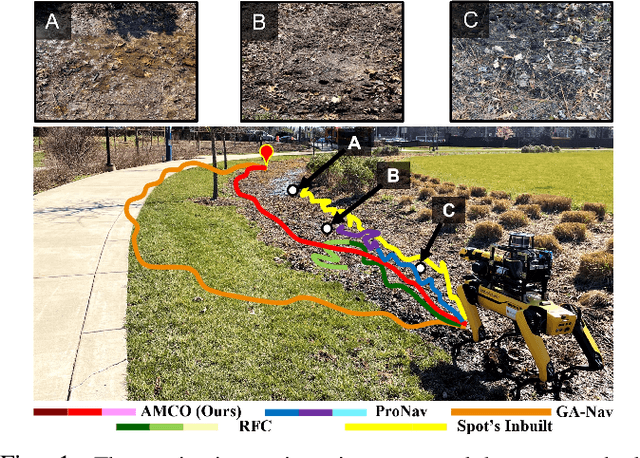
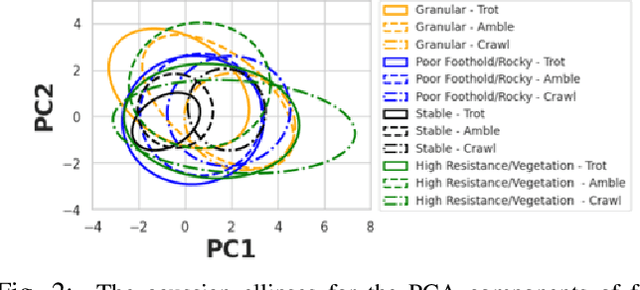
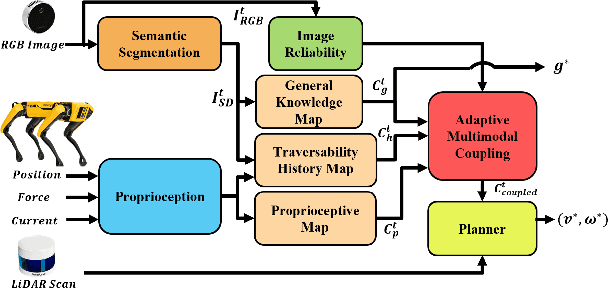
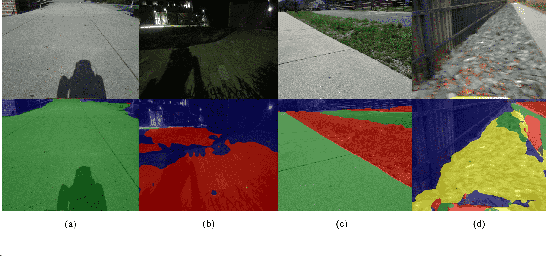
We present AMCO, a novel navigation method for quadruped robots that adaptively combines vision-based and proprioception-based perception capabilities. Our approach uses three cost maps: general knowledge map; traversability history map; and current proprioception map; which are derived from a robot's vision and proprioception data, and couples them to obtain a coupled traversability cost map for navigation. The general knowledge map encodes terrains semantically segmented from visual sensing, and represents a terrain's typically expected traversability. The traversability history map encodes the robot's recent proprioceptive measurements on a terrain and its semantic segmentation as a cost map. Further, the robot's present proprioceptive measurement is encoded as a cost map in the current proprioception map. As the general knowledge map and traversability history map rely on semantic segmentation, we evaluate the reliability of the visual sensory data by estimating the brightness and motion blur of input RGB images and accordingly combine the three cost maps to obtain the coupled traversability cost map used for navigation. Leveraging this adaptive coupling, the robot can depend on the most reliable input modality available. Finally, we present a novel planner that selects appropriate gaits and velocities for traversing challenging outdoor environments using the coupled traversability cost map. We demonstrate AMCO's navigation performance in different real-world outdoor environments and observe 10.8%-34.9% reduction w.r.t. two stability metrics, and up to 50% improvement in terms of success rate compared to current navigation methods.
Towards Robots That Know When They Need Help: Affordance-Based Uncertainty for Large Language Model Planners
Mar 19, 2024
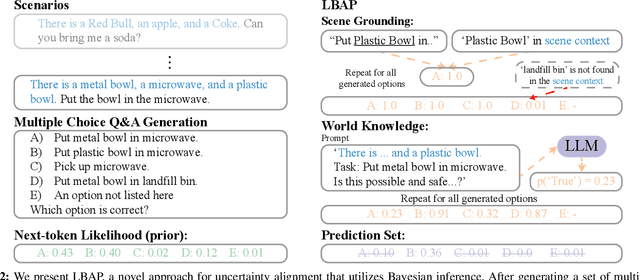


Large language models (LLMs) showcase many desirable traits for intelligent and helpful robots. However, they are also known to hallucinate predictions. This issue is exacerbated in consumer robotics where LLM hallucinations may result in robots confidently executing plans that are contrary to user goals, relying more frequently on human assistance, or preventing the robot from asking for help at all. In this work, we present LAP, a novel approach for utilizing off-the-shelf LLM's, alongside scene and object Affordances, in robotic Planners that minimize harmful hallucinations and know when to ask for help. Our key finding is that calculating and leveraging a scene affordance score, a measure of whether a given action is possible in the provided scene, helps to mitigate hallucinations in LLM predictions and better align the LLM's confidence measure with the probability of success. We specifically propose and test three different affordance scores, which can be used independently or in tandem to improve performance across different use cases. The most successful of these individual scores involves prompting an LLM to determine if a given action is possible and safe in the given scene and uses the LLM's response to compute the score. Through experiments in both simulation and the real world, on tasks with a variety of ambiguities, we show that LAP significantly increases success rate and decreases the amount of human intervention required relative to prior art. For example, in our real-world testing paradigm, LAP decreases the human help rate of previous methods by over 33% at a success rate of 70%.
Global Optimality without Mixing Time Oracles in Average-reward RL via Multi-level Actor-Critic
Mar 18, 2024In the context of average-reward reinforcement learning, the requirement for oracle knowledge of the mixing time, a measure of the duration a Markov chain under a fixed policy needs to achieve its stationary distribution-poses a significant challenge for the global convergence of policy gradient methods. This requirement is particularly problematic due to the difficulty and expense of estimating mixing time in environments with large state spaces, leading to the necessity of impractically long trajectories for effective gradient estimation in practical applications. To address this limitation, we consider the Multi-level Actor-Critic (MAC) framework, which incorporates a Multi-level Monte Carlo (MLMC) gradient estimator. With our approach, we effectively alleviate the dependency on mixing time knowledge, a first for average-reward MDPs global convergence. Furthermore, our approach exhibits the tightest-available dependence of $\mathcal{O}\left( \sqrt{\tau_{mix}} \right)$ relative to prior work. With a 2D gridworld goal-reaching navigation experiment, we demonstrate that MAC achieves higher reward than a previous PG-based method for average reward, Parameterized Policy Gradient with Advantage Estimation (PPGAE), especially in cases with relatively small training sample budget restricting trajectory length.
Right Place, Right Time! Towards ObjectNav for Non-Stationary Goals
Mar 14, 2024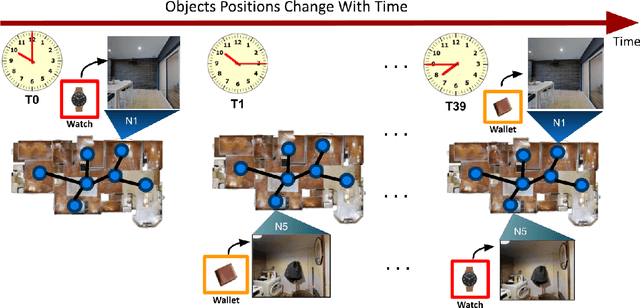
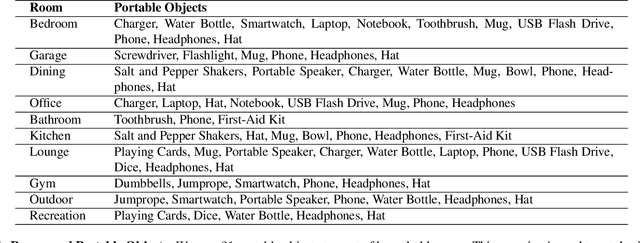
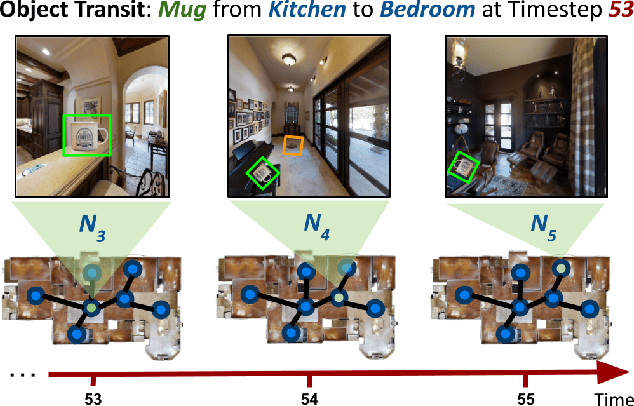
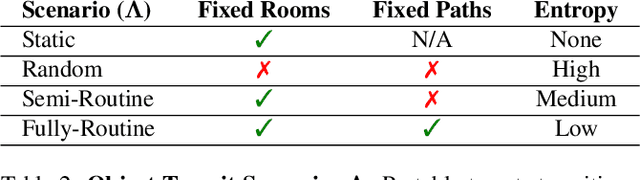
We present a novel approach to tackle the ObjectNav task for non-stationary and potentially occluded targets in an indoor environment. We refer to this task Portable ObjectNav (or P-ObjectNav), and in this work, present its formulation, feasibility, and a navigation benchmark using a novel memory-enhanced LLM-based policy. In contrast to ObjNav where target object locations are fixed for each episode, P-ObjectNav tackles the challenging case where the target objects move during the episode. This adds a layer of time-sensitivity to navigation, and is particularly relevant in scenarios where the agent needs to find portable targets (e.g. misplaced wallets) in human-centric environments. The agent needs to estimate not just the correct location of the target, but also the time at which the target is at that location for visual grounding -- raising the question about the feasibility of the task. We address this concern by inferring results on two cases for object placement: one where the objects placed follow a routine or a path, and the other where they are placed at random. We dynamize Matterport3D for these experiments, and modify PPO and LLM-based navigation policies for evaluation. Using PPO, we observe that agent performance in the random case stagnates, while the agent in the routine-following environment continues to improve, allowing us to infer that P-ObjectNav is solvable in environments with routine-following object placement. Using memory-enhancement on an LLM-based policy, we set a benchmark for P-ObjectNav. Our memory-enhanced agent significantly outperforms their non-memory-based counterparts across object placement scenarios by 71.76% and 74.68% on average when measured by Success Rate (SR) and Success Rate weighted by Path Length (SRPL), showing the influence of memory on improving P-ObjectNav performance. Our code and dataset will be made publicly available.