 Add to Chrome
 Add to Firefox
 Add to Edge
The Illusion of High Utility in Safety Alignment of Text-to-Image Diffusion Models
Jul 01, 2026
Safety alignment of text-to-image (T2I) diffusion models aims to suppress harmful generations while preserving utility on benign prompts. Recent methods often appear to deliver high safety with high utility, but this conclusion rests largely on coarse global utility metrics (e.g., FID, CLIPScore) that are insensitive to fine-grained semantic correctness, creating an illusion of high utility. We show that when utility is measured with structured evaluation, this illusion breaks: on TIFA (Text-to-Image Faithfulness evaluation with Question Answering), safety-aligned models suffer substantial drops in semantic fidelity, including failures in object counts, attributes, and relationships. To diagnose the source of this gap, we analyze the text-encoder prompt embedding space and uncover semantic collapse, a contraction of embedding spread coupled with distortion of inter-prompt similarity structure, which strongly correlates with structured utility loss. Guided by this insight, we propose StructureAware Geometric Regularization (SAGE), a safety alignment objective that explicitly preserves embedding spread and inter-prompt relational structure during adaptation. Our method restores structured utility (TIFA +5.0% over prior state-of-the-art) while maintaining strong safety performance and competitive coarse-grained utility scores. Our source code and trained models are available at https://adeelyousaf.github.io/SAGE_ECCV26_Project_Page/.

Does Reasoning Preserve Alignment? On the Trustworthiness of Large Reasoning Models
Jun 09, 2026Instruction-tuned LLMs are increasingly converted into reasoning models through post-training to improve multi-step task performance. This conversion is usually optimized for reasoning accuracy, without explicitly preserving the alignment behavior of the instruction-tuned model, such as safe refusal, bias avoidance, and privacy protection. We ask: does this conversion preserve alignment? We study this question through a trustworthiness audit and find that it is not behavior-preserving by default. For a systematic analysis, we compare reasoning models produced via supervised fine-tuning, RL-based post-training, and distillation against matched instruction-tuned baselines across six trustworthiness dimensions: safety, toxicity, stereotyping and bias, machine ethics, privacy, and out-of-distribution robustness. We observe that reasoning models often improve on reasoning benchmarks but exhibit alignment regressions, including increased toxicity, amplified stereotyping, miscalibrated refusal, and contextual privacy leakage. These regressions are consistent with behavioral drift from the instruction-tuned baseline, measured by KL divergence. Overall, our results point to the broader conclusion that trustworthiness metrics are essential for evaluating reasoning models and should be reported alongside gains in reasoning capability.
The Hidden Bias of Process Reward Models:PRISM for Rewarding the Right Reasoning
Jun 08, 2026Process Reward Models (PRMs) improve credit assignment for reasoning by providing step-level feedback. However, we identify a hidden bias in PRMs caused by severe imbalance in step-level training data. Standard cross-entropy training amplifies this bias, causing PRMs to overcredit plausible but incorrect steps and produce high false-positive rates. We show that these false positives have an asymmetric downstream effect: false negatives mainly slow exploration, whereas false positives actively steer Best-of-N selection, guided decoding, and policy optimization toward flawed reasoning. This suggests that PRM training should shift from pointwise label fitting to reliable relative comparisons. To address this, we propose PRISM (Precision Ranking for Improved Step Modeling), a policy-aware PRM training framework that learns from contrastive step-level comparisons and hard negatives generated by a temporal lookahead strategy, requiring no new human labels. We further use a difficulty-aware curriculum to optimize the contrastive step margin. Across PRMBench and ProcessBench, PRISM substantially reduces false positives (22% on PRMBench) and improves macro F1 over strong discriminative PRMs. When applied to policy optimization and search tasks, including guided decoding and Best-of-N selection, it consistently improves accuracy (up to 22% for guided decoding and 33% for Best-of-N) and robustness. More broadly, trustworthy process supervision is not just about assigning high rewards, but about rewarding the right reasoning for the right reasons.
OmniToM: Benchmarking Theory of Mind in LLMs via Explicit Belief Modeling
May 25, 2026Theory of Mind (ToM), the ability to infer others' knowledge, intentions, and emotions, is commonly evaluated in large language models (LLMs) using end-point question answering, where performance is judged solely by the final answer to a social reasoning query. This paradigm obscures whether the model actually constructs the underlying mental-state representations required for robust reasoning, particularly in scenarios involving divergent, evolving, or mistaken beliefs. In order to address this research gap, we introduce OmniToM, a benchmark that directly evaluates these representations by requiring explicit modeling of belief structures for all relevant actors within a narrative. These structures are composed of belief propositions: minimal statements of what an actor takes to be true about the world or another actor's mental state, allowing knowledge, intentions, emotions, and false beliefs to be analyzed in a common format. Models are evaluated in two stages: Stage 1: Belief Extraction, which extracts from the story the beliefs relevant to its social dynamics, and Stage 2: Belief Labeling, which assigns each belief a seven-dimensional schema label covering recursive order, truth status, knowledge access, explicitness, content type, mental source, and context. Built from 895 stories from the existing ToMBench story corpus and augmented with 22,343 labeled belief propositions, OmniToM uses a human-calibrated LLM-assisted annotation pipeline. Across diverse models in zero-shot evaluation, OmniToM reveals an actor-specific belief-tracking bottleneck: current LLMs struggle with the knowledge-access and representational decisions required to transform narrative facts into actors' beliefs and shared mental states.
RL with Learnable Textual Feedback: A Bilevel Approach
May 23, 2026Reinforcement learning with verifiable rewards can improve LLM reasoning, but learning remains sample-inefficient when terminal rewards are sparse. This has motivated a growing line of work on RL with textual feedback, where a critic model generates natural language feedback to guide a reasoning model (the actor), augmenting scalar rewards with richer learning signals. However, existing methods typically treat feedback as fixed or auxiliary, which misses a key property: feedback should not merely be correct, but should improve the policy (actor model) when provided in context. This motivates a paradigm of learnable textual feedback for RL. Yet the learnability and usefulness of feedback depend on the policy's ability to learn from it, making RL with learnable feedback an inherently bilevel problem. We formalize this coupling as a Stackelberg bilevel program and derive Bilevel Natural Language Actor-Critic (Bi-NAC), which jointly trains a critic to generate reward-improving feedback and an actor to exploit it. Across MATH-500, MBPP, and GPQA, Bi-NAC improves sample and parameter efficiency over RL and fixed-critic baselines: our 2B model outperforms the 3B GRPO baseline, achieving 46.6% versus 41.4% on MATH-500, while our 6B model surpasses the 7B GRPO baseline, achieving 49.3% versus 43.6% on GPQA.
SABER: A Stealthy Agentic Black-Box Attack Framework for Vision-Language-Action Models
Mar 26, 2026Vision-language-action (VLA) models enable robots to follow natural-language instructions grounded in visual observations, but the instruction channel also introduces a critical vulnerability: small textual perturbations can alter downstream robot behavior. Systematic robustness evaluation therefore requires a black-box attacker that can generate minimal yet effective instruction edits across diverse VLA models. To this end, we present SABER, an agent-centric approach for automatically generating instruction-based adversarial attacks on VLA models under bounded edit budgets. SABER uses a GRPO-trained ReAct attacker to generate small, plausible adversarial instruction edits using character-, token-, and prompt-level tools under a bounded edit budget that induces targeted behavioral degradation, including task failure, unnecessarily long execution, and increased constraint violations. On the LIBERO benchmark across six state-of-the-art VLA models, SABER reduces task success by 20.6%, increases action-sequence length by 55%, and raises constraint violations by 33%, while requiring 21.1% fewer tool calls and 54.7% fewer character edits than strong GPT-based baselines. These results show that small, plausible instruction edits are sufficient to substantially degrade robot execution, and that an agentic black-box pipeline offers a practical, scalable, and adaptive approach for red-teaming robotic foundation models.
Why Pass@k Optimization Can Degrade Pass@1: Prompt Interference in LLM Post-training
Feb 26, 2026Pass@k is a widely used performance metric for verifiable large language model tasks, including mathematical reasoning, code generation, and short-answer reasoning. It defines success if any of $k$ independently sampled solutions passes a verifier. This multi-sample inference metric has motivated inference-aware fine-tuning methods that directly optimize pass@$k$. However, prior work reports a recurring trade-off: pass@k improves while pass@1 degrades under such methods. This trade-off is practically important because pass@1 often remains a hard operational constraint due to latency and cost budgets, imperfect verifier coverage, and the need for a reliable single-shot fallback. We study the origin of this trade-off and provide a theoretical characterization of when pass@k policy optimization can reduce pass@1 through gradient conflict induced by prompt interference. We show that pass@$k$ policy gradients can conflict with pass@1 gradients because pass@$k$ optimization implicitly reweights prompts toward low-success prompts; when these prompts are what we term negatively interfering, their upweighting can rotate the pass@k update direction away from the pass@1 direction. We illustrate our theoretical findings with large language model experiments on verifiable mathematical reasoning tasks.
Safety Recovery in Reasoning Models Is Only a Few Early Steering Steps Away
Feb 11, 2026Reinforcement learning (RL) based post-training for explicit chain-of-thought (e.g., GRPO) improves the reasoning ability of multimodal large-scale reasoning models (MLRMs). But recent evidence shows that it can simultaneously degrade safety alignment and increase jailbreak success rates. We propose SafeThink, a lightweight inference-time defense that treats safety recovery as a satisficing constraint rather than a maximization objective. SafeThink monitors the evolving reasoning trace with a safety reward model and conditionally injects an optimized short corrective prefix ("Wait, think safely") only when the safety threshold is violated. In our evaluations across six open-source MLRMs and four jailbreak benchmarks (JailbreakV-28K, Hades, FigStep, and MM-SafetyBench), SafeThink reduces attack success rates by 30-60% (e.g., LlamaV-o1: 63.33% to 5.74% on JailbreakV-28K, R1-Onevision: 69.07% to 5.65% on Hades) while preserving reasoning performance (MathVista accuracy: 65.20% to 65.00%). A key empirical finding from our experiments is that safety recovery is often only a few steering steps away: intervening in the first 1-3 reasoning steps typically suffices to redirect the full generation toward safe completions.
AI Cap-and-Trade: Efficiency Incentives for Accessibility and Sustainability
Jan 27, 2026The race for artificial intelligence (AI) dominance often prioritizes scale over efficiency. Hyper-scaling is the common industry approach: larger models, more data, and as many computational resources as possible. Using more resources is a simpler path to improved AI performance. Thus, efficiency has been de-emphasized. Consequently, the need for costly computational resources has marginalized academics and smaller companies. Simultaneously, increased energy expenditure, due to growing AI use, has led to mounting environmental costs. In response to accessibility and sustainability concerns, we argue for research into, and implementation of, market-based methods that incentivize AI efficiency. We believe that incentivizing efficient operations and approaches will reduce emissions while opening new opportunities for academics and smaller companies. As a call to action, we propose a cap-and-trade system for AI. Our system provably reduces computations for AI deployment, thereby lowering emissions and monetizing efficiency to the benefit of of academics and smaller companies.
Test-Time Scaling in Diffusion LLMs via Hidden Semi-Autoregressive Experts
Oct 06, 2025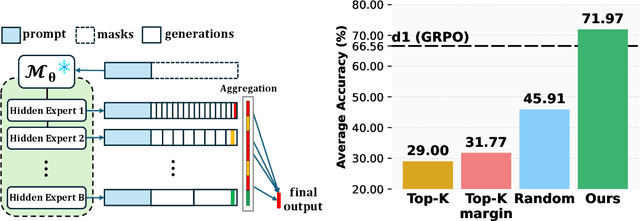
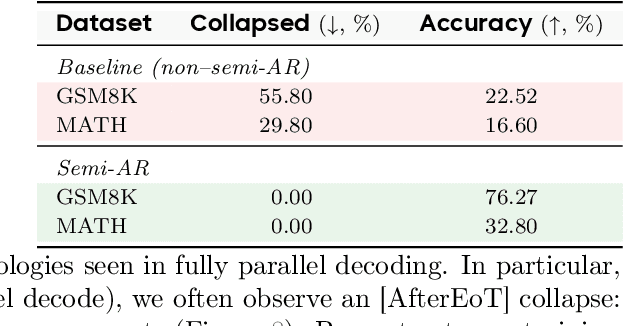
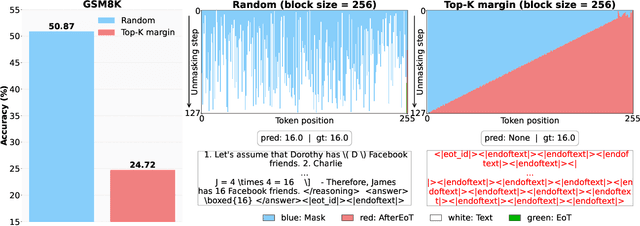
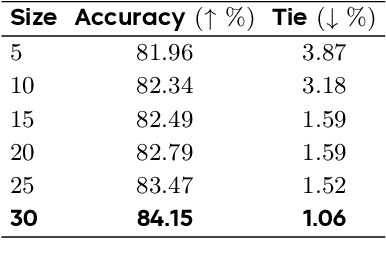
Diffusion-based large language models (dLLMs) are trained flexibly to model extreme dependence in the data distribution; however, how to best utilize this information at inference time remains an open problem. In this work, we uncover an interesting property of these models: dLLMs trained on textual data implicitly learn a mixture of semi-autoregressive experts, where different generation orders reveal different specialized behaviors. We show that committing to any single, fixed inference time schedule, a common practice, collapses performance by failing to leverage this latent ensemble. To address this, we introduce HEX (Hidden semiautoregressive EXperts for test-time scaling), a training-free inference method that ensembles across heterogeneous block schedules. By doing a majority vote over diverse block-sized generation paths, HEX robustly avoids failure modes associated with any single fixed schedule. On reasoning benchmarks such as GSM8K, it boosts accuracy by up to 3.56X (from 24.72% to 88.10%), outperforming top-K margin inference and specialized fine-tuned methods like GRPO, without additional training. HEX even yields significant gains on MATH benchmark from 16.40% to 40.00%, scientific reasoning on ARC-C from 54.18% to 87.80%, and TruthfulQA from 28.36% to 57.46%. Our results establish a new paradigm for test-time scaling in diffusion-based LLMs (dLLMs), revealing that the sequence in which masking is performed plays a critical role in determining performance during inference.