 Add to Chrome
 Add to Firefox
 Add to Edge
SpeGCL: Self-supervised Graph Spectrum Contrastive Learning without Positive Samples
Oct 14, 2024
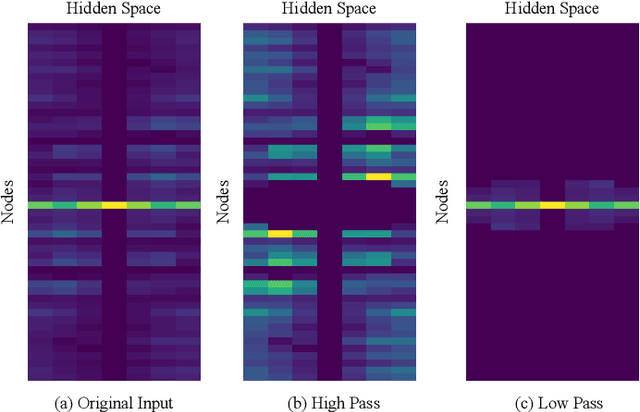
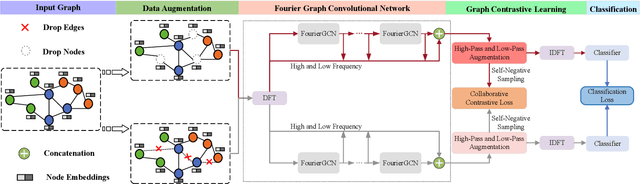
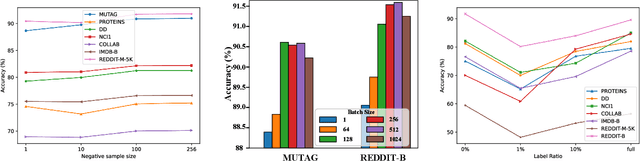
Graph Contrastive Learning (GCL) excels at managing noise and fluctuations in input data, making it popular in various fields (e.g., social networks, and knowledge graphs). Our study finds that the difference in high-frequency information between augmented graphs is greater than that in low-frequency information. However, most existing GCL methods focus mainly on the time domain (low-frequency information) for node feature representations and cannot make good use of high-frequency information to speed up model convergence. Furthermore, existing GCL paradigms optimize graph embedding representations by pulling the distance between positive sample pairs closer and pushing the distance between positive and negative sample pairs farther away, but our theoretical analysis shows that graph contrastive learning benefits from pushing negative pairs farther away rather than pulling positive pairs closer. To solve the above-mentioned problems, we propose a novel spectral GCL framework without positive samples, named SpeGCL. Specifically, to solve the problem that existing GCL methods cannot utilize high-frequency information, SpeGCL uses a Fourier transform to extract high-frequency and low-frequency information of node features, and constructs a contrastive learning mechanism in a Fourier space to obtain better node feature representation. Furthermore, SpeGCL relies entirely on negative samples to refine the graph embedding. We also provide a theoretical justification for the efficacy of using only negative samples in SpeGCL. Extensive experiments on un-supervised learning, transfer learning, and semi-supervised learning have validated the superiority of our SpeGCL framework over the state-of-the-art GCL methods.

Chain-of-Restoration: Multi-Task Image Restoration Models are Zero-Shot Step-by-Step Universal Image Restorers
Oct 11, 2024


Despite previous works typically targeting isolated degradation types, recent research has increasingly focused on addressing composite degradations which involve a complex interplay of multiple different isolated degradations. Recognizing the challenges posed by the exponential number of possible degradation combinations, we propose Universal Image Restoration (UIR), a new task setting that requires models to be trained on a set of degradation bases and then remove any degradation that these bases can potentially compose in a zero-shot manner. Inspired by the Chain-of-Thought which prompts LLMs to address problems step-by-step, we propose the Chain-of-Restoration (CoR), which instructs models to step-by-step remove unknown composite degradations. By integrating a simple Degradation Discriminator into pre-trained multi-task models, CoR facilitates the process where models remove one degradation basis per step, continuing this process until the image is fully restored from the unknown composite degradation. Extensive experiments show that CoR significantly improves model performance in removing composite degradations, achieving results comparable to or surpassing those of State-of-The-Art (SoTA) methods trained on all degradations. The code will be released at https://github.com/toummHus/Chain-of-Restoration.
SegEarth-OV: Towards Traning-Free Open-Vocabulary Segmentation for Remote Sensing Images
Oct 02, 2024Remote sensing image plays an irreplaceable role in fields such as agriculture, water resources, military, and disaster relief. Pixel-level interpretation is a critical aspect of remote sensing image applications; however, a prevalent limitation remains the need for extensive manual annotation. For this, we try to introduce open-vocabulary semantic segmentation (OVSS) into the remote sensing context. However, due to the sensitivity of remote sensing images to low-resolution features, distorted target shapes and ill-fitting boundaries are exhibited in the prediction mask. To tackle this issue, we propose a simple and general upsampler, SimFeatUp, to restore lost spatial information in deep features in a training-free style. Further, based on the observation of the abnormal response of local patch tokens to [CLS] token in CLIP, we propose to execute a straightforward subtraction operation to alleviate the global bias in patch tokens. Extensive experiments are conducted on 17 remote sensing datasets spanning semantic segmentation, building extraction, road detection, and flood detection tasks. Our method achieves an average of 5.8%, 8.2%, 4%, and 15.3% improvement over state-of-the-art methods on 4 tasks. All codes are released. \url{https://earth-insights.github.io/SegEarth-OV}
Component-based Sketching for Deep ReLU Nets
Sep 21, 2024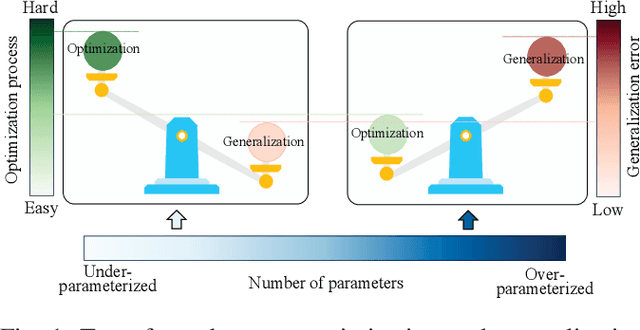
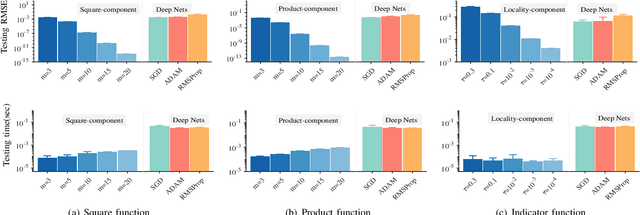
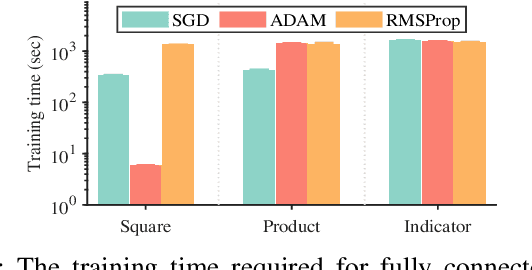
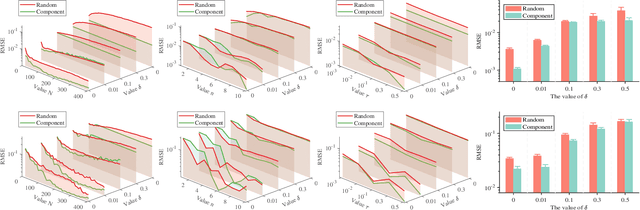
Deep learning has made profound impacts in the domains of data mining and AI, distinguished by the groundbreaking achievements in numerous real-world applications and the innovative algorithm design philosophy. However, it suffers from the inconsistency issue between optimization and generalization, as achieving good generalization, guided by the bias-variance trade-off principle, favors under-parameterized networks, whereas ensuring effective convergence of gradient-based algorithms demands over-parameterized networks. To address this issue, we develop a novel sketching scheme based on deep net components for various tasks. Specifically, we use deep net components with specific efficacy to build a sketching basis that embodies the advantages of deep networks. Subsequently, we transform deep net training into a linear empirical risk minimization problem based on the constructed basis, successfully avoiding the complicated convergence analysis of iterative algorithms. The efficacy of the proposed component-based sketching is validated through both theoretical analysis and numerical experiments. Theoretically, we show that the proposed component-based sketching provides almost optimal rates in approximating saturated functions for shallow nets and also achieves almost optimal generalization error bounds. Numerically, we demonstrate that, compared with the existing gradient-based training methods, component-based sketching possesses superior generalization performance with reduced training costs.
Symmetry Breaking in Neural Network Optimization: Insights from Input Dimension Expansion
Sep 10, 2024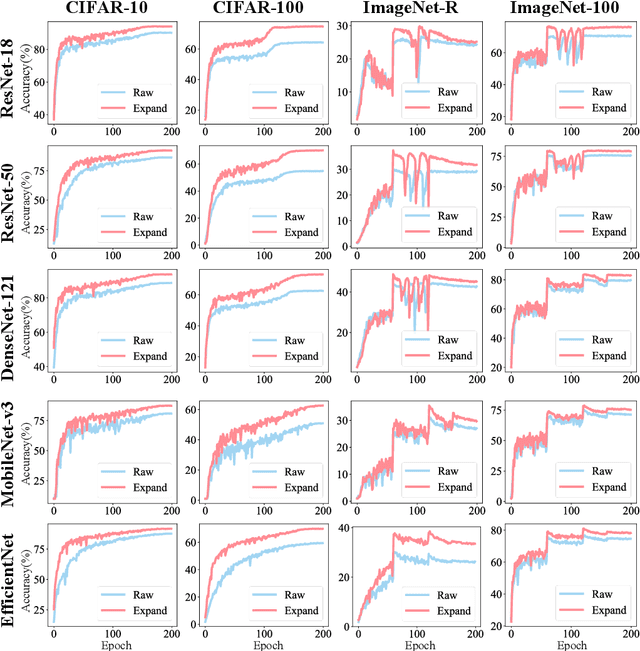


Understanding the mechanisms behind neural network optimization is crucial for improving network design and performance. While various optimization techniques have been developed, a comprehensive understanding of the underlying principles that govern these techniques remains elusive. Specifically, the role of symmetry breaking, a fundamental concept in physics, has not been fully explored in neural network optimization. This gap in knowledge limits our ability to design networks that are both efficient and effective. Here, we propose the symmetry breaking hypothesis to elucidate the significance of symmetry breaking in enhancing neural network optimization. We demonstrate that a simple input expansion can significantly improve network performance across various tasks, and we show that this improvement can be attributed to the underlying symmetry breaking mechanism. We further develop a metric to quantify the degree of symmetry breaking in neural networks, providing a practical approach to evaluate and guide network design. Our findings confirm that symmetry breaking is a fundamental principle that underpins various optimization techniques, including dropout, batch normalization, and equivariance. By quantifying the degree of symmetry breaking, our work offers a practical technique for performance enhancement and a metric to guide network design without the need for complete datasets and extensive training processes.
IVGF: The Fusion-Guided Infrared and Visible General Framework
Sep 02, 2024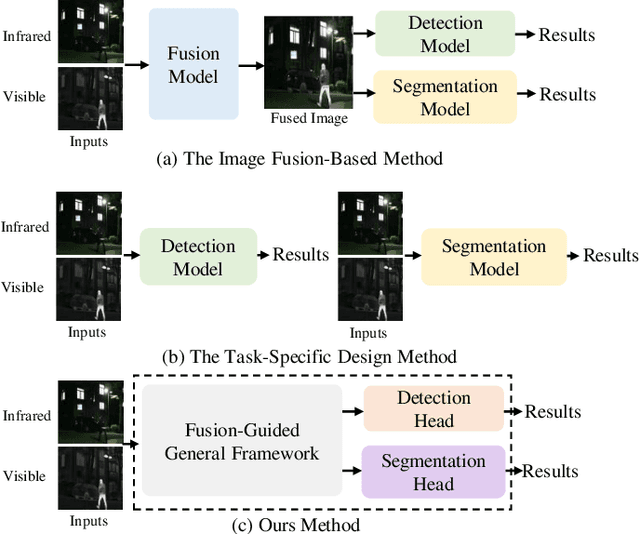
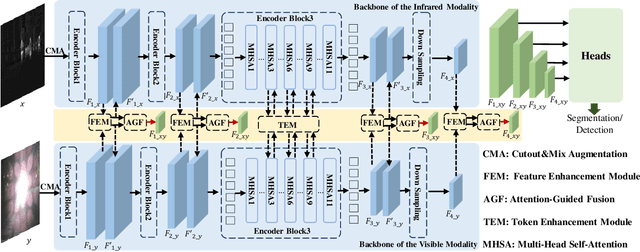
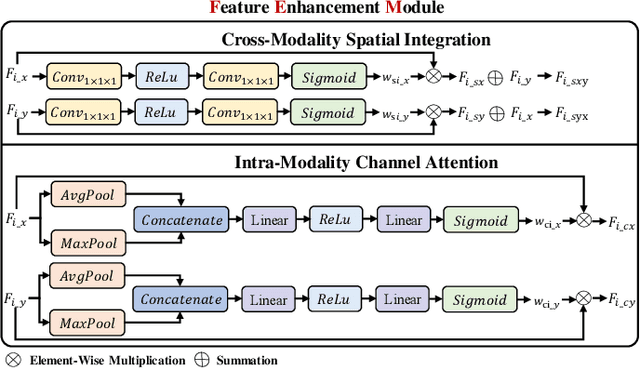

Infrared and visible dual-modality tasks such as semantic segmentation and object detection can achieve robust performance even in extreme scenes by fusing complementary information. Most current methods design task-specific frameworks, which are limited in generalization across multiple tasks. In this paper, we propose a fusion-guided infrared and visible general framework, IVGF, which can be easily extended to many high-level vision tasks. Firstly, we adopt the SOTA infrared and visible foundation models to extract the general representations. Then, to enrich the semantics information of these general representations for high-level vision tasks, we design the feature enhancement module and token enhancement module for feature maps and tokens, respectively. Besides, the attention-guided fusion module is proposed for effectively fusing by exploring the complementary information of two modalities. Moreover, we also adopt the cutout&mix augmentation strategy to conduct the data augmentation, which further improves the ability of the model to mine the regional complementary between the two modalities. Extensive experiments show that the IVGF outperforms state-of-the-art dual-modality methods in the semantic segmentation and object detection tasks. The detailed ablation studies demonstrate the effectiveness of each module, and another experiment explores the anti-missing modality ability of the proposed method in the dual-modality semantic segmentation task.
Towards Student Actions in Classroom Scenes: New Dataset and Baseline
Sep 02, 2024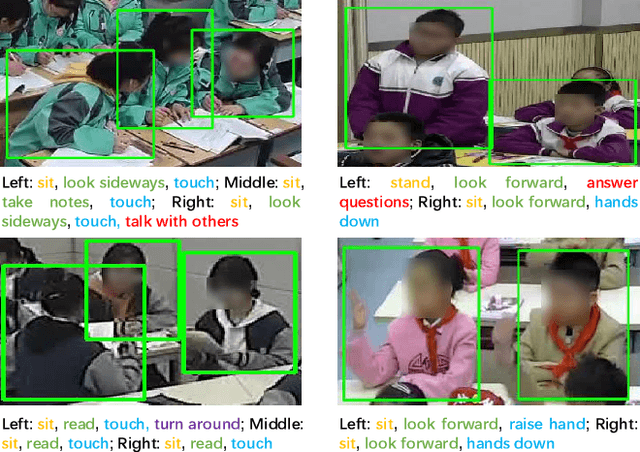
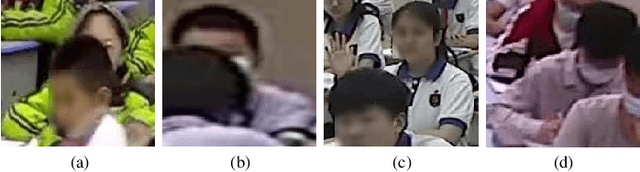
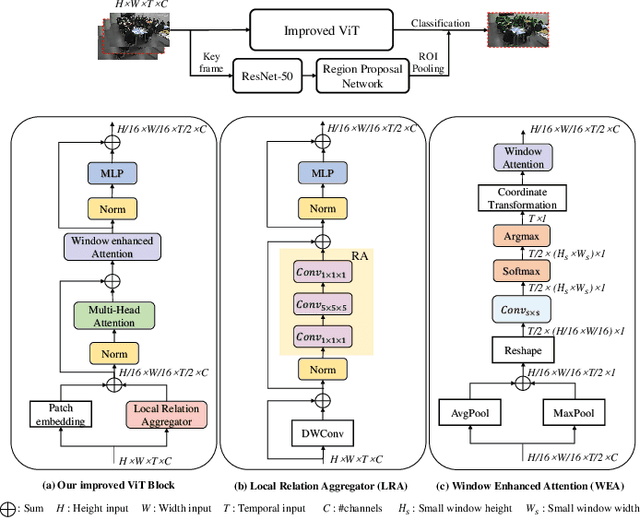
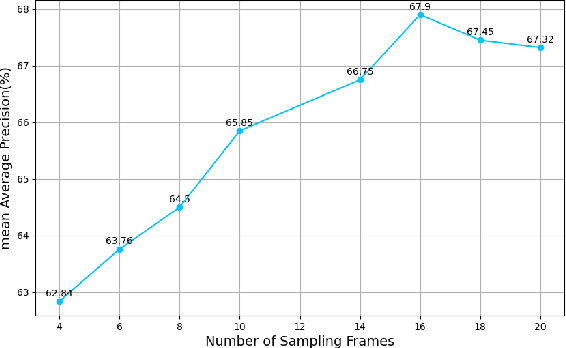
Analyzing student actions is an important and challenging task in educational research. Existing efforts have been hampered by the lack of accessible datasets to capture the nuanced action dynamics in classrooms. In this paper, we present a new multi-label student action video (SAV) dataset for complex classroom scenes. The dataset consists of 4,324 carefully trimmed video clips from 758 different classrooms, each labeled with 15 different actions displayed by students in classrooms. Compared to existing behavioral datasets, our dataset stands out by providing a wide range of real classroom scenarios, high-quality video data, and unique challenges, including subtle movement differences, dense object engagement, significant scale differences, varied shooting angles, and visual occlusion. The increased complexity of the dataset brings new opportunities and challenges for benchmarking action detection. Innovatively, we also propose a new baseline method, a visual transformer for enhancing attention to key local details in small and dense object regions. Our method achieves excellent performance with mean Average Precision (mAP) of 67.9\% and 27.4\% on SAV and AVA, respectively. This paper not only provides the dataset but also calls for further research into AI-driven educational tools that may transform teaching methodologies and learning outcomes. The code and dataset will be released at https://github.com/Ritatanz/SAV.
Enhancing Underwater Imaging with 4-D Light Fields: Dataset and Method
Aug 30, 2024In this paper, we delve into the realm of 4-D light fields (LFs) to enhance underwater imaging plagued by light absorption, scattering, and other challenges. Contrasting with conventional 2-D RGB imaging, 4-D LF imaging excels in capturing scenes from multiple perspectives, thereby indirectly embedding geometric information. This intrinsic property is anticipated to effectively address the challenges associated with underwater imaging. By leveraging both explicit and implicit depth cues present in 4-D LF images, we propose a progressive, mutually reinforcing framework for underwater 4-D LF image enhancement and depth estimation. Specifically, our framework explicitly utilizes estimated depth information alongside implicit depth-related dynamic convolutional kernels to modulate output features. The entire framework decomposes this complex task, iteratively optimizing the enhanced image and depth information to progressively achieve optimal enhancement results. More importantly, we construct the first 4-D LF-based underwater image dataset for quantitative evaluation and supervised training of learning-based methods, comprising 75 underwater scenes and 3675 high-resolution 2K pairs. To craft vibrant and varied underwater scenes, we build underwater environments with various objects and adopt several types of degradation. Through extensive experimentation, we showcase the potential and superiority of 4-D LF-based underwater imaging vis-a-vis traditional 2-D RGB-based approaches. Moreover, our method effectively corrects color bias and achieves state-of-the-art performance. The dataset and code will be publicly available at https://github.com/linlos1234/LFUIE.
Dual-CBA: Improving Online Continual Learning via Dual Continual Bias Adaptors from a Bi-level Optimization Perspective
Aug 26, 2024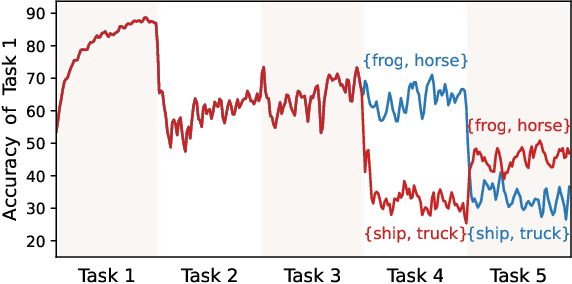
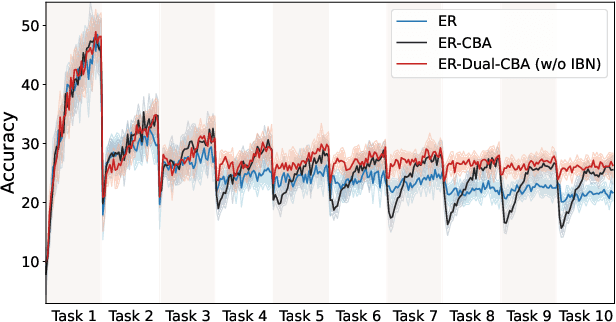
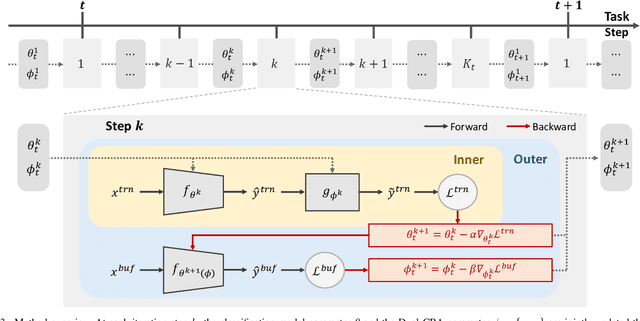
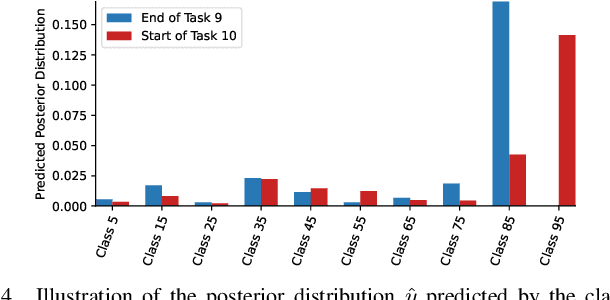
In online continual learning (CL), models trained on changing distributions easily forget previously learned knowledge and bias toward newly received tasks. To address this issue, we present Continual Bias Adaptor (CBA), a bi-level framework that augments the classification network to adapt to catastrophic distribution shifts during training, enabling the network to achieve a stable consolidation of all seen tasks. However, the CBA module adjusts distribution shifts in a class-specific manner, exacerbating the stability gap issue and, to some extent, fails to meet the need for continual testing in online CL. To mitigate this challenge, we further propose a novel class-agnostic CBA module that separately aggregates the posterior probabilities of classes from new and old tasks, and applies a stable adjustment to the resulting posterior probabilities. We combine the two kinds of CBA modules into a unified Dual-CBA module, which thus is capable of adapting to catastrophic distribution shifts and simultaneously meets the real-time testing requirements of online CL. Besides, we propose Incremental Batch Normalization (IBN), a tailored BN module to re-estimate its population statistics for alleviating the feature bias arising from the inner loop optimization problem of our bi-level framework. To validate the effectiveness of the proposed method, we theoretically provide some insights into how it mitigates catastrophic distribution shifts, and empirically demonstrate its superiority through extensive experiments based on four rehearsal-based baselines and three public continual learning benchmarks.
HAIR: Hypernetworks-based All-in-One Image Restoration
Aug 15, 2024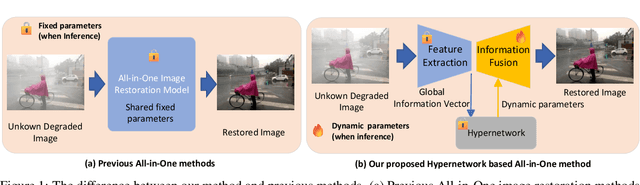


Image restoration involves recovering a high-quality clean image from its degraded version, which is a fundamental task in computer vision. Recent progress in image restoration has demonstrated the effectiveness of learning models capable of addressing various degradations simultaneously, i.e., the All-in-One image restoration models. However, these existing methods typically utilize the same parameters facing images with different degradation types, which causes the model to be forced to trade off between degradation types, therefore impair the total performance. To solve this problem, we propose HAIR, a Hypernetworks-based plug-in-and-play method that dynamically generated parameters for the corresponding networks based on the contents of input images. HAIR consists of 2 main components: Classifier (Cl) and Hyper Selecting Net (HSN). To be more specific, the Classifier is a simple image classification network which is used to generate a Global Information Vector (GIV) that contains the degradation information of the input image; And the HSNs can be seen as a simple Fully-connected Neural Network that receive the GIV and output parameters for the corresponding modules. Extensive experiments shows that incorporating HAIR into the architectures can significantly improve the performance of different models on image restoration tasks at a low cost, \textbf{although HAIR only generate parameters and haven't change these models' logical structures at all.} With incorporating HAIR into the popular architecture Restormer, our method obtains superior or at least comparable performance to current state-of-the-art methods on a range of image restoration tasks. \href{https://github.com/toummHus/HAIR}{\textcolor{blue}{$\underline{\textbf{Code and pre-trained checkpoints are available here.}}$}}