 Add to Chrome
 Add to Firefox
 Add to Edge
Harnessing the Potential of Optimizing Data Mixtures via Bayesian Domain Reweighting
Jul 30, 2026
The performance of Large Language Models (LLMs) is fundamentally influenced by the distributional composition of multi-domain pre-training data. While manual heuristics were prevalent in early models, they increasingly fail to capture the intricate synergies between domains as data complexity grows. To overcome the issue, a dominant approach seeks to fit a proxy function mapping between domain weights and their corresponding validation losses, and then find the optimal domain weights to minimize validation losses. These methods rely on strong structural assumptions, such as rank invariance or scaling laws, which are often violated, resulting in non-negligible estimation bias. A promising approach is to directly optimize the weighting scheme from data. However, it suffers from unstable optimization trajectory and prohibitive computational overhead, limiting its potential to search better domain weights configurations. This paper presents a Bayesian domain weighting method to infer the weights from a Dirichlet distribution via introducing Gamma prior information learned from observations. Experimental results demonstrate that proposed method could achieve stable and efficient domain weights learning, and identifies optimal mixtures while consuming substantially less data than search-based function-fitting methods, revitalizing optimization-based domain weighting for large-scale applications.

Sharper Analysis of Single-Loop Methods for Bilevel Optimization
Jul 11, 2026Bilevel optimization underpins many machine learning applications, including hyperparameter optimization, meta-learning, neural architecture search, and reinforcement learning. While hypergradient-based methods have advanced significantly, a gap persists between theoretical guarantees and practical single-loop implementations required for efficiency. We bridge this gap by establishing sharper convergence results for single-loop approximate implicit differentiation (AID) and iterative differentiation (ITD) methods, leveraging our proposed analytical framework, decoupled norm analysis (DNA). For AID, we improve the convergence rate from $\mathcal{O}(κ^6/K)$ to $\mathcal{O}(κ^5/K)$, where $κ$ is the condition number of the inner-level problem. For ITD, we prove that the asymptotic error is $\mathcal{O}(κ^2)$, exactly matching the known lower bound and improving upon the previous $\mathcal{O}(κ^3)$ guarantee. Numerical experiments on synthetic and real tasks corroborate our theoretical findings.
A Limit Theory of Foundation Models: A Mathematical Approach to Understanding Emergent Intelligence and Scaling Laws
Apr 28, 2026Emergent intelligence have played a major role in the modern AI development. While existing studies primarily rely on empirical observations to characterize this phenomenon, a rigorous theoretical framework remains underexplored. This study attempts to develop a mathematical approach to formalize emergent intelligence from the perspective of limit theory. Specifically, we introduce a performance function E(N, P, K), dependent on data size N, model size P and training steps K, to quantify intelligence behavior. We posit that intelligence emerges as a transition from finite to effectively infinite knowledge, and thus recast emergent intelligence as existence of the limit $\lim_{N,P,K \to \infty} \mathcal{E}(N,P,K)$, with emergent abilities corresponding to the limiting behavior. This limit theory helps reveal that emergent intelligence originates from the existence of a parameter-limit architecture (referred to as the limit architecture), and that emergent intelligence rationally corresponds to the learning behavior of this limit system. By introducing tools from nonlinear Lipschitz operator theory, we prove that the necessary and sufficient conditions for existence of the limit architecture. Furthermore, we derive the scaling law of foundation models by leveraging tools of Lipschitz operator and covering number. Theoretical results show that: 1) emergent intelligence is governed by three key factors-training steps, data size and the model architecture, where the properties of basic blocks play a crucial role in constructing foundation models; 2) the critical condition Lip(T)=1 for emergent intelligence provides theoretical support for existing findings. 3) emergent intelligence is determined by an infinite-dimensional system, yet can be effectively realized in practice through a finite-dimensional architecture. Our empirical results corroborate these theoretical findings.
KoopGen: Koopman Generator Networks for Representing and Predicting Dynamical Systems with Continuous Spectra
Feb 15, 2026Representing and predicting high-dimensional and spatiotemporally chaotic dynamical systems remains a fundamental challenge in dynamical systems and machine learning. Although data-driven models can achieve accurate short-term forecasts, they often lack stability, interpretability, and scalability in regimes dominated by broadband or continuous spectra. Koopman-based approaches provide a principled linear perspective on nonlinear dynamics, but existing methods rely on restrictive finite-dimensional assumptions or explicit spectral parameterizations that degrade in high-dimensional settings. Against these issues, we introduce KoopGen, a generator-based neural Koopman framework that models dynamics through a structured, state-dependent representation of Koopman generators. By exploiting the intrinsic Cartesian decomposition into skew-adjoint and self-adjoint components, KoopGen separates conservative transport from irreversible dissipation while enforcing exact operator-theoretic constraints during learning. Across systems ranging from nonlinear oscillators to high-dimensional chaotic and spatiotemporal dynamics, KoopGen improves prediction accuracy and stability, while clarifying which components of continuous-spectrum dynamics admit interpretable and learnable representations.
DuMeta++: Spatiotemporal Dual Meta-Learning for Generalizable Few-Shot Brain Tissue Segmentation Across Diverse Ages
Feb 06, 2026Accurate segmentation of brain tissues from MRI scans is critical for neuroscience and clinical applications, but achieving consistent performance across the human lifespan remains challenging due to dynamic, age-related changes in brain appearance and morphology. While prior work has sought to mitigate these shifts by using self-supervised regularization with paired longitudinal data, such data are often unavailable in practice. To address this, we propose \emph{DuMeta++}, a dual meta-learning framework that operates without paired longitudinal data. Our approach integrates: (1) meta-feature learning to extract age-agnostic semantic representations of spatiotemporally evolving brain structures, and (2) meta-initialization learning to enable data-efficient adaptation of the segmentation model. Furthermore, we propose a memory-bank-based class-aware regularization strategy to enforce longitudinal consistency without explicit longitudinal supervision. We theoretically prove the convergence of our DuMeta++, ensuring stability. Experiments on diverse datasets (iSeg-2019, IBIS, OASIS, ADNI) under few-shot settings demonstrate that DuMeta++ outperforms existing methods in cross-age generalization. Code will be available at https://github.com/ladderlab-xjtu/DuMeta++.
Improving Memory Efficiency for Training KANs via Meta Learning
Jun 09, 2025Inspired by the Kolmogorov-Arnold representation theorem, KANs offer a novel framework for function approximation by replacing traditional neural network weights with learnable univariate functions. This design demonstrates significant potential as an efficient and interpretable alternative to traditional MLPs. However, KANs are characterized by a substantially larger number of trainable parameters, leading to challenges in memory efficiency and higher training costs compared to MLPs. To address this limitation, we propose to generate weights for KANs via a smaller meta-learner, called MetaKANs. By training KANs and MetaKANs in an end-to-end differentiable manner, MetaKANs achieve comparable or even superior performance while significantly reducing the number of trainable parameters and maintaining promising interpretability. Extensive experiments on diverse benchmark tasks, including symbolic regression, partial differential equation solving, and image classification, demonstrate the effectiveness of MetaKANs in improving parameter efficiency and memory usage. The proposed method provides an alternative technique for training KANs, that allows for greater scalability and extensibility, and narrows the training cost gap with MLPs stated in the original paper of KANs. Our code is available at https://github.com/Murphyzc/MetaKAN.
Removing Multiple Hybrid Adverse Weather in Video via a Unified Model
Mar 08, 2025Videos captured under real-world adverse weather conditions typically suffer from uncertain hybrid weather artifacts with heterogeneous degradation distributions. However, existing algorithms only excel at specific single degradation distributions due to limited adaption capacity and have to deal with different weather degradations with separately trained models, thus may fail to handle real-world stochastic weather scenarios. Besides, the model training is also infeasible due to the lack of paired video data to characterize the coexistence of multiple weather. To ameliorate the aforementioned issue, we propose a novel unified model, dubbed UniWRV, to remove multiple heterogeneous video weather degradations in an all-in-one fashion. Specifically, to tackle degenerate spatial feature heterogeneity, we propose a tailored weather prior guided module that queries exclusive priors for different instances as prompts to steer spatial feature characterization. To tackle degenerate temporal feature heterogeneity, we propose a dynamic routing aggregation module that can automatically select optimal fusion paths for different instances to dynamically integrate temporal features. Additionally, we managed to construct a new synthetic video dataset, termed HWVideo, for learning and benchmarking multiple hybrid adverse weather removal, which contains 15 hybrid weather conditions with a total of 1500 adverse-weather/clean paired video clips. Real-world hybrid weather videos are also collected for evaluating model generalizability. Comprehensive experiments demonstrate that our UniWRV exhibits robust and superior adaptation capability in multiple heterogeneous degradations learning scenarios, including various generic video restoration tasks beyond weather removal.
On the Noise Robustness of In-Context Learning for Text Generation
May 27, 2024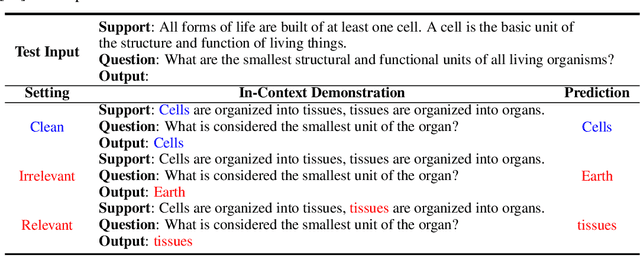
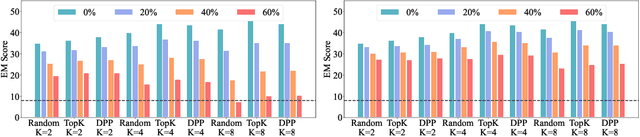
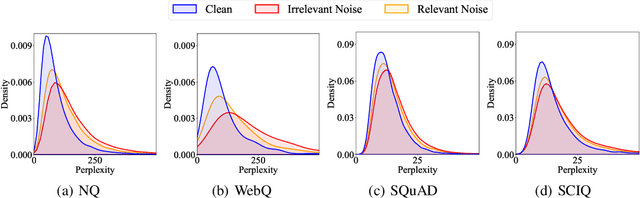
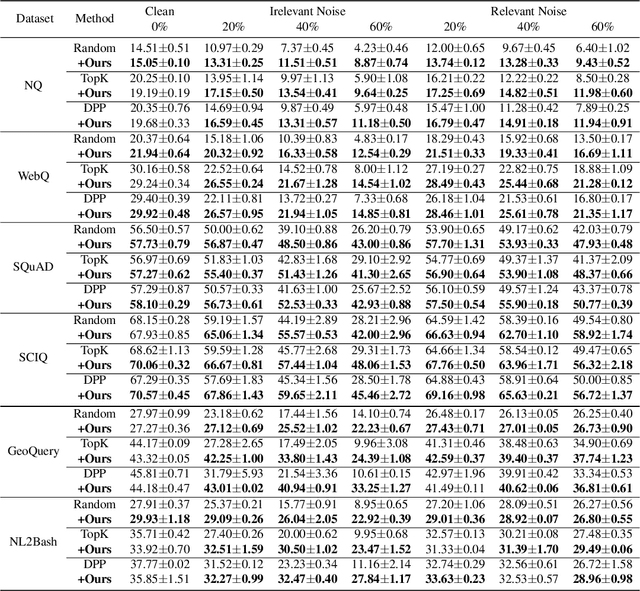
Large language models (LLMs) have shown impressive performance on downstream tasks by in-context learning (ICL), which heavily relies on the quality of demonstrations selected from a large set of annotated examples. Recent works claim that in-context learning is robust to noisy demonstrations in text classification. In this work, we show that, on text generation tasks, noisy annotations significantly hurt the performance of in-context learning. To circumvent the issue, we propose a simple and effective approach called Local Perplexity Ranking (LPR), which replaces the "noisy" candidates with their nearest neighbors that are more likely to be clean. Our method is motivated by analyzing the perplexity deviation caused by noisy labels and decomposing perplexity into inherent perplexity and matching perplexity. Our key idea behind LPR is thus to decouple the matching perplexity by performing the ranking among the neighbors in semantic space. Our approach can prevent the selected demonstrations from including mismatched input-label pairs while preserving the effectiveness of the original selection methods. Extensive experiments demonstrate the effectiveness of LPR, improving the EM score by up to 18.75 on common benchmarks with noisy annotations.
Are Dense Labels Always Necessary for 3D Object Detection from Point Cloud?
Mar 05, 2024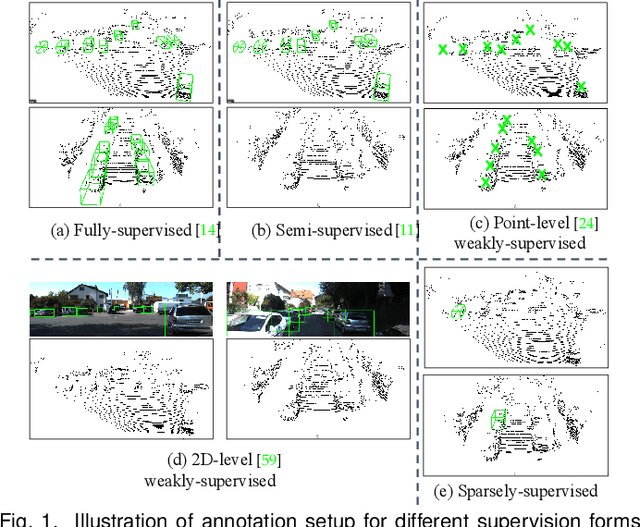
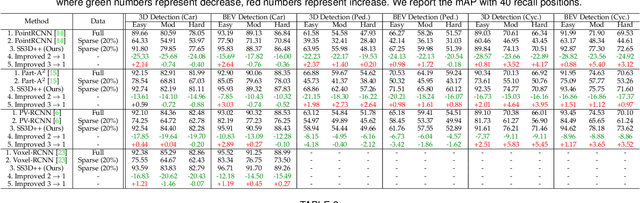
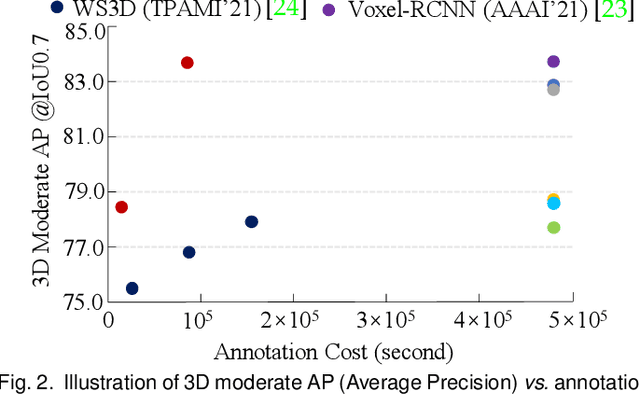

Current state-of-the-art (SOTA) 3D object detection methods often require a large amount of 3D bounding box annotations for training. However, collecting such large-scale densely-supervised datasets is notoriously costly. To reduce the cumbersome data annotation process, we propose a novel sparsely-annotated framework, in which we just annotate one 3D object per scene. Such a sparse annotation strategy could significantly reduce the heavy annotation burden, while inexact and incomplete sparse supervision may severely deteriorate the detection performance. To address this issue, we develop the SS3D++ method that alternatively improves 3D detector training and confident fully-annotated scene generation in a unified learning scheme. Using sparse annotations as seeds, we progressively generate confident fully-annotated scenes based on designing a missing-annotated instance mining module and reliable background mining module. Our proposed method produces competitive results when compared with SOTA weakly-supervised methods using the same or even more annotation costs. Besides, compared with SOTA fully-supervised methods, we achieve on-par or even better performance on the KITTI dataset with about 5x less annotation cost, and 90% of their performance on the Waymo dataset with about 15x less annotation cost. The additional unlabeled training scenes could further boost the performance. The code will be available at https://github.com/gaocq/SS3D2.
Dual Meta-Learning with Longitudinally Generalized Regularization for One-Shot Brain Tissue Segmentation Across the Human Lifespan
Aug 13, 2023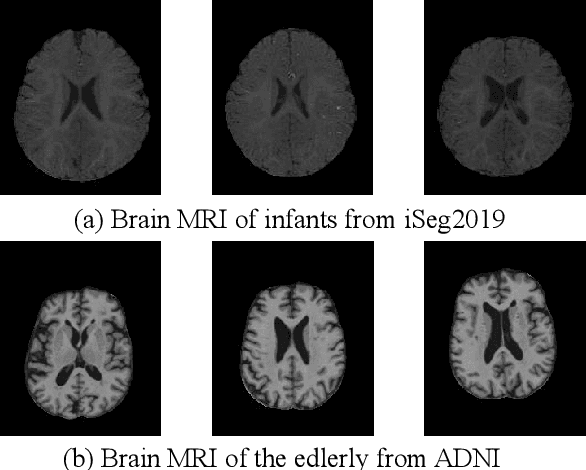
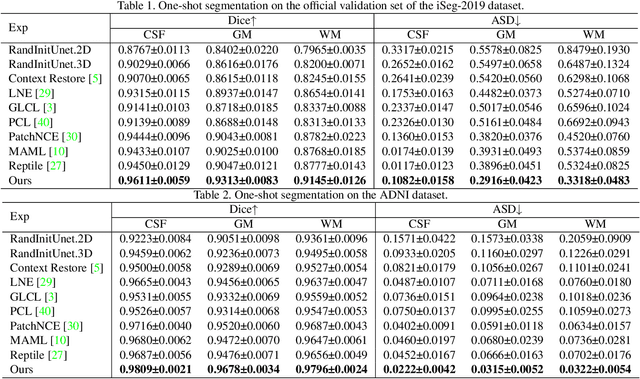
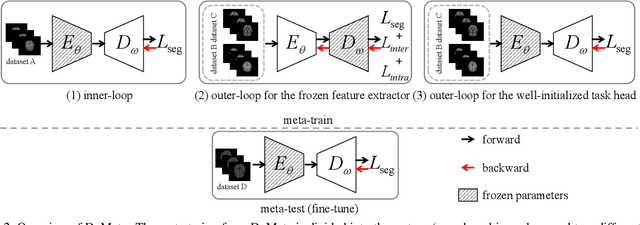
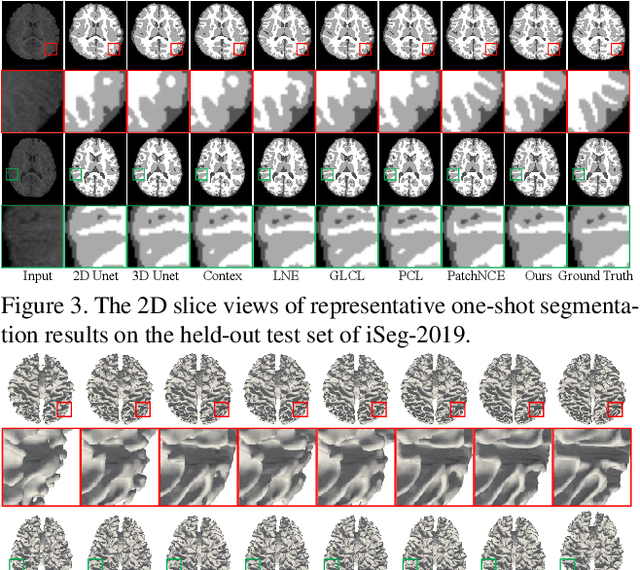
Brain tissue segmentation is essential for neuroscience and clinical studies. However, segmentation on longitudinal data is challenging due to dynamic brain changes across the lifespan. Previous researches mainly focus on self-supervision with regularizations and will lose longitudinal generalization when fine-tuning on a specific age group. In this paper, we propose a dual meta-learning paradigm to learn longitudinally consistent representations and persist when fine-tuning. Specifically, we learn a plug-and-play feature extractor to extract longitudinal-consistent anatomical representations by meta-feature learning and a well-initialized task head for fine-tuning by meta-initialization learning. Besides, two class-aware regularizations are proposed to encourage longitudinal consistency. Experimental results on the iSeg2019 and ADNI datasets demonstrate the effectiveness of our method. Our code is available at https://github.com/ladderlab-xjtu/DuMeta.