 Add to Chrome
 Add to Firefox
 Add to Edge
Any Information Is Just Worth One Single Screenshot: Unifying Search With Visualized Information Retrieval
Feb 17, 2025
With the popularity of multimodal techniques, it receives growing interests to acquire useful information in visual forms. In this work, we formally define an emerging IR paradigm called \textit{Visualized Information Retrieval}, or \textbf{Vis-IR}, where multimodal information, such as texts, images, tables and charts, is jointly represented by a unified visual format called \textbf{Screenshots}, for various retrieval applications. We further make three key contributions for Vis-IR. First, we create \textbf{VIRA} (Vis-IR Aggregation), a large-scale dataset comprising a vast collection of screenshots from diverse sources, carefully curated into captioned and question-answer formats. Second, we develop \textbf{UniSE} (Universal Screenshot Embeddings), a family of retrieval models that enable screenshots to query or be queried across arbitrary data modalities. Finally, we construct \textbf{MVRB} (Massive Visualized IR Benchmark), a comprehensive benchmark covering a variety of task forms and application scenarios. Through extensive evaluations on MVRB, we highlight the deficiency from existing multimodal retrievers and the substantial improvements made by UniSE. Our work will be shared with the community, laying a solid foundation for this emerging field.

O1 Embedder: Let Retrievers Think Before Action
Feb 12, 2025The growing power of large language models (LLMs) has revolutionized how people access and utilize information. Notably, the LLMs excel at performing fine-grained data representation, which facilitates precise retrieval of information. They also generate high-quality answers based on external references, enabling the production of useful knowledge. The recent introduction of reasoning models, like OpenAI O1 and DeepSeek R1, marks another leap forward, highlighting LLMs' ability to think progressively before delivering final answers. This breakthrough significantly improves the ability to address complex tasks, e.g., coding and math proofs. Inspired by this progress, we aim to develop similar capabilities for retrieval models, which hold great promise for tackling critical challenges in the field, including multi-task retrieval, zero-shot retrieval, and tasks requiring intensive reasoning of complex relationships. With this motivation, we propose a novel approach called O1 Embedder, which generates useful thoughts for the input query before making retrieval for the target documents. To realize this objective, we conquer two technical difficulties. First, we design a data synthesis workflow, creating training signals for O1 Embedder by generating initial thoughts from an LLM-expert and subsequently refining them using a retrieval committee. Second, we optimize the training process, enabling a pre-trained model to be jointly fine-tuned to generate retrieval thoughts via behavior cloning and perform dense retrieval through contrastive learning. Our approach is evaluated by comprehensive experiments, where substantial improvements are achieved across 12 popular datasets, spanning both in-domain and out-of-domain scenarios. These results highlight O1 Embedder's remarkable accuracy and generalizability, paving the way for the development of next-generation IR foundation models.
FuXi-$α$: Scaling Recommendation Model with Feature Interaction Enhanced Transformer
Feb 05, 2025
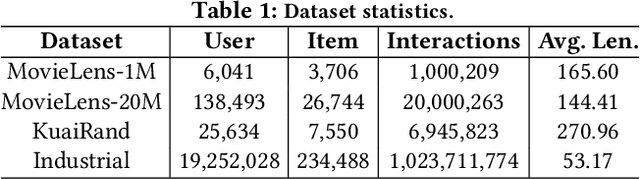


Inspired by scaling laws and large language models, research on large-scale recommendation models has gained significant attention. Recent advancements have shown that expanding sequential recommendation models to large-scale recommendation models can be an effective strategy. Current state-of-the-art sequential recommendation models primarily use self-attention mechanisms for explicit feature interactions among items, while implicit interactions are managed through Feed-Forward Networks (FFNs). However, these models often inadequately integrate temporal and positional information, either by adding them to attention weights or by blending them with latent representations, which limits their expressive power. A recent model, HSTU, further reduces the focus on implicit feature interactions, constraining its performance. We propose a new model called FuXi-$\alpha$ to address these issues. This model introduces an Adaptive Multi-channel Self-attention mechanism that distinctly models temporal, positional, and semantic features, along with a Multi-stage FFN to enhance implicit feature interactions. Our offline experiments demonstrate that our model outperforms existing models, with its performance continuously improving as the model size increases. Additionally, we conducted an online A/B test within the Huawei Music app, which showed a $4.76\%$ increase in the average number of songs played per user and a $5.10\%$ increase in the average listening duration per user. Our code has been released at https://github.com/USTC-StarTeam/FuXi-alpha.
General Time-series Model for Universal Knowledge Representation of Multivariate Time-Series data
Feb 05, 2025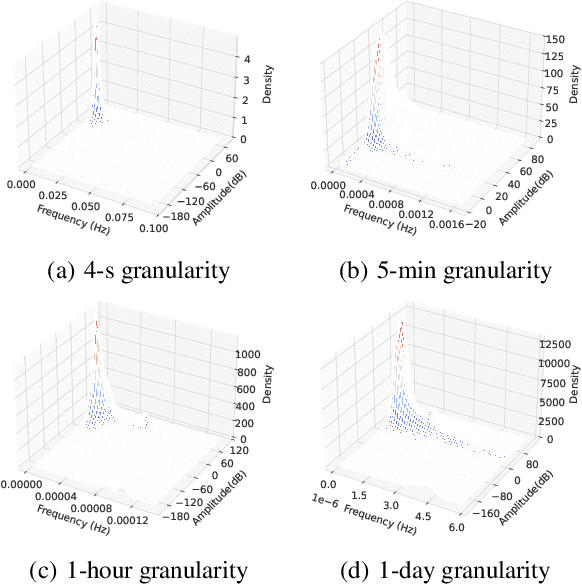
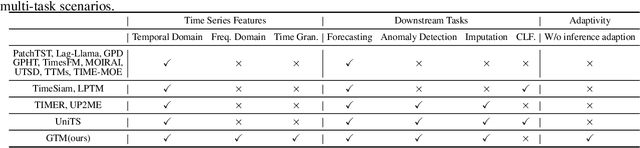
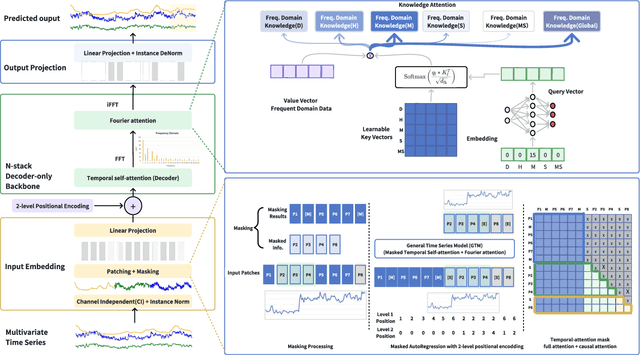

Universal knowledge representation is a central problem for multivariate time series(MTS) foundation models and yet remains open. This paper investigates this problem from the first principle and it makes four folds of contributions. First, a new empirical finding is revealed: time series with different time granularities (or corresponding frequency resolutions) exhibit distinct joint distributions in the frequency domain. This implies a crucial aspect of learning universal knowledge, one that has been overlooked by previous studies. Second, a novel Fourier knowledge attention mechanism is proposed to enable learning time granularity-aware representations from both the temporal and frequency domains. Third, an autoregressive blank infilling pre-training framework is incorporated to time series analysis for the first time, leading to a generative tasks agnostic pre-training strategy. To this end, we develop the General Time-series Model (GTM), a unified MTS foundation model that addresses the limitation of contemporary time series models, which often require token, pre-training, or model-level customizations for downstream tasks adaption. Fourth, extensive experiments show that GTM outperforms state-of-the-art (SOTA) methods across all generative tasks, including long-term forecasting, anomaly detection, and imputation.
Matryoshka Re-Ranker: A Flexible Re-Ranking Architecture With Configurable Depth and Width
Jan 27, 2025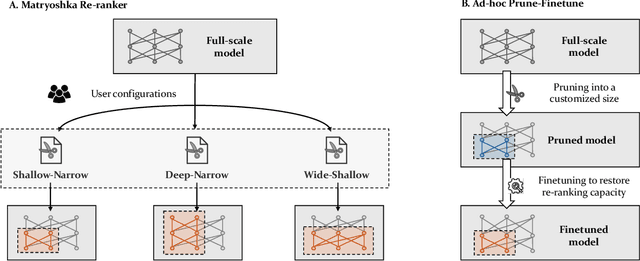
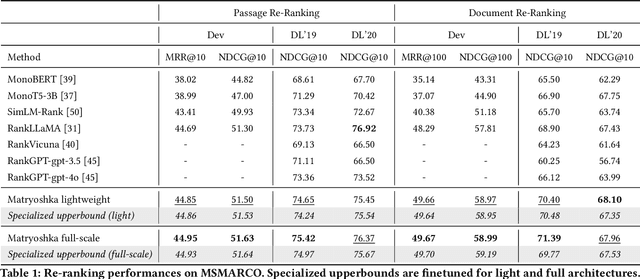
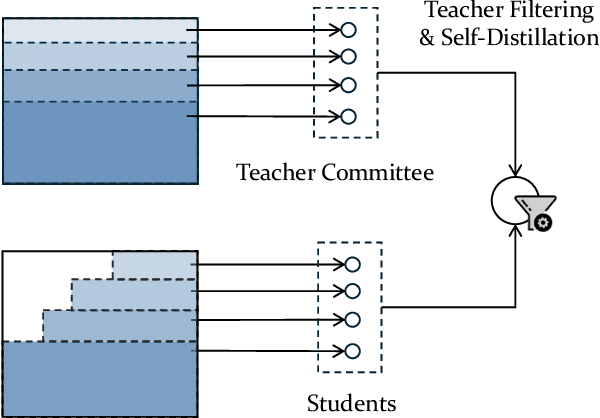
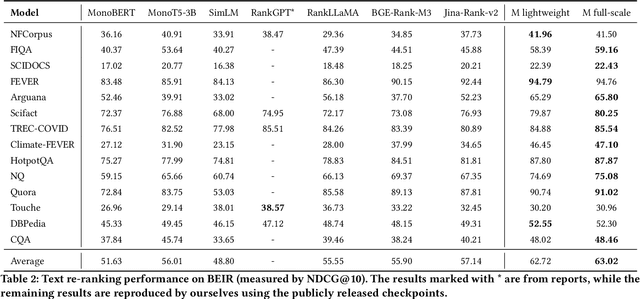
Large language models (LLMs) provide powerful foundations to perform fine-grained text re-ranking. However, they are often prohibitive in reality due to constraints on computation bandwidth. In this work, we propose a \textbf{flexible} architecture called \textbf{Matroyshka Re-Ranker}, which is designed to facilitate \textbf{runtime customization} of model layers and sequence lengths at each layer based on users' configurations. Consequently, the LLM-based re-rankers can be made applicable across various real-world situations. The increased flexibility may come at the cost of precision loss. To address this problem, we introduce a suite of techniques to optimize the performance. First, we propose \textbf{cascaded self-distillation}, where each sub-architecture learns to preserve a precise re-ranking performance from its super components, whose predictions can be exploited as smooth and informative teacher signals. Second, we design a \textbf{factorized compensation mechanism}, where two collaborative Low-Rank Adaptation modules, vertical and horizontal, are jointly employed to compensate for the precision loss resulted from arbitrary combinations of layer and sequence compression. We perform comprehensive experiments based on the passage and document retrieval datasets from MSMARCO, along with all public datasets from BEIR benchmark. In our experiments, Matryoshka Re-Ranker substantially outperforms the existing methods, while effectively preserving its superior performance across various forms of compression and different application scenarios.
Adaptive Sampled Softmax with Inverted Multi-Index: Methods, Theory and Applications
Jan 15, 2025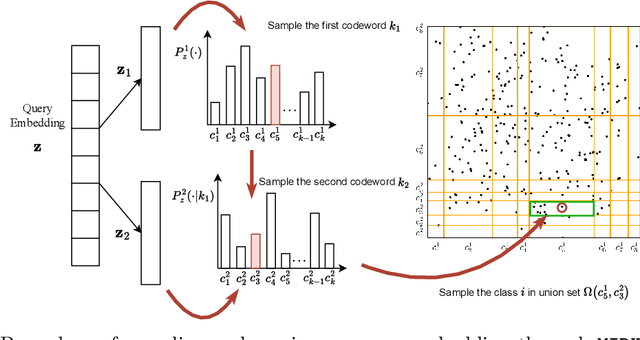


The softmax function is a cornerstone of multi-class classification, integral to a wide range of machine learning applications, from large-scale retrieval and ranking models to advanced large language models. However, its computational cost grows linearly with the number of classes, which becomes prohibitively expensive in scenarios with millions or even billions of classes. The sampled softmax, which relies on self-normalized importance sampling, has emerged as a powerful alternative, significantly reducing computational complexity. Yet, its estimator remains unbiased only when the sampling distribution matches the true softmax distribution. To improve both approximation accuracy and sampling efficiency, we propose the MIDX Sampler, a novel adaptive sampling strategy based on an inverted multi-index approach. Concretely, we decompose the softmax probability into several multinomial probabilities, each associated with a specific set of codewords and the last associated with the residual score of queries, thus reducing time complexity to the number of codewords instead of the number of classes. To further boost efficiency, we replace the query-specific residual probability with a simple uniform distribution, simplifying the computation while retaining high performance. Our method is backed by rigorous theoretical analysis, addressing key concerns such as sampling bias, gradient bias, convergence rates, and generalization error bounds. The results demonstrate that a smaller divergence from the ideal softmax distribution leads to faster convergence and improved generalization. Extensive experiments on large-scale language models, sequential recommenders, and extreme multi-class classification tasks confirm that the MIDX-Sampler delivers superior effectiveness and efficiency compared to existing approaches.
MegaPairs: Massive Data Synthesis For Universal Multimodal Retrieval
Dec 19, 2024Despite the rapidly growing demand for multimodal retrieval, progress in this field remains severely constrained by a lack of training data. In this paper, we introduce MegaPairs, a novel data synthesis method that leverages vision language models (VLMs) and open-domain images, together with a massive synthetic dataset generated from this method. Our empirical analysis shows that MegaPairs generates high-quality data, enabling the multimodal retriever to significantly outperform the baseline model trained on 70$\times$ more data from existing datasets. Moreover, since MegaPairs solely relies on general image corpora and open-source VLMs, it can be easily scaled up, enabling continuous improvements in retrieval performance. In this stage, we produced more than 26 million training instances and trained several models of varying sizes using this data. These new models achieve state-of-the-art zero-shot performance across 4 popular composed image retrieval (CIR) benchmarks and the highest overall performance on the 36 datasets provided by MMEB. They also demonstrate notable performance improvements with additional downstream fine-tuning. Our produced dataset, well-trained models, and data synthesis pipeline will be made publicly available to facilitate the future development of this field.
Boosting Long-Context Management via Query-Guided Activation Refilling
Dec 18, 2024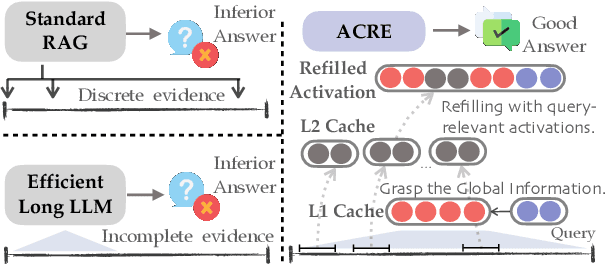
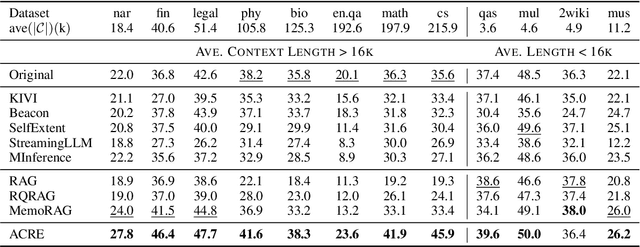

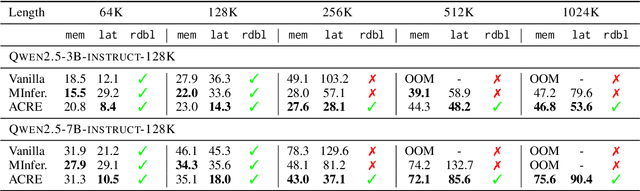
Processing long contexts poses a significant challenge for large language models (LLMs) due to their inherent context-window limitations and the computational burden of extensive key-value (KV) activations, which severely impact efficiency. For information-seeking tasks, full context perception is often unnecessary, as a query's information needs can dynamically range from localized details to a global perspective, depending on its complexity. However, existing methods struggle to adapt effectively to these dynamic information needs. In the paper, we propose a method for processing long-context information-seeking tasks via query-guided Activation Refilling (ACRE). ACRE constructs a Bi-layer KV Cache for long contexts, where the layer-1 (L1) cache compactly captures global information, and the layer-2 (L2) cache provides detailed and localized information. ACRE establishes a proxying relationship between the two caches, allowing the input query to attend to the L1 cache and dynamically refill it with relevant entries from the L2 cache. This mechanism integrates global understanding with query-specific local details, thus improving answer decoding. Experiments on a variety of long-context information-seeking datasets demonstrate ACRE's effectiveness, achieving improvements in both performance and efficiency.
AIR-Bench: Automated Heterogeneous Information Retrieval Benchmark
Dec 17, 2024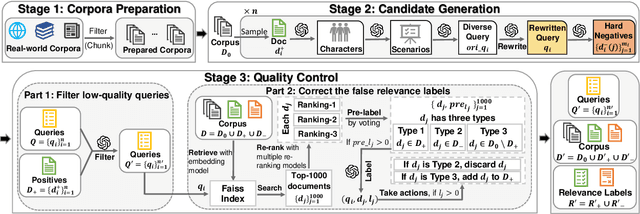

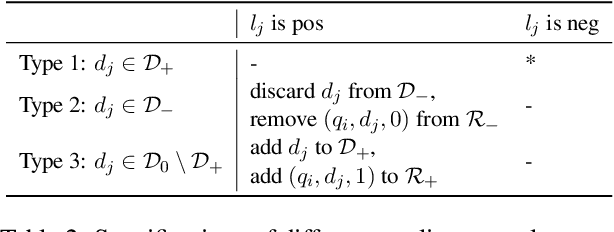

Evaluation plays a crucial role in the advancement of information retrieval (IR) models. However, current benchmarks, which are based on predefined domains and human-labeled data, face limitations in addressing evaluation needs for emerging domains both cost-effectively and efficiently. To address this challenge, we propose the Automated Heterogeneous Information Retrieval Benchmark (AIR-Bench). AIR-Bench is distinguished by three key features: 1) Automated. The testing data in AIR-Bench is automatically generated by large language models (LLMs) without human intervention. 2) Heterogeneous. The testing data in AIR-Bench is generated with respect to diverse tasks, domains and languages. 3) Dynamic. The domains and languages covered by AIR-Bench are constantly augmented to provide an increasingly comprehensive evaluation benchmark for community developers. We develop a reliable and robust data generation pipeline to automatically create diverse and high-quality evaluation datasets based on real-world corpora. Our findings demonstrate that the generated testing data in AIR-Bench aligns well with human-labeled testing data, making AIR-Bench a dependable benchmark for evaluating IR models. The resources in AIR-Bench are publicly available at https://github.com/AIR-Bench/AIR-Bench.
Boosting Long-Context Information Seeking via Query-Guided Activation Refilling
Dec 17, 2024Processing long contexts poses a significant challenge for large language models (LLMs) due to their inherent context-window limitations and the computational burden of extensive key-value (KV) activations, which severely impact efficiency. For information-seeking tasks, full context perception is often unnecessary, as a query's information needs can dynamically range from localized details to a global perspective, depending on its complexity. However, existing methods struggle to adapt effectively to these dynamic information needs. In the paper, we propose a method for processing long-context information-seeking tasks via query-guided Activation Refilling (ACRE). ACRE constructs a Bi-layer KV Cache for long contexts, where the layer-1 (L1) cache compactly captures global information, and the layer-2 (L2) cache provides detailed and localized information. ACRE establishes a proxying relationship between the two caches, allowing the input query to attend to the L1 cache and dynamically refill it with relevant entries from the L2 cache. This mechanism integrates global understanding with query-specific local details, thus improving answer decoding. Experiments on a variety of long-context information-seeking datasets demonstrate ACRE's effectiveness, achieving improvements in both performance and efficiency.