 Add to Chrome
 Add to Firefox
 Add to Edge
RAVEN: A Regime-Aware Variable-context Expert Network for Financial Time Series Forecasting
Jun 23, 2026
Financial time series forecasting presents structural challenges absent from standard benchmarks. Log-returns are non-stationary, exhibit exceptionally low signal-to-noise (SNR) ratios, and are governed by regime-dependent temporal dependencies. We identify a key limitation of state-of-the-art (SOTA) time series models in financial settings. A fixed context window is mismatched to the time-varying optimal look-back of non-stationary price processes. We propose the Regime-Aware Variable-context Expert Network (RAVEN), a Mixture-of-Experts framework designed to adaptively determine the temporal context for each input sample. Instead of relying on a fixed look-back horizon, RAVEN constructs a hierarchy of nested contiguous windows whose lengths are determined by the data itself. Specifically, RAVEN scores patches by learned importance in reverse chronological order and applies the Cumulative Importance Thresholding (CIT) mechanism to derive nested prefix windows, each routed to a scale-specialized expert. A Global Compressed Representation (GCR) branch runs in parallel over the full context, preserving global temporal coherence that local experts cannot guarantee. Because the nested routing induces structured overlap among expert inputs, we introduce a Correlation-Aware Weighting (CAW) to align variable-length expert outputs and penalize pairwise cosine similarity prior to aggregation. Experiments on cumulative log-return prediction (HS300, S&P500) and fund sales forecasting demonstrate that RAVEN achieves SOTA performances, improves Pearson correlation by 9.2% on HS300 and 20.2% on S&P500, and reduces MSE by 18.2% on fund sales forecasting, while achieving the best results in 14 of 16 metrics on four PEMS traffic benchmarks.

General Time-series Model for Universal Knowledge Representation of Multivariate Time-Series data
Feb 05, 2025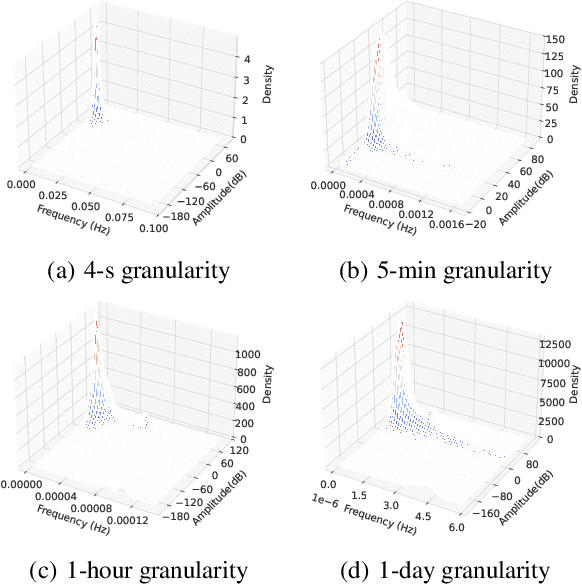
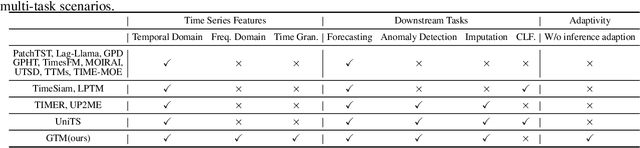
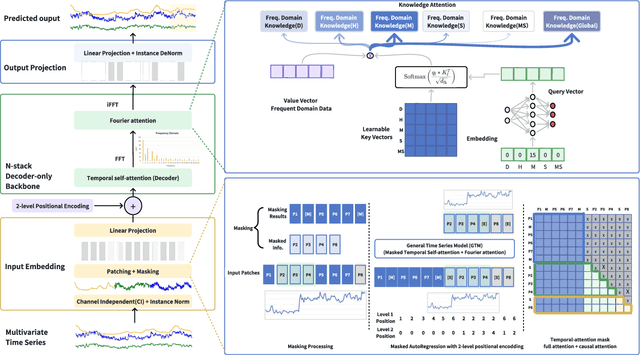

Universal knowledge representation is a central problem for multivariate time series(MTS) foundation models and yet remains open. This paper investigates this problem from the first principle and it makes four folds of contributions. First, a new empirical finding is revealed: time series with different time granularities (or corresponding frequency resolutions) exhibit distinct joint distributions in the frequency domain. This implies a crucial aspect of learning universal knowledge, one that has been overlooked by previous studies. Second, a novel Fourier knowledge attention mechanism is proposed to enable learning time granularity-aware representations from both the temporal and frequency domains. Third, an autoregressive blank infilling pre-training framework is incorporated to time series analysis for the first time, leading to a generative tasks agnostic pre-training strategy. To this end, we develop the General Time-series Model (GTM), a unified MTS foundation model that addresses the limitation of contemporary time series models, which often require token, pre-training, or model-level customizations for downstream tasks adaption. Fourth, extensive experiments show that GTM outperforms state-of-the-art (SOTA) methods across all generative tasks, including long-term forecasting, anomaly detection, and imputation.