 Add to Chrome
 Add to Firefox
 Add to Edge
LLM and Simulation as Bilevel Optimizers: A New Paradigm to Advance Physical Scientific Discovery
May 16, 2024
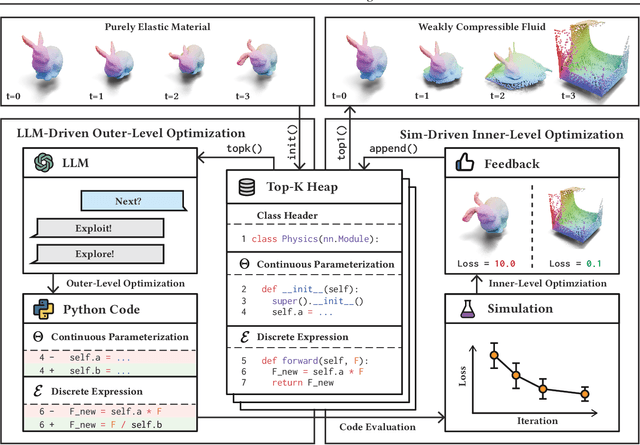
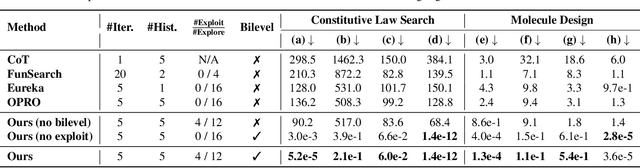
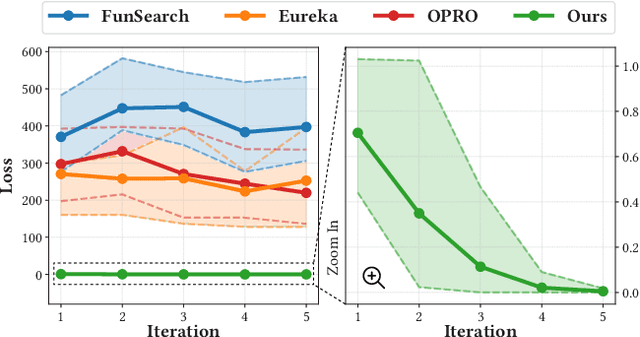
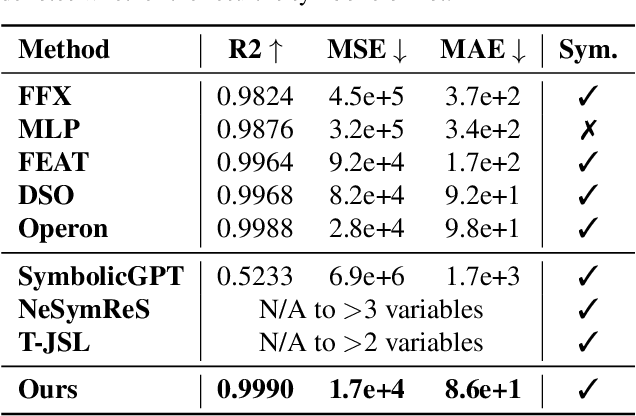
Large Language Models have recently gained significant attention in scientific discovery for their extensive knowledge and advanced reasoning capabilities. However, they encounter challenges in effectively simulating observational feedback and grounding it with language to propel advancements in physical scientific discovery. Conversely, human scientists undertake scientific discovery by formulating hypotheses, conducting experiments, and revising theories through observational analysis. Inspired by this, we propose to enhance the knowledge-driven, abstract reasoning abilities of LLMs with the computational strength of simulations. We introduce Scientific Generative Agent (SGA), a bilevel optimization framework: LLMs act as knowledgeable and versatile thinkers, proposing scientific hypotheses and reason about discrete components, such as physics equations or molecule structures; meanwhile, simulations function as experimental platforms, providing observational feedback and optimizing via differentiability for continuous parts, such as physical parameters. We conduct extensive experiments to demonstrate our framework's efficacy in constitutive law discovery and molecular design, unveiling novel solutions that differ from conventional human expectations yet remain coherent upon analysis.

STAR: A Benchmark for Situated Reasoning in Real-World Videos
May 15, 2024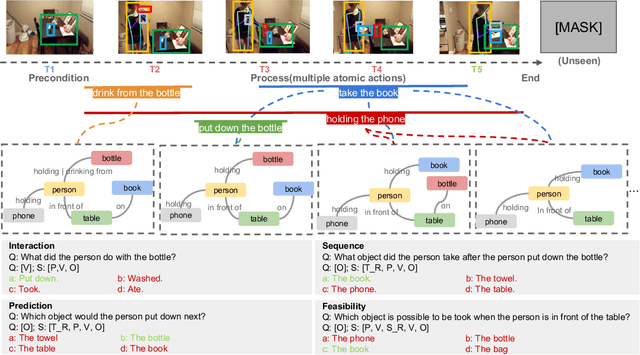
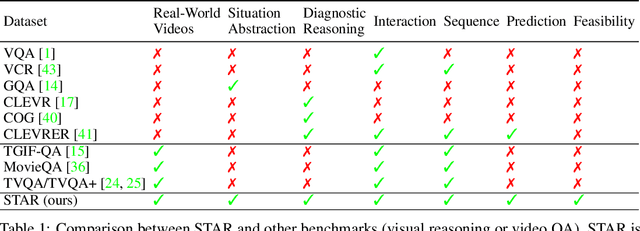
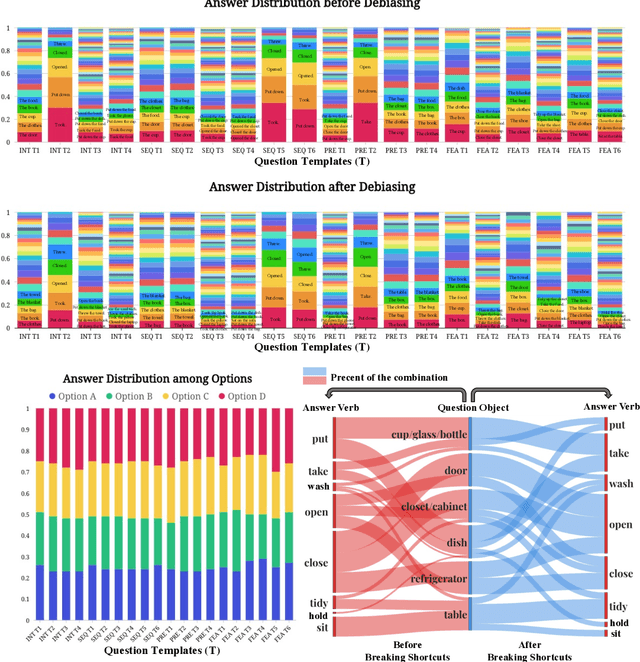
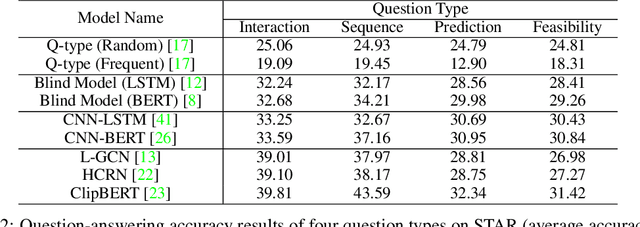
Reasoning in the real world is not divorced from situations. How to capture the present knowledge from surrounding situations and perform reasoning accordingly is crucial and challenging for machine intelligence. This paper introduces a new benchmark that evaluates the situated reasoning ability via situation abstraction and logic-grounded question answering for real-world videos, called Situated Reasoning in Real-World Videos (STAR Benchmark). This benchmark is built upon the real-world videos associated with human actions or interactions, which are naturally dynamic, compositional, and logical. The dataset includes four types of questions, including interaction, sequence, prediction, and feasibility. We represent the situations in real-world videos by hyper-graphs connecting extracted atomic entities and relations (e.g., actions, persons, objects, and relationships). Besides visual perception, situated reasoning also requires structured situation comprehension and logical reasoning. Questions and answers are procedurally generated. The answering logic of each question is represented by a functional program based on a situation hyper-graph. We compare various existing video reasoning models and find that they all struggle on this challenging situated reasoning task. We further propose a diagnostic neuro-symbolic model that can disentangle visual perception, situation abstraction, language understanding, and functional reasoning to understand the challenges of this benchmark.
QServe: W4A8KV4 Quantization and System Co-design for Efficient LLM Serving
May 07, 2024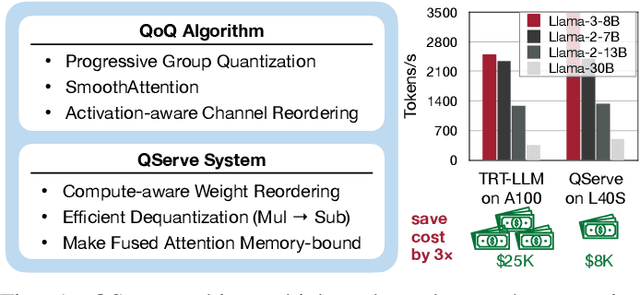
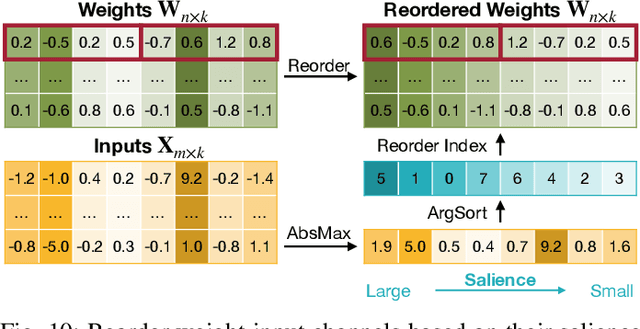
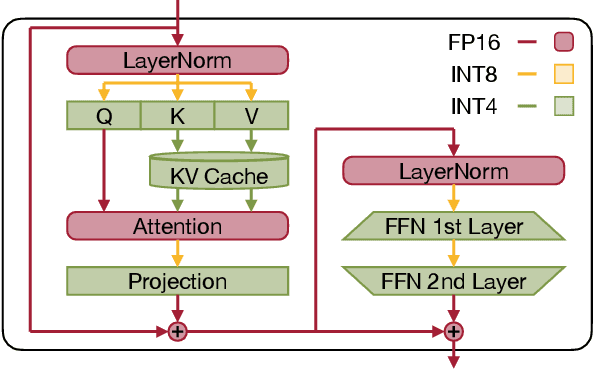
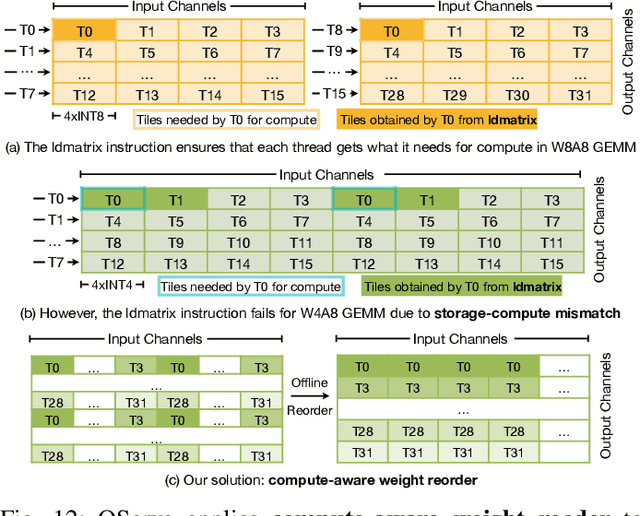
Quantization can accelerate large language model (LLM) inference. Going beyond INT8 quantization, the research community is actively exploring even lower precision, such as INT4. Nonetheless, state-of-the-art INT4 quantization techniques only accelerate low-batch, edge LLM inference, failing to deliver performance gains in large-batch, cloud-based LLM serving. We uncover a critical issue: existing INT4 quantization methods suffer from significant runtime overhead (20-90%) when dequantizing either weights or partial sums on GPUs. To address this challenge, we introduce QoQ, a W4A8KV4 quantization algorithm with 4-bit weight, 8-bit activation, and 4-bit KV cache. QoQ stands for quattuor-octo-quattuor, which represents 4-8-4 in Latin. QoQ is implemented by the QServe inference library that achieves measured speedup. The key insight driving QServe is that the efficiency of LLM serving on GPUs is critically influenced by operations on low-throughput CUDA cores. Building upon this insight, in QoQ algorithm, we introduce progressive quantization that can allow low dequantization overhead in W4A8 GEMM. Additionally, we develop SmoothAttention to effectively mitigate the accuracy degradation incurred by 4-bit KV quantization. In the QServe system, we perform compute-aware weight reordering and take advantage of register-level parallelism to reduce dequantization latency. We also make fused attention memory-bound, harnessing the performance gain brought by KV4 quantization. As a result, QServe improves the maximum achievable serving throughput of Llama-3-8B by 1.2x on A100, 1.4x on L40S; and Qwen1.5-72B by 2.4x on A100, 3.5x on L40S, compared to TensorRT-LLM. Remarkably, QServe on L40S GPU can achieve even higher throughput than TensorRT-LLM on A100. Thus, QServe effectively reduces the dollar cost of LLM serving by 3x. Code is available at https://github.com/mit-han-lab/qserve.
RoboDreamer: Learning Compositional World Models for Robot Imagination
Apr 18, 2024
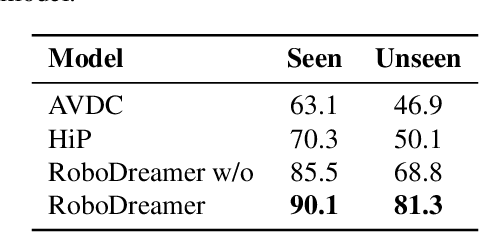
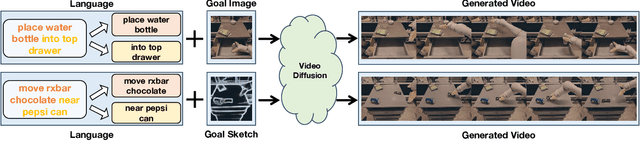
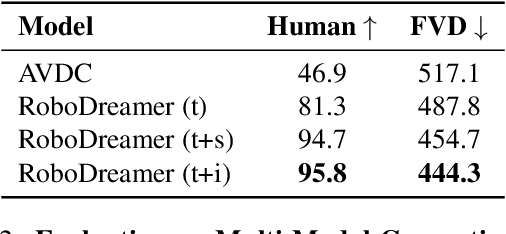
Text-to-video models have demonstrated substantial potential in robotic decision-making, enabling the imagination of realistic plans of future actions as well as accurate environment simulation. However, one major issue in such models is generalization -- models are limited to synthesizing videos subject to language instructions similar to those seen at training time. This is heavily limiting in decision-making, where we seek a powerful world model to synthesize plans of unseen combinations of objects and actions in order to solve previously unseen tasks in new environments. To resolve this issue, we introduce RoboDreamer, an innovative approach for learning a compositional world model by factorizing the video generation. We leverage the natural compositionality of language to parse instructions into a set of lower-level primitives, which we condition a set of models on to generate videos. We illustrate how this factorization naturally enables compositional generalization, by allowing us to formulate a new natural language instruction as a combination of previously seen components. We further show how such a factorization enables us to add additional multimodal goals, allowing us to specify a video we wish to generate given both natural language instructions and a goal image. Our approach can successfully synthesize video plans on unseen goals in the RT-X, enables successful robot execution in simulation, and substantially outperforms monolithic baseline approaches to video generation.
Virtual Foundry Graphnet for Metal Sintering Deformation Prediction
Apr 17, 2024


Metal Sintering is a necessary step for Metal Injection Molded parts and binder jet such as HP's metal 3D printer. The metal sintering process introduces large deformation varying from 25 to 50% depending on the green part porosity. In this paper, we use a graph-based deep learning approach to predict the part deformation, which can speed up the deformation simulation substantially at the voxel level. Running a well-trained Metal Sintering inferencing engine only takes a range of seconds to obtain the final sintering deformation value. The tested accuracy on example complex geometry achieves 0.7um mean deviation for a 63mm testing part.
COMBO: Compositional World Models for Embodied Multi-Agent Cooperation
Apr 16, 2024In this paper, we investigate the problem of embodied multi-agent cooperation, where decentralized agents must cooperate given only partial egocentric views of the world. To effectively plan in this setting, in contrast to learning world dynamics in a single-agent scenario, we must simulate world dynamics conditioned on an arbitrary number of agents' actions given only partial egocentric visual observations of the world. To address this issue of partial observability, we first train generative models to estimate the overall world state given partial egocentric observations. To enable accurate simulation of multiple sets of actions on this world state, we then propose to learn a compositional world model for multi-agent cooperation by factorizing the naturally composable joint actions of multiple agents and compositionally generating the video. By leveraging this compositional world model, in combination with Vision Language Models to infer the actions of other agents, we can use a tree search procedure to integrate these modules and facilitate online cooperative planning. To evaluate the efficacy of our methods, we create two challenging embodied multi-agent long-horizon cooperation tasks using the ThreeDWorld simulator and conduct experiments with 2-4 agents. The results show our compositional world model is effective and the framework enables the embodied agents to cooperate efficiently with different agents across various tasks and an arbitrary number of agents, showing the promising future of our proposed framework. More videos can be found at https://vis-www.cs.umass.edu/combo/.
Thin-Shell Object Manipulations With Differentiable Physics Simulations
Mar 30, 2024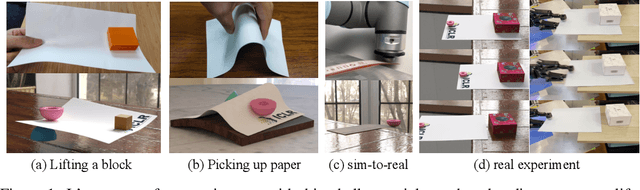
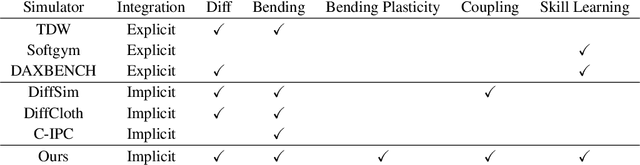
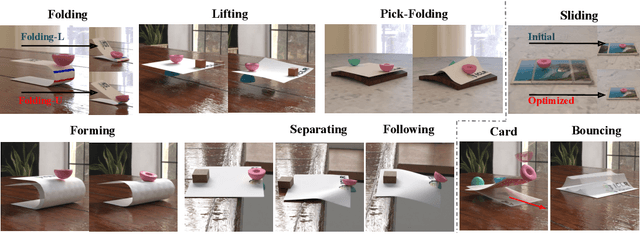
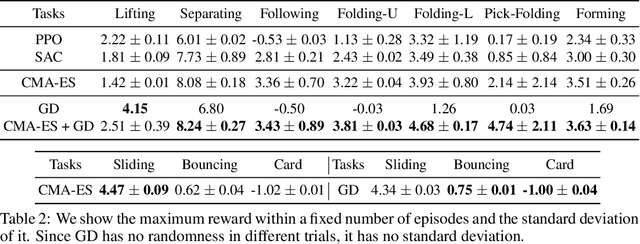
In this work, we aim to teach robots to manipulate various thin-shell materials. Prior works studying thin-shell object manipulation mostly rely on heuristic policies or learn policies from real-world video demonstrations, and only focus on limited material types and tasks (e.g., cloth unfolding). However, these approaches face significant challenges when extended to a wider variety of thin-shell materials and a diverse range of tasks. While virtual simulations are shown to be effective in diverse robot skill learning and evaluation, prior thin-shell simulation environments only support a subset of thin-shell materials, which also limits their supported range of tasks. We introduce ThinShellLab - a fully differentiable simulation platform tailored for robotic interactions with diverse thin-shell materials possessing varying material properties, enabling flexible thin-shell manipulation skill learning and evaluation. Our experiments suggest that manipulating thin-shell objects presents several unique challenges: 1) thin-shell manipulation relies heavily on frictional forces due to the objects' co-dimensional nature, 2) the materials being manipulated are highly sensitive to minimal variations in interaction actions, and 3) the constant and frequent alteration in contact pairs makes trajectory optimization methods susceptible to local optima, and neither standard reinforcement learning algorithms nor trajectory optimization methods (either gradient-based or gradient-free) are able to solve the tasks alone. To overcome these challenges, we present an optimization scheme that couples sampling-based trajectory optimization and gradient-based optimization, boosting both learning efficiency and converged performance across various proposed tasks. In addition, the differentiable nature of our platform facilitates a smooth sim-to-real transition.
Easy-to-Hard Generalization: Scalable Alignment Beyond Human Supervision
Mar 14, 2024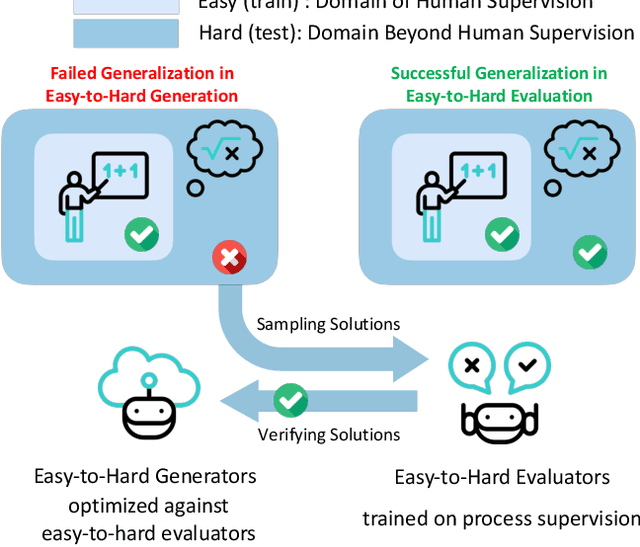
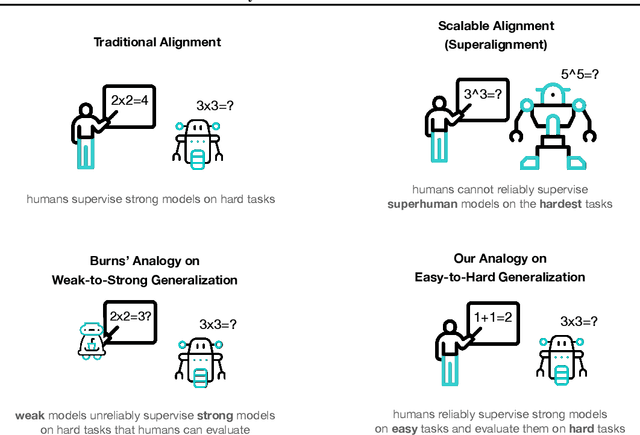
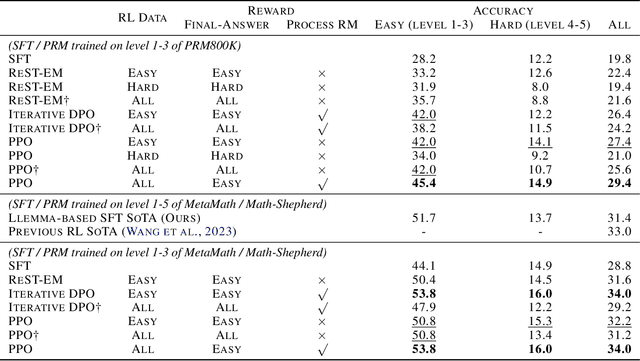
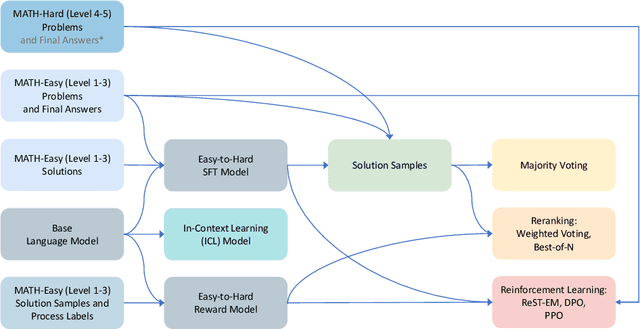
Current AI alignment methodologies rely on human-provided demonstrations or judgments, and the learned capabilities of AI systems would be upper-bounded by human capabilities as a result. This raises a challenging research question: How can we keep improving the systems when their capabilities have surpassed the levels of humans? This paper answers this question in the context of tackling hard reasoning tasks (e.g., level 4-5 MATH problems) via learning from human annotations on easier tasks (e.g., level 1-3 MATH problems), which we term as \textit{easy-to-hard generalization}. Our key insight is that an evaluator (reward model) trained on supervisions for easier tasks can be effectively used for scoring candidate solutions of harder tasks and hence facilitating easy-to-hard generalization over different levels of tasks. Based on this insight, we propose a novel approach to scalable alignment, which firstly trains the process-supervised reward models on easy problems (e.g., level 1-3), and then uses them to evaluate the performance of policy models on hard problems. We show that such \textit{easy-to-hard generalization from evaluators} can enable \textit{easy-to-hard generalizations in generators} either through re-ranking or reinforcement learning (RL). Notably, our process-supervised 7b RL model achieves an accuracy of 34.0\% on MATH500, despite only using human supervision on easy problems. Our approach suggests a promising path toward AI systems that advance beyond the frontier of human supervision.
3D-VLA: A 3D Vision-Language-Action Generative World Model
Mar 14, 2024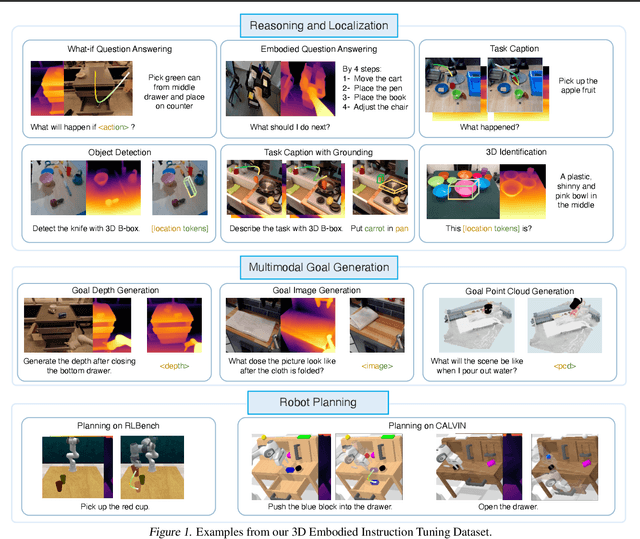
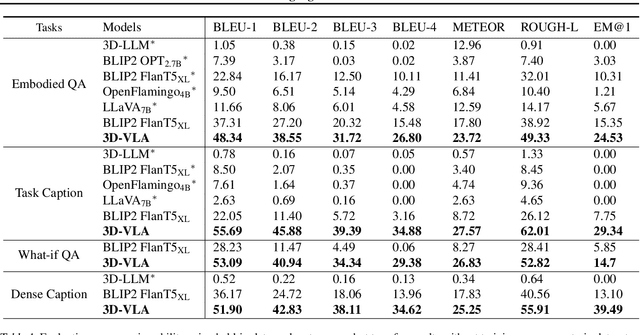
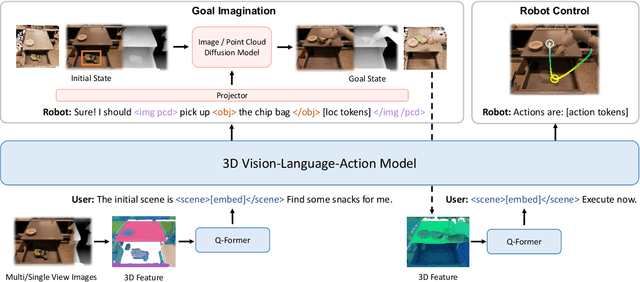
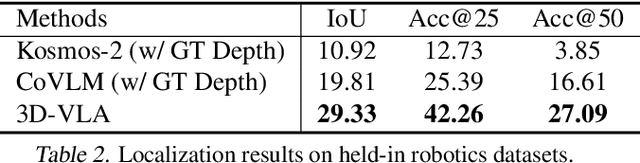
Recent vision-language-action (VLA) models rely on 2D inputs, lacking integration with the broader realm of the 3D physical world. Furthermore, they perform action prediction by learning a direct mapping from perception to action, neglecting the vast dynamics of the world and the relations between actions and dynamics. In contrast, human beings are endowed with world models that depict imagination about future scenarios to plan actions accordingly. To this end, we propose 3D-VLA by introducing a new family of embodied foundation models that seamlessly link 3D perception, reasoning, and action through a generative world model. Specifically, 3D-VLA is built on top of a 3D-based large language model (LLM), and a set of interaction tokens is introduced to engage with the embodied environment. Furthermore, to inject generation abilities into the model, we train a series of embodied diffusion models and align them into the LLM for predicting the goal images and point clouds. To train our 3D-VLA, we curate a large-scale 3D embodied instruction dataset by extracting vast 3D-related information from existing robotics datasets. Our experiments on held-in datasets demonstrate that 3D-VLA significantly improves the reasoning, multimodal generation, and planning capabilities in embodied environments, showcasing its potential in real-world applications.
DIFFTACTILE: A Physics-based Differentiable Tactile Simulator for Contact-rich Robotic Manipulation
Mar 13, 2024We introduce DIFFTACTILE, a physics-based differentiable tactile simulation system designed to enhance robotic manipulation with dense and physically accurate tactile feedback. In contrast to prior tactile simulators which primarily focus on manipulating rigid bodies and often rely on simplified approximations to model stress and deformations of materials in contact, DIFFTACTILE emphasizes physics-based contact modeling with high fidelity, supporting simulations of diverse contact modes and interactions with objects possessing a wide range of material properties. Our system incorporates several key components, including a Finite Element Method (FEM)-based soft body model for simulating the sensing elastomer, a multi-material simulator for modeling diverse object types (such as elastic, elastoplastic, cables) under manipulation, a penalty-based contact model for handling contact dynamics. The differentiable nature of our system facilitates gradient-based optimization for both 1) refining physical properties in simulation using real-world data, hence narrowing the sim-to-real gap and 2) efficient learning of tactile-assisted grasping and contact-rich manipulation skills. Additionally, we introduce a method to infer the optical response of our tactile sensor to contact using an efficient pixel-based neural module. We anticipate that DIFFTACTILE will serve as a useful platform for studying contact-rich manipulations, leveraging the benefits of dense tactile feedback and differentiable physics. Code and supplementary materials are available at the project website https://difftactile.github.io/.