 Add to Chrome
 Add to Firefox
 Add to Edge
Fidelity- and Perception-Aware Local Implicit Attention for Arbitrary-Scale Image Super-Resolution
Jun 20, 2026
Arbitrary-scale image super-resolution (ASISR) aims to reconstruct high-resolution images from low-resolution inputs over a continuous range of upscaling factors. While traditional pixel-regression approaches often produce overly smooth results that lack realistic details, recent diffusion methods can produce sharper and more realistic textures. However, these diffusion techniques frequently introduce the risk of structural hallucinations. To address these issues, we propose Fidelity- and Perception-Aware Local Implicit Attention (FPLIA), a framework that effectively integrates fidelity-oriented features into a diffusion pipeline to produce realistic and faithful reconstructions for ASISR. We introduce a Fidelity and Perception Attention Module (FPAM), which applies both self-attention and cross-attention to fidelity-oriented and perceptual features to enhance representational capacity. To further exploit their complements, we design a Fidelity and Perception Select Module (FPSM) that adaptively selects the most representative features for RGB values prediction. We conduct extensive experiments to validate the effectiveness of these components. Both qualitative and quantitative results show that FPLIA delivers superior perceptual realism while maintaining reconstruction accuracy on standard ASISR benchmarks. The source code is accessible at the following repository: https://github.com/XUSean0118/FPLIA.

The Lie We Tell: Correcting the Euclidean Fallacy in Vision Language Action Policies via Score Matching on Tangent Space
Jun 01, 2026Diffusion-based Vision-Language-Action policies achieve remarkable success in robotic manipulation, yet commit a fundamental geometric error we term the $\textbf{Euclidean Fallacy}$: representing SE(3) poses as flat $\mathbb{R}^{12}$ vectors. This approximation induces (1) manifold drift violating SO(3) constraints, (2) broken equivariance under coordinate transformations, and (3) non-geodesic trajectories with excessive kinematic cost. We introduce $\textbf{Lie Diffuser Actor (LDA)}$, a diffusion framework operating intrinsically on SE(3). Our method injects noise through left-invariant SDEs, predicts scores in the tangent space, and retracts samples via the exponential map. This formulation eliminates manifold drift by construction while guaranteeing coordinate-frame equivariance and geodesic optimality. On CALVIN ABC$\rightarrow$D, LDA improves average task length from $3.27$ to $3.51$ ($+7.3\%$). We further validate our method on real robot and the results show that our methodology outperforms the baseline on majority tasks.
Landscape-Awareness for Geometric View Diffusion Model
May 19, 2026Accurate camera viewpoint estimation under sparse-view conditions remains challenging, particularly in two-view scenarios. Recent approaches leverage diffusion models such as Zero123 to synthesize novel views conditioned on relative viewpoint, showing promising results when repurposed for viewpoint estimation via optimization with MSE loss. However, existing methods often suffer from nonconvex loss landscape with numerous local minima, making them sensitive to initialization and reliant on naive multistart strategies. We analyze these optimization challenges and visualize failure cases, showing that geometric ambiguities, such as symmetry and self-similarity, can mislead gradient-based updates toward incorrect viewpoints. To address these limitations, we propose a score-based method that reshapes the optimization landscape to guide updates toward the ground-truth viewpoint, followed by a refinement stage using a viewpoint-conditioned diffusion model. Experiments show that our method improves convergence, reduces reliance on brute-force sampling, and achieves competitive accuracy with higher sample-efficiency.
ALICE: A Multifaceted Evaluation Framework of Large Audio-Language Models' In-Context Learning Ability
Mar 20, 2026While Large Audio-Language Models (LALMs) have been shown to exhibit degraded instruction-following capabilities, their ability to infer task patterns from in-context examples under audio conditioning remains unstudied. To address this gap, we present ALICE, a three-stage framework that progressively reduces textual guidance to systematically evaluate LALMs' in-context learning ability under audio conditioning. Evaluating six LALMs across four audio understanding tasks under two output constraint categories, we uncover a consistent asymmetry across all stages and LALMs: in-context demonstrations reliably improve format compliance but fail to improve, and often degrade, the core task performance. This suggests that LALMs can glean surface-level formatting patterns from demonstrations but may struggle to leverage cross-modal semantic grounding to reliably infer task objectives from audio-conditioned examples, highlighting potential limitations in current cross-modal integration.
MDM-Prime-v2: Binary Encoding and Index Shuffling Enable Compute-optimal Scaling of Diffusion Language Models
Mar 17, 2026Masked diffusion models (MDM) exhibit superior generalization when learned using a Partial masking scheme (Prime). This approach converts tokens into sub-tokens and models the diffusion process at the sub-token level. We identify two limitations of the MDM-Prime framework. First, we lack tools to guide the hyperparameter choice of the token granularity in the subtokenizer. Second, we find that the function form of the subtokenizer significantly degrades likelihood estimation when paired with commonly used Byte-Pair-Encoding (BPE) tokenizers. To address these limitations, we study the tightness of the variational bound in MDM-Prime and develop MDM-Prime-v2, a masked diffusion language model which incorporates Binary Encoding and Index Shuffling. Our scaling analysis reveals that MDM-Prime-v2 is 21.8$\times$ more compute-efficient than autoregressive models (ARM). In compute-optimal comparisons, MDM-Prime-v2 achieves 7.77 perplexity on OpenWebText, outperforming ARM (12.99), MDM (18.94), and MDM-Prime (13.41). When extending the model size to 1.1B parameters, our model further demonstrates superior zero-shot accuracy on various commonsense reasoning tasks.
Feasibility-Guided Planning over Multi-Specialized Locomotion Policies
Feb 08, 2026Planning over unstructured terrain presents a significant challenge in the field of legged robotics. Although recent works in reinforcement learning have yielded various locomotion strategies, planning over multiple experts remains a complex issue. Existing approaches encounter several constraints: traditional planners are unable to integrate skill-specific policies, whereas hierarchical learning frameworks often lose interpretability and require retraining whenever new policies are added. In this paper, we propose a feasibility-guided planning framework that successfully incorporates multiple terrain-specific policies. Each policy is paired with a Feasibility-Net, which learned to predict feasibility tensors based on the local elevation maps and task vectors. This integration allows classical planning algorithms to derive optimal paths. Through both simulated and real-world experiments, we demonstrate that our method efficiently generates reliable plans across diverse and challenging terrains, while consistently aligning with the capabilities of the underlying policies.
Beyond Masked and Unmasked: Discrete Diffusion Models via Partial Masking
May 24, 2025Masked diffusion models (MDM) are powerful generative models for discrete data that generate samples by progressively unmasking tokens in a sequence. Each token can take one of two states: masked or unmasked. We observe that token sequences often remain unchanged between consecutive sampling steps; consequently, the model repeatedly processes identical inputs, leading to redundant computation. To address this inefficiency, we propose the Partial masking scheme (Prime), which augments MDM by allowing tokens to take intermediate states interpolated between the masked and unmasked states. This design enables the model to make predictions based on partially observed token information, and facilitates a fine-grained denoising process. We derive a variational training objective and introduce a simple architectural design to accommodate intermediate-state inputs. Our method demonstrates superior performance across a diverse set of generative modeling tasks. On text data, it achieves a perplexity of 15.36 on OpenWebText, outperforming previous MDM (21.52), autoregressive models (17.54), and their hybrid variants (17.58), without relying on an autoregressive formulation. On image data, it attains competitive FID scores of 3.26 on CIFAR-10 and 6.98 on ImageNet-32, comparable to leading continuous generative models.
HoliSDiP: Image Super-Resolution via Holistic Semantics and Diffusion Prior
Nov 27, 2024Text-to-image diffusion models have emerged as powerful priors for real-world image super-resolution (Real-ISR). However, existing methods may produce unintended results due to noisy text prompts and their lack of spatial information. In this paper, we present HoliSDiP, a framework that leverages semantic segmentation to provide both precise textual and spatial guidance for diffusion-based Real-ISR. Our method employs semantic labels as concise text prompts while introducing dense semantic guidance through segmentation masks and our proposed Segmentation-CLIP Map. Extensive experiments demonstrate that HoliSDiP achieves significant improvement in image quality across various Real-ISR scenarios through reduced prompt noise and enhanced spatial control.
Fine-Grained Alignment in Vision-and-Language Navigation through Bayesian Optimization
Nov 22, 2024
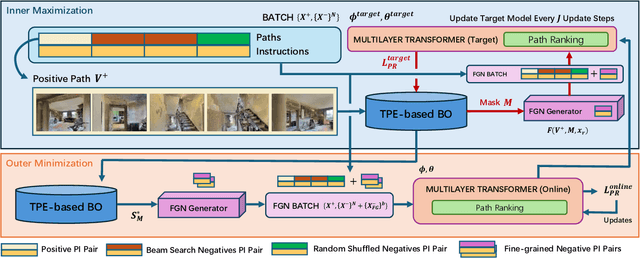


This paper addresses the challenge of fine-grained alignment in Vision-and-Language Navigation (VLN) tasks, where robots navigate realistic 3D environments based on natural language instructions. Current approaches use contrastive learning to align language with visual trajectory sequences. Nevertheless, they encounter difficulties with fine-grained vision negatives. To enhance cross-modal embeddings, we introduce a novel Bayesian Optimization-based adversarial optimization framework for creating fine-grained contrastive vision samples. To validate the proposed methodology, we conduct a series of experiments to assess the effectiveness of the enriched embeddings on fine-grained vision negatives. We conduct experiments on two common VLN benchmarks R2R and REVERIE, experiments on the them demonstrate that these embeddings benefit navigation, and can lead to a promising performance enhancement. Our source code and trained models are available at: https://anonymous.4open.science/r/FGVLN.
Retraining-Free Merging of Sparse Mixture-of-Experts via Hierarchical Clustering
Oct 11, 2024


Sparse Mixture-of-Experts (SMoE) models represent a significant breakthrough in large language model development. These models enable performance improvements without a proportional increase in inference costs. By selectively activating a small set of parameters during task execution, SMoEs enhance model capacity. However, their deployment remains challenging due to the substantial memory footprint required to accommodate the growing number of experts. This constraint renders them less feasible in environments with limited hardware resources. To address this challenge, we propose Hierarchical Clustering for Sparsely activated Mixture of Experts (HC-SMoE), a task-agnostic expert merging framework that reduces SMoE model parameters without retraining. Unlike previous methods, HC-SMoE employs hierarchical clustering based on expert outputs. This approach ensures that the merging process remains unaffected by routing decisions. The output-based clustering strategy captures functional similarities between experts, offering an adaptable solution for models with numerous experts. We validate our approach through extensive experiments on eight zero-shot language tasks and demonstrate its effectiveness in large-scale SMoE models such as Qwen and Mixtral. Our comprehensive results demonstrate that HC-SMoE consistently achieves strong performance, which highlights its potential for real-world deployment.