 Add to Chrome
 Add to Firefox
 Add to Edge
Controllable Latent Diffusion for Traffic Simulation
Mar 14, 2025
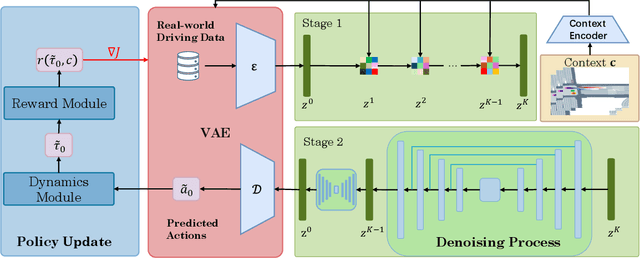
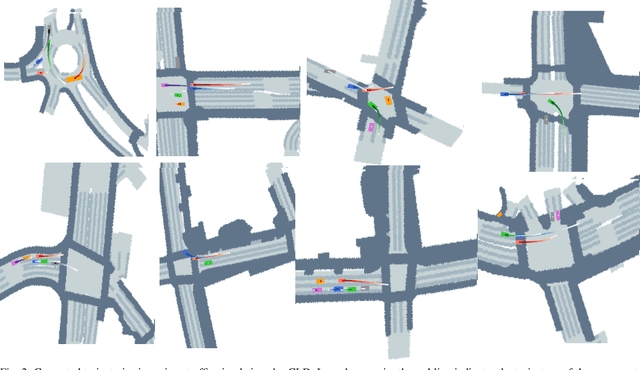
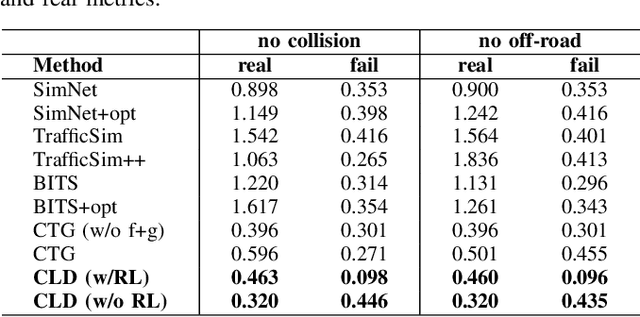
The validation of autonomous driving systems benefits greatly from the ability to generate scenarios that are both realistic and precisely controllable. Conventional approaches, such as real-world test drives, are not only expensive but also lack the flexibility to capture targeted edge cases for thorough evaluation. To address these challenges, we propose a controllable latent diffusion that guides the training of diffusion models via reinforcement learning to automatically generate a diverse and controllable set of driving scenarios for virtual testing. Our approach removes the reliance on large-scale real-world data by generating complex scenarios whose properties can be finely tuned to challenge and assess autonomous vehicle systems. Experimental results show that our approach has the lowest collision rate of $0.098$ and lowest off-road rate of $0.096$, demonstrating superiority over existing baselines. The proposed approach significantly improves the realism, stability and controllability of the generated scenarios, enabling more nuanced safety evaluation of autonomous vehicles.

Learning to Detect Objects from Multi-Agent LiDAR Scans without Manual Labels
Mar 13, 2025Unsupervised 3D object detection serves as an important solution for offline 3D object annotation. However, due to the data sparsity and limited views, the clustering-based label fitting in unsupervised object detection often generates low-quality pseudo-labels. Multi-agent collaborative dataset, which involves the sharing of complementary observations among agents, holds the potential to break through this bottleneck. In this paper, we introduce a novel unsupervised method that learns to Detect Objects from Multi-Agent LiDAR scans, termed DOtA, without using labels from external. DOtA first uses the internally shared ego-pose and ego-shape of collaborative agents to initialize the detector, leveraging the generalization performance of neural networks to infer preliminary labels. Subsequently,DOtA uses the complementary observations between agents to perform multi-scale encoding on preliminary labels, then decodes high-quality and low-quality labels. These labels are further used as prompts to guide a correct feature learning process, thereby enhancing the performance of the unsupervised object detection task. Extensive experiments on the V2V4Real and OPV2V datasets show that our DOtA outperforms state-of-the-art unsupervised 3D object detection methods. Additionally, we also validate the effectiveness of the DOtA labels under various collaborative perception frameworks.The code is available at https://github.com/xmuqimingxia/DOtA.
SP3D: Boosting Sparsely-Supervised 3D Object Detection via Accurate Cross-Modal Semantic Prompts
Mar 09, 2025


Recently, sparsely-supervised 3D object detection has gained great attention, achieving performance close to fully-supervised 3D objectors while requiring only a few annotated instances. Nevertheless, these methods suffer challenges when accurate labels are extremely absent. In this paper, we propose a boosting strategy, termed SP3D, explicitly utilizing the cross-modal semantic prompts generated from Large Multimodal Models (LMMs) to boost the 3D detector with robust feature discrimination capability under sparse annotation settings. Specifically, we first develop a Confident Points Semantic Transfer (CPST) module that generates accurate cross-modal semantic prompts through boundary-constrained center cluster selection. Based on these accurate semantic prompts, which we treat as seed points, we introduce a Dynamic Cluster Pseudo-label Generation (DCPG) module to yield pseudo-supervision signals from the geometry shape of multi-scale neighbor points. Additionally, we design a Distribution Shape score (DS score) that chooses high-quality supervision signals for the initial training of the 3D detector. Experiments on the KITTI dataset and Waymo Open Dataset (WOD) have validated that SP3D can enhance the performance of sparsely supervised detectors by a large margin under meager labeling conditions. Moreover, we verified SP3D in the zero-shot setting, where its performance exceeded that of the state-of-the-art methods. The code is available at https://github.com/xmuqimingxia/SP3D.
Mid-infrared laser chaos lidar
Mar 06, 2025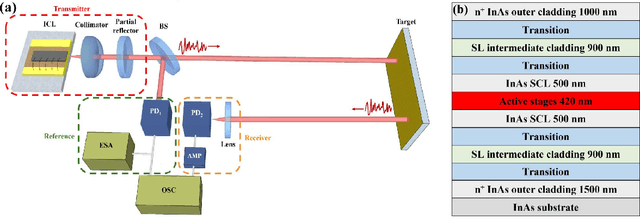

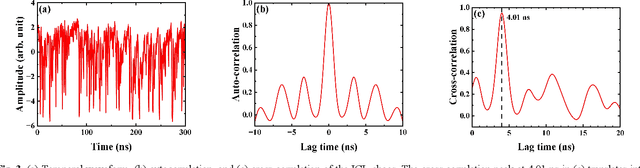
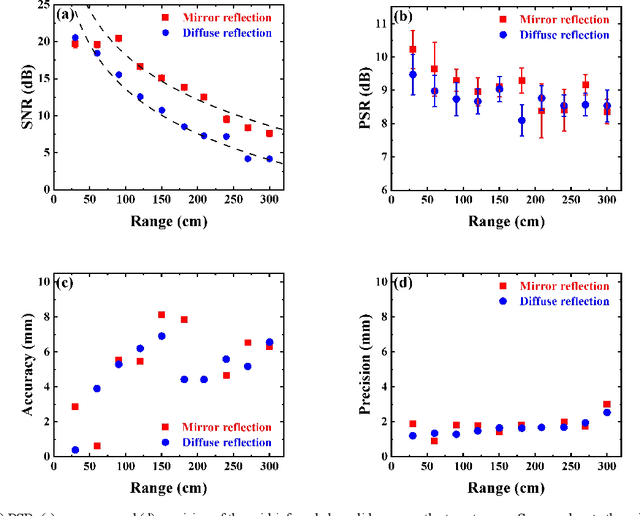
Chaos lidars detect targets through the cross-correlation between the back-scattered chaos signal from the target and the local reference one. Chaos lidars have excellent anti-jamming and anti-interference capabilities, owing to the random nature of chaotic oscillations. However, most chaos lidars operate in the near-infrared spectral regime, where the atmospheric attenuation is significant. Here we show a mid-infrared chaos lidar, which is suitable for long-reach ranging and imaging applications within the low-loss transmission window of the atmosphere. The proof-of-concept mid-infrared chaos lidar utilizes an interband cascade laser with optical feedback as the laser chaos source. Experimental results reveal that the chaos lidar achieves an accuracy better than 0.9 cm and a precision better than 0.3 cm for ranging distances up to 300 cm. In addition, it is found that a minimum signal-to-noise ratio of only 1 dB is required to sustain both sub-cm accuracy and sub-cm precision. This work paves the way for developing remote chaos lidar systems in the mid-infrared spectral regime.
Progressive Collaborative and Semantic Knowledge Fusion for Generative Recommendation
Feb 10, 2025


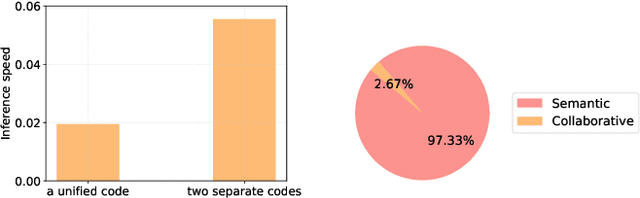
With the recent surge in interest surrounding generative paradigms, generative recommendation has increasingly attracted the attention of researchers in the recommendation community. This paradigm generally consists of two stages. In the first stage, pretrained semantic embeddings or collaborative ID embeddings are quantized to create item codes, aiming to capture and preserve rich semantic or collaborative knowledge within these codes. The second stage involves utilizing these discrete codes to perform an autoregressive sequence generation task. Existing methods often either overlook collaborative or semantic knowledge, or combine the two roughly. In this paper, we observe that naively concatenating representations from semantic and collaborative modality leads to a semantic domination issue, where the resulting representation is overly influenced by semantic information, effectively overshadowing the collaborative representation. Consequently, downstream recommendation tasks fail to fully exploit the knowledge from both modalities, resulting in suboptimal performance. To address this, we propose a progressive collaborative and semantic knowledge fusion model for generative recommendation, named PRORec, which integrates semantic and collaborative knowledge with a unified code through a two-stage framework. Specifically, in the first stage, we propose a cross-modality knowledge alignment task, which integrates semantic knowledge into collaborative embeddings, enhancing their representational capability. In the second stage, we propose an in-modality knowledge distillation task, designed to effectively capture and integrate knowledge from both semantic and collaborative modalities. Extensive experiments on three widely used benchmarks validate the effectiveness of our approach, demonstrating its superiority compared to existing methods.
AdaCo: Overcoming Visual Foundation Model Noise in 3D Semantic Segmentation via Adaptive Label Correction
Dec 24, 2024
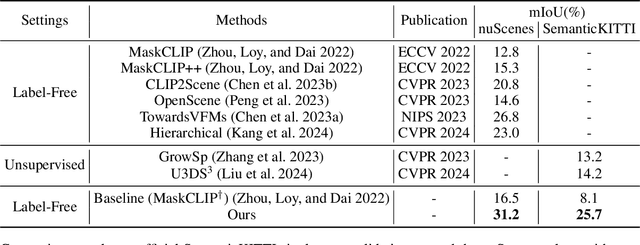

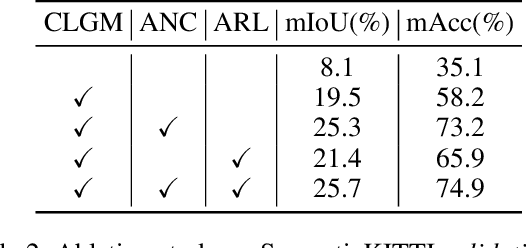
Recently, Visual Foundation Models (VFMs) have shown a remarkable generalization performance in 3D perception tasks. However, their effectiveness in large-scale outdoor datasets remains constrained by the scarcity of accurate supervision signals, the extensive noise caused by variable outdoor conditions, and the abundance of unknown objects. In this work, we propose a novel label-free learning method, Adaptive Label Correction (AdaCo), for 3D semantic segmentation. AdaCo first introduces the Cross-modal Label Generation Module (CLGM), providing cross-modal supervision with the formidable interpretive capabilities of the VFMs. Subsequently, AdaCo incorporates the Adaptive Noise Corrector (ANC), updating and adjusting the noisy samples within this supervision iteratively during training. Moreover, we develop an Adaptive Robust Loss (ARL) function to modulate each sample's sensitivity to noisy supervision, preventing potential underfitting issues associated with robust loss. Our proposed AdaCo can effectively mitigate the performance limitations of label-free learning networks in 3D semantic segmentation tasks. Extensive experiments on two outdoor benchmark datasets highlight the superior performance of our method.
Robustness-enhanced Myoelectric Control with GAN-based Open-set Recognition
Dec 20, 2024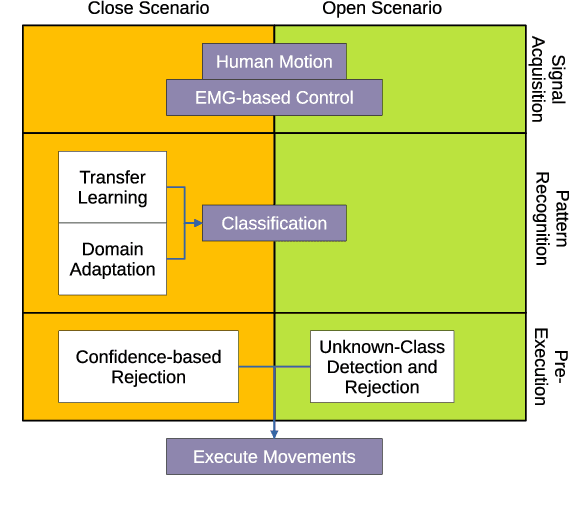
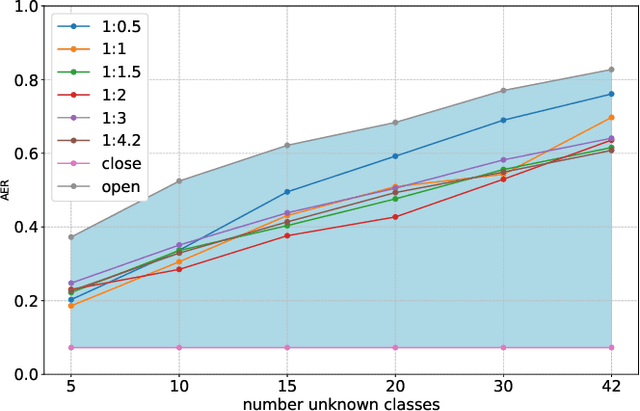
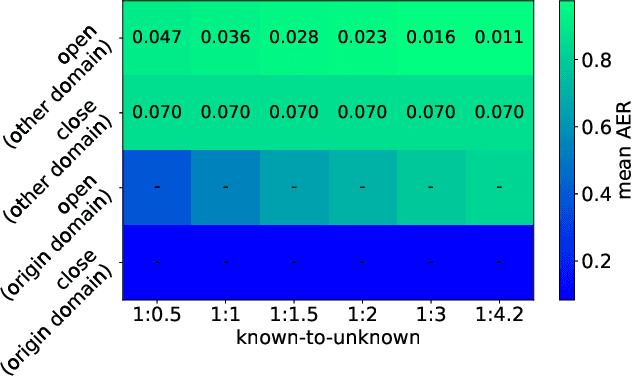
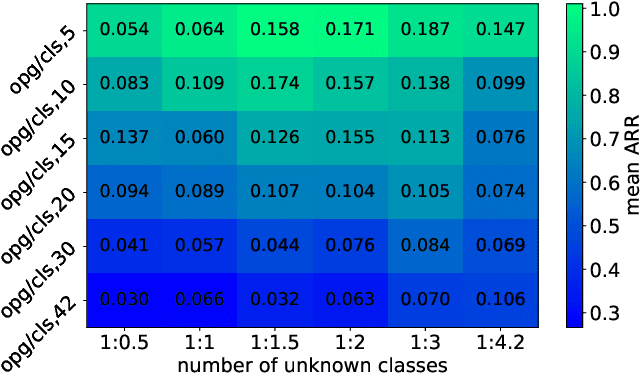
Electromyography (EMG) signals are widely used in human motion recognition and medical rehabilitation, yet their variability and susceptibility to noise significantly limit the reliability of myoelectric control systems. Existing recognition algorithms often fail to handle unfamiliar actions effectively, leading to system instability and errors. This paper proposes a novel framework based on Generative Adversarial Networks (GANs) to enhance the robustness and usability of myoelectric control systems by enabling open-set recognition. The method incorporates a GAN-based discriminator to identify and reject unknown actions, maintaining system stability by preventing misclassifications. Experimental evaluations on publicly available and self-collected datasets demonstrate a recognition accuracy of 97.6\% for known actions and a 23.6\% improvement in Active Error Rate (AER) after rejecting unknown actions. The proposed approach is computationally efficient and suitable for deployment on edge devices, making it practical for real-world applications.
ConDo: Continual Domain Expansion for Absolute Pose Regression
Dec 18, 2024



Visual localization is a fundamental machine learning problem. Absolute Pose Regression (APR) trains a scene-dependent model to efficiently map an input image to the camera pose in a pre-defined scene. However, many applications have continually changing environments, where inference data at novel poses or scene conditions (weather, geometry) appear after deployment. Training APR on a fixed dataset leads to overfitting, making it fail catastrophically on challenging novel data. This work proposes Continual Domain Expansion (ConDo), which continually collects unlabeled inference data to update the deployed APR. Instead of applying standard unsupervised domain adaptation methods which are ineffective for APR, ConDo effectively learns from unlabeled data by distilling knowledge from scene-agnostic localization methods. By sampling data uniformly from historical and newly collected data, ConDo can effectively expand the generalization domain of APR. Large-scale benchmarks with various scene types are constructed to evaluate models under practical (long-term) data changes. ConDo consistently and significantly outperforms baselines across architectures, scene types, and data changes. On challenging scenes (Fig.1), it reduces the localization error by >7x (14.8m vs 1.7m). Analysis shows the robustness of ConDo against compute budgets, replay buffer sizes and teacher prediction noise. Comparing to model re-training, ConDo achieves similar performance up to 25x faster.
A New Adversarial Perspective for LiDAR-based 3D Object Detection
Dec 17, 2024


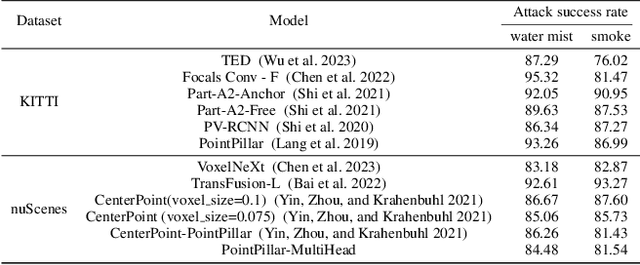
Autonomous vehicles (AVs) rely on LiDAR sensors for environmental perception and decision-making in driving scenarios. However, ensuring the safety and reliability of AVs in complex environments remains a pressing challenge. To address this issue, we introduce a real-world dataset (ROLiD) comprising LiDAR-scanned point clouds of two random objects: water mist and smoke. In this paper, we introduce a novel adversarial perspective by proposing an attack framework that utilizes water mist and smoke to simulate environmental interference. Specifically, we propose a point cloud sequence generation method using a motion and content decomposition generative adversarial network named PCS-GAN to simulate the distribution of random objects. Furthermore, leveraging the simulated LiDAR scanning characteristics implemented with Range Image, we examine the effects of introducing random object perturbations at various positions on the target vehicle. Extensive experiments demonstrate that adversarial perturbations based on random objects effectively deceive vehicle detection and reduce the recognition rate of 3D object detection models.
DiffusionDrive: Truncated Diffusion Model for End-to-End Autonomous Driving
Nov 22, 2024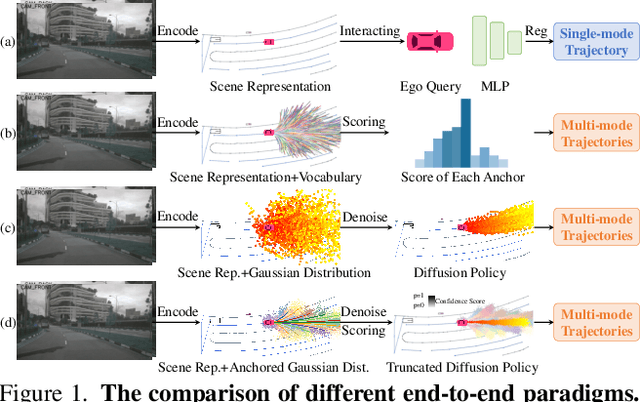
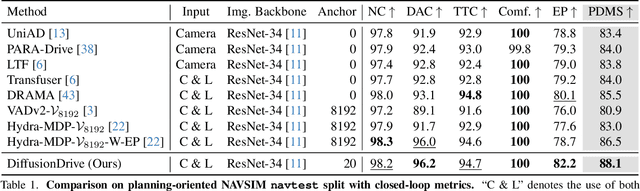
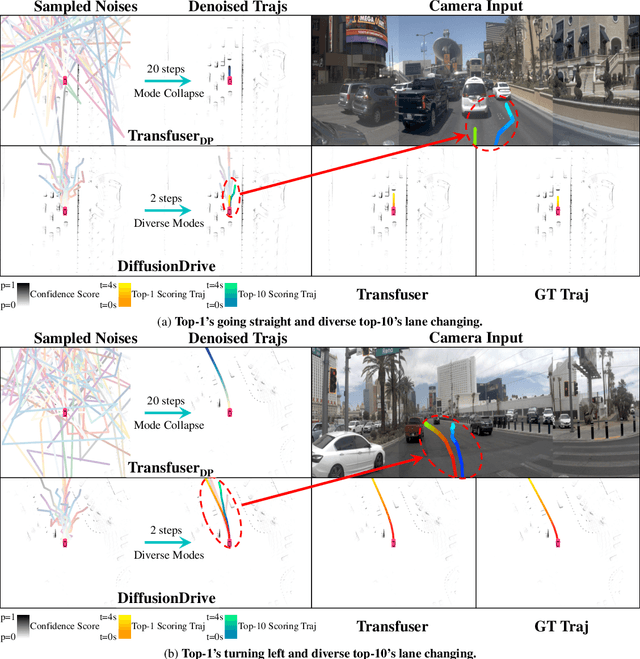
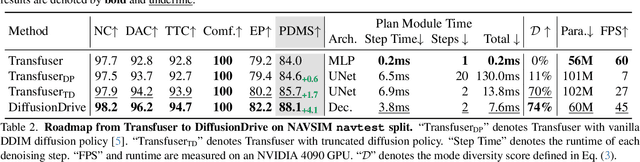
Recently, the diffusion model has emerged as a powerful generative technique for robotic policy learning, capable of modeling multi-mode action distributions. Leveraging its capability for end-to-end autonomous driving is a promising direction. However, the numerous denoising steps in the robotic diffusion policy and the more dynamic, open-world nature of traffic scenes pose substantial challenges for generating diverse driving actions at a real-time speed. To address these challenges, we propose a novel truncated diffusion policy that incorporates prior multi-mode anchors and truncates the diffusion schedule, enabling the model to learn denoising from anchored Gaussian distribution to the multi-mode driving action distribution. Additionally, we design an efficient cascade diffusion decoder for enhanced interaction with conditional scene context. The proposed model, DiffusionDrive, demonstrates 10$\times$ reduction in denoising steps compared to vanilla diffusion policy, delivering superior diversity and quality in just 2 steps. On the planning-oriented NAVSIM dataset, with the aligned ResNet-34 backbone, DiffusionDrive achieves 88.1 PDMS without bells and whistles, setting a new record, while running at a real-time speed of 45 FPS on an NVIDIA 4090. Qualitative results on challenging scenarios further confirm that DiffusionDrive can robustly generate diverse plausible driving actions. Code and model will be available at https://github.com/hustvl/DiffusionDrive.