 Add to Chrome
 Add to Firefox
 Add to Edge
A Digital Twin Platform Enabling Monolithic Crystal-Free Bluetooth Low Energy Single-Chip Sensor Motes
May 22, 2026
Low-power wireless-capable systems-on-chips (SoCs) are critical for researching many of our current environmental issues. The scale at which these devices are needed for many applications necessitates innovation in their design to reduce the various capital and labor costs involved with operating an extensive sensor network. This can be difficult for devices with novel wireless architectures, as many emerging architectures lack commercially available development platforms. This makes pre-silicon validation challenging, and the impact of a failed tapeout is unacceptable when the cost is of primary concern for these devices. In this work, we propose a digital twin ecosystem for Bluetooth Low-Energy (BLE) with physical-layer (PHY) control intended for novel device development and demonstrated through use with crystal-free single-chip sensor motes. We present this system operating with multiple RF front ends and digital baseband implementations, including a commercially available Software Defined Radio (SDR) with synthesized RTL and embedded firmware, along with an existing crystal-free SoC front end and FPGA digital baseband. These configurations are shown to be capable of communicating sensor data with commercially available BLE devices and achieving receiver sensitivities up to -82 dBm, exceeding the minimum BLE specification. This approach is extendable to other hardware and communication protocols and promises to enable inexpensive, reusable validation and verification tools for novel wireless devices.

Monaas: Mobile Node as a Service for TSCH-based Industrial IoT Networks
Jan 07, 2026The Time-Slotted Channel Hopping (TSCH) mode of IEEE802.15.4 standard provides ultra high end-to-end reliability and low-power consumption for application in field of Industrial Internet of Things (IIoT). With the evolving of Industrial 4.0, dynamic and bursty tasks with varied Quality of Service (QoS); effective management and utilization of growing number of mobile equipments become two major challenges for network solutions. The existing TSCH-based networks lack of a system framework design to handle these challenges. In this paper, we propose a novel, service-oriented, and hierarchical IoT network architecture named Mobile Node as a Service (Monaas). Monaas aims to systematically manage and schedule mobile nodes as on-demand, elastic resources through a new architectural design and protocol mechanisms. Its core features include a hierarchical architecture to balance global coordination with local autonomy, task-driven scheduling for proactive resource allocation, and an on-demand mobile resource integration mechanism. The feasibility and potential of the Monaas link layer mechanisms are validated through implementation and performance evaluation on an nRF52840 hardware testbed, demonstrating its potential advantages in specific scenarios. On a physical nRF52840 testbed, Monaas consistently achieved a Task Completion Rate (TCR) above 98% for high-priority tasks under bursty traffic and link degradation, whereas all representative baselines (Static TSCH, 6TiSCH Minimal, OST, FTS-SDN) remained below 40%.Moreover, its on-demand mobile resource integration activated services in 1.2 s, at least 65% faster than SDN (3.5 s) and OST/6TiSCH (> 5.8 s).
Robustness-enhanced Myoelectric Control with GAN-based Open-set Recognition
Dec 20, 2024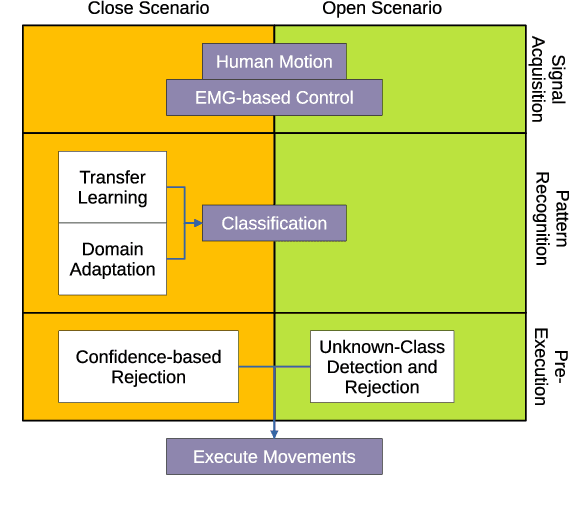
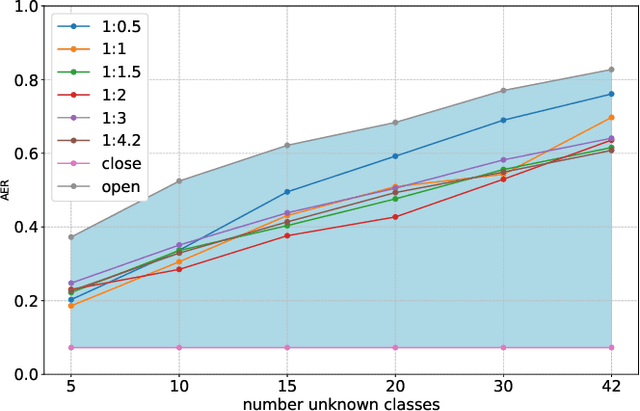
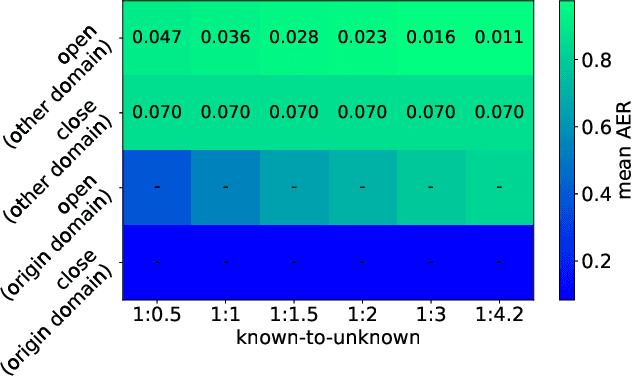
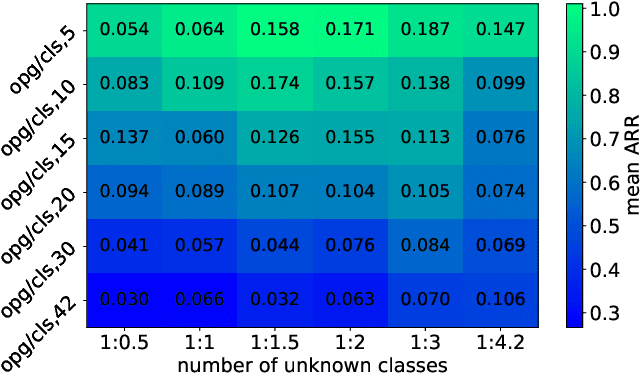
Electromyography (EMG) signals are widely used in human motion recognition and medical rehabilitation, yet their variability and susceptibility to noise significantly limit the reliability of myoelectric control systems. Existing recognition algorithms often fail to handle unfamiliar actions effectively, leading to system instability and errors. This paper proposes a novel framework based on Generative Adversarial Networks (GANs) to enhance the robustness and usability of myoelectric control systems by enabling open-set recognition. The method incorporates a GAN-based discriminator to identify and reject unknown actions, maintaining system stability by preventing misclassifications. Experimental evaluations on publicly available and self-collected datasets demonstrate a recognition accuracy of 97.6\% for known actions and a 23.6\% improvement in Active Error Rate (AER) after rejecting unknown actions. The proposed approach is computationally efficient and suitable for deployment on edge devices, making it practical for real-world applications.