 Add to Chrome
 Add to Firefox
 Add to Edge
V2U4Real: A Real-world Large-scale Dataset for Vehicle-to-UAV Cooperative Perception
Mar 26, 2026
Modern autonomous vehicle perception systems are often constrained by occlusions, blind spots, and limited sensing range. While existing cooperative perception paradigms, such as Vehicle-to-Vehicle (V2V) and Vehicle-to-Infrastructure (V2I), have demonstrated their effectiveness in mitigating these challenges, they remain limited to ground-level collaboration and cannot fully address large-scale occlusions or long-range perception in complex environments. To advance research in cross-view cooperative perception, we present V2U4Real, the first large-scale real-world multi-modal dataset for Vehicle-to-UAV (V2U) cooperative object perception. V2U4Real is collected by a ground vehicle and a UAV equipped with multi-view LiDARs and RGB cameras. The dataset covers urban streets, university campuses, and rural roads under diverse traffic scenarios, comprising over 56K LiDAR frames, 56K multi-view camera images, and 700K annotated 3D bounding boxes across four classes. To support a wide range of research tasks, we establish benchmarks for single-agent 3D object detection, cooperative 3D object detection, and object tracking. Comprehensive evaluations of several state-of-the-art models demonstrate the effectiveness of V2U cooperation in enhancing perception robustness and long-range awareness. The V2U4Real dataset and codebase is available at https://github.com/VjiaLi/V2U4Real.

Learning to Detect Objects from Multi-Agent LiDAR Scans without Manual Labels
Mar 13, 2025Unsupervised 3D object detection serves as an important solution for offline 3D object annotation. However, due to the data sparsity and limited views, the clustering-based label fitting in unsupervised object detection often generates low-quality pseudo-labels. Multi-agent collaborative dataset, which involves the sharing of complementary observations among agents, holds the potential to break through this bottleneck. In this paper, we introduce a novel unsupervised method that learns to Detect Objects from Multi-Agent LiDAR scans, termed DOtA, without using labels from external. DOtA first uses the internally shared ego-pose and ego-shape of collaborative agents to initialize the detector, leveraging the generalization performance of neural networks to infer preliminary labels. Subsequently,DOtA uses the complementary observations between agents to perform multi-scale encoding on preliminary labels, then decodes high-quality and low-quality labels. These labels are further used as prompts to guide a correct feature learning process, thereby enhancing the performance of the unsupervised object detection task. Extensive experiments on the V2V4Real and OPV2V datasets show that our DOtA outperforms state-of-the-art unsupervised 3D object detection methods. Additionally, we also validate the effectiveness of the DOtA labels under various collaborative perception frameworks.The code is available at https://github.com/xmuqimingxia/DOtA.
Mining and Transferring Feature-Geometry Coherence for Unsupervised Point Cloud Registration
Nov 04, 2024
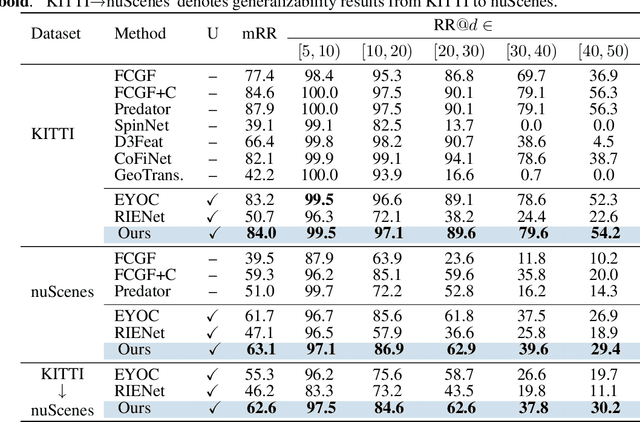

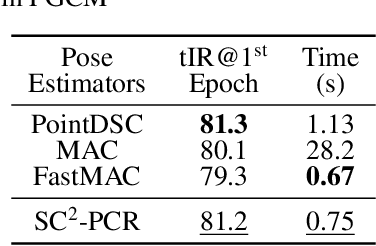
Point cloud registration, a fundamental task in 3D vision, has achieved remarkable success with learning-based methods in outdoor environments. Unsupervised outdoor point cloud registration methods have recently emerged to circumvent the need for costly pose annotations. However, they fail to establish reliable optimization objectives for unsupervised training, either relying on overly strong geometric assumptions, or suffering from poor-quality pseudo-labels due to inadequate integration of low-level geometric and high-level contextual information. We have observed that in the feature space, latent new inlier correspondences tend to cluster around respective positive anchors that summarize features of existing inliers. Motivated by this observation, we propose a novel unsupervised registration method termed INTEGER to incorporate high-level contextual information for reliable pseudo-label mining. Specifically, we propose the Feature-Geometry Coherence Mining module to dynamically adapt the teacher for each mini-batch of data during training and discover reliable pseudo-labels by considering both high-level feature representations and low-level geometric cues. Furthermore, we propose Anchor-Based Contrastive Learning to facilitate contrastive learning with anchors for a robust feature space. Lastly, we introduce a Mixed-Density Student to learn density-invariant features, addressing challenges related to density variation and low overlap in the outdoor scenario. Extensive experiments on KITTI and nuScenes datasets demonstrate that our INTEGER achieves competitive performance in terms of accuracy and generalizability.