 Add to Chrome
 Add to Firefox
 Add to Edge
Learning Responsibility-Attributed Adversarial Scenarios for Testing Autonomous Vehicles
May 13, 2026
Establishing trustworthy safety assurance for autonomous driving systems (ADSs) requires evidence that failures arise from avoidable system deficiencies rather than unavoidable traffic conflicts. Current adversarial simulation methods can efficiently expose collisions, but generally lack mechanisms to distinguish these fundamentally different failure modes. Here we present CARS (Context-Aware, Responsibility-attributed Scenario generation), a framework that integrates responsibility attribution directly into adversarial scenario generation. CARS combines context-aware adversary selection with a generative adversarial policy optimized in closed-loop simulation to construct collision scenarios that are both physically feasible and diagnostically attributable. Across benchmark datasets spanning heterogeneous national traffic environments, CARS consistently discovers feasible collision scenarios with high attribution rates under multiple regulation-prescribed careful and competent driver models. By coupling adversarial generation with normative responsibility assessment, CARS moves simulation testing beyond collision discovery toward the construction of interpretable, regulation-aligned safety evidence for scalable ADS validation.

Controllable Latent Diffusion for Traffic Simulation
Mar 14, 2025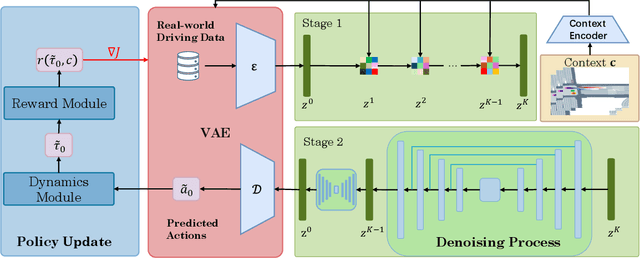
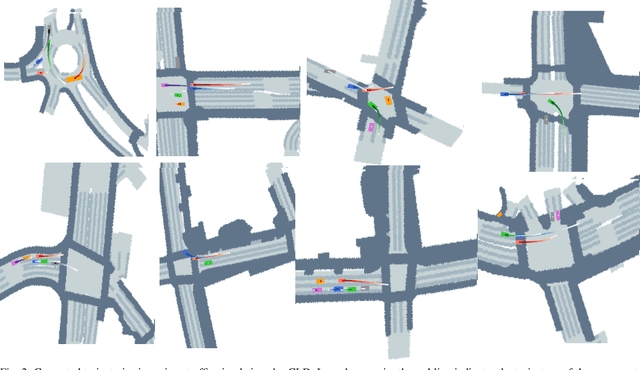
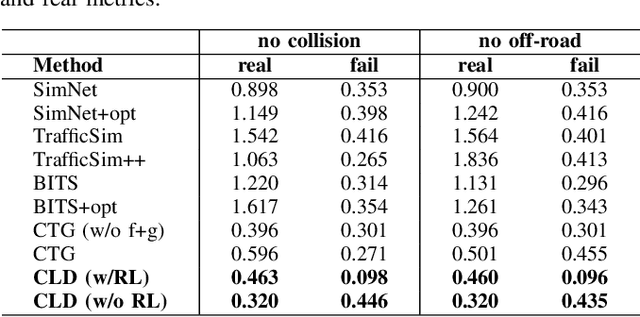
The validation of autonomous driving systems benefits greatly from the ability to generate scenarios that are both realistic and precisely controllable. Conventional approaches, such as real-world test drives, are not only expensive but also lack the flexibility to capture targeted edge cases for thorough evaluation. To address these challenges, we propose a controllable latent diffusion that guides the training of diffusion models via reinforcement learning to automatically generate a diverse and controllable set of driving scenarios for virtual testing. Our approach removes the reliance on large-scale real-world data by generating complex scenarios whose properties can be finely tuned to challenge and assess autonomous vehicle systems. Experimental results show that our approach has the lowest collision rate of $0.098$ and lowest off-road rate of $0.096$, demonstrating superiority over existing baselines. The proposed approach significantly improves the realism, stability and controllability of the generated scenarios, enabling more nuanced safety evaluation of autonomous vehicles.