 Add to Chrome
 Add to Firefox
 Add to Edge
RoTE: Coarse-to-Fine Multi-Level Rotary Time Embedding for Sequential Recommendation
Apr 15, 2026
Sequential recommendation models have been widely adopted for modeling user behavior. Existing approaches typically construct user interaction sequences by sorting items according to timestamps and then model user preferences from historical behaviors. While effective, such a process only considers the order of temporal information but overlooks the actual time spans between interactions, resulting in a coarse representation of users' temporal dynamics and limiting the model's ability to capture long-term and short-term interest evolution. To address this limitation, we propose RoTE, a novel multi-level temporal embedding module that explicitly models time span information in sequential recommendation. RoTE decomposes each interaction timestamp into multiple temporal granularities, ranging from coarse to fine, and incorporates the resulting temporal representations into item embeddings. This design enables models to capture heterogeneous temporal patterns and better perceive temporal distances among user interactions during sequence modeling. RoTE is a lightweight, plug-and-play module that can be seamlessly integrated into existing Transformer-based sequential recommendation models without modifying their backbone architectures. We apply RoTE to several representative models and conduct extensive experiments on three public benchmarks. Experimental results demonstrate that RoTE consistently enhances the corresponding backbone models, achieving up to a 20.11% improvement in NDCG@5, which confirms the effectiveness and generality of the proposed approach. Our code is available at https://github.com/XiaoLongtaoo/RoTE.

FAIR: Focused Attention Is All You Need for Generative Recommendation
Dec 17, 2025Recently, transformer-based generative recommendation has garnered significant attention for user behavior modeling. However, it often requires discretizing items into multi-code representations (e.g., typically four code tokens or more), which sharply increases the length of the original item sequence. This expansion poses challenges to transformer-based models for modeling user behavior sequences with inherent noises, since they tend to overallocate attention to irrelevant or noisy context. To mitigate this issue, we propose FAIR, the first generative recommendation framework with focused attention, which enhances attention scores to relevant context while suppressing those to irrelevant ones. Specifically, we propose (1) a focused attention mechanism integrated into the standard Transformer, which learns two separate sets of Q and K attention weights and computes their difference as the final attention scores to eliminate attention noise while focusing on relevant contexts; (2) a noise-robustness objective, which encourages the model to maintain stable attention patterns under stochastic perturbations, preventing undesirable shifts toward irrelevant context due to noise; and (3) a mutual information maximization objective, which guides the model to identify contexts that are most informative for next-item prediction. We validate the effectiveness of FAIR on four public benchmarks, demonstrating its superior performance compared to existing methods.
Progressive Collaborative and Semantic Knowledge Fusion for Generative Recommendation
Feb 10, 2025


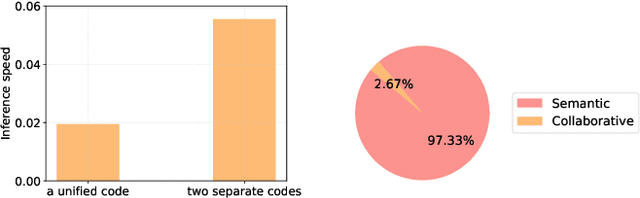
With the recent surge in interest surrounding generative paradigms, generative recommendation has increasingly attracted the attention of researchers in the recommendation community. This paradigm generally consists of two stages. In the first stage, pretrained semantic embeddings or collaborative ID embeddings are quantized to create item codes, aiming to capture and preserve rich semantic or collaborative knowledge within these codes. The second stage involves utilizing these discrete codes to perform an autoregressive sequence generation task. Existing methods often either overlook collaborative or semantic knowledge, or combine the two roughly. In this paper, we observe that naively concatenating representations from semantic and collaborative modality leads to a semantic domination issue, where the resulting representation is overly influenced by semantic information, effectively overshadowing the collaborative representation. Consequently, downstream recommendation tasks fail to fully exploit the knowledge from both modalities, resulting in suboptimal performance. To address this, we propose a progressive collaborative and semantic knowledge fusion model for generative recommendation, named PRORec, which integrates semantic and collaborative knowledge with a unified code through a two-stage framework. Specifically, in the first stage, we propose a cross-modality knowledge alignment task, which integrates semantic knowledge into collaborative embeddings, enhancing their representational capability. In the second stage, we propose an in-modality knowledge distillation task, designed to effectively capture and integrate knowledge from both semantic and collaborative modalities. Extensive experiments on three widely used benchmarks validate the effectiveness of our approach, demonstrating its superiority compared to existing methods.