 Add to Chrome
 Add to Firefox
 Add to Edge
TextRefine: Improving Textual Fidelity, Spatial Placement, and Glyph Rendering for Text Editing in Product Posters
Aug 20, 2026
Text editing in product posters entails inserting new text or replacing existing text while preserving product appearance, background content, and global composition. Despite recent progress in instruction-based image editing, general-purpose models remain unreliable in this setting: they often omit or incorrectly render the target text, place it over salient products or pre-existing content, and produce structurally distorted or visually inconsistent glyphs. We introduce \textbf{TextRefine}, a task-aligned post-training framework that combines supervised fine-tuning with operation-specific reward optimization to address these complementary failure modes. For text insertion, our text-span-level reward jointly assesses semantic fidelity and target-span coverage, penalizes spatial conflicts with products and existing text, and employs a gated structural constraint to preserve non-text regions. For text replacement, our glyph-level reward leverages the connectionist temporal classification (CTC) posterior of the target character to provide graded supervision for fine-grained defects, including missing strokes, structural deformations, and confusion among visually similar characters. We further introduce \textbf{OpenTextEdit}, a dataset comprising 100K images for text editing in product posters, with multi-text layouts, detailed text attributes, product masks, and challenging low-frequency characters. Extensive experiments on both insertion and replacement demonstrate that TextRefine consistently outperforms the evaluated image editing baselines in textual fidelity, placement reliability, and glyph quality while better preserving source-image content.

Multimodal Plant Root Phenotyping with Integration of 3D Skeleton Extraction and Language Analysis
Aug 04, 2026Plant root phenotyping is fundamental to understanding below-ground structures, optimizing crop management, and improving agricultural sustainability. This paper presents a multimodal robotic AI framework that integrates 3D skeleton extraction with language-guided reasoning for interpretable and data-efficient root analysis. We develop an unsupervised skeleton extraction network based on Weighted Laplacian Contraction (W-LBC) to generate high-fidelity structural representations from dense point clouds captured by robotic 3D sensing platforms. Quantitative morphological descriptors, including root count, length, branching angle, and density, are computed from the reconstructed skeleton graph to capture geometric and topological characteristics. Building on these features, we introduce an Evidence-First language modeling framework that fine-tunes GPT as an interactive analytical chatbot using automatically generated instruction--response pairs. Each training sample provides measurable evidence before natural-language reasoning, enabling the model to ground interpretation in quantitative morphology. Through supervised fine-tuning, GPT associates numerical structure with semantic meaning, producing biologically consistent explanations of growth patterns and adaptive traits. Experiments show that the structure-guided framework achieves robust, interpretable reasoning across 12 plant species with diverse root architectures. By integrating unsupervised 3D geometric perception with large-scale language understanding, our approach bridges quantitative analysis and semantic interpretation, establishing a unified paradigm for explainable robotic plant root phenotyping.
DetailAnywhere: Fashion Detail Generation via Cross-Modal Feature Alignment Distillation
Jul 02, 2026Diffusion-based generative AI has achieved remarkable success in e-commerce applications such as virtual try-on, poster generation, and product background synthesis. However, when making online purchasing decisions for apparel, consumers also desire the freedom to examine specific detail regions of interest, such as collars, cuffs, and fabric textures, yet existing methods have not explicitly studied this setting. We therefore formalize a new, non-template task: Fashion Detail Generation with focus conditioning, and release FDBench, the first benchmark comprising 40K+ human-verified reference-detail pairs across 41 different categories. This task poses a unique semantic gap challenge: the model must bridge the correspondence between a focus marker on a product reference image and a photorealistic close-up view of the indicated region, while faithfully preserving the garment's identity, without any precise prompt. To bridge this gap, we propose Cross-modal Feature Alignment Distillation (CFAD), which leverages a fine-tuned DINOv3 teacher to align both branches of a Multimodal Diffusion Transformer in a shared semantic space via dual-branch distillation. To further improve consistency between generated details and reference images, we introduce a consistency reward model that jointly scores image pairs along three quality axes and optimizes generation via reinforcement learning. Experiments show that our model DetailAnywhere significantly outperforms all state-of-the-art opensource methods across all metrics and human evaluations.
CaC: Advancing Video Reward Models via Hierarchical Spatiotemporal Concentrating
May 12, 2026In this paper, we propose Concentrate and Concentrate (CaC), a coarse-to-fine anomaly reward model based on Vision-Language Models. During inference, it first conducts a global temporal scan to anchor anomalous time windows, then performs fine-grained spatial grounding within the localized interval, and finally derives robust judgments via structured spatiotemporal Chain-of-Thought reasoning. To equip the model with these capabilities, we construct the first large-scale generated video anomaly dataset with per-frame bounding-box annotations, temporal anomaly windows, and fine-grained attribution labels. Building on this dataset, we design a three-stage progressive training paradigm. The model initially learns spatial and temporal anchoring through single- and multi-frame supervised fine-tuning, and then is optimized by a reinforcement learning strategy based on two-turn Group Relative Policy Optimization (GRPO). Beyond conventional accuracy rewards, we introduce Temporal and Spatial IoU rewards to supervise the intermediate localization process, effectively guiding the model toward more grounded and interpretable spatiotemporal reasoning. Extensive experiments demonstrate that CaC can stably concentrate on subtle anomalies, achieving a 25.7% accuracy improvement on fine-grained anomaly benchmarks and, when used as a reward signal, CaC reduces generated-video anomalies by 11.7% while improving overall video quality.
MedVAR: Towards Scalable and Efficient Medical Image Generation via Next-scale Autoregressive Prediction
Feb 16, 2026Medical image generation is pivotal in applications like data augmentation for low-resource clinical tasks and privacy-preserving data sharing. However, developing a scalable generative backbone for medical imaging requires architectural efficiency, sufficient multi-organ data, and principled evaluation, yet current approaches leave these aspects unresolved. Therefore, we introduce MedVAR, the first autoregressive-based foundation model that adopts the next-scale prediction paradigm to enable fast and scale-up-friendly medical image synthesis. MedVAR generates images in a coarse-to-fine manner and produces structured multi-scale representations suitable for downstream use. To support hierarchical generation, we curate a harmonized dataset of around 440,000 CT and MRI images spanning six anatomical regions. Comprehensive experiments across fidelity, diversity, and scalability show that MedVAR achieves state-of-the-art generative performance and offers a promising architectural direction for future medical generative foundation models.
DV-VLN: Dual Verification for Reliable LLM-Based Vision-and-Language Navigation
Jan 26, 2026Vision-and-Language Navigation (VLN) requires an embodied agent to navigate in a complex 3D environment according to natural language instructions. Recent progress in large language models (LLMs) has enabled language-driven navigation with improved interpretability. However, most LLM-based agents still rely on single-shot action decisions, where the model must choose one option from noisy, textualized multi-perspective observations. Due to local mismatches and imperfect intermediate reasoning, such decisions can easily deviate from the correct path, leading to error accumulation and reduced reliability in unseen environments. In this paper, we propose DV-VLN, a new VLN framework that follows a generate-then-verify paradigm. DV-VLN first performs parameter-efficient in-domain adaptation of an open-source LLaMA-2 backbone to produce a structured navigational chain-of-thought, and then verifies candidate actions with two complementary channels: True-False Verification (TFV) and Masked-Entity Verification (MEV). DV-VLN selects actions by aggregating verification successes across multiple samples, yielding interpretable scores for reranking. Experiments on R2R, RxR (English subset), and REVERIE show that DV-VLN consistently improves over direct prediction and sampling-only baselines, achieving competitive performance among language-only VLN agents and promising results compared with several cross-modal systems.Code is available at https://github.com/PlumJun/DV-VLN.
Automated Genomic Interpretation via Concept Bottleneck Models for Medical Robotics
Oct 02, 2025We propose an automated genomic interpretation module that transforms raw DNA sequences into actionable, interpretable decisions suitable for integration into medical automation and robotic systems. Our framework combines Chaos Game Representation (CGR) with a Concept Bottleneck Model (CBM), enforcing predictions to flow through biologically meaningful concepts such as GC content, CpG density, and k mer motifs. To enhance reliability, we incorporate concept fidelity supervision, prior consistency alignment, KL distribution matching, and uncertainty calibration. Beyond accurate classification of HIV subtypes across both in-house and LANL datasets, our module delivers interpretable evidence that can be directly validated against biological priors. A cost aware recommendation layer further translates predictive outputs into decision policies that balance accuracy, calibration, and clinical utility, reducing unnecessary retests and improving efficiency. Extensive experiments demonstrate that the proposed system achieves state of the art classification performance, superior concept prediction fidelity, and more favorable cost benefit trade-offs compared to existing baselines. By bridging the gap between interpretable genomic modeling and automated decision-making, this work establishes a reliable foundation for robotic and clinical automation in genomic medicine.
Adaptive Event Stream Slicing for Open-Vocabulary Event-Based Object Detection via Vision-Language Knowledge Distillation
Oct 01, 2025Event cameras offer advantages in object detection tasks due to high-speed response, low latency, and robustness to motion blur. However, event cameras lack texture and color information, making open-vocabulary detection particularly challenging. Current event-based detection methods are typically trained on predefined categories, limiting their ability to generalize to novel objects, where encountering previously unseen objects is common. Vision-language models (VLMs) have enabled open-vocabulary object detection in RGB images. However, the modality gap between images and event streams makes it ineffective to directly transfer CLIP to event data, as CLIP was not designed for event streams. To bridge this gap, we propose an event-image knowledge distillation framework that leverages CLIP's semantic understanding to achieve open-vocabulary object detection on event data. Instead of training CLIP directly on event streams, we use image frames as inputs to a teacher model, guiding the event-based student model to learn CLIP's rich visual representations. Through spatial attention-based distillation, the student network learns meaningful visual features directly from raw event inputs while inheriting CLIP's broad visual knowledge. Furthermore, to prevent information loss due to event data segmentation, we design a hybrid spiking neural network (SNN) and convolutional neural network (CNN) framework. Unlike fixed-group event segmentation methods, which often discard crucial temporal information, our SNN adaptively determines the optimal event segmentation moments, ensuring that key temporal features are extracted. The extracted event features are then processed by CNNs for object detection.
Sculpting Features from Noise: Reward-Guided Hierarchical Diffusion for Task-Optimal Feature Transformation
May 21, 2025
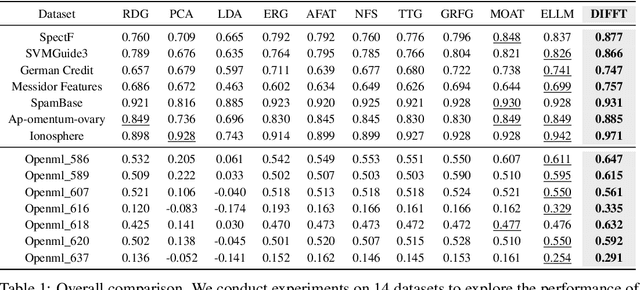
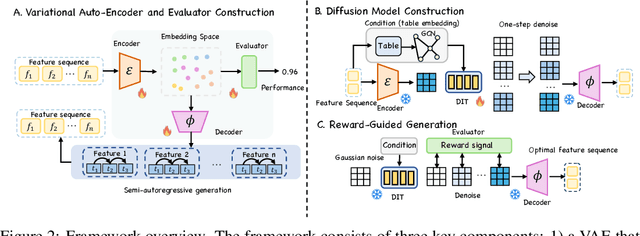
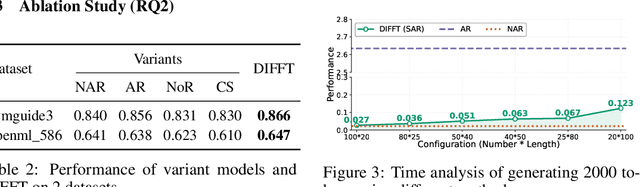
Feature Transformation (FT) crafts new features from original ones via mathematical operations to enhance dataset expressiveness for downstream models. However, existing FT methods exhibit critical limitations: discrete search struggles with enormous combinatorial spaces, impeding practical use; and continuous search, being highly sensitive to initialization and step sizes, often becomes trapped in local optima, restricting global exploration. To overcome these limitations, DIFFT redefines FT as a reward-guided generative task. It first learns a compact and expressive latent space for feature sets using a Variational Auto-Encoder (VAE). A Latent Diffusion Model (LDM) then navigates this space to generate high-quality feature embeddings, its trajectory guided by a performance evaluator towards task-specific optima. This synthesis of global distribution learning (from LDM) and targeted optimization (reward guidance) produces potent embeddings, which a novel semi-autoregressive decoder efficiently converts into structured, discrete features, preserving intra-feature dependencies while allowing parallel inter-feature generation. Extensive experiments on 14 benchmark datasets show DIFFT consistently outperforms state-of-the-art baselines in predictive accuracy and robustness, with significantly lower training and inference times.
TMCIR: Token Merge Benefits Composed Image Retrieval
Apr 15, 2025Composed Image Retrieval (CIR) retrieves target images using a multi-modal query that combines a reference image with text describing desired modifications. The primary challenge is effectively fusing this visual and textual information. Current cross-modal feature fusion approaches for CIR exhibit an inherent bias in intention interpretation. These methods tend to disproportionately emphasize either the reference image features (visual-dominant fusion) or the textual modification intent (text-dominant fusion through image-to-text conversion). Such an imbalanced representation often fails to accurately capture and reflect the actual search intent of the user in the retrieval results. To address this challenge, we propose TMCIR, a novel framework that advances composed image retrieval through two key innovations: 1) Intent-Aware Cross-Modal Alignment. We first fine-tune CLIP encoders contrastively using intent-reflecting pseudo-target images, synthesized from reference images and textual descriptions via a diffusion model. This step enhances the encoder ability of text to capture nuanced intents in textual descriptions. 2) Adaptive Token Fusion. We further fine-tune all encoders contrastively by comparing adaptive token-fusion features with the target image. This mechanism dynamically balances visual and textual representations within the contrastive learning pipeline, optimizing the composed feature for retrieval. Extensive experiments on Fashion-IQ and CIRR datasets demonstrate that TMCIR significantly outperforms state-of-the-art methods, particularly in capturing nuanced user intent.