 Add to Chrome
 Add to Firefox
 Add to Edge
Leveraging Inter-Chunk Interactions for Enhanced Retrieval in Large Language Model-Based Question Answering
Aug 06, 2024


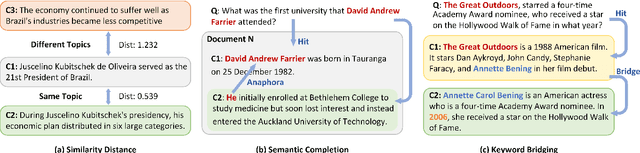
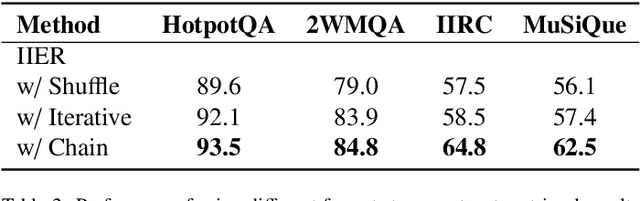
Retrieving external knowledge and prompting large language models with relevant information is an effective paradigm to enhance the performance of question-answering tasks. Previous research typically handles paragraphs from external documents in isolation, resulting in a lack of context and ambiguous references, particularly in multi-document and complex tasks. To overcome these challenges, we propose a new retrieval framework IIER, that leverages Inter-chunk Interactions to Enhance Retrieval. This framework captures the internal connections between document chunks by considering three types of interactions: structural, keyword, and semantic. We then construct a unified Chunk-Interaction Graph to represent all external documents comprehensively. Additionally, we design a graph-based evidence chain retriever that utilizes previous paths and chunk interactions to guide the retrieval process. It identifies multiple seed nodes based on the target question and iteratively searches for relevant chunks to gather supporting evidence. This retrieval process refines the context and reasoning chain, aiding the large language model in reasoning and answer generation. Extensive experiments demonstrate that IIER outperforms strong baselines across four datasets, highlighting its effectiveness in improving retrieval and reasoning capabilities.

Sewer Image Super-Resolution with Depth Priors and Its Lightweight Network
Jul 27, 2024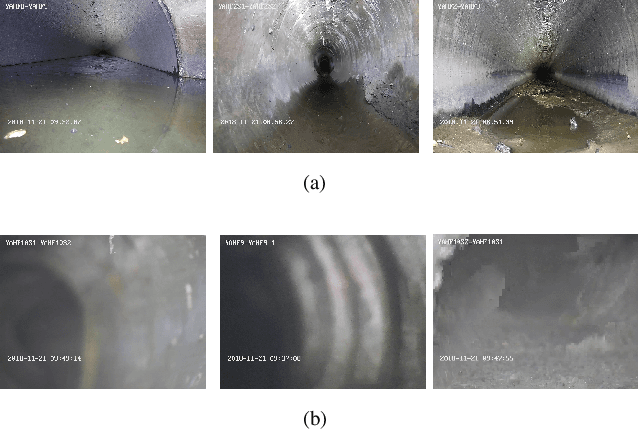
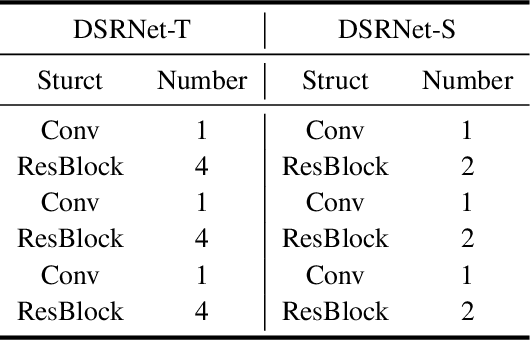
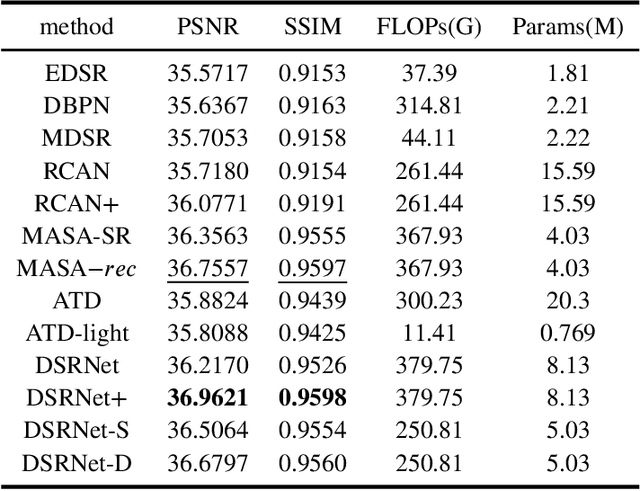
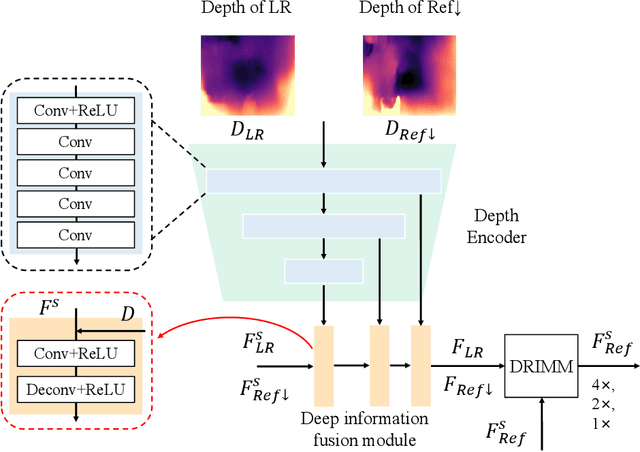
The Quick-view (QV) technique serves as a primary method for detecting defects within sewerage systems. However, the effectiveness of QV is impeded by the limited visual range of its hardware, resulting in suboptimal image quality for distant portions of the sewer network. Image super-resolution is an effective way to improve image quality and has been applied in a variety of scenes. However, research on super-resolution for sewer images remains considerably unexplored. In response, this study leverages the inherent depth relationships present within QV images and introduces a novel Depth-guided, Reference-based Super-Resolution framework denoted as DSRNet. It comprises two core components: a depth extraction module and a depth information matching module (DMM). DSRNet utilizes the adjacent frames of the low-resolution image as reference images and helps them recover texture information based on the correlation. By combining these modules, the integration of depth priors significantly enhances both visual quality and performance benchmarks. Besides, in pursuit of computational efficiency and compactness, our paper introduces a super-resolution knowledge distillation model based on an attention mechanism. This mechanism facilitates the acquisition of feature similarity between a more complex teacher model and a streamlined student model, the latter being a lightweight version of DSRNet. Experimental results demonstrate that DSRNet significantly improves PSNR and SSIM compared with other methods. This study also conducts experiments on sewer defect semantic segmentation, object detection, and classification on the Pipe dataset and Sewer-ML dataset. Experiments show that the method can improve the performance of low-resolution sewer images in these tasks.
Learning-augmented Maximum Independent Set
Jul 16, 2024We study the Maximum Independent Set (MIS) problem on general graphs within the framework of learning-augmented algorithms. The MIS problem is known to be NP-hard and is also NP-hard to approximate to within a factor of $n^{1-\delta}$ for any $\delta>0$. We show that we can break this barrier in the presence of an oracle obtained through predictions from a machine learning model that answers vertex membership queries for a fixed MIS with probability $1/2+\varepsilon$. In the first setting we consider, the oracle can be queried once per vertex to know if a vertex belongs to a fixed MIS, and the oracle returns the correct answer with probability $1/2 + \varepsilon$. Under this setting, we show an algorithm that obtains an $\tilde{O}(\sqrt{\Delta}/\varepsilon)$-approximation in $O(m)$ time where $\Delta$ is the maximum degree of the graph. In the second setting, we allow multiple queries to the oracle for a vertex, each of which is correct with probability $1/2 + \varepsilon$. For this setting, we show an $O(1)$-approximation algorithm using $O(n/\varepsilon^2)$ total queries and $\tilde{O}(m)$ runtime.
Map It Anywhere (MIA): Empowering Bird's Eye View Mapping using Large-scale Public Data
Jul 11, 2024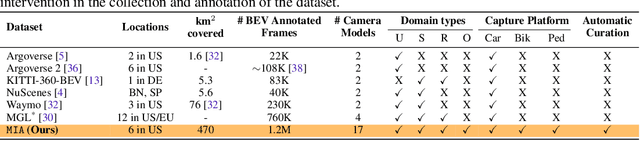
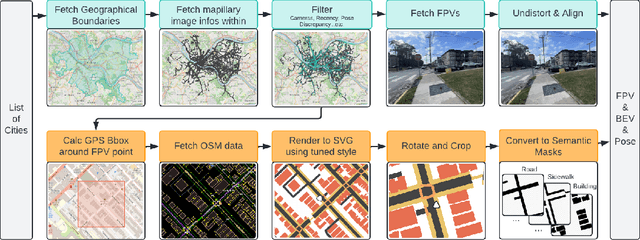
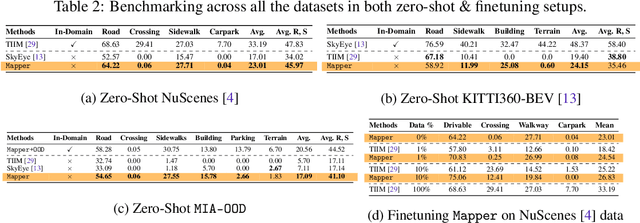
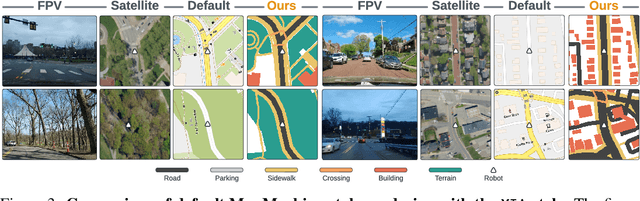
Top-down Bird's Eye View (BEV) maps are a popular representation for ground robot navigation due to their richness and flexibility for downstream tasks. While recent methods have shown promise for predicting BEV maps from First-Person View (FPV) images, their generalizability is limited to small regions captured by current autonomous vehicle-based datasets. In this context, we show that a more scalable approach towards generalizable map prediction can be enabled by using two large-scale crowd-sourced mapping platforms, Mapillary for FPV images and OpenStreetMap for BEV semantic maps. We introduce Map It Anywhere (MIA), a data engine that enables seamless curation and modeling of labeled map prediction data from existing open-source map platforms. Using our MIA data engine, we display the ease of automatically collecting a dataset of 1.2 million pairs of FPV images & BEV maps encompassing diverse geographies, landscapes, environmental factors, camera models & capture scenarios. We further train a simple camera model-agnostic model on this data for BEV map prediction. Extensive evaluations using established benchmarks and our dataset show that the data curated by MIA enables effective pretraining for generalizable BEV map prediction, with zero-shot performance far exceeding baselines trained on existing datasets by 35%. Our analysis highlights the promise of using large-scale public maps for developing & testing generalizable BEV perception, paving the way for more robust autonomous navigation.
Variational and Explanatory Neural Networks for Encoding Cancer Profiles and Predicting Drug Responses
Jul 05, 2024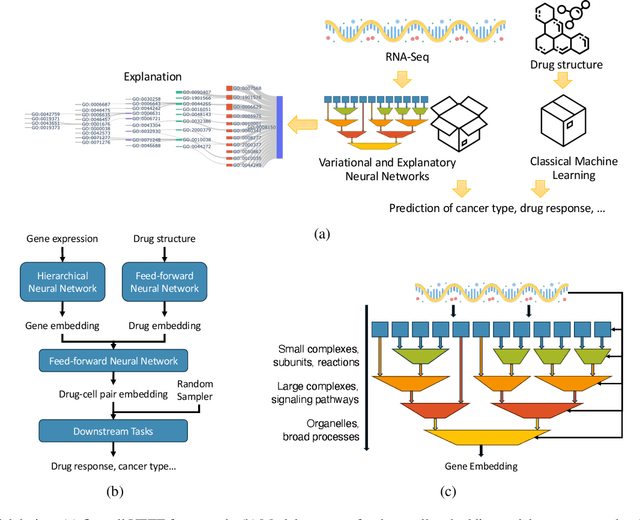
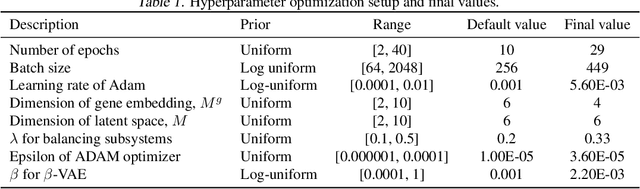
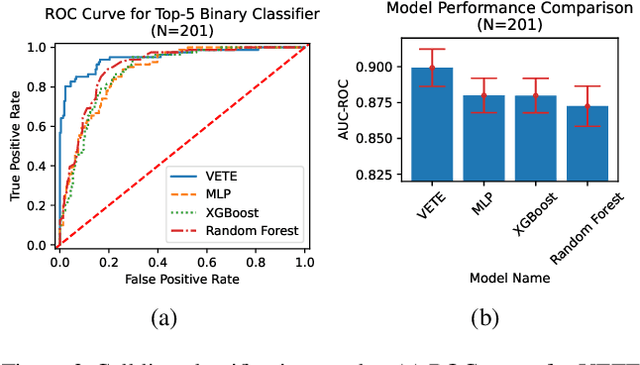
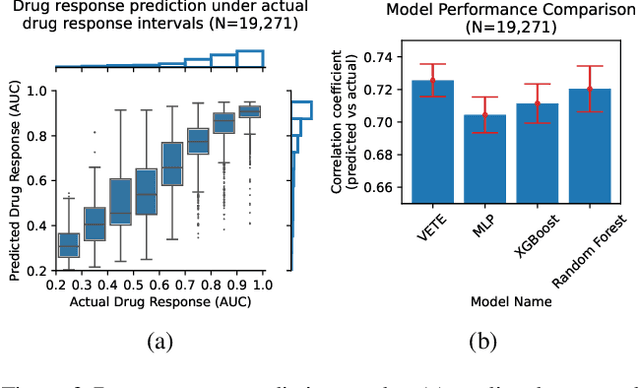
Human cancers present a significant public health challenge and require the discovery of novel drugs through translational research. Transcriptomics profiling data that describes molecular activities in tumors and cancer cell lines are widely utilized for predicting anti-cancer drug responses. However, existing AI models face challenges due to noise in transcriptomics data and lack of biological interpretability. To overcome these limitations, we introduce VETE (Variational and Explanatory Transcriptomics Encoder), a novel neural network framework that incorporates a variational component to mitigate noise effects and integrates traceable gene ontology into the neural network architecture for encoding cancer transcriptomics data. Key innovations include a local interpretability-guided method for identifying ontology paths, a visualization tool to elucidate biological mechanisms of drug responses, and the application of centralized large scale hyperparameter optimization. VETE demonstrated robust accuracy in cancer cell line classification and drug response prediction. Additionally, it provided traceable biological explanations for both tasks and offers insights into the mechanisms underlying its predictions. VETE bridges the gap between AI-driven predictions and biologically meaningful insights in cancer research, which represents a promising advancement in the field.
PointViG: A Lightweight GNN-based Model for Efficient Point Cloud Analysis
Jul 01, 2024In the domain of point cloud analysis, despite the significant capabilities of Graph Neural Networks (GNNs) in managing complex 3D datasets, existing approaches encounter challenges like high computational costs and scalability issues with extensive scenarios. These limitations restrict the practical deployment of GNNs, notably in resource-constrained environments. To address these issues, this study introduce <b>Point<\b> <b>Vi<\b>sion <b>G<\b>NN (PointViG), an efficient framework for point cloud analysis. PointViG incorporates a lightweight graph convolutional module to efficiently aggregate local features and mitigate over-smoothing. For large-scale point cloud scenes, we propose an adaptive dilated graph convolution technique that searches for sparse neighboring nodes within a dilated neighborhood based on semantic correlation, thereby expanding the receptive field and ensuring computational efficiency. Experiments demonstrate that PointViG achieves performance comparable to state-of-the-art models while balancing performance and complexity. On the ModelNet40 classification task, PointViG achieved 94.3% accuracy with 1.5M parameters. For the S3DIS segmentation task, it achieved an mIoU of 71.7% with 5.3M parameters. These results underscore the potential and efficiency of PointViG in point cloud analysis.
Seeing Is Believing: Black-Box Membership Inference Attacks Against Retrieval Augmented Generation
Jun 27, 2024
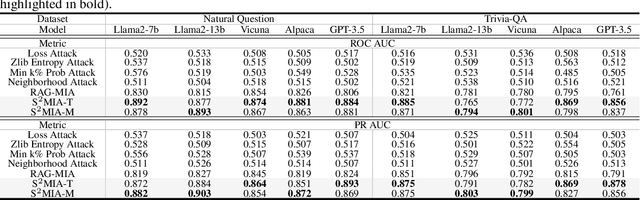
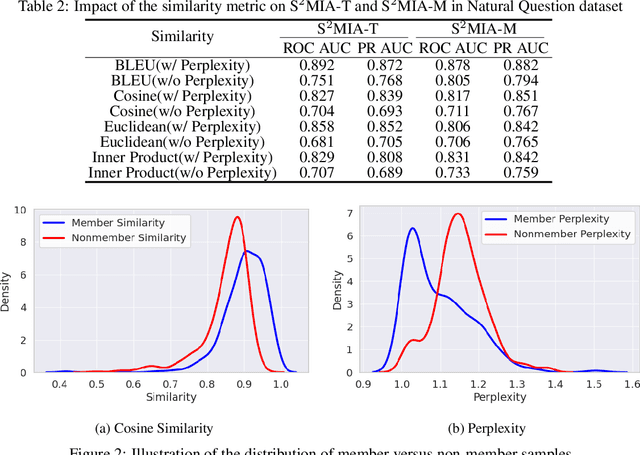
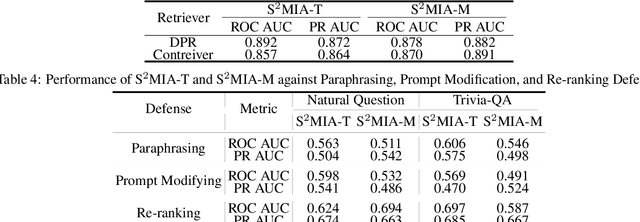
Retrieval-Augmented Generation (RAG) is a state-of-the-art technique that enhances Large Language Models (LLMs) by retrieving relevant knowledge from an external, non-parametric database. This approach aims to mitigate common LLM issues such as hallucinations and outdated knowledge. Although existing research has demonstrated security and privacy vulnerabilities within RAG systems, making them susceptible to attacks like jailbreaks and prompt injections, the security of the RAG system's external databases remains largely underexplored. In this paper, we employ Membership Inference Attacks (MIA) to determine whether a sample is part of the knowledge database of a RAG system, using only black-box API access. Our core hypothesis posits that if a sample is a member, it will exhibit significant similarity to the text generated by the RAG system. To test this, we compute the cosine similarity and the model's perplexity to establish a membership score, thereby building robust features. We then introduce two novel attack strategies: a Threshold-based Attack and a Machine Learning-based Attack, designed to accurately identify membership. Experimental validation of our methods has achieved a ROC AUC of 82%.
DICE: End-to-end Deformation Capture of Hand-Face Interactions from a Single Image
Jun 26, 2024

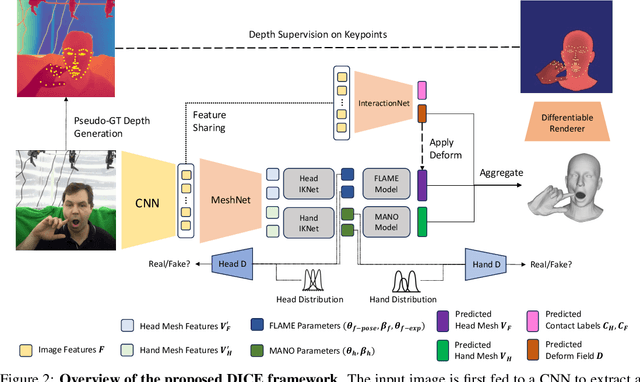
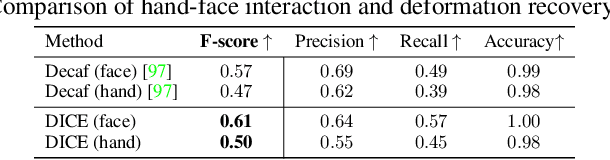
Reconstructing 3D hand-face interactions with deformations from a single image is a challenging yet crucial task with broad applications in AR, VR, and gaming. The challenges stem from self-occlusions during single-view hand-face interactions, diverse spatial relationships between hands and face, complex deformations, and the ambiguity of the single-view setting. The first and only method for hand-face interaction recovery, Decaf, introduces a global fitting optimization guided by contact and deformation estimation networks trained on studio-collected data with 3D annotations. However, Decaf suffers from a time-consuming optimization process and limited generalization capability due to its reliance on 3D annotations of hand-face interaction data. To address these issues, we present DICE, the first end-to-end method for Deformation-aware hand-face Interaction reCovEry from a single image. DICE estimates the poses of hands and faces, contacts, and deformations simultaneously using a Transformer-based architecture. It features disentangling the regression of local deformation fields and global mesh vertex locations into two network branches, enhancing deformation and contact estimation for precise and robust hand-face mesh recovery. To improve generalizability, we propose a weakly-supervised training approach that augments the training set using in-the-wild images without 3D ground-truth annotations, employing the depths of 2D keypoints estimated by off-the-shelf models and adversarial priors of poses for supervision. Our experiments demonstrate that DICE achieves state-of-the-art performance on a standard benchmark and in-the-wild data in terms of accuracy and physical plausibility. Additionally, our method operates at an interactive rate (20 fps) on an Nvidia 4090 GPU, whereas Decaf requires more than 15 seconds for a single image. Our code will be publicly available upon publication.
Imperative Learning: A Self-supervised Neural-Symbolic Learning Framework for Robot Autonomy
Jun 23, 2024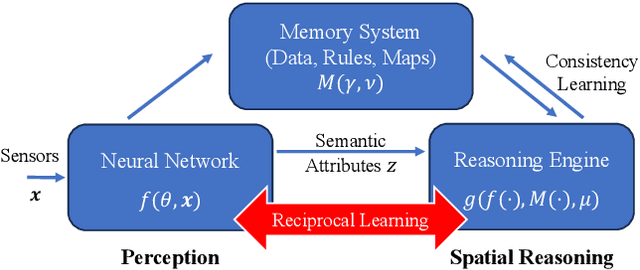

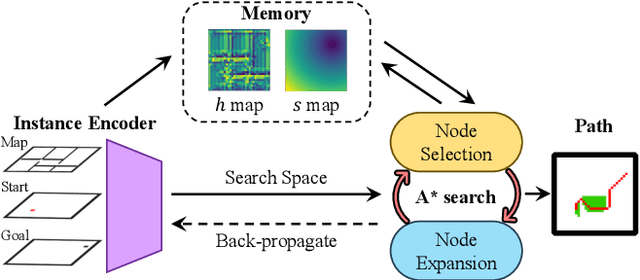

Data-driven methods such as reinforcement and imitation learning have achieved remarkable success in robot autonomy. However, their data-centric nature still hinders them from generalizing well to ever-changing environments. Moreover, collecting large datasets for robotic tasks is often impractical and expensive. To overcome these challenges, we introduce a new self-supervised neural-symbolic (NeSy) computational framework, imperative learning (IL), for robot autonomy, leveraging the generalization abilities of symbolic reasoning. The framework of IL consists of three primary components: a neural module, a reasoning engine, and a memory system. We formulate IL as a special bilevel optimization (BLO), which enables reciprocal learning over the three modules. This overcomes the label-intensive obstacles associated with data-driven approaches and takes advantage of symbolic reasoning concerning logical reasoning, physical principles, geometric analysis, etc. We discuss several optimization techniques for IL and verify their effectiveness in five distinct robot autonomy tasks including path planning, rule induction, optimal control, visual odometry, and multi-robot routing. Through various experiments, we show that IL can significantly enhance robot autonomy capabilities and we anticipate that it will catalyze further research across diverse domains.
Taxonomy-Guided Zero-Shot Recommendations with LLMs
Jun 20, 2024With the emergence of large language models (LLMs) and their ability to perform a variety of tasks, their application in recommender systems (RecSys) has shown promise. However, we are facing significant challenges when deploying LLMs into RecSys, such as limited prompt length, unstructured item information, and un-constrained generation of recommendations, leading to sub-optimal performance. To address these issues, we propose a novel method using a taxonomy dictionary. This method provides a systematic framework for categorizing and organizing items, improving the clarity and structure of item information. By incorporating the taxonomy dictionary into LLM prompts, we achieve efficient token utilization and controlled feature generation, leading to more accurate and contextually relevant recommendations. Our Taxonomy-guided Recommendation (TaxRec) approach features a two-step process: one-time taxonomy categorization and LLM-based recommendation, enabling zero-shot recommendations without the need for domain-specific fine-tuning. Experimental results demonstrate TaxRec significantly enhances recommendation quality compared to traditional zero-shot approaches, showcasing its efficacy as personal recommender with LLMs. Code is available at https://github.com/yueqingliang1/TaxRec.