 Add to Chrome
 Add to Firefox
 Add to Edge
Learning with Bilevel-Minimax Optimization for Efficient and Reliable Transfer Attacks
Aug 12, 2026
Transfer-based adversarial attacks craft adversarial examples using surrogate models to mislead black-box victim models. Beyond perturbation generation, transferability is fundamentally governed by the coupling of initialization, surrogate adaptation, and gradient dynamics. We revisit this challenge from a bilevel-minimax perspective and propose BMAT (Bilevel-Minimax Adversarial Transfer). The bilevel formulation captures the dependency between initialization and perturbation, while the inner minimax problem promotes surrogate robustness for cross-architecture generalization. Algorithmically, we develop an integrated bottom-up solver that combines a Soft Weight Modulator and an Implicit Gradient Approximator to enable ternary coupling among initialization, surrogate adaptation, and perturbation optimization. We further provide theoretical insights into the optimization dynamics of the proposed bilevel-minimax framework. Extensive experiments on classification and segmentation benchmarks show that BMAT outperforms more than 10 strong baselines across more than 30 victim models, improving both intra- and cross-architecture transfer and yielding up to a 2x reduction in mIoU. Code is available at https://github.com/callous-youth/BMAT.

FSTC-Encoder: Feature--Spatial--Temporal Correlation Learning for Generalizable RF Sensing
Aug 09, 2026Heterogeneous RF sensing differs substantially in feature structure, spatial layout, and temporal scale, making existing models difficult to reuse across devices, environments, and RF modalities. We propose FSTC-Encoder, which unifies heterogeneous RF representation learning through feature, spatial, and temporal correlation modeling. Structure-aware feature encoding accommodates different signal structures, set-based spatial encoding aggregates variable observations, and hierarchical temporal encoding jointly captures local variations and long-range dependencies. Across sensing tasks and modalities, FSTC-Encoder retains the same spatial--temporal backbone architecture while varying only the feature configuration and task head. Across Widar3.0, CSI-Bench, and XRF55, FSTC-Encoder achieves 92.15% mean Accuracy under multi-factor cross-domain protocols, ranks first on three of four additional sensing tasks, remains consistently strong across WiFi, millimeter-wave radar, and RFID, and reduces the cross-modality performance gap from 18.85% to 12.93% through cross-RF learning. These results demonstrate that FSTC-Encoder achieves high domain robustness, task generality, and modality extensibility.
TRACE-Memory: Public-Conditioned Retrieval and Utility-Aware Evidence Admission for Personalized Generation
Aug 09, 2026Personalized generation systems retrieve user history by request--memory relevance and inject it into the model context. Yet relevant history may concern the wrong preference aspect, duplicate public information, or provide insufficient support. We argue that personal memory should be used only when it adds utility beyond a public-only response. We propose TRACE-Memory, a two-stage framework for selective personalization. Stage 1 queries for user-specific information missing from the request and public context, then retrieves a coverage-oriented candidate pool. Stage 2 admits a compact subset of source-traceable evidence units, or the empty set, according to response-level incremental utility. We progressively train the query-generation and evidence-admission policies through structured SFT initialization, reduced-space stage-wise GRPO warm-up, and nested multi-sample Joint GRPO. Across 4,500 Controlled and Natural tasks from Goodreads, Amazon Reviews, and Reddit, TRACE-Memory consistently outperforms random and lexical memory use, improves over semantic retrieval, remains competitive with frontier-LLM memory pipelines as local generator capacity increases, and conditions evidence admission on public-context sufficiency, supporting selective rather than default personalization.
What Language Does and What the Evidence Supports: A Functional Role Taxonomy and Evidence Audit of Language Grounding in Embodied Agents
Aug 04, 2026Foundation models place language throughout embodied agents, but its presence does not show what it contributes or how well that contribution is grounded. This survey separates these two questions. We define five non-exclusive functional roles for language: Specification, Embodied Representation, Action Orchestration, Grounding Regulation, and Execution Coupling. For each role, we trace the path from linguistic content to its embodied consumer and identify the observations or interventions that can test the claimed responsibility. Applying this framework to the reviewed literature reveals a recurring gap between functional use and evidential support. Interpretable or revised linguistic intermediates may be incorrect, go unused, or fail to affect later behavior. Even when actions are directly conditioned on language, system-level success does not by itself isolate language's contribution. We therefore evaluate grounding claim by claim, asking whether the reported evidence supports the specific responsibility assigned to language. Using role claims rather than architectures as the unit of comparison allows us to compare modular and end-to-end embodied agents without extending conclusions beyond the reported evidence.
Ensuring Trustworthy Online A/B Testing: Addressing Five Key Questions on CUPED
Jun 17, 2026A/B testing has become the gold standard for data-driven decision-making in large-scale online experimentation, providing critical guidance for feature launch, pricing optimization, and user experience enhancement. To maximize statistical sensitivity, many technology companies routinely employ Controlled-experiment Using Pre-Experiment Data (CUPED), a technique that achieves substantial variance reduction while preserving the unbiasedness of estimating the average treatment effect. Despite its widespread adoption, several critical methodological and practical nuances of CUPED remain underexplored. This paper systematically addresses five frequently encountered yet overlooked questions regarding the application of CUPED. First, we provide a comparative analysis of various post-CUPED estimators to identify the optimal adjustment specification. Second, we evaluate the validity of regression-based adjustments and delineate robust variance estimation methods tailored for such frameworks. Finally, we extend our investigation to complex but common scenarios, including multi-arm experiments and two-stage sampling designs. Our findings reveal that in these settings, naive reliance on standard variance estimators can lead to severely misleading inferences. By offering rigorous theoretical insights and extensive experimental validation, this work deepens the conceptual understanding of CUPED. Notably, the recommended methodologies have been successfully deployed and integrated into ByteDance's experimentation platform.
Algorithmic Feature Highlighting for Human-AI Decision-Making
Apr 24, 2026Human decision-makers often face choices about complex cases with many potentially relevant features, but limited bandwidth to inspect and integrate all available information. In such settings, we study algorithms that highlight a small subset of case-specific features for human consideration, rather than producing a single prediction or recommendation. We model highlighting as a constrained information policy that selects a small number of features to reveal. A central issue is how humans interpret the algorithm's choice of features: a sophisticated agent correctly conditions on the selection rule, while a naive agent updates only on revealed feature values and treats the selection event as exogenous. We show that optimizing highlighting for sophisticated agents can be computationally intractable, even in simple discrete and binary settings, whereas optimizing for naive agents is tractable as long as the maximal bandwidth is fixed. We also show that a highlighting policy that is optimal for sophisticated agents can perform arbitrarily poorly when deployed to naive agents, motivating robust, implementable alternatives. We illustrate our framework in a calibrated empirical exercise based on the American Housing Survey. Overall, our results establish the value of highlighting a context-specific set of features rather than a fixed one as a practically appealing and computationally feasible tool for achieving human-algorithm complementarity.
FAS-aided Robust Anti-Jamming Communications: Continuous and Discrete Positioning Designs
Apr 13, 2026This paper investigates the joint optimization of beamforming and antenna positions in fluid antenna system (FAS)-aided anti-jamming communications. We consider a multi-user multiple-input multiple-output downlink scenario where multiple malicious jammers exist and the jammer channel state information is imperfect. The goal is to maximize the worst-case sum-rate under quality-of-service and transmit power constraints. To achieve this, we develop two distinct optimization frameworks for continuous and discrete antenna position designs, respectively. For continuous design, we propose an alternating optimization (AO) framework that integrates successive convex approximation and majorization minimization (MM) to handle the highly non-convex problem. For discrete design, based on the minimum mean squared error criterion and MM, we reformulate the problem as a sparse recovery task and propose a low-complexity block coordinate descent and simultaneous orthogonal matching pursuit, which enables joint design rather than AO. Through systematic comparison, we uncover a practical phenomenon: the discrete joint design yields superior sum-rate performance compared to the AO-based continuous counterpart under identical conditions. This superiority stems from the sparse recovery formulation which effectively circumvents the severe local optima. Our findings challenge the conventional view that continuous optimization is inherently superior, and reveal that discretization combined with sparse recovery can offer a more effective paradigm for exploiting spatial degrees-of-freedom in FAS-aided anti-jamming communications.
Robust Hybrid Precoding for Millimeter Wave MU-MISO System Via Meta-Learning
Nov 24, 2024Thanks to the low cost and power consumption, hybrid analog-digital architectures are considered as a promising energy-efficient solution for massive multiple-input multiple-output (MIMO) systems. The key idea is to connect one RF chain to multiple antennas through low-cost phase shifters. However, due to the non-convex objective function and constraints, we propose a gradient-guided meta-learning (GGML) based alternating optimization framework to solve this challenging problem. The GGML based hybrid precoding framework is \textit{free-of-training} and \textit{plug-and-play}. Specifically, GGML feeds the raw gradient information into a neural network, leveraging gradient descent to alternately optimize sub-problems from a local perspective, while a lightweight neural network embedded within the meta-learning framework is updated from a global perspective. We also extend the proposed framework to include precoding with imperfect channel state information. Simulation results demonstrate that GGML can significantly enhance spectral efficiency, and speed up the convergence by 8 times faster compared to traditional approaches. Moreover, GGML could even outperform fully digital weighted minimum mean square error (WMMSE) precoding with the same number of antennas.
Meta-Learning for Hybrid Precoding in Millimeter Wave MIMO System
Oct 12, 2024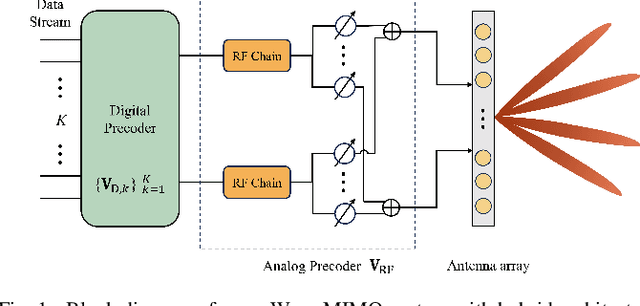
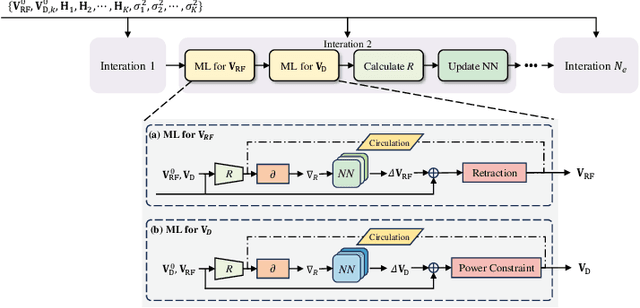
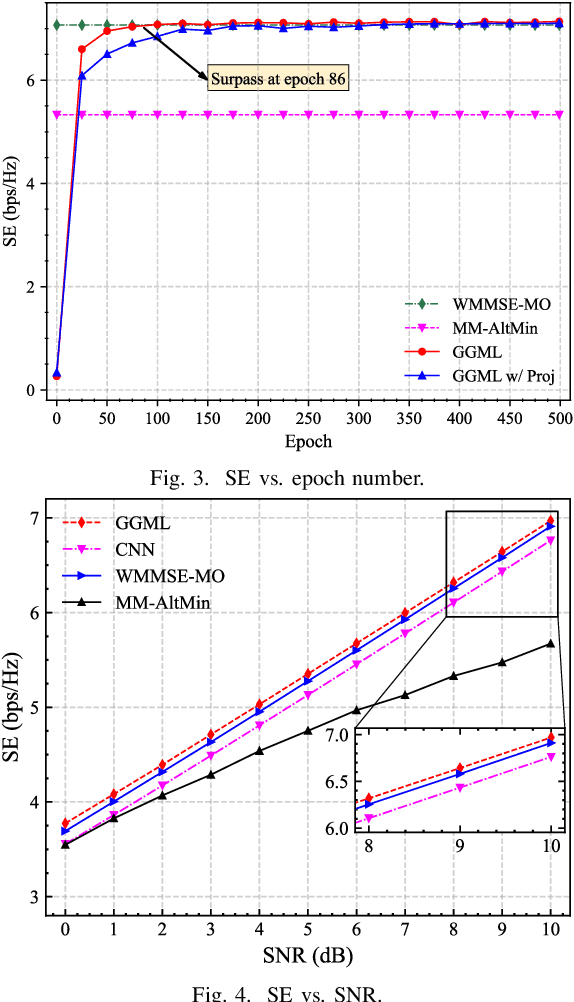
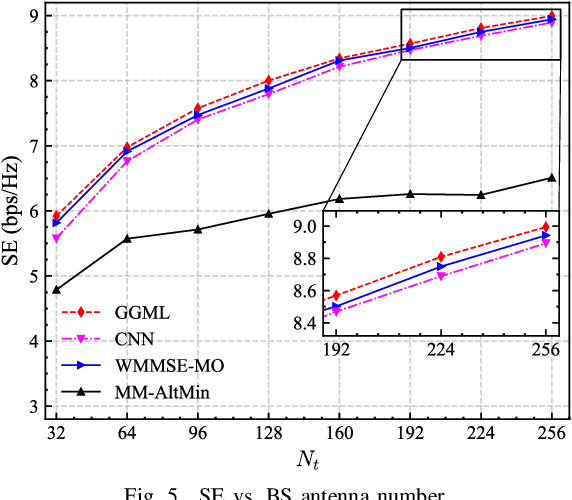
The hybrid analog/digital architecture that connects a limited number of RF chains to multiple antennas through phase shifters could effectively address the energy consumption issues in massive multiple-input multiple-output (MIMO) systems. However, the main challenges in hybrid precoding lie in the coupling between analog and digital precoders and the constant modulus constraint. Generally, traditional optimization algorithms for this problem typically suffer from high computational complexity or suboptimal performance, while deep learning based solutions exhibit poor scalability and robustness. This paper proposes a plug and play, free of pre-training solution that leverages gradient guided meta learning (GGML) framework to maximize the spectral efficiency of MIMO systems through hybrid precoding. Specifically, GGML utilizes gradient information as network input to facilitate the sharing of gradient information flow. We retain the iterative process of traditional algorithms and leverage meta learning to alternately optimize the precoder. Simulation results show that this method outperforms existing methods, demonstrates robustness to variations in system parameters, and can even exceed the performance of fully digital weighted minimum mean square error (WMMSE) precoding with the same number of antennas.
Range-based Multi-Robot Integrity Monitoring Against Cyberattacks and Faults: An Anchor-Free Approach
Aug 20, 2024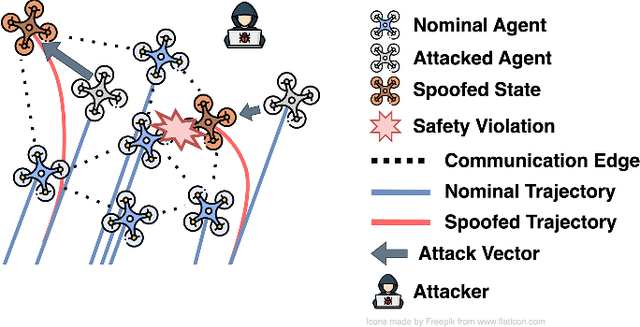
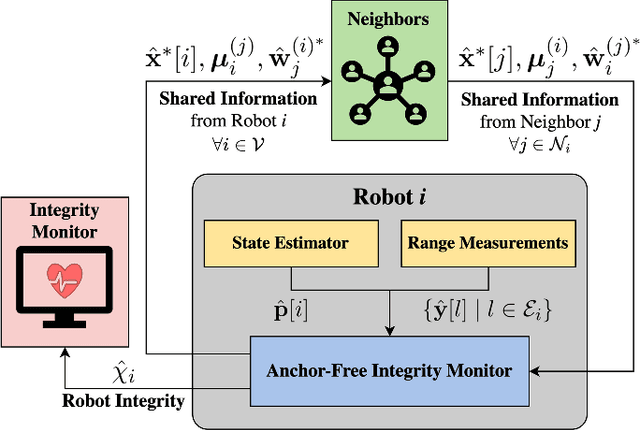
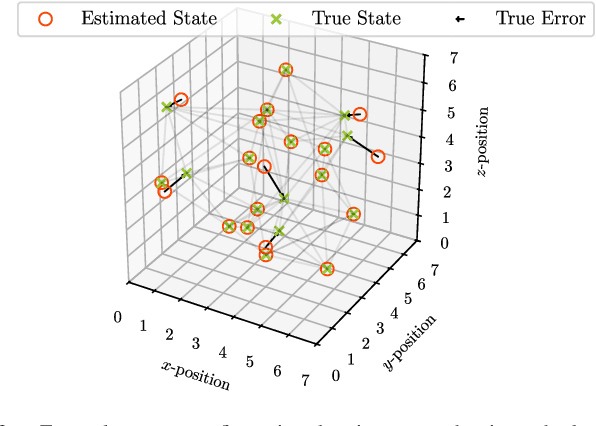
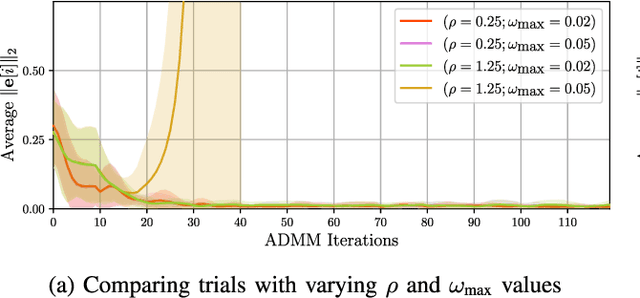
Coordination of multi-robot systems (MRSs) relies on efficient sensing and reliable communication among the robots. However, the sensors and communication channels of these robots are often vulnerable to cyberattacks and faults, which can disrupt their individual behavior and the overall objective of the MRS. In this work, we present a multi-robot integrity monitoring framework that utilizes inter-robot range measurements to (i) detect the presence of cyberattacks or faults affecting the MRS, (ii) identify the affected robot(s), and (iii) reconstruct the resulting localization error of these robot(s). The proposed iterative algorithm leverages sequential convex programming and alternating direction of multipliers method to enable real-time and distributed implementation. Our approach is validated using numerical simulations and demonstrated using PX4-SiTL in Gazebo on an MRS, where certain agents deviate from their desired position due to a GNSS spoofing attack. Furthermore, we demonstrate the scalability and interoperability of our algorithm through mixed-reality experiments by forming a heterogeneous MRS comprising real Crazyflie UAVs and virtual PX4-SiTL UAVs working in tandem.