 Add to Chrome
 Add to Firefox
 Add to Edge
Uplink-Completion-Triggered Edge-GPU Inference for Multi-Agent Cooperative Perception
Aug 08, 2026
This paper investigates the coupling between wireless input completion and graphics processing unit (GPU) execution in centralized multi-agent cooperative perception. Specifically, beyond the conceptual treatment of completion-triggered overlap, a complete execution path is realized and validated on a physical GPU for a cooperative-perception deep neural network (DNN). Each encoder branch is released immediately upon completion of its corresponding input transmission, while the original fusion dependencies and inference mapping are preserved. The resulting release-triggered communication computation coupling (RTCC) propagates validated wireless completion events through host-to-device (H2D) staging, CUDA synchronization, and dependency-preserving branch dispatch, while remaining compatible with causal wireless schedulers. Experiments combining trace-driven wireless arrivals, physical GPU execution, and measured-DAG evaluation show that RTCC reduces complete-detection latency across different communication loads and schedulers, while preserving identical detection outputs and average-precision performance relative to conventional execution.

Split-Gate Pooled-Evidence Stochastic-Rollout Scheduling for Timely Progressive Edge Inference
Aug 08, 2026This paper investigates causal radio scheduling for progressive edge inference, with the goal of maximizing timely inference throughput under job-specific deadlines. Specifically, a multi-tenant system is modeled in which each job alternates between wireless transmission and graphics processing unit (GPU) computation. The model captures time-varying uplink service, inter-stage precedence, variant-aware batching, non-preemptive execution on two GPU streams, and heterogeneous deadlines. To account for delayed radio-GPU coupling, a split-gate pooled-evidence stochastic-rollout (SGPE-SR) scheduler is proposed. Candidate and fallback policies are selected on one set of sampled futures, after which admission is evaluated on an independent held-out set; common random numbers are retained within each held-out candidate-fallback comparison. The override is executed only when its pooled nominal/recent-history held-out advantage is sufficiently positive and an independent recent-history replication statistic is nonnegative. System-level simulations using measured GPU profiles and paired random instances show that, in a prespecified long-horizon evaluation over 30 previously unused seeds and 3,379 offered jobs, SGPE-SR improves timely completions over the strongest rate-based baseline by 4.27%, with a mean paired gain of 3.00 jobs per run and a 95% bootstrap interval of [1.60, 4.43].
BehaviorGuard: Online Backdoor Defense for Deep Reinforcement Learning
May 07, 2026Backdoor attacks pose a serious threat to deep reinforcement learning (DRL). Current defenses typically rely on reward anomalies to reverse-engineer triggers and model finetuning to remove backdoors. However, complex trigger patterns undermine their robustness, and fine-tuning entails high costs, limiting practical utility. Therefore, we shift defense concerns to trigger-agnostic backdoor output behaviors and propose BehaviorGuard, an online behavior-based backdoor detection and mitigation framework for DRL. Specifically, we find that regardless of attacks, backdoored policies induce consistent shifts in action distributions to ensure reliable activation, leaving detectable traces in high-quantile regions and distribution tails, even in the absence of triggers. Based on this, we design a novel metric that captures behavioral drift in action distributions to identify and suppress backdoor actions at runtime. To our knowledge, this is the first online backdoor defense that counters attacks both in single- and multi-agent DRL. Evaluated across diverse benchmarks with different backdoor attacks, BehaviorGuard consistently surpasses prior methods in both efficacy and efficiency.
* 11 pages
Joint Scheduling of Sensing Data Offloading and Edge Inference for Multi-UAV Networks
May 05, 2026Unmanned aerial vehicles (UAVs) often collaborate by collecting and offloading sensing streams to an edge server, where a deep neural network (DNN) model performs cross-stream alignment, fusion, and inference. However, the coupling between wireless offloading and DNN execution makes end-to-end latency minimization challenging. To address this issue, this paper investigates efficient edge inference in multi-UAV networks. Specifically, a multi-UAV collaborative edge inference model is first established, in which UAV sensing streams are processed by a multi-branch DNN on a multi-core accelerator. Based on this model, an end-to-end latency minimization problem with a synchronization penalty is formulated. A genetic algorithm (GA)-based full joint scheduler, termed \texttt{GA-Joint}, is then developed to obtain high-quality scheduling solutions. To reduce the search complexity, two lightweight variants, termed \texttt{GA-DAG} and \texttt{GA-DACS}, are further proposed. Simulation results demonstrate that the proposed GA-based scheduling algorithms achieve lower end-to-end latency than \texttt{Decoupled-Greedy} and \texttt{Joint-Greedy}, which represent decoupled and joint greedy scheduling schemes, respectively, in most cases. Furthermore, \texttt{GA-DACS} achieves performance close to that of \texttt{GA-Joint} in many cases and even delivers slightly lower latency in certain scenarios.
Joint Scheduling of Multi-Band Radar Sensing and DNN Inference for Cross-Stage Parallelism
Apr 20, 2026This paper studies end-to-end latency minimization for a multi-band radar sensing and deep neural network (DNN) inference pipeline. Unlike conventional stage-wise designs that treat radar sensing and DNN inference as two sequential stages, the proposed framework exploits cross-stage parallelism by allowing the inference branch associated with a sensed band to start as soon as that band completes sensing, without waiting for all bands to finish. To characterize this interaction, we formulate a joint scheduling problem that couples sensing-time allocation, branch release timing, and non-preemptive multi-core execution of a directed acyclic graph (DAG) under sensing-feasibility, precedence, and core-capacity constraints. Since the resulting problem is combinatorial and strongly time-coupled, we further develop a release-aware heuristic that evaluates each sensing decision according to its downstream impact on the DAG makespan, together with a greedy list scheduler for multi-core DAG execution under release times. Simulation results show that the proposed design can effectively exploit cross-stage parallelism and reduce end-to-end latency relative to a decoupled baseline in many heterogeneous sensing scenarios, while also clarifying the operating regimes in which the latency gain becomes limited.
Exploiting Self-Sustainable Information-Bearing RIS in Underlay CR-NOMA Networks
Mar 22, 2026Information-bearing reconfigurable intelligent surfaces (IB-RIS) provide a promising solution to self-sustainable and green communications by harvesting ambient radio frequency energy while embedding information via passive reflection. This paper investigates a self-sustainable IB-RIS (SIB-RIS)-assisted non-orthogonal multiple access (NOMA) network operating in an underlay cognitive radio (CR) system. Specifically, a multi-antenna primary transmitter (PT) serves a primary user (PU) and concurrently illuminates the secondary nodes, which enables each SIB-RIS to perform simultaneous energy harvesting and backscatter-based information embedding at each RIS. Based on this model, a weighted sum spectral efficiency (WSSE) maximization problem is formulated for the secondary network by jointly optimizing the PT transmit beamforming vector, the SIB-RIS reflection coefficients, and the power-splitting ratios. To tackle the intricately-coupled non-convex problem, an efficient block coordinate descent (BCD) optimization framework is developed, which leverages fractional programming via Lagrangian dual and quadratic transforms together with a difference-of-convex programming approach. Numerical results demonstrate that the proposed SIB-RIS-assisted NOMA CR system yields substantial WSSE gains over both orthogonal multiple access (OMA)-based and active antenna schemes. Moreover, a 2-bit discrete-phase SIB-RIS implementation achieves competitive to which WSSE performance, confirming the practicality of the low-resolution architecture.
Orchestrating Multimodal DNN Workloads in Wireless Neural Processing
Mar 02, 2026In edge inference, wireless resource allocation and accelerator-level deep neural network (DNN) scheduling have yet to be co-optimized in an end-to-end manner. The lack of coordination between wireless transmission and accelerator-level DNN execution prevents efficient overlap, leading to higher end-to-end inference latency. To address this issue, this paper investigates multimodal DNN workload orchestration in wireless neural processing (WNP), a paradigm that integrates wireless transmission and multi-core accelerator execution into a unified end-to-end pipeline. First, we develop a unified communication-computation model for multimodal DNN execution and formulate the corresponding optimization problem. Second, we propose O-WiN, a framework that orchestrates DNN workloads in WNP through two tightly coupled stages: simulation-based optimization and runtime execution. Third, we develop two algorithms, RTFS and PACS. RTFS schedules communication and computation sequentially, whereas PACS interleaves them to enable pipeline parallelism by overlapping wireless data transfer with accelerator-level DNN execution. Simulation results demonstrate that PACS significantly outperforms RTFS under high modality heterogeneity by better masking wireless latency through communication-computation overlap, thereby highlighting the effectiveness of communication-computation pipelining in accelerating multimodal DNN execution in WNP.
Pinching-Antenna-Enabled Cognitive Radio Networks
Nov 17, 2025This paper investigates a pinching-antenna (PA)-enabled cognitive radio network, where both the primary transmitter (PT) and secondary transmitter (ST) are equipped with a single waveguide and multiple PAs to facilitate simultaneous spectrum sharing. Under a general Ricean fading channel model, a closed-form analytical expression for the average spectral efficiency (SE) achieved by PAs is first derived. Based on this, a sum-SE maximization problem is formulated to jointly optimize the primary and secondary pinching beamforming, subject to system constraints on the transmission power budgets, minimum antenna separation requirements, and feasible PA deployment regions. To address this non-convex problem, a three-stage optimization algorithm is developed to sequentially optimize both the PT and ST pinching beamforming, and the ST power control. For the PT and ST pinching beamforming optimization, the coarse positions of PA are first determined at the waveguide-level. Then, wavelength-level refinements achieve constructive signal combination at the intended user and destructive superposition at the unintended user. For the ST power control, a closed-form solution is derived. Simulation results demonstrate that i) PAs can achieve significant SE improvements over conventional fixed-position antennas; ii) the proposed pinching beamforming design achieves effective interference suppression and superior performance for both even and odd numbers of PAs; and iii) the developed three-stage optimization algorithm enables nearly orthogonal transmission between the primary and secondary networks.
Fluid Antenna System-Assisted Self-Interference Cancellation for In-Band Full Duplex Communications
Jun 05, 2025In-band full-duplex (IBFD) systems are expected to double the spectral efficiency compared to half-duplex systems, provided that loopback self-interference (SI) can be effectively suppressed. The inherent interference mitigation capabilities of the emerging fluid antenna system (FAS) technology make it a promising candidate for addressing the SI challenge in IBFD systems. This paper thus proposes a FAS-assisted self-interference cancellation (SIC) framework, which leverages a receiver-side FAS to dynamically select an interference-free port. Analytical results include a lower bound and an approximation of the residual SI (RSI) power, both derived for rich-scattering channels by considering the joint spatial correlation amongst the FAS ports. Simulations of RSI power and forward link rates validate the analysis, showing that the SIC performance improves with the number of FAS ports. Additionally, simulations under practical conditions, such as finite-scattering environments and wideband integrated access and backhaul (IAB) channels, reveal that the proposed approach offers superior SIC capability and significant forward rate gains over conventional IBFD SIC schemes.
GSM: A GNN-based Space-MIMO Framework for Direct-to-Cell Communications
Dec 10, 2024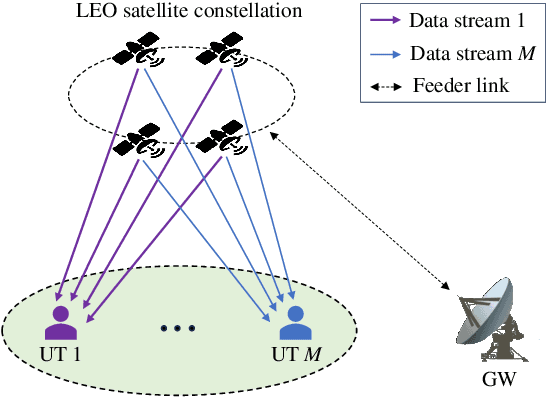
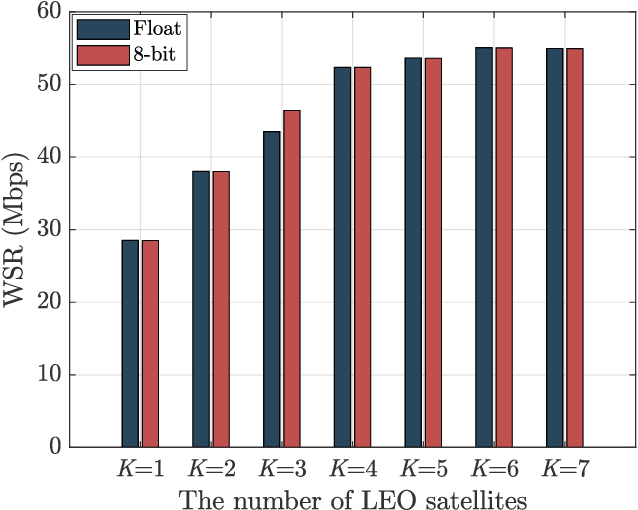
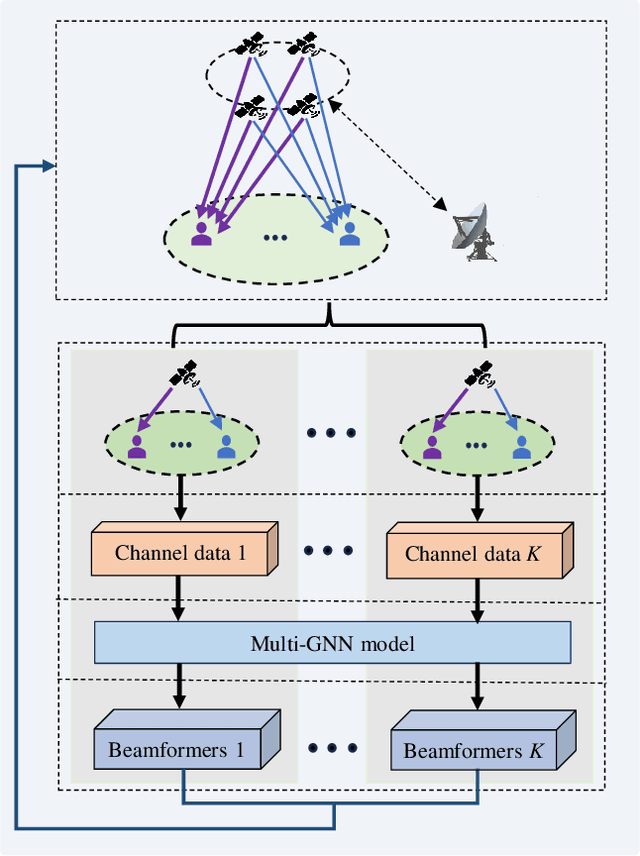
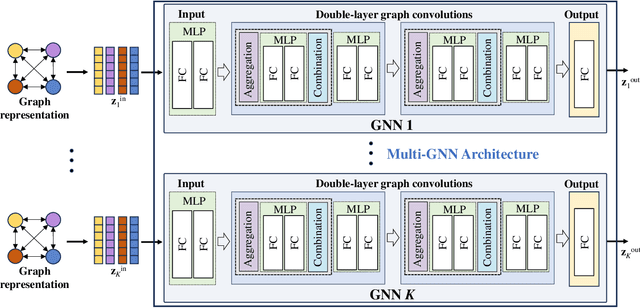
This paper proposes a graph neural network (GNN)-based space multiple-input multiple-output (MIMO) framework, named GSM, for direct-to-cell communications, aiming to achieve distributed coordinated beamforming for low Earth orbit (LEO) satellites. Firstly, a system model for LEO multi-satellite communications is established, where multiple LEO satellites collaborate to perform distributed beamforming and communicate with terrestrial user terminals coherently. Based on the system model, a weighted sum rate maximization problem is formulated. Secondly, a GNN-based method is developed to address the optimization problem. Particularly, the adopted neural network is composed of multiple identical GNNs, which are trained together and then deployed individually on each LEO satellite. Finally, the trained GNN is quantized and deployed on a field-programmable gate array (FPGA) to accelerate the inference by customizing the microarchitecture. Simulation results demonstrate that the proposed GNN scheme outperforms the benchmark ones including maximum ratio transmission, zero forcing and minimum mean square error. Furthermore, experimental results show that the FPGA-based accelerator achieves remarkably low inference latency, ranging from 3.863 to 5.883 ms under a 10-ns target clock period with 8-bit fixed-point data representation.