 Add to Chrome
 Add to Firefox
 Add to Edge
Mamba or RWKV: Exploring High-Quality and High-Efficiency Segment Anything Model
Jun 27, 2024
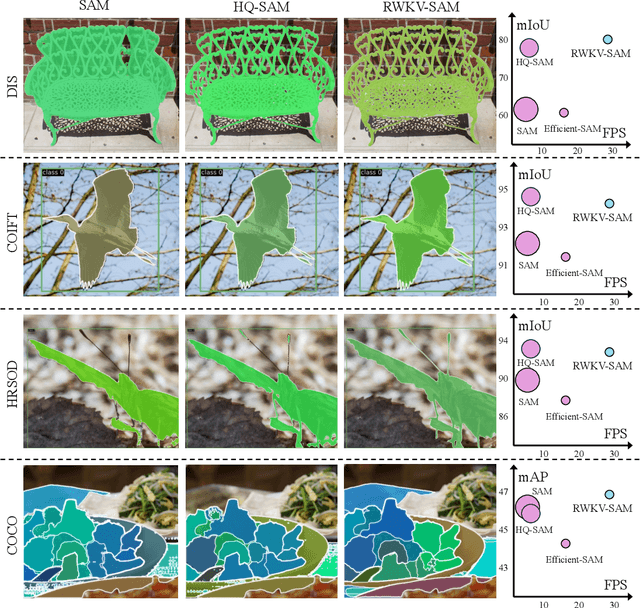
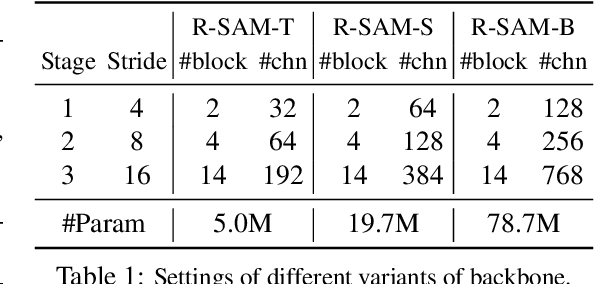
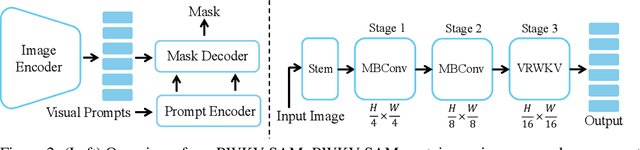
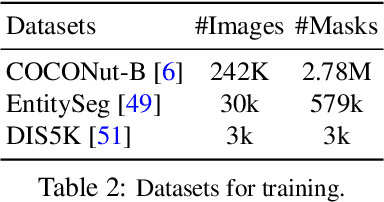
Transformer-based segmentation methods face the challenge of efficient inference when dealing with high-resolution images. Recently, several linear attention architectures, such as Mamba and RWKV, have attracted much attention as they can process long sequences efficiently. In this work, we focus on designing an efficient segment-anything model by exploring these different architectures. Specifically, we design a mixed backbone that contains convolution and RWKV operation, which achieves the best for both accuracy and efficiency. In addition, we design an efficient decoder to utilize the multiscale tokens to obtain high-quality masks. We denote our method as RWKV-SAM, a simple, effective, fast baseline for SAM-like models. Moreover, we build a benchmark containing various high-quality segmentation datasets and jointly train one efficient yet high-quality segmentation model using this benchmark. Based on the benchmark results, our RWKV-SAM achieves outstanding performance in efficiency and segmentation quality compared to transformers and other linear attention models. For example, compared with the same-scale transformer model, RWKV-SAM achieves more than 2x speedup and can achieve better segmentation performance on various datasets. In addition, RWKV-SAM outperforms recent vision Mamba models with better classification and semantic segmentation results. Code and models will be publicly available.

OMG-LLaVA: Bridging Image-level, Object-level, Pixel-level Reasoning and Understanding
Jun 27, 2024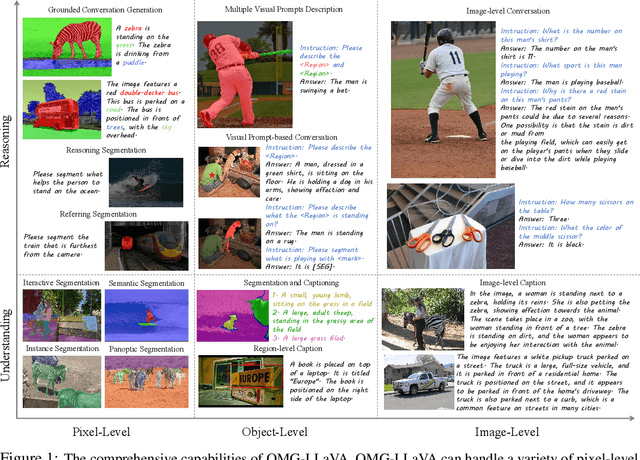
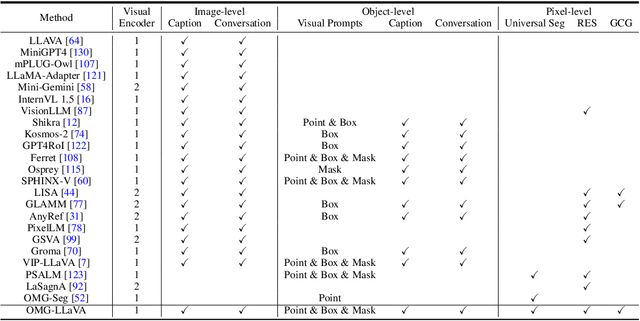

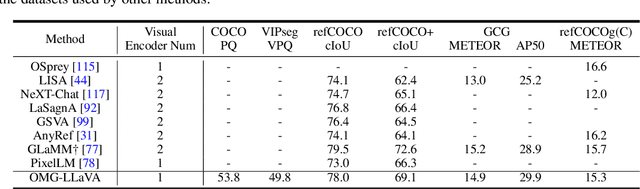
Current universal segmentation methods demonstrate strong capabilities in pixel-level image and video understanding. However, they lack reasoning abilities and cannot be controlled via text instructions. In contrast, large vision-language multimodal models exhibit powerful vision-based conversation and reasoning capabilities but lack pixel-level understanding and have difficulty accepting visual prompts for flexible user interaction. This paper proposes OMG-LLaVA, a new and elegant framework combining powerful pixel-level vision understanding with reasoning abilities. It can accept various visual and text prompts for flexible user interaction. Specifically, we use a universal segmentation method as the visual encoder, integrating image information, perception priors, and visual prompts into visual tokens provided to the LLM. The LLM is responsible for understanding the user's text instructions and providing text responses and pixel-level segmentation results based on the visual information. We propose perception prior embedding to better integrate perception priors with image features. OMG-LLaVA achieves image-level, object-level, and pixel-level reasoning and understanding in a single model, matching or surpassing the performance of specialized methods on multiple benchmarks. Rather than using LLM to connect each specialist, our work aims at end-to-end training on one encoder, one decoder, and one LLM. The code and model have been released for further research.
Denoising as Adaptation: Noise-Space Domain Adaptation for Image Restoration
Jun 26, 2024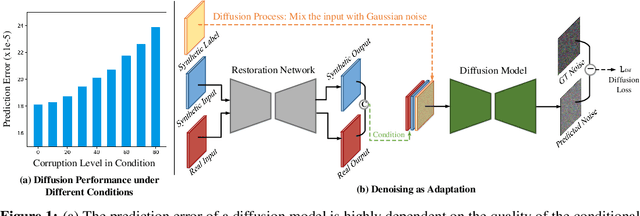

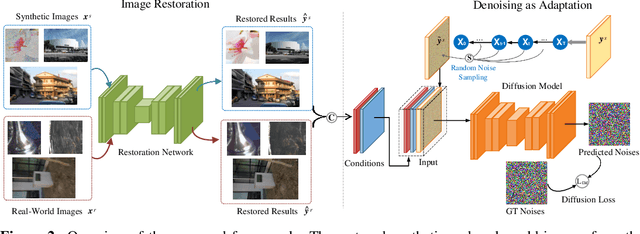

Although deep learning-based image restoration methods have made significant progress, they still struggle with limited generalization to real-world scenarios due to the substantial domain gap caused by training on synthetic data. Existing methods address this issue by improving data synthesis pipelines, estimating degradation kernels, employing deep internal learning, and performing domain adaptation and regularization. Previous domain adaptation methods have sought to bridge the domain gap by learning domain-invariant knowledge in either feature or pixel space. However, these techniques often struggle to extend to low-level vision tasks within a stable and compact framework. In this paper, we show that it is possible to perform domain adaptation via the noise-space using diffusion models. In particular, by leveraging the unique property of how the multi-step denoising process is influenced by auxiliary conditional inputs, we obtain meaningful gradients from noise prediction to gradually align the restored results of both synthetic and real-world data to a common clean distribution. We refer to this method as denoising as adaptation. To prevent shortcuts during training, we present useful techniques such as channel shuffling and residual-swapping contrastive learning. Experimental results on three classical image restoration tasks, namely denoising, deblurring, and deraining, demonstrate the effectiveness of the proposed method. Code will be released at: https://github.com/KangLiao929/Noise-DA/.
AITTI: Learning Adaptive Inclusive Token for Text-to-Image Generation
Jun 18, 2024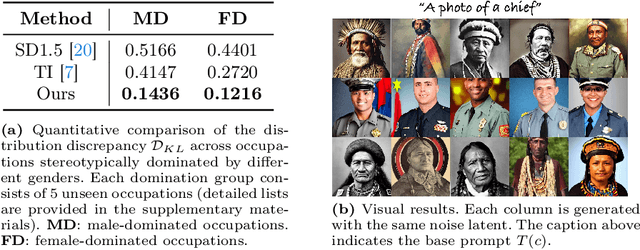
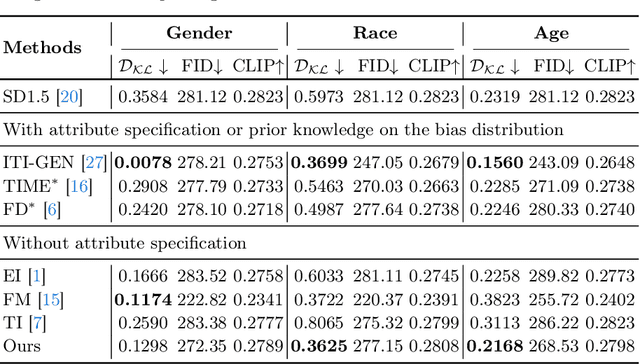

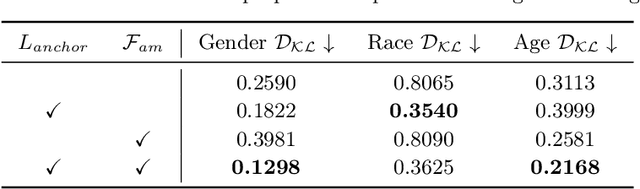
Despite the high-quality results of text-to-image generation, stereotypical biases have been spotted in their generated contents, compromising the fairness of generative models. In this work, we propose to learn adaptive inclusive tokens to shift the attribute distribution of the final generative outputs. Unlike existing de-biasing approaches, our method requires neither explicit attribute specification nor prior knowledge of the bias distribution. Specifically, the core of our method is a lightweight adaptive mapping network, which can customize the inclusive tokens for the concepts to be de-biased, making the tokens generalizable to unseen concepts regardless of their original bias distributions. This is achieved by tuning the adaptive mapping network with a handful of balanced and inclusive samples using an anchor loss. Experimental results demonstrate that our method outperforms previous bias mitigation methods without attribute specification while preserving the alignment between generative results and text descriptions. Moreover, our method achieves comparable performance to models that require specific attributes or editing directions for generation. Extensive experiments showcase the effectiveness of our adaptive inclusive tokens in mitigating stereotypical bias in text-to-image generation. The code will be available at https://github.com/itsmag11/AITTI.
MIPI 2024 Challenge on Few-shot RAW Image Denoising: Methods and Results
Jun 11, 2024

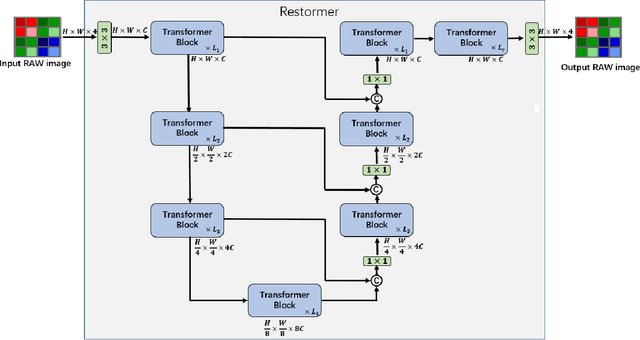

The increasing demand for computational photography and imaging on mobile platforms has led to the widespread development and integration of advanced image sensors with novel algorithms in camera systems. However, the scarcity of high-quality data for research and the rare opportunity for in-depth exchange of views from industry and academia constrain the development of mobile intelligent photography and imaging (MIPI). Building on the achievements of the previous MIPI Workshops held at ECCV 2022 and CVPR 2023, we introduce our third MIPI challenge including three tracks focusing on novel image sensors and imaging algorithms. In this paper, we summarize and review the Few-shot RAW Image Denoising track on MIPI 2024. In total, 165 participants were successfully registered, and 7 teams submitted results in the final testing phase. The developed solutions in this challenge achieved state-of-the-art erformance on Few-shot RAW Image Denoising. More details of this challenge and the link to the dataset can be found at https://mipichallenge.org/MIPI2024.
F-LMM: Grounding Frozen Large Multimodal Models
Jun 09, 2024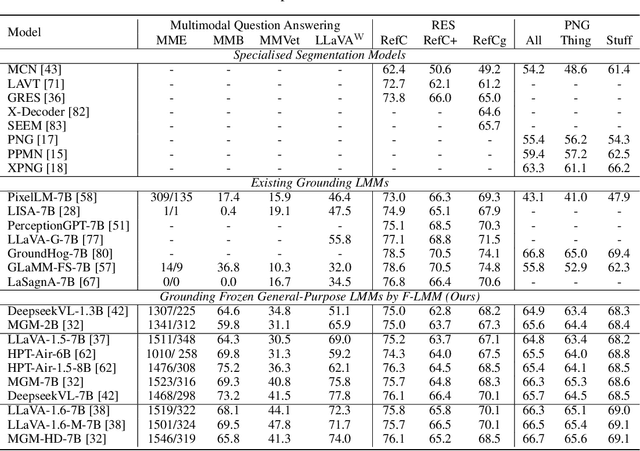
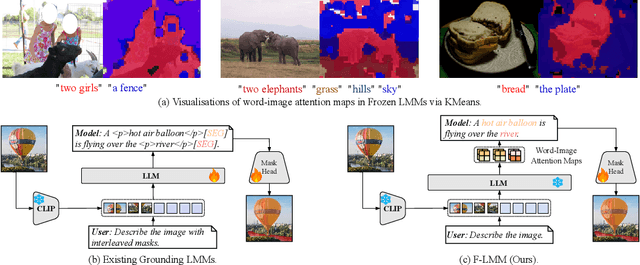
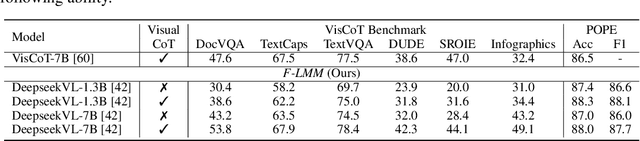

Endowing Large Multimodal Models (LMMs) with visual grounding capability can significantly enhance AIs' understanding of the visual world and their interaction with humans. However, existing methods typically fine-tune the parameters of LMMs to learn additional segmentation tokens and overfit grounding and segmentation datasets. Such a design would inevitably cause a catastrophic diminution in the indispensable conversational capability of general AI assistants. In this paper, we comprehensively evaluate state-of-the-art grounding LMMs across a suite of multimodal question-answering benchmarks, observing pronounced performance drops that indicate vanishing general knowledge comprehension and weakened instruction following ability. To address this issue, we present F-LMM -- grounding frozen off-the-shelf LMMs in human-AI conversations -- a straightforward yet effective design based on the fact that word-pixel correspondences conducive to visual grounding inherently exist in the attention weights of well-trained LMMs. Using only a few trainable CNN layers, we can translate word-pixel attention weights to mask logits, which a SAM-based mask refiner can further optimise. Our F-LMM neither learns special segmentation tokens nor utilises high-quality grounded instruction-tuning data, but achieves competitive performance on referring expression segmentation and panoptic narrative grounding benchmarks while completely preserving LMMs' original conversational ability. Additionally, with instruction-following ability preserved and grounding ability obtained, our F-LMM can perform visual chain-of-thought reasoning and better resist object hallucinations.
MIPI 2024 Challenge on Demosaic for HybridEVS Camera: Methods and Results
May 08, 2024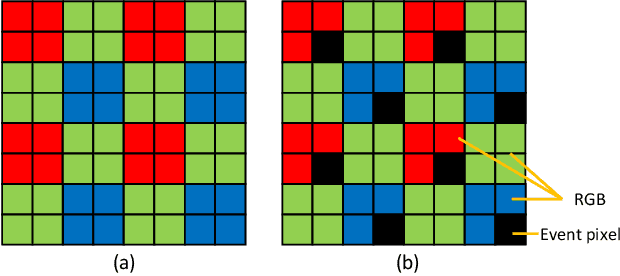


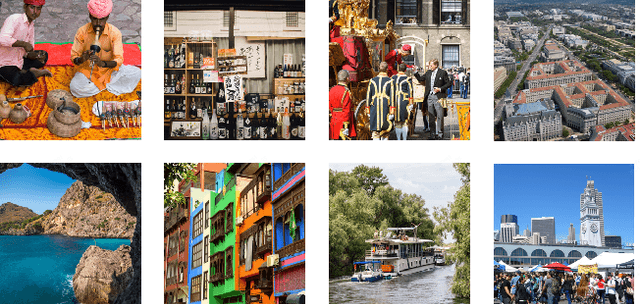
The increasing demand for computational photography and imaging on mobile platforms has led to the widespread development and integration of advanced image sensors with novel algorithms in camera systems. However, the scarcity of high-quality data for research and the rare opportunity for in-depth exchange of views from industry and academia constrain the development of mobile intelligent photography and imaging (MIPI). Building on the achievements of the previous MIPI Workshops held at ECCV 2022 and CVPR 2023, we introduce our third MIPI challenge including three tracks focusing on novel image sensors and imaging algorithms. In this paper, we summarize and review the Nighttime Flare Removal track on MIPI 2024. In total, 170 participants were successfully registered, and 14 teams submitted results in the final testing phase. The developed solutions in this challenge achieved state-of-the-art performance on Nighttime Flare Removal. More details of this challenge and the link to the dataset can be found at https://mipi-challenge.org/MIPI2024/.
MVIP-NeRF: Multi-view 3D Inpainting on NeRF Scenes via Diffusion Prior
May 05, 2024Despite the emergence of successful NeRF inpainting methods built upon explicit RGB and depth 2D inpainting supervisions, these methods are inherently constrained by the capabilities of their underlying 2D inpainters. This is due to two key reasons: (i) independently inpainting constituent images results in view-inconsistent imagery, and (ii) 2D inpainters struggle to ensure high-quality geometry completion and alignment with inpainted RGB images. To overcome these limitations, we propose a novel approach called MVIP-NeRF that harnesses the potential of diffusion priors for NeRF inpainting, addressing both appearance and geometry aspects. MVIP-NeRF performs joint inpainting across multiple views to reach a consistent solution, which is achieved via an iterative optimization process based on Score Distillation Sampling (SDS). Apart from recovering the rendered RGB images, we also extract normal maps as a geometric representation and define a normal SDS loss that motivates accurate geometry inpainting and alignment with the appearance. Additionally, we formulate a multi-view SDS score function to distill generative priors simultaneously from different view images, ensuring consistent visual completion when dealing with large view variations. Our experimental results show better appearance and geometry recovery than previous NeRF inpainting methods.
MIPI 2024 Challenge on Nighttime Flare Removal: Methods and Results
Apr 30, 2024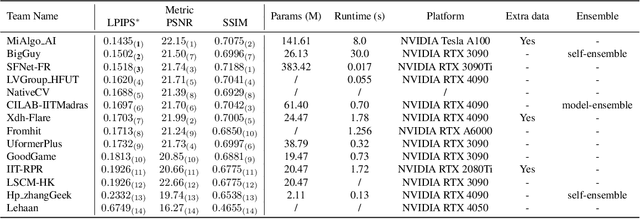
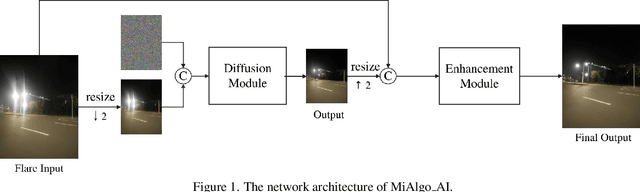
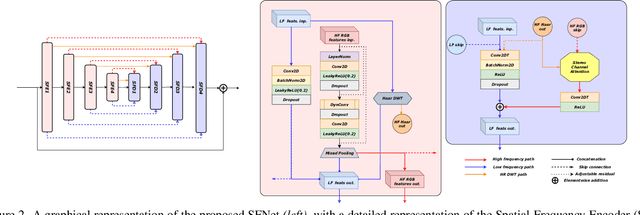

The increasing demand for computational photography and imaging on mobile platforms has led to the widespread development and integration of advanced image sensors with novel algorithms in camera systems. However, the scarcity of high-quality data for research and the rare opportunity for in-depth exchange of views from industry and academia constrain the development of mobile intelligent photography and imaging (MIPI). Building on the achievements of the previous MIPI Workshops held at ECCV 2022 and CVPR 2023, we introduce our third MIPI challenge including three tracks focusing on novel image sensors and imaging algorithms. In this paper, we summarize and review the Nighttime Flare Removal track on MIPI 2024. In total, 170 participants were successfully registered, and 14 teams submitted results in the final testing phase. The developed solutions in this challenge achieved state-of-the-art performance on Nighttime Flare Removal. More details of this challenge and the link to the dataset can be found at https://mipi-challenge.org/MIPI2024/.
Point-In-Context: Understanding Point Cloud via In-Context Learning
Apr 18, 2024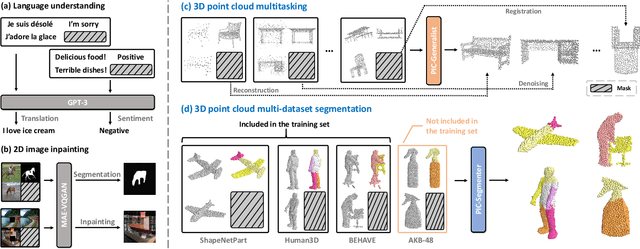
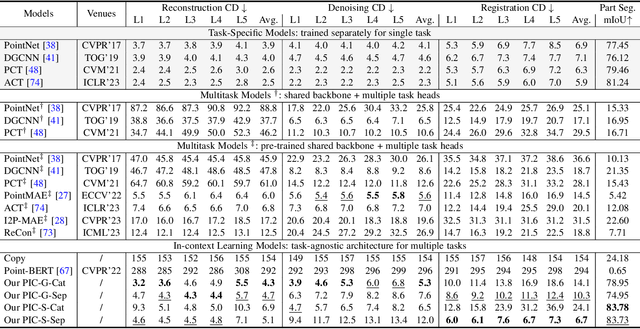
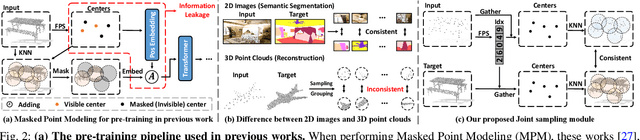

With the emergence of large-scale models trained on diverse datasets, in-context learning has emerged as a promising paradigm for multitasking, notably in natural language processing and image processing. However, its application in 3D point cloud tasks remains largely unexplored. In this work, we introduce Point-In-Context (PIC), a novel framework for 3D point cloud understanding via in-context learning. We address the technical challenge of effectively extending masked point modeling to 3D point clouds by introducing a Joint Sampling module and proposing a vanilla version of PIC called Point-In-Context-Generalist (PIC-G). PIC-G is designed as a generalist model for various 3D point cloud tasks, with inputs and outputs modeled as coordinates. In this paradigm, the challenging segmentation task is achieved by assigning label points with XYZ coordinates for each category; the final prediction is then chosen based on the label point closest to the predictions. To break the limitation by the fixed label-coordinate assignment, which has poor generalization upon novel classes, we propose two novel training strategies, In-Context Labeling and In-Context Enhancing, forming an extended version of PIC named Point-In-Context-Segmenter (PIC-S), targeting improving dynamic context labeling and model training. By utilizing dynamic in-context labels and extra in-context pairs, PIC-S achieves enhanced performance and generalization capability in and across part segmentation datasets. PIC is a general framework so that other tasks or datasets can be seamlessly introduced into our PIC through a unified data format. We conduct extensive experiments to validate the versatility and adaptability of our proposed methods in handling a wide range of tasks and segmenting multi-datasets. Our PIC-S is capable of generalizing unseen datasets and performing novel part segmentation by customizing prompts.