 Add to Chrome
 Add to Firefox
 Add to Edge
DynaKRAG: A Unified Framework for Learnable Evidence Control in Multi-Hop Retrieval-Augmented Generation
Jul 07, 2026
Multi-hop retrieval-augmented generation (RAG) acquires evidence sequentially, with each new document potentially revealing missing facts, bridge entities, query defects, or sufficient support for answering. Existing methods provide useful operations such as iterative retrieval, query reformulation, evidence critique, and sufficiency judging, but typically organize them within method-specific pipelines or predefined control topologies. This leaves underexplored how to learn a shared state-conditioned policy that chooses among currently valid evidence operations. We introduce DynaKRAG, which formulates multi-hop evidence acquisition as state-conditioned control over atomic evidence operations. At each step, a validity layer constructs the executable action set, and a learned controller selects the next operation. The resulting transition updates the evidence state and may enable new operations at subsequent steps. With Qwen2.5-7B-Instruct, DynaKRAG achieves F1 scores of 0.5998 on HotpotQA, 0.5340 on 2Wiki, and 0.3061 on MuSiQue, outperforming the strongest controlled baseline on all three benchmarks. Replacing the learned controller with a uniform-valid policy reduces F1 by 3.96--5.78 points, while removing sufficiency feedback hurts all three datasets. Controlled retrieval-cap experiments further show that additional retrieval is not uniformly beneficial. Together, these results demonstrate the benefit of coordinating retrieval, diagnosis, and gap-directed acquisition under an evolving evidence state.

MIPI 2024 Challenge on Demosaic for HybridEVS Camera: Methods and Results
May 08, 2024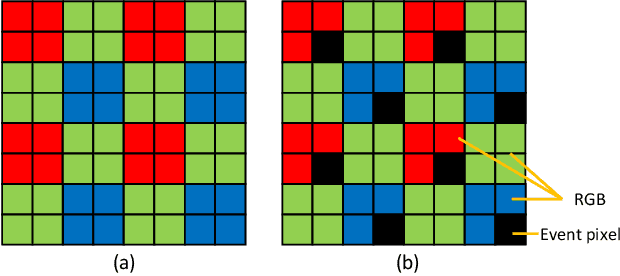



The increasing demand for computational photography and imaging on mobile platforms has led to the widespread development and integration of advanced image sensors with novel algorithms in camera systems. However, the scarcity of high-quality data for research and the rare opportunity for in-depth exchange of views from industry and academia constrain the development of mobile intelligent photography and imaging (MIPI). Building on the achievements of the previous MIPI Workshops held at ECCV 2022 and CVPR 2023, we introduce our third MIPI challenge including three tracks focusing on novel image sensors and imaging algorithms. In this paper, we summarize and review the Nighttime Flare Removal track on MIPI 2024. In total, 170 participants were successfully registered, and 14 teams submitted results in the final testing phase. The developed solutions in this challenge achieved state-of-the-art performance on Nighttime Flare Removal. More details of this challenge and the link to the dataset can be found at https://mipi-challenge.org/MIPI2024/.
TD^2-Net: Toward Denoising and Debiasing for Dynamic Scene Graph Generation
Jan 23, 2024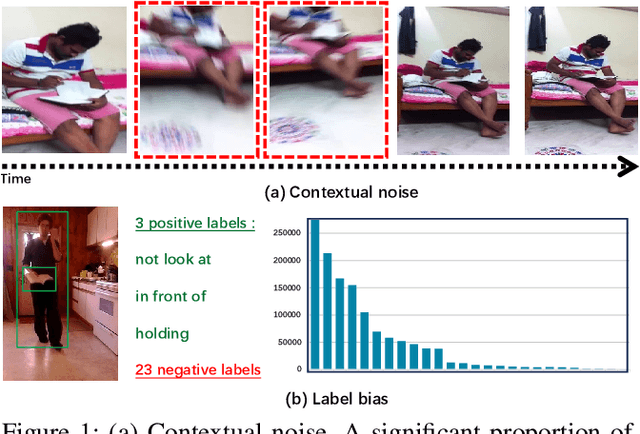
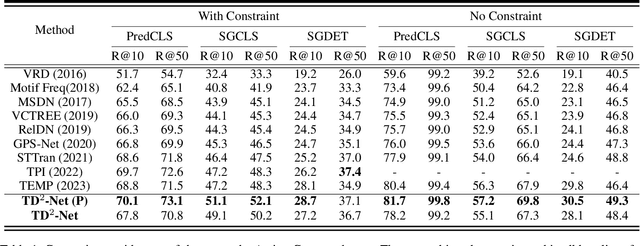
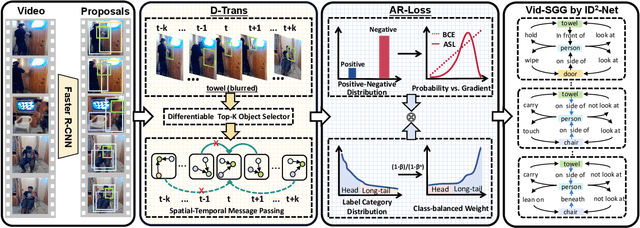
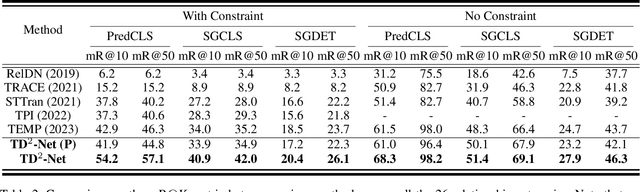
Dynamic scene graph generation (SGG) focuses on detecting objects in a video and determining their pairwise relationships. Existing dynamic SGG methods usually suffer from several issues, including 1) Contextual noise, as some frames might contain occluded and blurred objects. 2) Label bias, primarily due to the high imbalance between a few positive relationship samples and numerous negative ones. Additionally, the distribution of relationships exhibits a long-tailed pattern. To address the above problems, in this paper, we introduce a network named TD$^2$-Net that aims at denoising and debiasing for dynamic SGG. Specifically, we first propose a denoising spatio-temporal transformer module that enhances object representation with robust contextual information. This is achieved by designing a differentiable Top-K object selector that utilizes the gumbel-softmax sampling strategy to select the relevant neighborhood for each object. Second, we introduce an asymmetrical reweighting loss to relieve the issue of label bias. This loss function integrates asymmetry focusing factors and the volume of samples to adjust the weights assigned to individual samples. Systematic experimental results demonstrate the superiority of our proposed TD$^2$-Net over existing state-of-the-art approaches on Action Genome databases. In more detail, TD$^2$-Net outperforms the second-best competitors by 12.7 \% on mean-Recall@10 for predicate classification.
Efficient and Accurate Quantized Image Super-Resolution on Mobile NPUs, Mobile AI & AIM 2022 challenge: Report
Nov 07, 2022

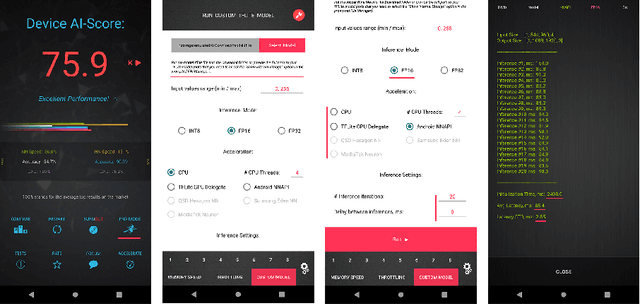
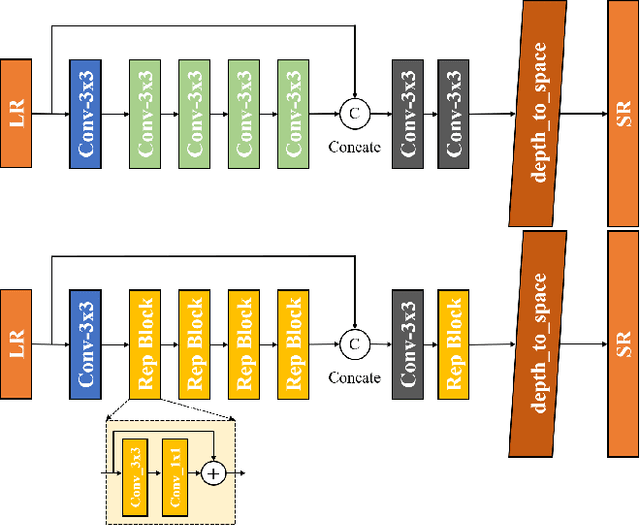
Image super-resolution is a common task on mobile and IoT devices, where one often needs to upscale and enhance low-resolution images and video frames. While numerous solutions have been proposed for this problem in the past, they are usually not compatible with low-power mobile NPUs having many computational and memory constraints. In this Mobile AI challenge, we address this problem and propose the participants to design an efficient quantized image super-resolution solution that can demonstrate a real-time performance on mobile NPUs. The participants were provided with the DIV2K dataset and trained INT8 models to do a high-quality 3X image upscaling. The runtime of all models was evaluated on the Synaptics VS680 Smart Home board with a dedicated edge NPU capable of accelerating quantized neural networks. All proposed solutions are fully compatible with the above NPU, demonstrating an up to 60 FPS rate when reconstructing Full HD resolution images. A detailed description of all models developed in the challenge is provided in this paper.
Learned Smartphone ISP on Mobile GPUs with Deep Learning, Mobile AI & AIM 2022 Challenge: Report
Nov 07, 2022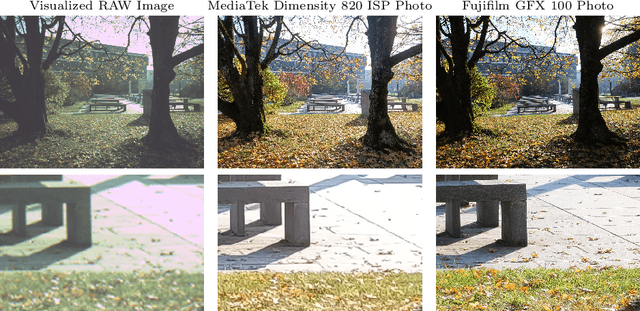
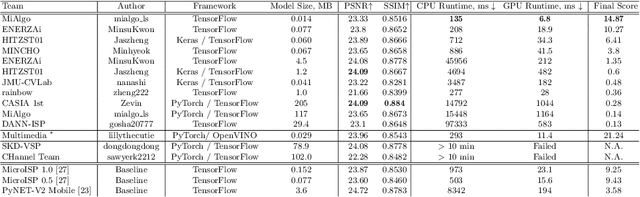
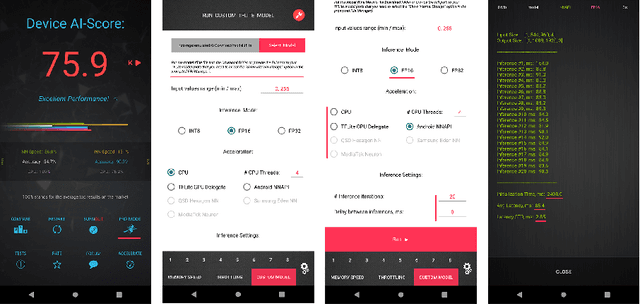
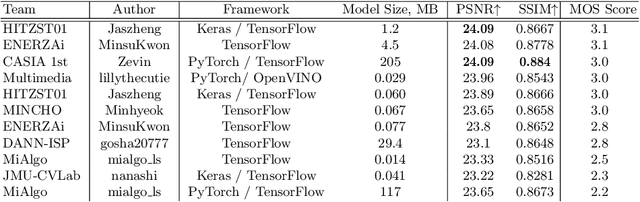
The role of mobile cameras increased dramatically over the past few years, leading to more and more research in automatic image quality enhancement and RAW photo processing. In this Mobile AI challenge, the target was to develop an efficient end-to-end AI-based image signal processing (ISP) pipeline replacing the standard mobile ISPs that can run on modern smartphone GPUs using TensorFlow Lite. The participants were provided with a large-scale Fujifilm UltraISP dataset consisting of thousands of paired photos captured with a normal mobile camera sensor and a professional 102MP medium-format FujiFilm GFX100 camera. The runtime of the resulting models was evaluated on the Snapdragon's 8 Gen 1 GPU that provides excellent acceleration results for the majority of common deep learning ops. The proposed solutions are compatible with all recent mobile GPUs, being able to process Full HD photos in less than 20-50 milliseconds while achieving high fidelity results. A detailed description of all models developed in this challenge is provided in this paper.
NTIRE 2020 Challenge on Real Image Denoising: Dataset, Methods and Results
May 08, 2020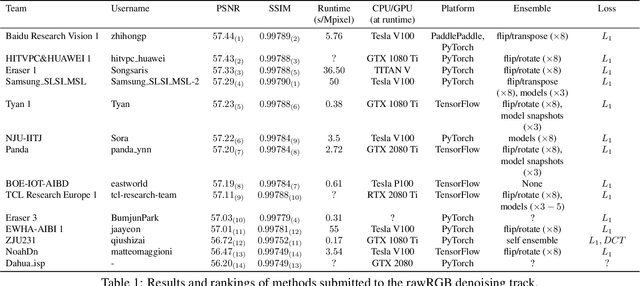
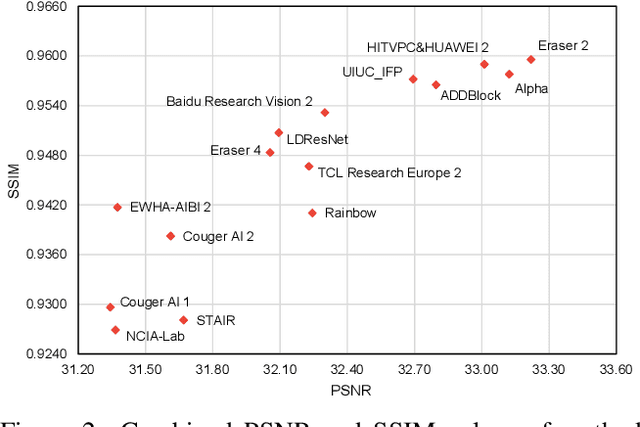
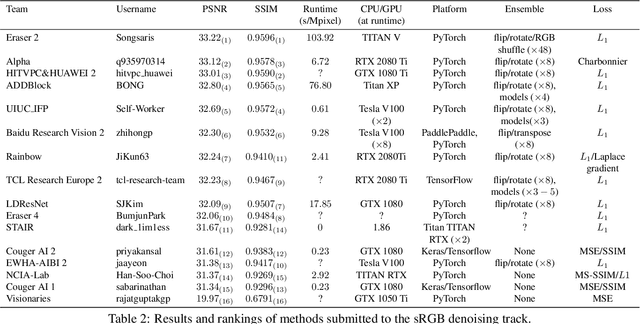
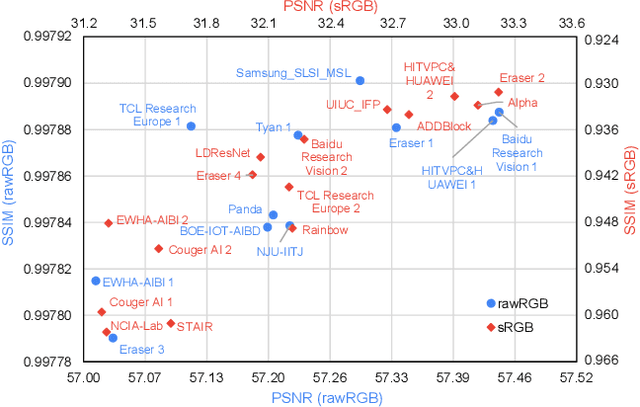
This paper reviews the NTIRE 2020 challenge on real image denoising with focus on the newly introduced dataset, the proposed methods and their results. The challenge is a new version of the previous NTIRE 2019 challenge on real image denoising that was based on the SIDD benchmark. This challenge is based on a newly collected validation and testing image datasets, and hence, named SIDD+. This challenge has two tracks for quantitatively evaluating image denoising performance in (1) the Bayer-pattern rawRGB and (2) the standard RGB (sRGB) color spaces. Each track ~250 registered participants. A total of 22 teams, proposing 24 methods, competed in the final phase of the challenge. The proposed methods by the participating teams represent the current state-of-the-art performance in image denoising targeting real noisy images. The newly collected SIDD+ datasets are publicly available at: https://bit.ly/siddplus_data.