 Add to Chrome
 Add to Firefox
 Add to Edge
Retrieve-Plan-Generation: An Iterative Planning and Answering Framework for Knowledge-Intensive LLM Generation
Jun 21, 2024
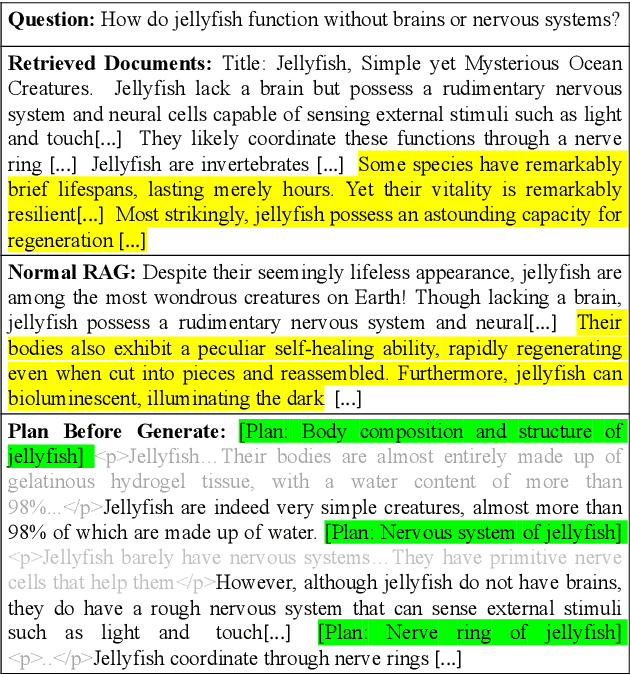
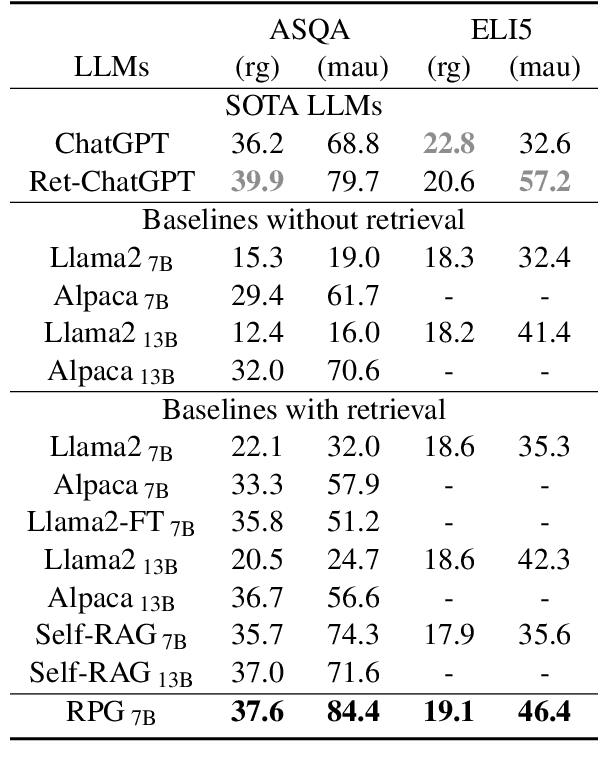
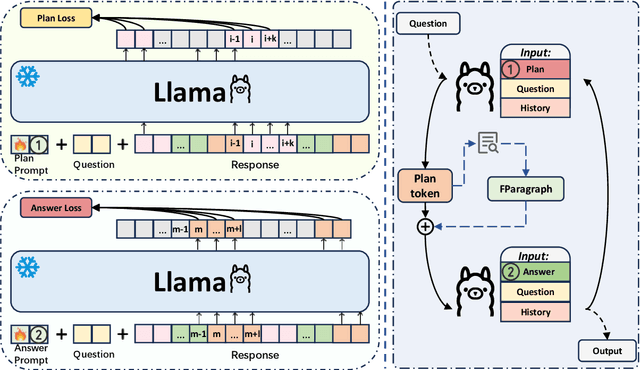
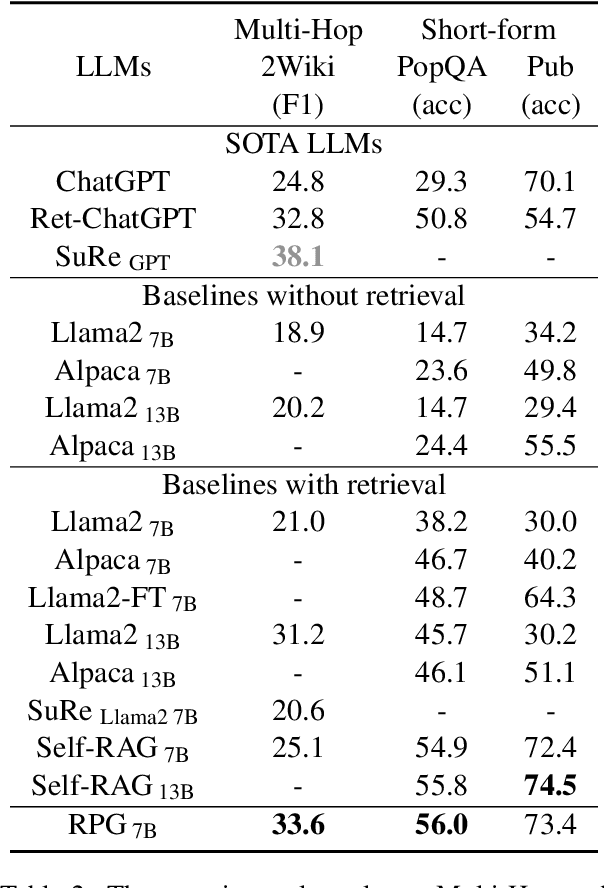
Despite the significant progress of large language models (LLMs) in various tasks, they often produce factual errors due to their limited internal knowledge. Retrieval-Augmented Generation (RAG), which enhances LLMs with external knowledge sources, offers a promising solution. However, these methods can be misled by irrelevant paragraphs in retrieved documents. Due to the inherent uncertainty in LLM generation, inputting the entire document may introduce off-topic information, causing the model to deviate from the central topic and affecting the relevance of the generated content. To address these issues, we propose the Retrieve-Plan-Generation (RPG) framework. RPG generates plan tokens to guide subsequent generation in the plan stage. In the answer stage, the model selects relevant fine-grained paragraphs based on the plan and uses them for further answer generation. This plan-answer process is repeated iteratively until completion, enhancing generation relevance by focusing on specific topics. To implement this framework efficiently, we utilize a simple but effective multi-task prompt-tuning method, enabling the existing LLMs to handle both planning and answering. We comprehensively compare RPG with baselines across 5 knowledge-intensive generation tasks, demonstrating the effectiveness of our approach.

LLMatDesign: Autonomous Materials Discovery with Large Language Models
Jun 19, 2024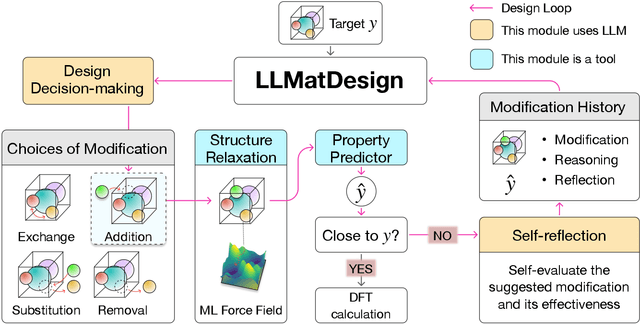
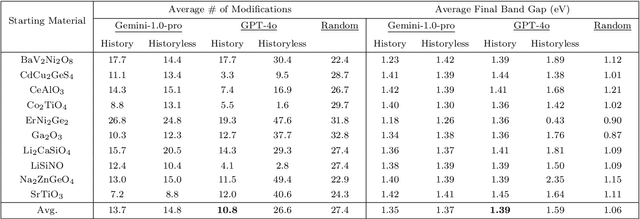
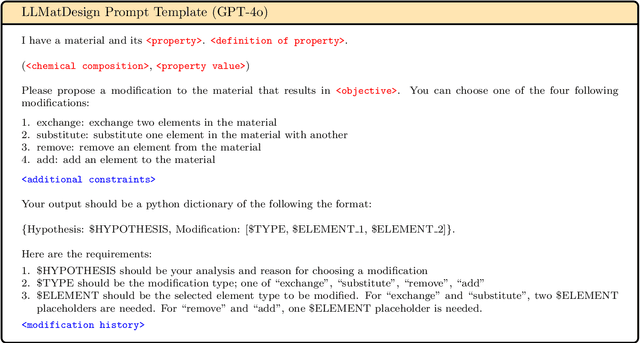
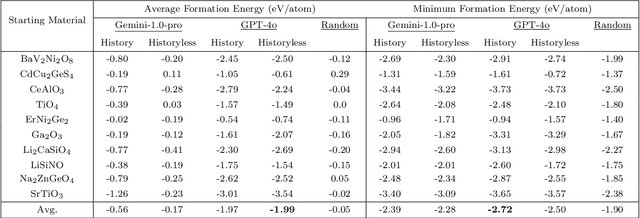
Discovering new materials can have significant scientific and technological implications but remains a challenging problem today due to the enormity of the chemical space. Recent advances in machine learning have enabled data-driven methods to rapidly screen or generate promising materials, but these methods still depend heavily on very large quantities of training data and often lack the flexibility and chemical understanding often desired in materials discovery. We introduce LLMatDesign, a novel language-based framework for interpretable materials design powered by large language models (LLMs). LLMatDesign utilizes LLM agents to translate human instructions, apply modifications to materials, and evaluate outcomes using provided tools. By incorporating self-reflection on its previous decisions, LLMatDesign adapts rapidly to new tasks and conditions in a zero-shot manner. A systematic evaluation of LLMatDesign on several materials design tasks, in silico, validates LLMatDesign's effectiveness in developing new materials with user-defined target properties in the small data regime. Our framework demonstrates the remarkable potential of autonomous LLM-guided materials discovery in the computational setting and towards self-driving laboratories in the future.
Bridging the Gap: Integrating Pre-trained Speech Enhancement and Recognition Models for Robust Speech Recognition
Jun 18, 2024Noise robustness is critical when applying automatic speech recognition (ASR) in real-world scenarios. One solution involves the used of speech enhancement (SE) models as the front end of ASR. However, neural network-based (NN-based) SE often introduces artifacts into the enhanced signals and harms ASR performance, particularly when SE and ASR are independently trained. Therefore, this study introduces a simple yet effective SE post-processing technique to address the gap between various pre-trained SE and ASR models. A bridge module, which is a lightweight NN, is proposed to evaluate the signal-level information of the speech signal. Subsequently, using the signal-level information, the observation addition technique is applied to effectively reduce the shortcomings of SE. The experimental results demonstrate the success of our method in integrating diverse pre-trained SE and ASR models, considerably boosting the ASR robustness. Crucially, no prior knowledge of the ASR or speech contents is required during the training or inference stages. Moreover, the effectiveness of this approach extends to different datasets without necessitating the fine-tuning of the bridge module, ensuring efficiency and improved generalization.
NTIRE 2024 Challenge on Night Photography Rendering
Jun 18, 2024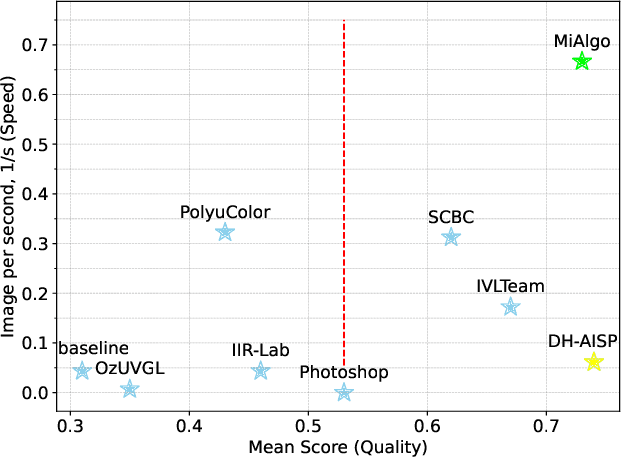
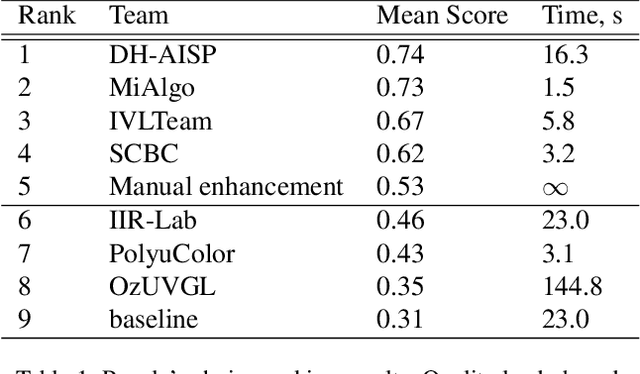

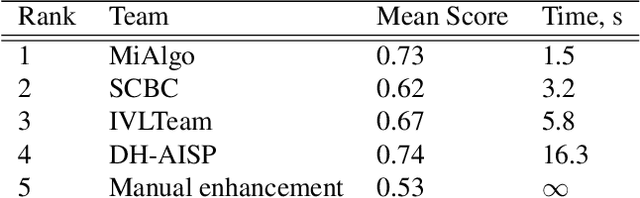
This paper presents a review of the NTIRE 2024 challenge on night photography rendering. The goal of the challenge was to find solutions that process raw camera images taken in nighttime conditions, and thereby produce a photo-quality output images in the standard RGB (sRGB) space. Unlike the previous year's competition, the challenge images were collected with a mobile phone and the speed of algorithms was also measured alongside the quality of their output. To evaluate the results, a sufficient number of viewers were asked to assess the visual quality of the proposed solutions, considering the subjective nature of the task. There were 2 nominations: quality and efficiency. Top 5 solutions in terms of output quality were sorted by evaluation time (see Fig. 1). The top ranking participants' solutions effectively represent the state-of-the-art in nighttime photography rendering. More results can be found at https://nightimaging.org.
Time-Series Forecasting for Out-of-Distribution Generalization Using Invariant Learning
Jun 13, 2024Time-series forecasting (TSF) finds broad applications in real-world scenarios. Due to the dynamic nature of time-series data, it is crucial to equip TSF models with out-of-distribution (OOD) generalization abilities, as historical training data and future test data can have different distributions. In this paper, we aim to alleviate the inherent OOD problem in TSF via invariant learning. We identify fundamental challenges of invariant learning for TSF. First, the target variables in TSF may not be sufficiently determined by the input due to unobserved core variables in TSF, breaking the conventional assumption of invariant learning. Second, time-series datasets lack adequate environment labels, while existing environmental inference methods are not suitable for TSF. To address these challenges, we propose FOIL, a model-agnostic framework that enables timeseries Forecasting for Out-of-distribution generalization via Invariant Learning. FOIL employs a novel surrogate loss to mitigate the impact of unobserved variables. Further, FOIL implements a joint optimization by alternately inferring environments effectively with a multi-head network while preserving the temporal adjacency structure, and learning invariant representations across inferred environments for OOD generalized TSF. We demonstrate that the proposed FOIL significantly improves the performance of various TSF models, achieving gains of up to 85%.
Can Large Language Models Understand Spatial Audio?
Jun 12, 2024This paper explores enabling large language models (LLMs) to understand spatial information from multichannel audio, a skill currently lacking in auditory LLMs. By leveraging LLMs' advanced cognitive and inferential abilities, the aim is to enhance understanding of 3D environments via audio. We study 3 spatial audio tasks: sound source localization (SSL), far-field speech recognition (FSR), and localisation-informed speech extraction (LSE), achieving notable progress in each task. For SSL, our approach achieves an MAE of $2.70^{\circ}$ on the Spatial LibriSpeech dataset, substantially surpassing the prior benchmark of about $6.60^{\circ}$. Moreover, our model can employ spatial cues to improve FSR accuracy and execute LSE by selectively attending to sounds originating from a specified direction via text prompts, even amidst overlapping speech. These findings highlight the potential of adapting LLMs to grasp physical audio concepts, paving the way for LLM-based agents in 3D environments.
Time-MMD: A New Multi-Domain Multimodal Dataset for Time Series Analysis
Jun 12, 2024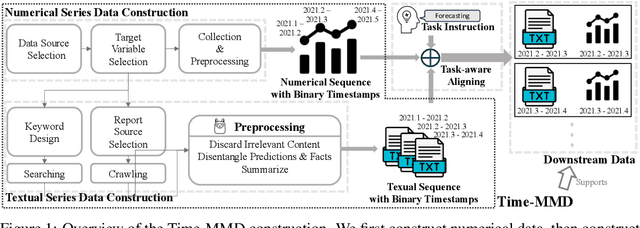

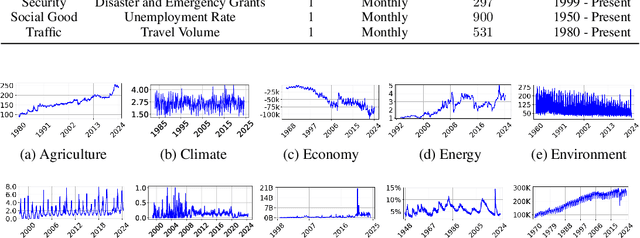

Time series data are ubiquitous across a wide range of real-world domains. While real-world time series analysis (TSA) requires human experts to integrate numerical series data with multimodal domain-specific knowledge, most existing TSA models rely solely on numerical data, overlooking the significance of information beyond numerical series. This oversight is due to the untapped potential of textual series data and the absence of a comprehensive, high-quality multimodal dataset. To overcome this obstacle, we introduce Time-MMD, the first multi-domain, multimodal time series dataset covering 9 primary data domains. Time-MMD ensures fine-grained modality alignment, eliminates data contamination, and provides high usability. Additionally, we develop MM-TSFlib, the first multimodal time-series forecasting (TSF) library, seamlessly pipelining multimodal TSF evaluations based on Time-MMD for in-depth analyses. Extensive experiments conducted on Time-MMD through MM-TSFlib demonstrate significant performance enhancements by extending unimodal TSF to multimodality, evidenced by over 15% mean squared error reduction in general, and up to 40% in domains with rich textual data. More importantly, our datasets and library revolutionize broader applications, impacts, research topics to advance TSA. The dataset and library are available at https://github.com/AdityaLab/Time-MMD and https://github.com/AdityaLab/MM-TSFlib.
From a Social Cognitive Perspective: Context-aware Visual Social Relationship Recognition
Jun 12, 2024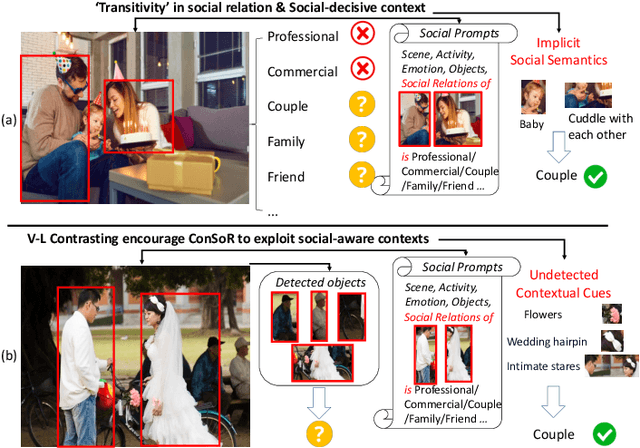
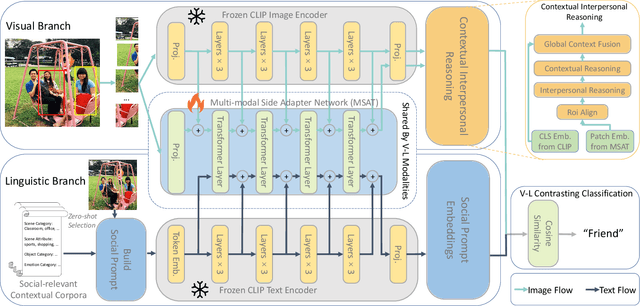
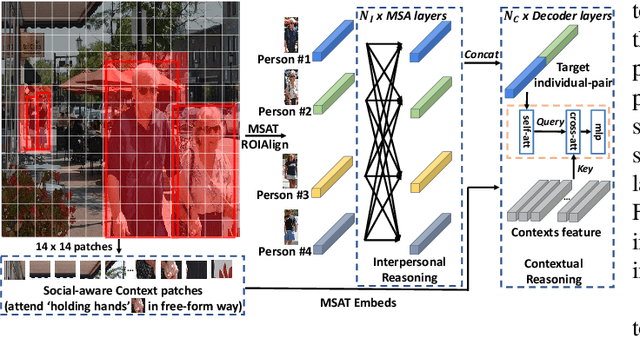
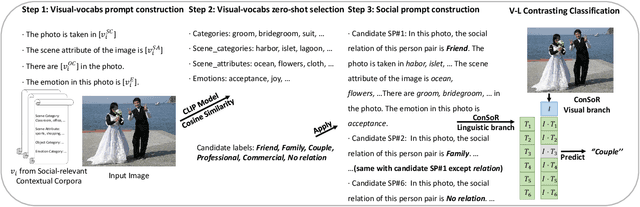
People's social relationships are often manifested through their surroundings, with certain objects or interactions acting as symbols for specific relationships, e.g., wedding rings, roses, hugs, or holding hands. This brings unique challenges to recognizing social relationships, requiring understanding and capturing the essence of these contexts from visual appearances. However, current methods of social relationship understanding rely on the basic classification paradigm of detected persons and objects, which fails to understand the comprehensive context and often overlooks decisive social factors, especially subtle visual cues. To highlight the social-aware context and intricate details, we propose a novel approach that recognizes \textbf{Con}textual \textbf{So}cial \textbf{R}elationships (\textbf{ConSoR}) from a social cognitive perspective. Specifically, to incorporate social-aware semantics, we build a lightweight adapter upon the frozen CLIP to learn social concepts via our novel multi-modal side adapter tuning mechanism. Further, we construct social-aware descriptive language prompts (e.g., scene, activity, objects, emotions) with social relationships for each image, and then compel ConSoR to concentrate more intensively on the decisive visual social factors via visual-linguistic contrasting. Impressively, ConSoR outperforms previous methods with a 12.2\% gain on the People-in-Social-Context (PISC) dataset and a 9.8\% increase on the People-in-Photo-Album (PIPA) benchmark. Furthermore, we observe that ConSoR excels at finding critical visual evidence to reveal social relationships.
An Improved Empirical Fisher Approximation for Natural Gradient Descent
Jun 10, 2024Approximate Natural Gradient Descent (NGD) methods are an important family of optimisers for deep learning models, which use approximate Fisher information matrices to pre-condition gradients during training. The empirical Fisher (EF) method approximates the Fisher information matrix empirically by reusing the per-sample gradients collected during back-propagation. Despite its ease of implementation, the EF approximation has its theoretical and practical limitations. This paper first investigates the inversely-scaled projection issue of EF, which is shown to be a major cause of the poor empirical approximation quality. An improved empirical Fisher (iEF) method, motivated as a generalised NGD method from a loss reduction perspective, is proposed to address this issue, meanwhile retaining the practical convenience of EF. The exact iEF and EF methods are experimentally evaluated using practical deep learning setups, including widely-used setups for parameter-efficient fine-tuning of pre-trained models (T5-base with LoRA and Prompt-Tuning on GLUE tasks, and ViT with LoRA for CIFAR100). Optimisation experiments show that applying exact iEF as an optimiser provides strong convergence and generalisation. It achieves the best test performance and the lowest training loss for majority of the tasks, even when compared with well-tuned AdamW/Adafactor baselines. Additionally, under a novel empirical evaluation framework, the proposed iEF method shows consistently better approximation quality to the exact Natural Gradient updates than both EF and the more expensive sampled Fisher (SF). Further investigation also shows that the superior approximation quality of iEF is robust to damping across tasks and training stages. Improving existing approximate NGD optimisers with iEF is expected to lead to better convergence ability and stronger robustness to choice of damping.
PLaD: Preference-based Large Language Model Distillation with Pseudo-Preference Pairs
Jun 06, 2024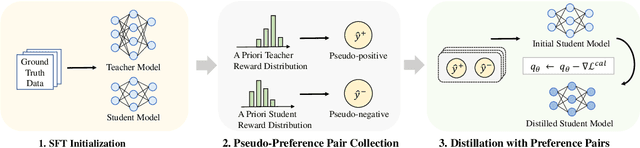
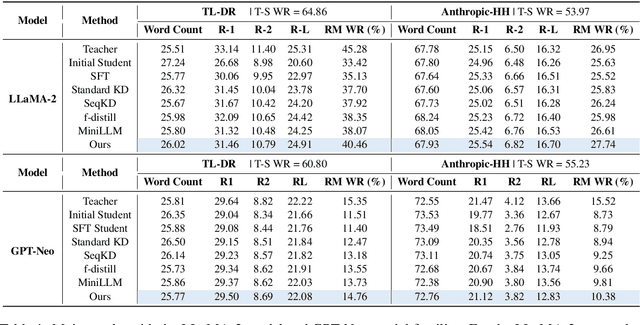
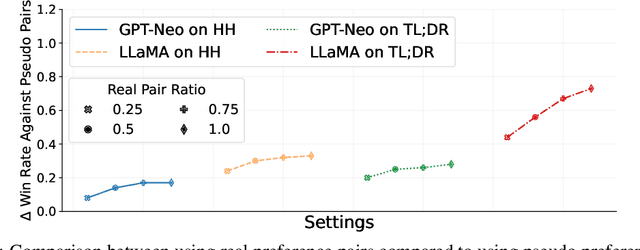
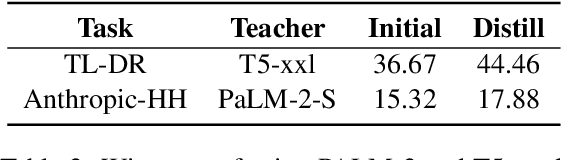
Large Language Models (LLMs) have exhibited impressive capabilities in various tasks, yet their vast parameter sizes restrict their applicability in resource-constrained settings. Knowledge distillation (KD) offers a viable solution by transferring expertise from large teacher models to compact student models. However, traditional KD techniques face specific challenges when applied to LLMs, including restricted access to LLM outputs, significant teacher-student capacity gaps, and the inherited mis-calibration issue. In this work, we present PLaD, a novel preference-based LLM distillation framework. PLaD exploits the teacher-student capacity discrepancy to generate pseudo-preference pairs where teacher outputs are preferred over student outputs. Then, PLaD leverages a ranking loss to re-calibrate student's estimation of sequence likelihood, which steers the student's focus towards understanding the relative quality of outputs instead of simply imitating the teacher. PLaD bypasses the need for access to teacher LLM's internal states, tackles the student's expressivity limitations, and mitigates the student mis-calibration issue. Through extensive experiments on two sequence generation tasks and with various LLMs, we demonstrate the effectiveness of our proposed PLaD framework.