 Add to Chrome
 Add to Firefox
 Add to Edge
Agentic Commerce World: An Auditable and Verifiable Environment for Vibe Commerce
Aug 03, 2026
In vibe coding, people describe software in natural language and delegate implementation to AI agents. By analogy, vibe commerce allows people to express buying or selling goals in natural language and delegate the corresponding tasks to agents. Commerce, however, requires independently controlled Buyer and Merchant agents to interact in a shared market while preserving their private objectives and distinct authority. We introduce Agentic Commerce World (ACWorld), an environment for evaluating such agents across ongoing transactions. Through its Vibe Commerce Protocol (VCP), ACWorld validates agent actions before updating shared transaction state and records the resulting interactions, making agent behavior auditable and evaluation reproducible. The ACWorld Benchmark contains a 200-task capability-coverage track and a 60-task large-catalog track that searches 785,022 transactable listings. Across ten models, mean scores range from 65.9% to 85.6% and from 56.1% to 91.4%, respectively. Our analysis shows that process-level evidence is necessary: final state alone can miss evaluated errors, incomplete trajectories still retain useful process signals, and large-catalog tasks expose bottlenecks across stages.

Teaching Vision-Language-Action Models What to See and Where to Look
Jul 02, 2026Vision-Language-Action (VLA) models have emerged as a promising paradigm for end-to-end autonomous driving. However, existing VLAs' training relies heavily on text-centric visual question answering and chain-of-thought reasoning data, which emphasizes linguistic reasoning rather than action-grounded planning. As a result, the learned representations capture semantic knowledge but lack spatial dependencies crucial for reliable trajectory prediction. We propose DriveTeach-VLA, a framework that explicitly teaches VLAs what to see and where to look. Driving-aware Vision Distillation (DVD) injects driving-specific perceptual priors into the vision encoder, while 2D Trajectory-Guided Prompts (2D-TGP) provide spatial conditioning aligned with feasible driving trajectories. Together, they form a vision-guided learning pipeline: what to see (DVD pretraining) - where to look (TGP-guided SFT) - how to act (TGP-guided GRPO). DriveTeach-VLA achieves the state-of-the-art performance on NAVSIM and nuScenes. Our code is available at: https://github.com/ShivaTeam/DriveTeach-VLA.
CLOVER: Closed-Loop Value Estimation \& Ranking for End-to-End Autonomous Driving Planning
May 14, 2026End-to-end autonomous driving planners are commonly trained by imitating a single logged trajectory, yet evaluated by rule-based planning metrics that measure safety, feasibility, progress, and comfort. This creates a training--evaluation mismatch: trajectories close to the logged path may violate planning rules, while alternatives farther from the demonstration can remain valid and high-scoring. The mismatch is especially limiting for proposal-selection planners, whose performance depends on candidate-set coverage and scorer ranking quality. We propose CLOVER, a Closed-LOop Value Estimation and Ranking framework for end-to-end autonomous driving planning. CLOVER follows a lightweight generator--scorer formulation: a generator produces diverse candidate trajectories, and a scorer predicts planning-metric sub-scores to rank them at inference time. To expand proposal support beyond single-trajectory imitation, CLOVER constructs evaluator-filtered pseudo-expert trajectories and trains the generator with set-level coverage supervision. It then performs conservative closed-loop self-distillation: the scorer is fitted to true evaluator sub-scores on generated proposals, while the generator is refined toward teacher-selected top-$k$ and vector-Pareto targets with stability regularization. We analyze when an imperfect scorer can improve the generator, showing that scorer-mediated refinement is reliable when scorer-selected targets are enriched under the true evaluator and updates remain conservative. On NAVSIM, CLOVER achieves 94.5 PDMS and 90.4 EPDMS, establishing a new state of the art. On the more challenging NavHard split, it obtains 48.3 EPDMS, matching the strongest reported result. On supplementary nuScenes open-loop evaluation, CLOVER achieves the lowest L2 error and collision rate among compared methods. Code data will be released at https://github.com/WilliamXuanYu/CLOVER.
SilLang: Improving Gait Recognition with Silhouette Language Encoding
Mar 25, 2026Gait silhouettes, which can be encoded into binary gait codes, are widely adopted to representing motion patterns of pedestrian. Recent approaches commonly leverage visual backbones to encode gait silhouettes, achieving successful performance. However, they primarily focus on continuous visual features, overlooking the discrete nature of binary silhouettes that inherently share a discrete encoding space with natural language. Large Language Models (LLMs) have demonstrated exceptional capability in extracting discriminative features from discrete sequences and modeling long-range dependencies, highlighting their potential to capture temporal motion patterns by identifying subtle variations. Motivated by these observations, we explore bridging binary gait silhouettes and natural language within a binary encoding space. However, the encoding spaces of text tokens and binary gait silhouettes remain misaligned, primarily due to differences in token frequency and density. To address this issue, we propose the Contour-Velocity Tokenizer, which encodes binary gait silhouettes while reshaping their distribution to better align with the text token space. We then establish a dual-branch framework termed Silhouette Language Model, which enhances visual silhouettes by integrating discrete linguistic embeddings derived from LLMs. Implemented on mainstream gait backbones, SilLang consistently improves state-of-the-art methods across SUSTech1K, GREW, and Gait3D.
From Representational Complementarity to Dual Systems: Synergizing VLM and Vision-Only Backbones for End-to-End Driving
Feb 11, 2026Vision-Language-Action (VLA) driving augments end-to-end (E2E) planning with language-enabled backbones, yet it remains unclear what changes beyond the usual accuracy--cost trade-off. We revisit this question with 3--RQ analysis in RecogDrive by instantiating the system with a full VLM and vision-only backbones, all under an identical diffusion Transformer planner. RQ1: At the backbone level, the VLM can introduce additional subspaces upon the vision-only backbones. RQ2: This unique subspace leads to a different behavioral in some long-tail scenario: the VLM tends to be more aggressive whereas ViT is more conservative, and each decisively wins on about 2--3% of test scenarios; With an oracle that selects, per scenario, the better trajectory between the VLM and ViT branches, we obtain an upper bound of 93.58 PDMS. RQ3: To fully harness this observation, we propose HybridDriveVLA, which runs both ViT and VLM branches and selects between their endpoint trajectories using a learned scorer, improving PDMS to 92.10. Finally, DualDriveVLA implements a practical fast--slow policy: it runs ViT by default and invokes the VLM only when the scorer's confidence falls below a threshold; calling the VLM on 15% of scenarios achieves 91.00 PDMS while improving throughput by 3.2x. Code will be released.
Artificial Entanglement in the Fine-Tuning of Large Language Models
Jan 11, 2026Large language models (LLMs) can be adapted to new tasks using parameter-efficient fine-tuning (PEFT) methods that modify only a small number of trainable parameters, often through low-rank updates. In this work, we adopt a quantum-information-inspired perspective to understand their effectiveness. From this perspective, low-rank parameterizations naturally correspond to low-dimensional Matrix Product States (MPS) representations, which enable entanglement-based characterizations of parameter structure. Thereby, we term and measure "Artificial Entanglement", defined as the entanglement entropy of the parameters in artificial neural networks (in particular the LLMs). We first study the representative low-rank adaptation (LoRA) PEFT method, alongside full fine-tuning (FFT), using LLaMA models at the 1B and 8B scales trained on the Tulu3 and OpenThoughts3 datasets, and uncover: (i) Internal artificial entanglement in the updates of query and value projection matrices in LoRA follows a volume law with a central suppression (termed as the "Entanglement Valley"), which is sensitive to hyper-parameters and is distinct from that in FFT; (ii) External artificial entanglement in attention matrices, corresponding to token-token correlations in representation space, follows an area law with logarithmic corrections and remains robust to LoRA hyper-parameters and training steps. Drawing a parallel to the No-Hair Theorem in black hole physics, we propose that although LoRA and FFT induce distinct internal entanglement signatures, such differences do not manifest in the attention outputs, suggesting a "no-hair" property that results in the effectiveness of low rank updates. We further provide theoretical support based on random matrix theory, and extend our analysis to an MPS Adaptation PEFT method, which exhibits qualitatively similar behaviors.
Chameleon: On the Scene Diversity and Domain Variety of AI-Generated Videos Detection
Mar 09, 2025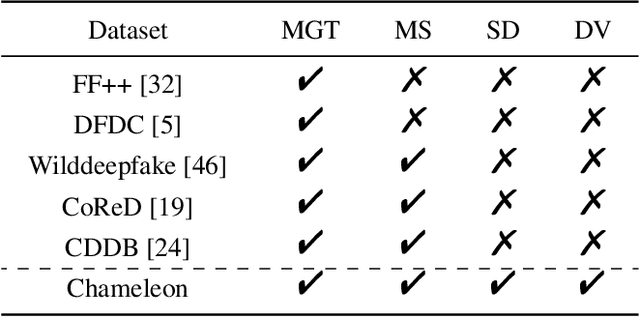
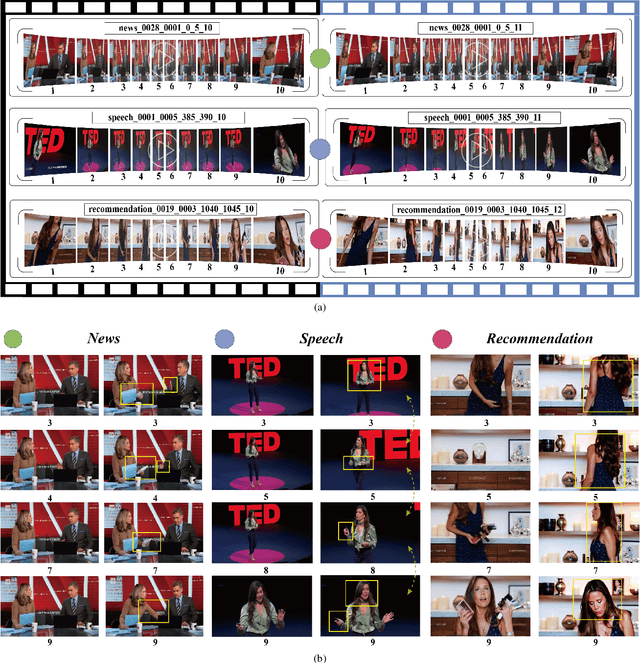
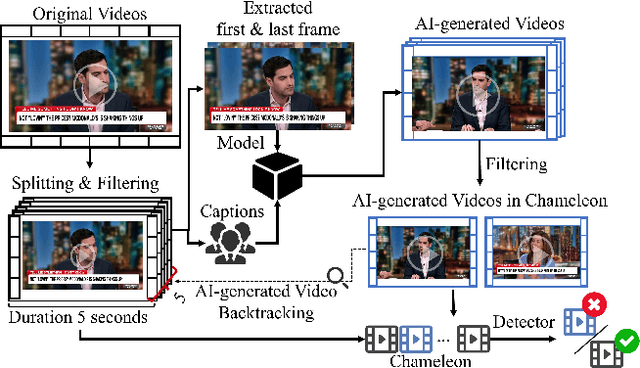
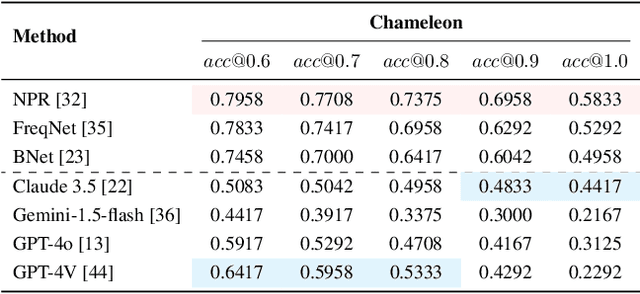
Artificial intelligence generated content (AIGC), known as DeepFakes, has emerged as a growing concern because it is being utilized as a tool for spreading disinformation. While much research exists on identifying AI-generated text and images, research on detecting AI-generated videos is limited. Existing datasets for AI-generated videos detection exhibit limitations in terms of diversity, complexity, and realism. To address these issues, this paper focuses on AI-generated videos detection and constructs a diverse dataset named Chameleon. We generate videos through multiple generation tools and various real video sources. At the same time, we preserve the videos' real-world complexity, including scene switches and dynamic perspective changes, and expand beyond face-centered detection to include human actions and environment generation. Our work bridges the gap between AI-generated dataset construction and real-world forensic needs, offering a valuable benchmark to counteract the evolving threats of AI-generated content.
SearchRAG: Can Search Engines Be Helpful for LLM-based Medical Question Answering?
Feb 18, 2025Large Language Models (LLMs) have shown remarkable capabilities in general domains but often struggle with tasks requiring specialized knowledge. Conventional Retrieval-Augmented Generation (RAG) techniques typically retrieve external information from static knowledge bases, which can be outdated or incomplete, missing fine-grained clinical details essential for accurate medical question answering. In this work, we propose SearchRAG, a novel framework that overcomes these limitations by leveraging real-time search engines. Our method employs synthetic query generation to convert complex medical questions into search-engine-friendly queries and utilizes uncertainty-based knowledge selection to filter and incorporate the most relevant and informative medical knowledge into the LLM's input. Experimental results demonstrate that our method significantly improves response accuracy in medical question answering tasks, particularly for complex questions requiring detailed and up-to-date knowledge.
From Generation to Judgment: Opportunities and Challenges of LLM-as-a-judge
Nov 25, 2024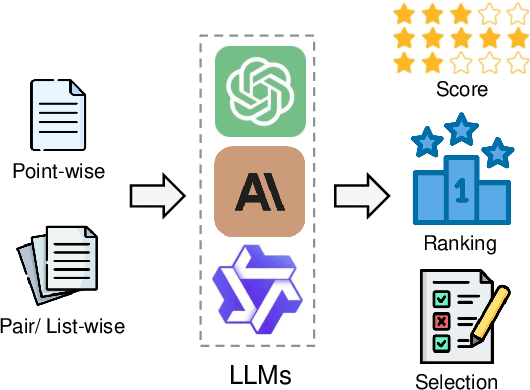

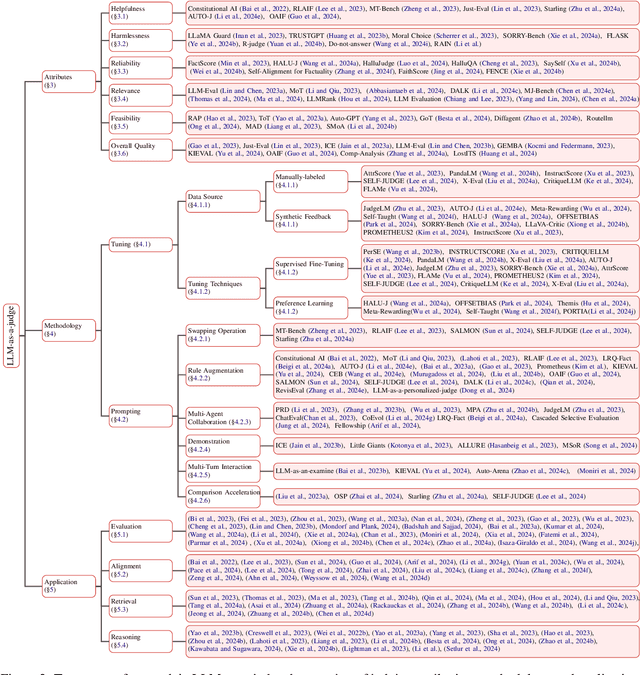

Assessment and evaluation have long been critical challenges in artificial intelligence (AI) and natural language processing (NLP). However, traditional methods, whether matching-based or embedding-based, often fall short of judging subtle attributes and delivering satisfactory results. Recent advancements in Large Language Models (LLMs) inspire the "LLM-as-a-judge" paradigm, where LLMs are leveraged to perform scoring, ranking, or selection across various tasks and applications. This paper provides a comprehensive survey of LLM-based judgment and assessment, offering an in-depth overview to advance this emerging field. We begin by giving detailed definitions from both input and output perspectives. Then we introduce a comprehensive taxonomy to explore LLM-as-a-judge from three dimensions: what to judge, how to judge and where to judge. Finally, we compile benchmarks for evaluating LLM-as-a-judge and highlight key challenges and promising directions, aiming to provide valuable insights and inspire future research in this promising research area. Paper list and more resources about LLM-as-a-judge can be found at \url{https://github.com/llm-as-a-judge/Awesome-LLM-as-a-judge} and \url{https://llm-as-a-judge.github.io}.
ClinicalBench: Can LLMs Beat Traditional ML Models in Clinical Prediction?
Nov 10, 2024Large Language Models (LLMs) hold great promise to revolutionize current clinical systems for their superior capacities on medical text processing tasks and medical licensing exams. Meanwhile, traditional ML models such as SVM and XGBoost have still been mainly adopted in clinical prediction tasks. An emerging question is Can LLMs beat traditional ML models in clinical prediction? Thus, we build a new benchmark ClinicalBench to comprehensively study the clinical predictive modeling capacities of both general-purpose and medical LLMs, and compare them with traditional ML models. ClinicalBench embraces three common clinical prediction tasks, two databases, 14 general-purpose LLMs, 8 medical LLMs, and 11 traditional ML models. Through extensive empirical investigation, we discover that both general-purpose and medical LLMs, even with different model scales, diverse prompting or fine-tuning strategies, still cannot beat traditional ML models in clinical prediction yet, shedding light on their potential deficiency in clinical reasoning and decision-making. We call for caution when practitioners adopt LLMs in clinical applications. ClinicalBench can be utilized to bridge the gap between LLMs' development for healthcare and real-world clinical practice.