 Add to Chrome
 Add to Firefox
 Add to Edge
MARINER: A 3E-Driven Benchmark for Fine-Grained Perception and Complex Reasoning in Open-Water Environments
Apr 09, 2026
Fine-grained visual understanding and high-level reasoning in real-world open-water environments remain under-explored due to the lack of dedicated benchmarks. We introduce MARINER, a comprehensive benchmark built under the novel Entity-Environment-Event (3E) paradigm. MARINER contains 16,629 multi-source maritime images with 63 fine-grained vessel categories, diverse adverse environments, and 5 typical dynamic maritime incidents, covering fine-grained classification, object detection, and visual question answering tasks. We conduct extensive evaluations on mainstream Multimodal Large language models (MLLMs) and establish baselines, revealing that even advanced models struggle with fine-grained discrimination and causal reasoning in complex marine scenes. As a dedicated maritime benchmark, MARINER fills the gap of realistic and cognitive-level evaluation for maritime multimodal understanding, and promotes future research on robust vision-language models for open-water applications. Appendix and supplementary materials are available at https://lxixim.github.io/MARINER.

Chameleon: On the Scene Diversity and Domain Variety of AI-Generated Videos Detection
Mar 09, 2025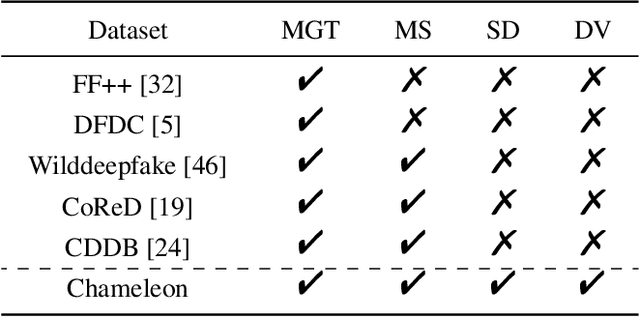
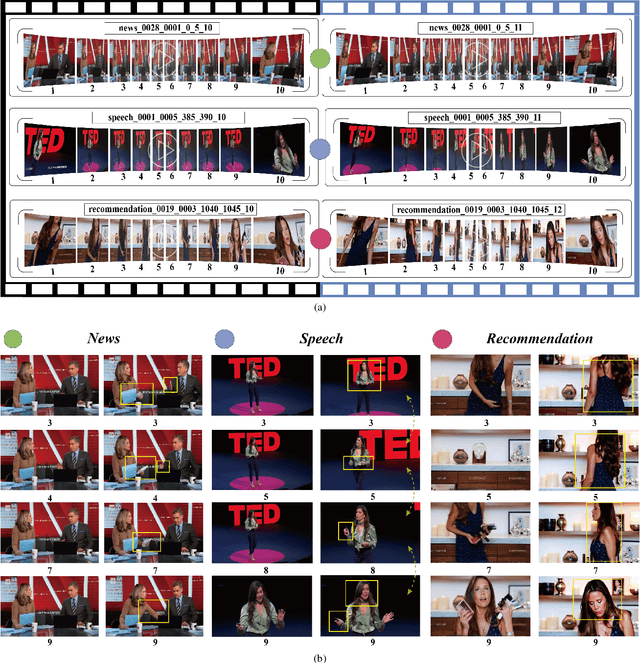
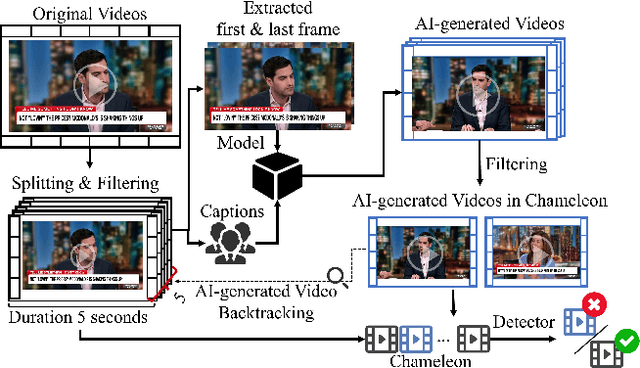
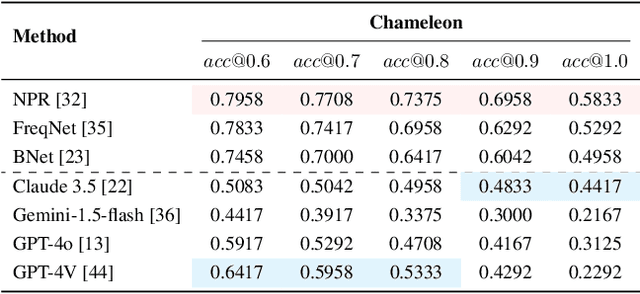
Artificial intelligence generated content (AIGC), known as DeepFakes, has emerged as a growing concern because it is being utilized as a tool for spreading disinformation. While much research exists on identifying AI-generated text and images, research on detecting AI-generated videos is limited. Existing datasets for AI-generated videos detection exhibit limitations in terms of diversity, complexity, and realism. To address these issues, this paper focuses on AI-generated videos detection and constructs a diverse dataset named Chameleon. We generate videos through multiple generation tools and various real video sources. At the same time, we preserve the videos' real-world complexity, including scene switches and dynamic perspective changes, and expand beyond face-centered detection to include human actions and environment generation. Our work bridges the gap between AI-generated dataset construction and real-world forensic needs, offering a valuable benchmark to counteract the evolving threats of AI-generated content.
Composited-Nested-Learning with Data Augmentation for Nested Named Entity Recognition
Jun 18, 2024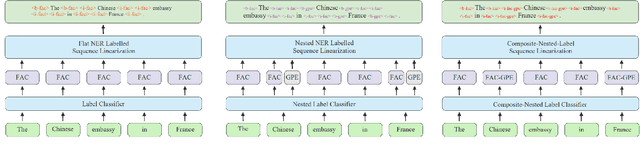
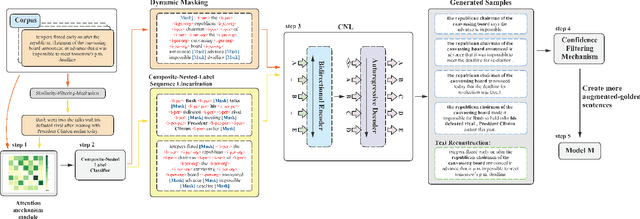
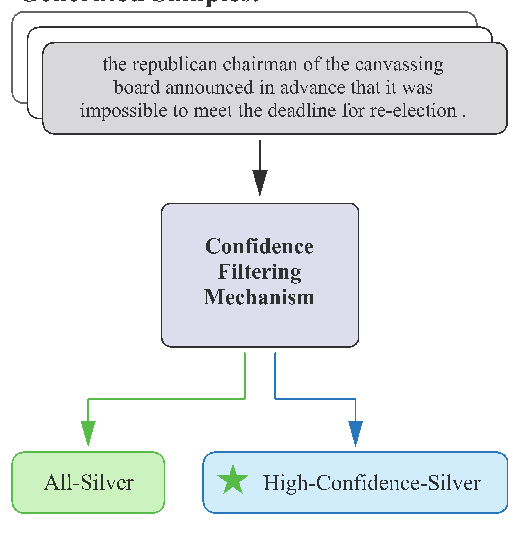
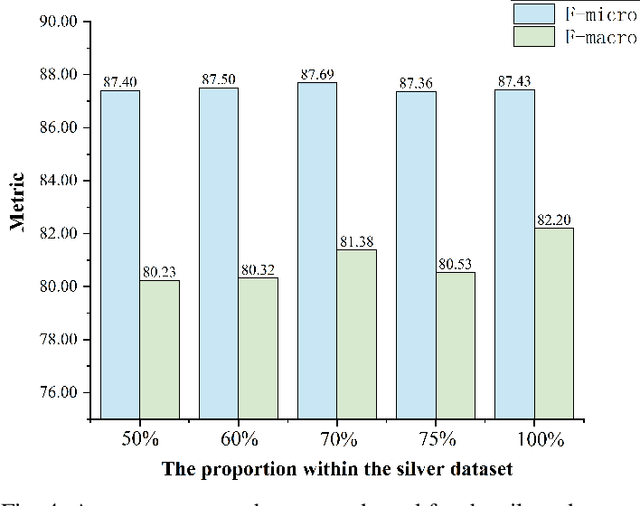
Nested Named Entity Recognition (NNER) focuses on addressing overlapped entity recognition. Compared to Flat Named Entity Recognition (FNER), annotated resources are scarce in the corpus for NNER. Data augmentation is an effective approach to address the insufficient annotated corpus. However, there is a significant lack of exploration in data augmentation methods for NNER. Due to the presence of nested entities in NNER, existing data augmentation methods cannot be directly applied to NNER tasks. Therefore, in this work, we focus on data augmentation for NNER and resort to more expressive structures, Composited-Nested-Label Classification (CNLC) in which constituents are combined by nested-word and nested-label, to model nested entities. The dataset is augmented using the Composited-Nested-Learning (CNL). In addition, we propose the Confidence Filtering Mechanism (CFM) for a more efficient selection of generated data. Experimental results demonstrate that this approach results in improvements in ACE2004 and ACE2005 and alleviates the impact of sample imbalance.