 Add to Chrome
 Add to Firefox
 Add to Edge
Leveraging Large Language Models for NLG Evaluation: A Survey
Jan 13, 2024
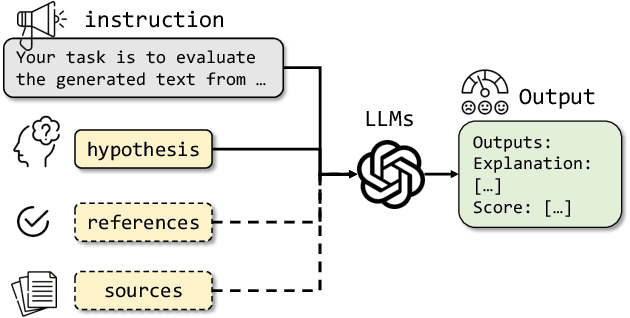
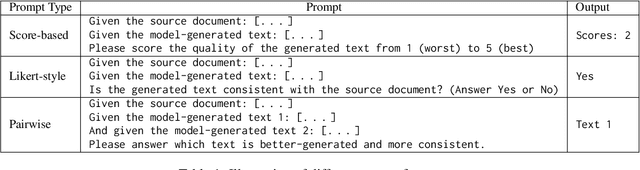
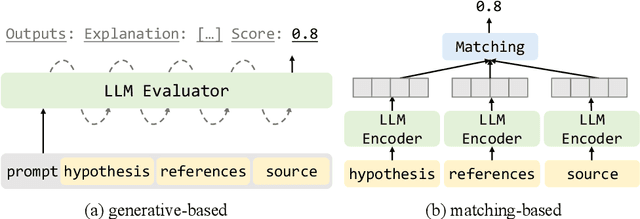
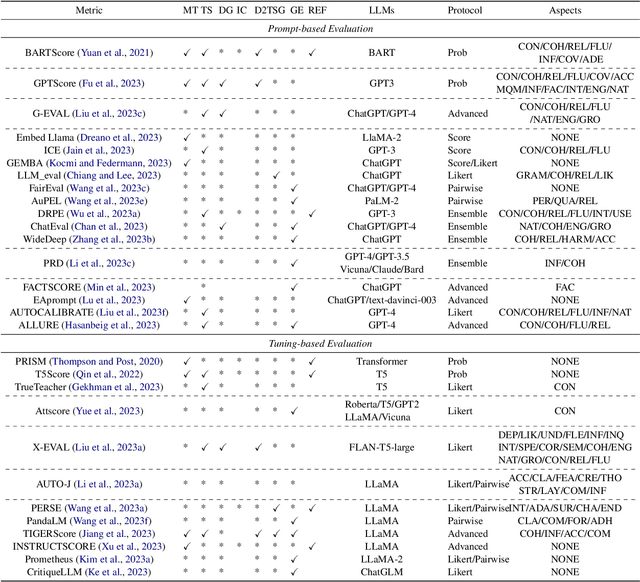
In the rapidly evolving domain of Natural Language Generation (NLG) evaluation, introducing Large Language Models (LLMs) has opened new avenues for assessing generated content quality, e.g., coherence, creativity, and context relevance. This survey aims to provide a thorough overview of leveraging LLMs for NLG evaluation, a burgeoning area that lacks a systematic analysis. We propose a coherent taxonomy for organizing existing LLM-based evaluation metrics, offering a structured framework to understand and compare these methods. Our detailed exploration includes critically assessing various LLM-based methodologies, as well as comparing their strengths and limitations in evaluating NLG outputs. By discussing unresolved challenges, including bias, robustness, domain-specificity, and unified evaluation, this survey seeks to offer insights to researchers and advocate for fairer and more advanced NLG evaluation techniques.

WaveCoder: Widespread And Versatile Enhanced Instruction Tuning with Refined Data Generation
Jan 11, 2024Recent work demonstrates that, after being fine-tuned on a high-quality instruction dataset, the resulting model can obtain impressive capabilities to address a wide range of tasks. However, existing methods for instruction data generation often produce duplicate data and are not controllable enough on data quality. In this paper, we extend the generalization of instruction tuning by classifying the instruction data to 4 code-related tasks and propose a LLM-based Generator-Discriminator data process framework to generate diverse, high-quality instruction data from open source code. Hence, we introduce CodeOcean, a dataset comprising 20,000 instruction instances across 4 universal code-related tasks,which is aimed at augmenting the effectiveness of instruction tuning and improving the generalization ability of fine-tuned model. Subsequently, we present WaveCoder, a fine-tuned Code LLM with Widespread And Versatile Enhanced instruction tuning. This model is specifically designed for enhancing instruction tuning of Code Language Models (LLMs). Our experiments demonstrate that Wavecoder models outperform other open-source models in terms of generalization ability across different code-related tasks at the same level of fine-tuning scale. Moreover, Wavecoder exhibits high efficiency in previous code generation tasks. This paper thus offers a significant contribution to the field of instruction data generation and fine-tuning models, providing new insights and tools for enhancing performance in code-related tasks.
Geometric-Facilitated Denoising Diffusion Model for 3D Molecule Generation
Jan 05, 2024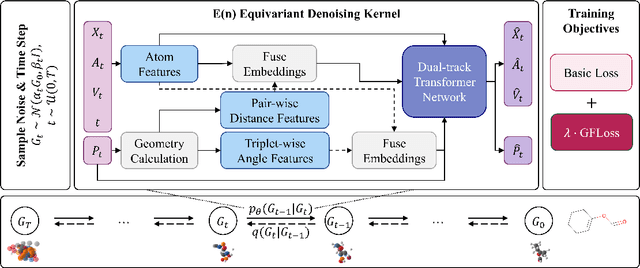

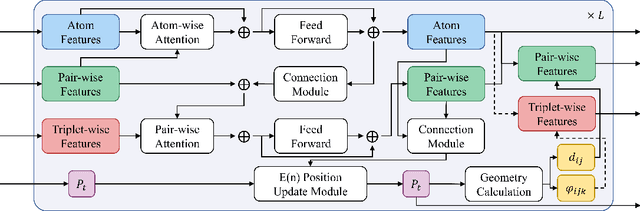

Denoising diffusion models have shown great potential in multiple research areas. Existing diffusion-based generative methods on de novo 3D molecule generation face two major challenges. Since majority heavy atoms in molecules allow connections to multiple atoms through single bonds, solely using pair-wise distance to model molecule geometries is insufficient. Therefore, the first one involves proposing an effective neural network as the denoising kernel that is capable to capture complex multi-body interatomic relationships and learn high-quality features. Due to the discrete nature of graphs, mainstream diffusion-based methods for molecules heavily rely on predefined rules and generate edges in an indirect manner. The second challenge involves accommodating molecule generation to diffusion and accurately predicting the existence of bonds. In our research, we view the iterative way of updating molecule conformations in diffusion process is consistent with molecular dynamics and introduce a novel molecule generation method named Geometric-Facilitated Molecular Diffusion (GFMDiff). For the first challenge, we introduce a Dual-Track Transformer Network (DTN) to fully excevate global spatial relationships and learn high quality representations which contribute to accurate predictions of features and geometries. As for the second challenge, we design Geometric-Facilitated Loss (GFLoss) which intervenes the formation of bonds during the training period, instead of directly embedding edges into the latent space. Comprehensive experiments on current benchmarks demonstrate the superiority of GFMDiff.
Re-Reading Improves Reasoning in Language Models
Sep 12, 2023Reasoning presents a significant and challenging issue for Large Language Models (LLMs). The predominant focus of research has revolved around developing diverse prompting strategies to guide and structure the reasoning processes of LLMs. However, these approaches based on decoder-only causal language models often operate the input question in a single forward pass, potentially missing the rich, back-and-forth interactions inherent in human reasoning. Scant attention has been paid to a critical dimension, i.e., the input question itself embedded within the prompts. In response, we introduce a deceptively simple yet highly effective prompting strategy, termed question "re-reading". Drawing inspiration from human learning and problem-solving, re-reading entails revisiting the question information embedded within input prompts. This approach aligns seamlessly with the cognitive principle of reinforcement, enabling LLMs to extract deeper insights, identify intricate patterns, establish more nuanced connections, and ultimately enhance their reasoning capabilities across various tasks. Experiments conducted on a series of reasoning benchmarks serve to underscore the effectiveness and generality of our method. Moreover, our findings demonstrate that our approach seamlessly integrates with various language models, though-eliciting prompting methods, and ensemble techniques, further underscoring its versatility and compatibility in the realm of LLMs.
WizardMath: Empowering Mathematical Reasoning for Large Language Models via Reinforced Evol-Instruct
Aug 18, 2023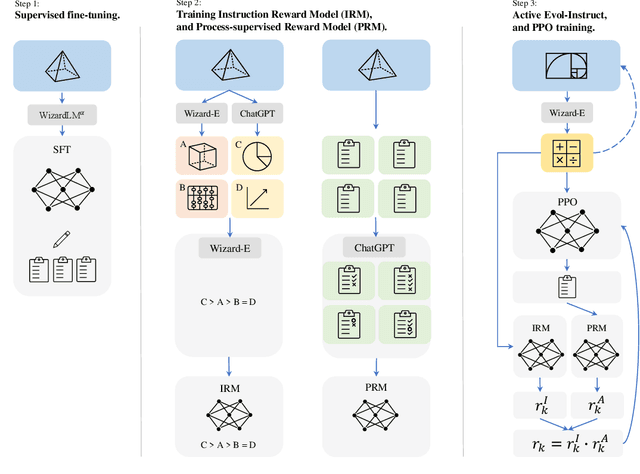
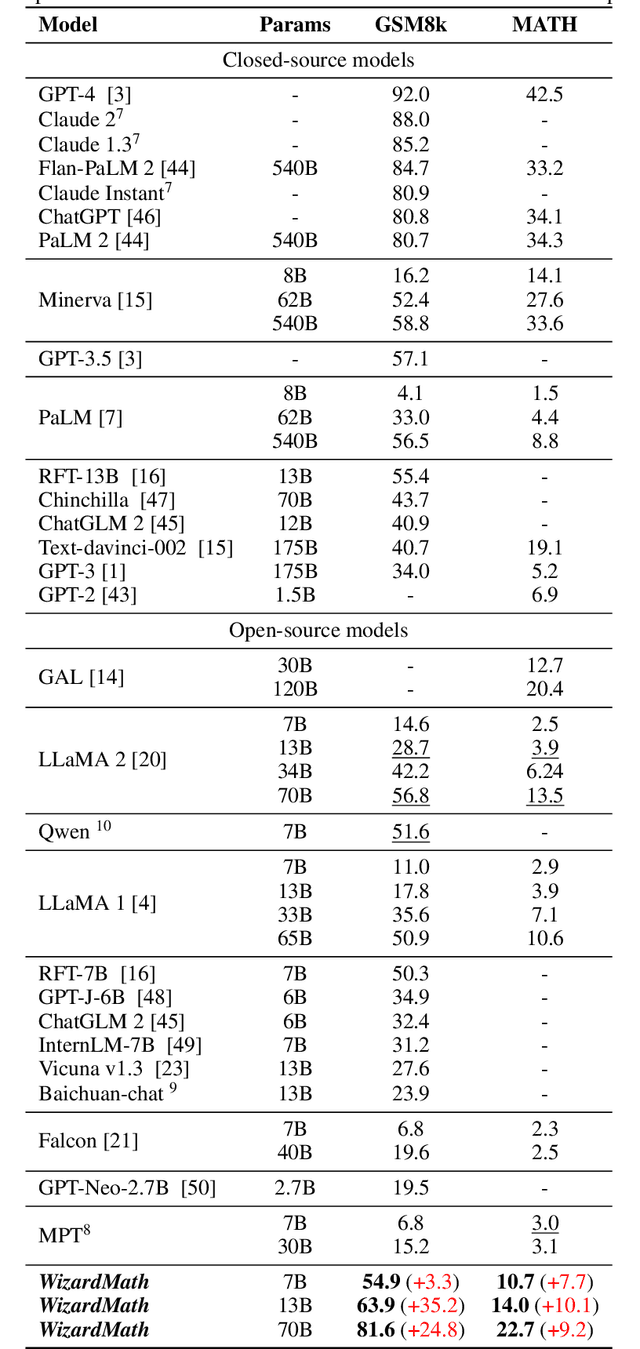
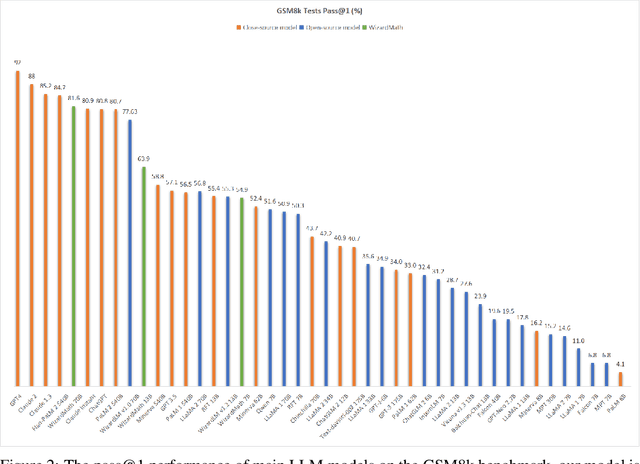
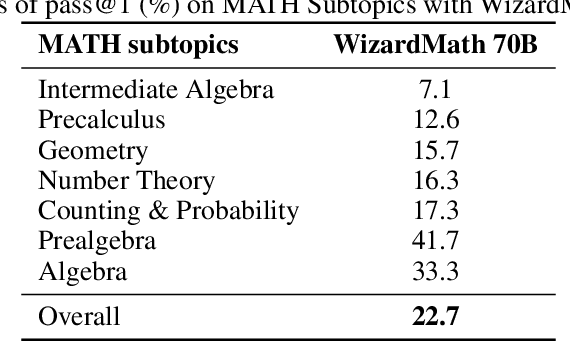
Large language models (LLMs), such as GPT-4, have shown remarkable performance in natural language processing (NLP) tasks, including challenging mathematical reasoning. However, most existing open-source models are only pre-trained on large-scale internet data and without math-related optimization. In this paper, we present WizardMath, which enhances the mathematical reasoning abilities of Llama-2, by applying our proposed Reinforcement Learning from Evol-Instruct Feedback (RLEIF) method to the domain of math. Through extensive experiments on two mathematical reasoning benchmarks, namely GSM8k and MATH, we reveal the extraordinary capabilities of our model. WizardMath surpasses all other open-source LLMs by a substantial margin. Furthermore, our model even outperforms ChatGPT-3.5, Claude Instant-1, PaLM-2 and Minerva on GSM8k, simultaneously surpasses Text-davinci-002, PaLM-1 and GPT-3 on MATH. More details and model weights are public at https://github.com/nlpxucan/WizardLM and https://huggingface.co/WizardLM.
SubT-MRS: A Subterranean, Multi-Robot, Multi-Spectral and Multi-Degraded Dataset for Robust SLAM
Aug 02, 2023


In recent years, significant progress has been made in the field of simultaneous localization and mapping (SLAM) research. However, current state-of-the-art solutions still struggle with limited accuracy and robustness in real-world applications. One major reason is the lack of datasets that fully capture the conditions faced by robots in the wild. To address this problem, we present SubT-MRS, an extremely challenging real-world dataset designed to push the limits of SLAM and perception algorithms. SubT-MRS is a multi-modal, multi-robot dataset collected mainly from subterranean environments having multi-degraded conditions including structureless corridors, varying lighting conditions, and perceptual obscurants such as smoke and dust. Furthermore, the dataset packages information from a diverse range of time-synchronized sensors, including LiDAR, visual cameras, thermal cameras, and IMUs captured using varied vehicular motions like aerial, legged, and wheeled, to support research in sensor fusion, which is essential for achieving accurate and robust robotic perception in complex environments. To evaluate the accuracy of SLAM systems, we also provide a dense 3D model with sub-centimeter-level accuracy, as well as accurate 6DoF ground truth. Our benchmarking approach includes several state-of-the-art methods to demonstrate the challenges our datasets introduce, particularly in the case of multi-degraded environments.
Investigating the Learning Behaviour of In-context Learning: A Comparison with Supervised Learning
Aug 01, 2023Large language models (LLMs) have shown remarkable capacity for in-context learning (ICL), where learning a new task from just a few training examples is done without being explicitly pre-trained. However, despite the success of LLMs, there has been little understanding of how ICL learns the knowledge from the given prompts. In this paper, to make progress toward understanding the learning behaviour of ICL, we train the same LLMs with the same demonstration examples via ICL and supervised learning (SL), respectively, and investigate their performance under label perturbations (i.e., noisy labels and label imbalance) on a range of classification tasks. First, via extensive experiments, we find that gold labels have significant impacts on the downstream in-context performance, especially for large language models; however, imbalanced labels matter little to ICL across all model sizes. Second, when comparing with SL, we show empirically that ICL is less sensitive to label perturbations than SL, and ICL gradually attains comparable performance to SL as the model size increases.
WizardCoder: Empowering Code Large Language Models with Evol-Instruct
Jun 14, 2023Code Large Language Models (Code LLMs), such as StarCoder, have demonstrated exceptional performance in code-related tasks. However, most existing models are solely pre-trained on extensive raw code data without instruction fine-tuning. In this paper, we introduce WizardCoder, which empowers Code LLMs with complex instruction fine-tuning, by adapting the Evol-Instruct method to the domain of code. Through comprehensive experiments on four prominent code generation benchmarks, namely HumanEval, HumanEval+, MBPP, and DS-1000, we unveil the exceptional capabilities of our model. It surpasses all other open-source Code LLMs by a substantial margin. Moreover, our model even outperforms the largest closed LLMs, Anthropic's Claude and Google's Bard, on HumanEval and HumanEval+. Our code, model weights, and data are public at https://github.com/nlpxucan/WizardLM
Knowledge Refinement via Interaction Between Search Engines and Large Language Models
May 21, 2023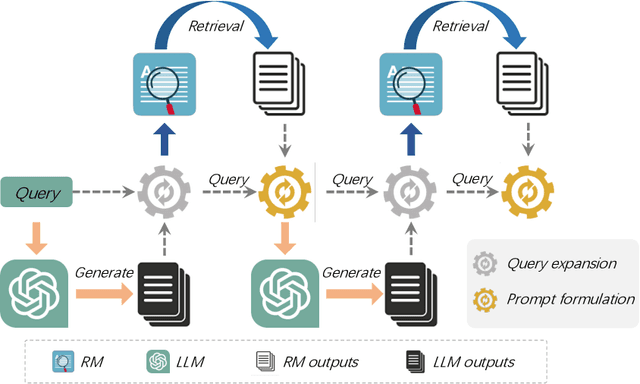


Information retrieval (IR) plays a crucial role in locating relevant resources from vast amounts of data, and its applications have evolved from traditional knowledge bases to modern search engines (SEs). The emergence of large language models (LLMs) has further revolutionized the IR field by enabling users to interact with search systems in natural language. In this paper, we explore the advantages and disadvantages of LLMs and SEs, highlighting their respective strengths in understanding user-issued queries and retrieving up-to-date information. To leverage the benefits of both paradigms while circumventing their limitations, we propose InteR, a novel framework that facilitates knowledge refinement through interaction between SEs and LLMs. InteR allows SEs to expand knowledge in queries using LLM-generated knowledge collections and enables LLMs to enhance prompt formulation using SE-retrieved documents. This iterative refinement process augments the inputs of SEs and LLMs, leading to more accurate retrieval. Experiments on large-scale retrieval benchmarks involving web search and low-resource retrieval tasks demonstrate that InteR achieves overall superior zero-shot retrieval performance compared to state-of-the-art methods, even those using relevance judgment. Source code is available at https://github.com/Cyril-JZ/InteR
Augmented Large Language Models with Parametric Knowledge Guiding
May 18, 2023Large Language Models (LLMs) have significantly advanced natural language processing (NLP) with their impressive language understanding and generation capabilities. However, their performance may be suboptimal for domain-specific tasks that require specialized knowledge due to limited exposure to the related data. Additionally, the lack of transparency of most state-of-the-art (SOTA) LLMs, which can only be accessed via APIs, impedes further fine-tuning with domain custom data. Moreover, providing private data to the LLMs' owner leads to data privacy problems. To address these challenges, we propose the novel Parametric Knowledge Guiding (PKG) framework, which equips LLMs with a knowledge-guiding module to access relevant knowledge without altering the LLMs' parameters. Our PKG is based on open-source "white-box" language models, allowing offline memory of any knowledge that LLMs require. We demonstrate that our PKG framework can enhance the performance of "black-box" LLMs on a range of domain knowledge-intensive tasks that require factual (+7.9%), tabular (+11.9%), medical (+3.0%), and multimodal (+8.1%) knowledge.