 Add to Chrome
 Add to Firefox
 Add to Edge
Effective Large Language Model Debugging with Best-first Tree Search
Jul 26, 2024
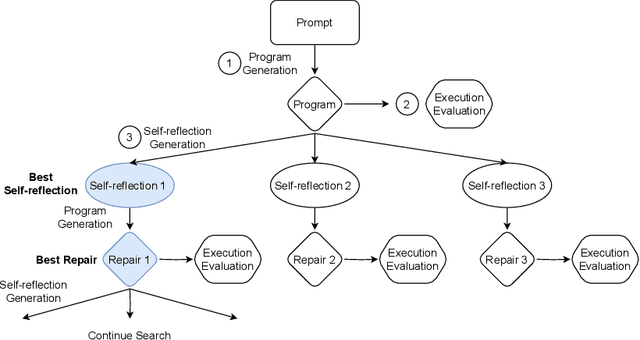
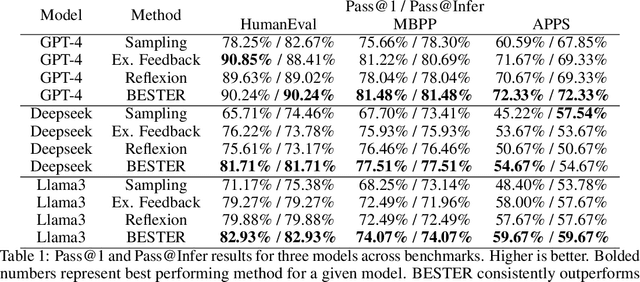
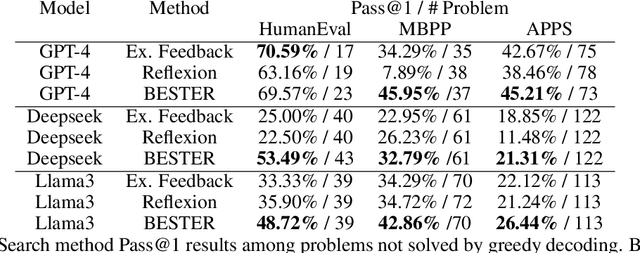
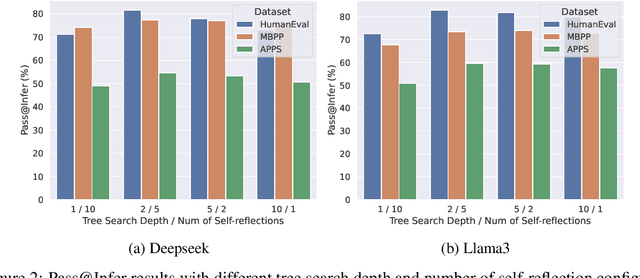
Large Language Models (LLMs) show promise in code generation tasks. However, their code-writing abilities are often limited in scope: while they can successfully implement simple functions, they struggle with more complex tasks. A fundamental difference with how an LLM writes code, compared to a human programmer, is that it cannot consistently spot and fix bugs. Debugging is a crucial skill for programmers and it enables iterative code refinement towards a correct implementation. In this work, we propose a novel algorithm to enable LLMs to debug their code via self-reflection and search where a model attempts to identify its previous mistakes. Our key contributions are 1) a best-first tree search algorithm with self-reflections (BESTER) that achieves state-of-the-art Pass@1 in three code generation benchmarks. BESTER maintains its superiority when we measure pass rates taking into account additional inference costs incurred by tree search. 2) A novel interpretability study on what self-reflections attend to in buggy programs and how they impact bug fixes, which provides a deeper understanding of the debugging process. 3) An extensive study on when self-reflections are effective in finding bugs.

Compact Language Models via Pruning and Knowledge Distillation
Jul 19, 2024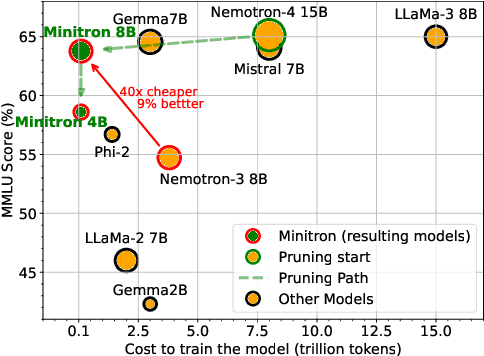
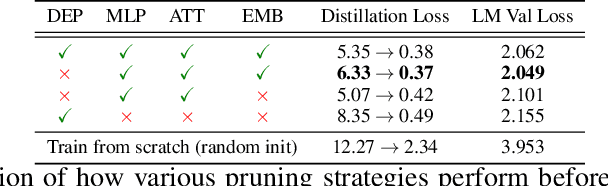
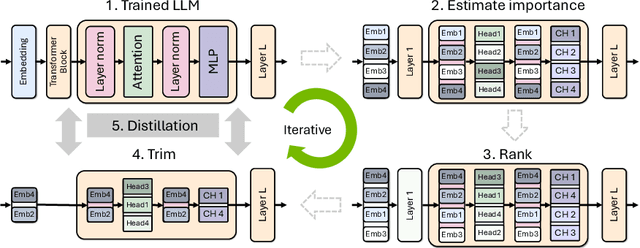
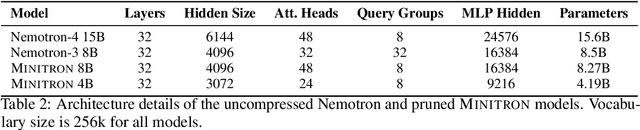
Large language models (LLMs) targeting different deployment scales and sizes are currently produced by training each variant from scratch; this is extremely compute-intensive. In this paper, we investigate if pruning an existing LLM and then re-training it with a fraction (<3%) of the original training data can be a suitable alternative to repeated, full retraining. To this end, we develop a set of practical and effective compression best practices for LLMs that combine depth, width, attention and MLP pruning with knowledge distillation-based retraining; we arrive at these best practices through a detailed empirical exploration of pruning strategies for each axis, methods to combine axes, distillation strategies, and search techniques for arriving at optimal compressed architectures. We use this guide to compress the Nemotron-4 family of LLMs by a factor of 2-4x, and compare their performance to similarly-sized models on a variety of language modeling tasks. Deriving 8B and 4B models from an already pretrained 15B model using our approach requires up to 40x fewer training tokens per model compared to training from scratch; this results in compute cost savings of 1.8x for training the full model family (15B, 8B, and 4B). Minitron models exhibit up to a 16% improvement in MMLU scores compared to training from scratch, perform comparably to other community models such as Mistral 7B, Gemma 7B and Llama-3 8B, and outperform state-of-the-art compression techniques from the literature. We have open-sourced Minitron model weights on Huggingface, with corresponding supplementary material including example code available on GitHub.
ChatQA 2: Bridging the Gap to Proprietary LLMs in Long Context and RAG Capabilities
Jul 19, 2024

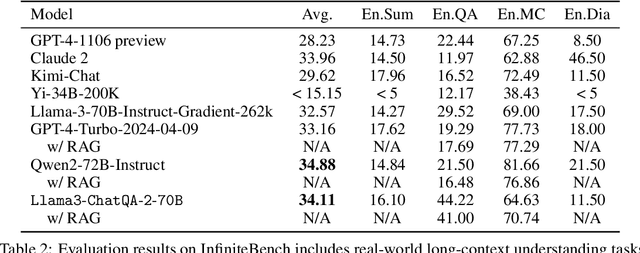

In this work, we introduce ChatQA 2, a Llama3-based model designed to bridge the gap between open-access LLMs and leading proprietary models (e.g., GPT-4-Turbo) in long-context understanding and retrieval-augmented generation (RAG) capabilities. These two capabilities are essential for LLMs to process large volumes of information that cannot fit into a single prompt and are complementary to each other, depending on the downstream tasks and computational budgets. We present a detailed continued training recipe to extend the context window of Llama3-70B-base from 8K to 128K tokens, along with a three-stage instruction tuning process to enhance the model's instruction-following, RAG performance, and long-context understanding capabilities. Our results demonstrate that the Llama3-ChatQA-2-70B model achieves accuracy comparable to GPT-4-Turbo-2024-0409 on many long-context understanding tasks and surpasses it on the RAG benchmark. Interestingly, we find that the state-of-the-art long-context retriever can alleviate the top-k context fragmentation issue in RAG, further improving RAG-based results for long-context understanding tasks. We also provide extensive comparisons between RAG and long-context solutions using state-of-the-art long-context LLMs.
Reuse, Don't Retrain: A Recipe for Continued Pretraining of Language Models
Jul 09, 2024As language models have scaled both their number of parameters and pretraining dataset sizes, the computational cost for pretraining has become intractable except for the most well-resourced teams. This increasing cost makes it ever more important to be able to reuse a model after it has completed pretraining; allowing for a model's abilities to further improve without needing to train from scratch. In this work, we detail a set of guidelines that cover how to design efficacious data distributions and learning rate schedules for continued pretraining of language models. When applying these findings within a continued pretraining run on top of a well-trained 15B parameter model, we show an improvement of 9\% in average model accuracy compared to the baseline of continued training on the pretraining set. The resulting recipe provides a practical starting point with which to begin developing language models through reuse rather than retraining.
Data, Data Everywhere: A Guide for Pretraining Dataset Construction
Jul 08, 2024The impressive capabilities of recent language models can be largely attributed to the multi-trillion token pretraining datasets that they are trained on. However, model developers fail to disclose their construction methodology which has lead to a lack of open information on how to develop effective pretraining sets. To address this issue, we perform the first systematic study across the entire pipeline of pretraining set construction. First, we run ablations on existing techniques for pretraining set development to identify which methods translate to the largest gains in model accuracy on downstream evaluations. Then, we categorize the most widely used data source, web crawl snapshots, across the attributes of toxicity, quality, type of speech, and domain. Finally, we show how such attribute information can be used to further refine and improve the quality of a pretraining set. These findings constitute an actionable set of steps that practitioners can use to develop high quality pretraining sets.
RankRAG: Unifying Context Ranking with Retrieval-Augmented Generation in LLMs
Jul 02, 2024


Large language models (LLMs) typically utilize the top-k contexts from a retriever in retrieval-augmented generation (RAG). In this work, we propose a novel instruction fine-tuning framework RankRAG, which instruction-tunes a single LLM for the dual purpose of context ranking and answer generation in RAG. In particular, the instruction-tuned LLMs work surprisingly well by adding a small fraction of ranking data into the training blend, and outperform existing expert ranking models, including the same LLM exclusively fine-tuned on a large amount of ranking data. For generation, we compare our model with many strong baselines, including GPT-4-0613, GPT-4-turbo-2024-0409, and ChatQA-1.5, an open-sourced model with the state-of-the-art performance on RAG benchmarks. Specifically, our Llama3-RankRAG significantly outperforms Llama3-ChatQA-1.5 and GPT-4 models on nine knowledge-intensive benchmarks. In addition, it also performs comparably to GPT-4 on five RAG benchmarks in the biomedical domain without instruction fine-tuning on biomedical data, demonstrating its superb capability for generalization to new domains.
Improving Text-To-Audio Models with Synthetic Captions
Jun 18, 2024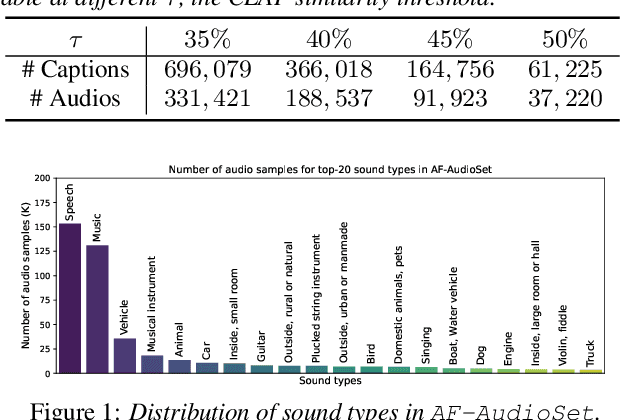
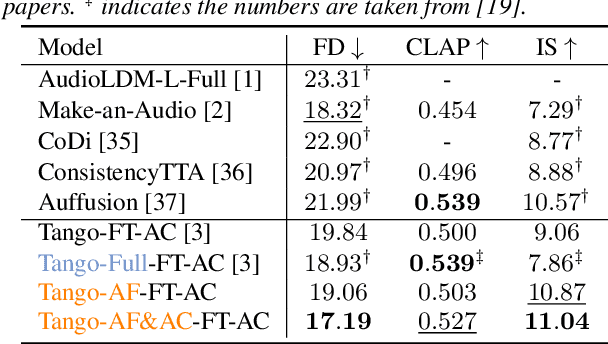

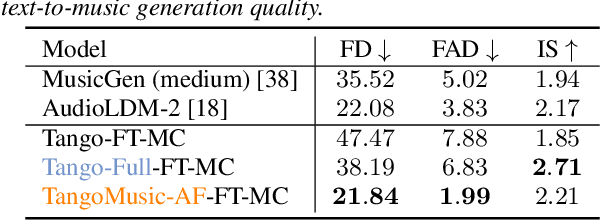
It is an open challenge to obtain high quality training data, especially captions, for text-to-audio models. Although prior methods have leveraged \textit{text-only language models} to augment and improve captions, such methods have limitations related to scale and coherence between audio and captions. In this work, we propose an audio captioning pipeline that uses an \textit{audio language model} to synthesize accurate and diverse captions for audio at scale. We leverage this pipeline to produce a dataset of synthetic captions for AudioSet, named \texttt{AF-AudioSet}, and then evaluate the benefit of pre-training text-to-audio models on these synthetic captions. Through systematic evaluations on AudioCaps and MusicCaps, we find leveraging our pipeline and synthetic captions leads to significant improvements on audio generation quality, achieving a new \textit{state-of-the-art}.
Nemotron-4 340B Technical Report
Jun 17, 2024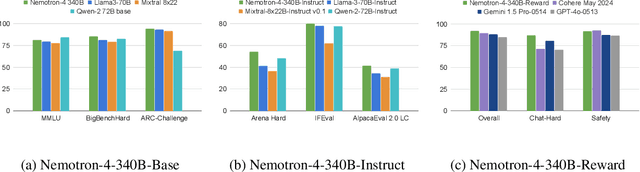

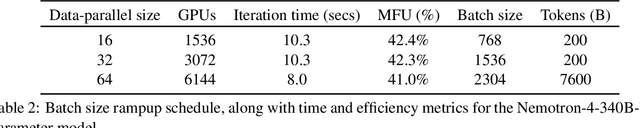
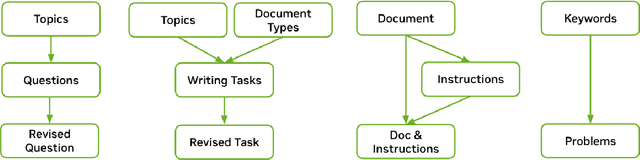
We release the Nemotron-4 340B model family, including Nemotron-4-340B-Base, Nemotron-4-340B-Instruct, and Nemotron-4-340B-Reward. Our models are open access under the NVIDIA Open Model License Agreement, a permissive model license that allows distribution, modification, and use of the models and its outputs. These models perform competitively to open access models on a wide range of evaluation benchmarks, and were sized to fit on a single DGX H100 with 8 GPUs when deployed in FP8 precision. We believe that the community can benefit from these models in various research studies and commercial applications, especially for generating synthetic data to train smaller language models. Notably, over 98% of data used in our model alignment process is synthetically generated, showcasing the effectiveness of these models in generating synthetic data. To further support open research and facilitate model development, we are also open-sourcing the synthetic data generation pipeline used in our model alignment process.
CircuitVAE: Efficient and Scalable Latent Circuit Optimization
Jun 13, 2024
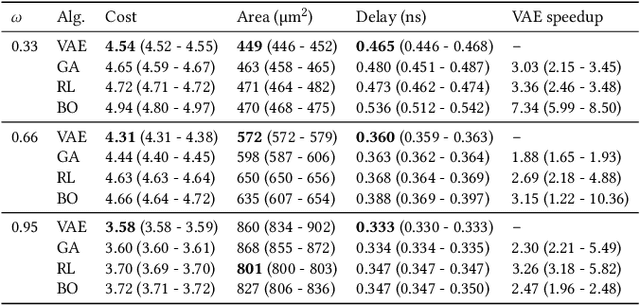
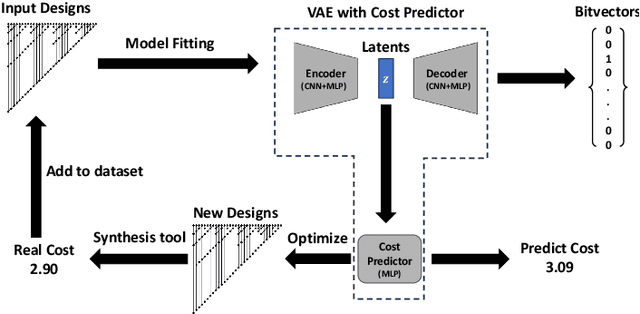
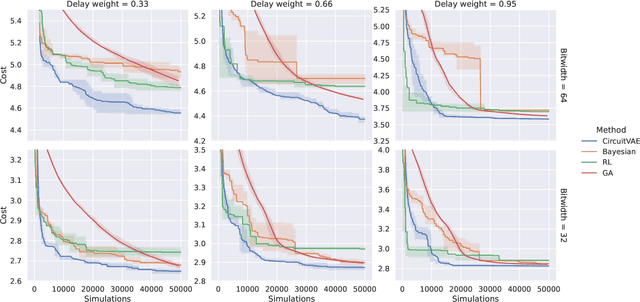
Automatically designing fast and space-efficient digital circuits is challenging because circuits are discrete, must exactly implement the desired logic, and are costly to simulate. We address these challenges with CircuitVAE, a search algorithm that embeds computation graphs in a continuous space and optimizes a learned surrogate of physical simulation by gradient descent. By carefully controlling overfitting of the simulation surrogate and ensuring diverse exploration, our algorithm is highly sample-efficient, yet gracefully scales to large problem instances and high sample budgets. We test CircuitVAE by designing binary adders across a large range of sizes, IO timing constraints, and sample budgets. Our method excels at designing large circuits, where other algorithms struggle: compared to reinforcement learning and genetic algorithms, CircuitVAE typically finds 64-bit adders which are smaller and faster using less than half the sample budget. We also find CircuitVAE can design state-of-the-art adders in a real-world chip, demonstrating that our method can outperform commercial tools in a realistic setting.
An Empirical Study of Mamba-based Language Models
Jun 12, 2024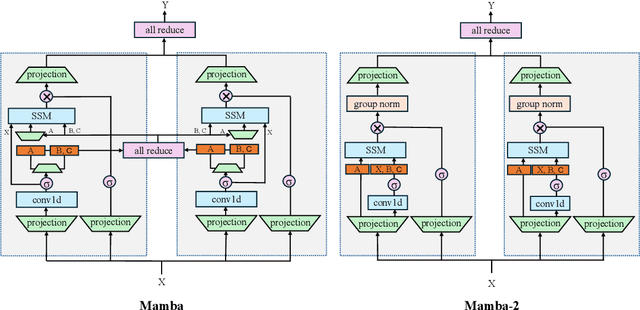


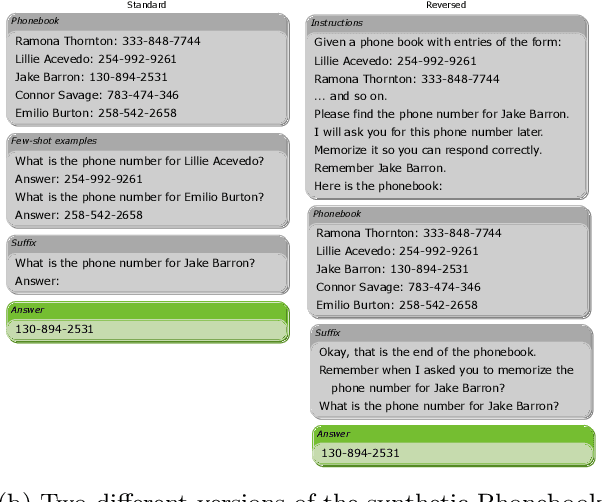
Selective state-space models (SSMs) like Mamba overcome some of the shortcomings of Transformers, such as quadratic computational complexity with sequence length and large inference-time memory requirements from the key-value cache. Moreover, recent studies have shown that SSMs can match or exceed the language modeling capabilities of Transformers, making them an attractive alternative. In a controlled setting (e.g., same data), however, studies so far have only presented small scale experiments comparing SSMs to Transformers. To understand the strengths and weaknesses of these architectures at larger scales, we present a direct comparison between 8B-parameter Mamba, Mamba-2, and Transformer models trained on the same datasets of up to 3.5T tokens. We also compare these models to a hybrid architecture consisting of 43% Mamba-2, 7% attention, and 50% MLP layers (Mamba-2-Hybrid). Using a diverse set of tasks, we answer the question of whether Mamba models can match Transformers at larger training budgets. Our results show that while pure SSMs match or exceed Transformers on many tasks, they lag behind Transformers on tasks which require strong copying or in-context learning abilities (e.g., 5-shot MMLU, Phonebook) or long-context reasoning. In contrast, we find that the 8B Mamba-2-Hybrid exceeds the 8B Transformer on all 12 standard tasks we evaluated (+2.65 points on average) and is predicted to be up to 8x faster when generating tokens at inference time. To validate long-context capabilities, we provide additional experiments evaluating variants of the Mamba-2-Hybrid and Transformer extended to support 16K, 32K, and 128K sequences. On an additional 23 long-context tasks, the hybrid model continues to closely match or exceed the Transformer on average. To enable further study, we release the checkpoints as well as the code used to train our models as part of NVIDIA's Megatron-LM project.