 Add to Chrome
 Add to Firefox
 Add to Edge
Illusion of Alignment: Detecting Hidden Disagreement in Collaborative Dialogue
Aug 08, 2026
Collaborative dialogue can end with apparent agreement while participants still differ on goals, assumptions, or execution plans, creating an \textbf{illusion of alignment (IoA)}. A real-user study across 18 meetings confirms that IoA arises routinely in human collaboration. Yet IoA poses a paradox: if participants were aware of such disagreements, they would already be explicit; if not, they cannot articulate them when asked, leaving IoA invisible to both participants and observers. In this work, we make IoA detectable by generating diagnostic multiple-choice questions whose divergent answers across participants provide direct behavioral evidence of hidden disagreement. We construct \textbf{IoA-Suite}, a dataset and evaluation protocol for detecting hidden disagreement, spanning five task types and six domains. We find that even the best model attains only 49.5\% F1, with the bottleneck traced to private context that the dialogue does not surface. We then train \textbf{IoA-Prober-8B} based on IoA-Suite, reaching 51.8\% F1 on IoA-Suite. Across the aforementioned 18 real meetings, it surfaces 2.89 hidden disagreements per meeting that participants confirm they had not voiced, transferring to live human dialogue. Further, in multi-agent collaboration, pairing IoA-Prober-8B with LLM agents improves downstream task performance on BigCodeBench-Hard and HiddenBench.

TheraAgent: Self-Improving Therapeutic Agent for Precise and Comprehensive Treatment Planning
May 07, 2026Formulating a treatment plan is inherently a complex reasoning and refinement task rather than a simple generation problem. However, existing large language models (LLMs) mainly rely on one-shot output without explicit verification, which may result in rough, incomplete, and potentially unsafe treatment plans. To address these limitations, we propose TheraAgent, an agentic framework that replaces one-shot generation with an iterative generate-judge-refine pipeline. By mirroring the actual reasoning process of human experts who iteratively revise treatment plans, our framework progressively transforms coarse and incomplete drafts into precise, comprehensive, and safer therapeutic regimens. To facilitate the critical judge component, we introduce TheraJudge, a treatment-specific evaluation module integrated into the inference loop to enforce clinical standards. Experiments show TheraAgent achieves state-of-the-art results on HealthBench, leading in Accuracy and Completeness. In expert evaluations, it attains an 86% win rate against physicians, with superior Targeting and Harm Control. Moreover, the highly agreement between TheraJudge and HealthBench evaluations confirms the reliability of our framework.
Beyond Words: Evaluating and Bridging Epistemic Divergence in User-Agent Interaction via Theory of Mind
Feb 14, 2026Large Language Models (LLMs) have developed rapidly and are widely applied to both general-purpose and professional tasks to assist human users. However, they still struggle to comprehend and respond to the true user needs when intentions and instructions are imprecisely conveyed, leading to a divergence between subjective user believes and true environment states. Resolving this epistemic divergence requires Theory of Mind (ToM), yet existing ToM evaluations for LLMs primarily focus on isolated belief inference, overlooking its functional utility in real-world interaction. To this end, we formalize ToM for LLMs as a mechanism for epistemic divergence detection and resolution, and propose a benchmark, \benchname, to assess how models reconcile user beliefs and profiles in practice. Results across 11 leading models reveal a significant limitation to identify underlying cognitive gaps that impede task success. To bridge this gap, we further curate a trajectory-based ToM dataset linking belief tracking with task-related state inference. The model trained on this data via reinforcement learning shows consistent improvement in reasoning about user mental states, leading to enhanced downstream performance. Our work highlights the practical value of ToM as an essential interaction-level mechanism rather than as a standalone reasoning skill.
Doctor-R1: Mastering Clinical Inquiry with Experiential Agentic Reinforcement Learning
Oct 05, 2025The professionalism of a human doctor in outpatient service depends on two core abilities: the ability to make accurate medical decisions and the medical consultation skill to conduct strategic, empathetic patient inquiry. Existing Large Language Models (LLMs) have achieved remarkable accuracy on medical decision-making benchmarks. However, they often lack the ability to conduct the strategic and empathetic consultation, which is essential for real-world clinical scenarios. To address this gap, we propose Doctor-R1, an AI doctor agent trained to master both of the capabilities by ask high-yield questions and conduct strategic multi-turn inquiry to guide decision-making. Our framework introduces three key components: a multi-agent interactive environment, a two-tiered reward architecture that separately optimizes clinical decision-making and communicative inquiry skills, and an experience repository to ground policy learning in high-quality prior trajectories. We evaluate Doctor-R1 on OpenAI's HealthBench and MAQuE, assessed across multi-facet metrics, such as communication quality, user experience, and task accuracy. Remarkably, Doctor-R1 surpasses state-of-the-art open-source specialized LLMs by a substantial margin with higher parameter efficiency and outperforms powerful proprietary models. Furthermore, the human evaluations show a strong preference for Doctor-R1 to generate human-preferred clinical dialogue, demonstrating the effectiveness of the framework.
Agent Hospital: A Simulacrum of Hospital with Evolvable Medical Agents
May 05, 2024
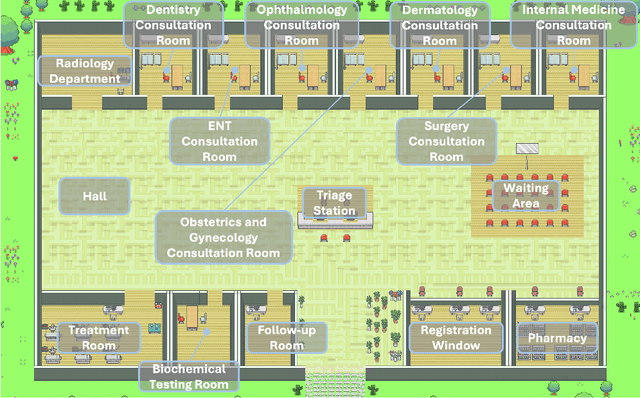
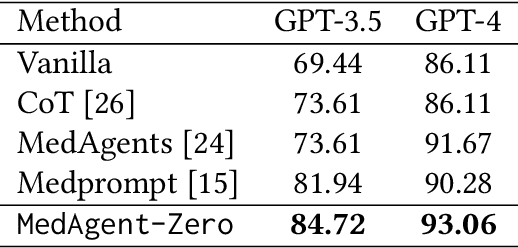
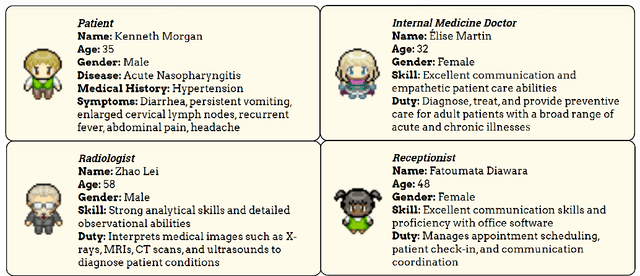
In this paper, we introduce a simulacrum of hospital called Agent Hospital that simulates the entire process of treating illness. All patients, nurses, and doctors are autonomous agents powered by large language models (LLMs). Our central goal is to enable a doctor agent to learn how to treat illness within the simulacrum. To do so, we propose a method called MedAgent-Zero. As the simulacrum can simulate disease onset and progression based on knowledge bases and LLMs, doctor agents can keep accumulating experience from both successful and unsuccessful cases. Simulation experiments show that the treatment performance of doctor agents consistently improves on various tasks. More interestingly, the knowledge the doctor agents have acquired in Agent Hospital is applicable to real-world medicare benchmarks. After treating around ten thousand patients (real-world doctors may take over two years), the evolved doctor agent achieves a state-of-the-art accuracy of 93.06% on a subset of the MedQA dataset that covers major respiratory diseases. This work paves the way for advancing the applications of LLM-powered agent techniques in medical scenarios.
ToMBench: Benchmarking Theory of Mind in Large Language Models
Feb 23, 2024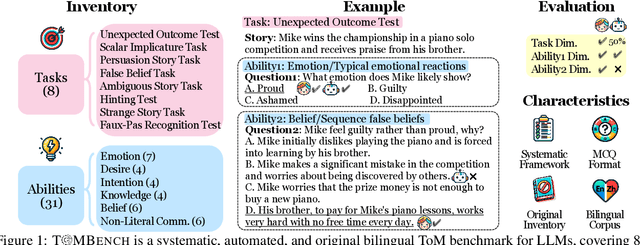
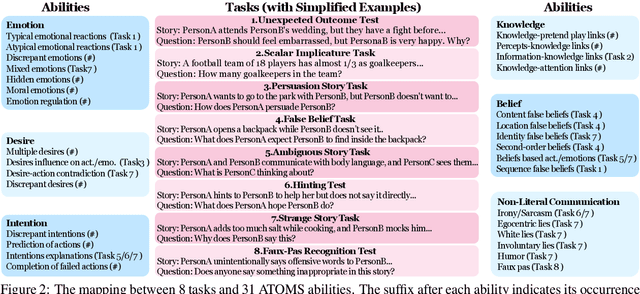
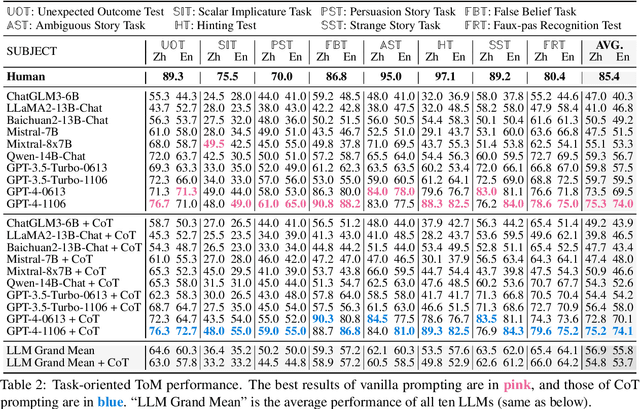
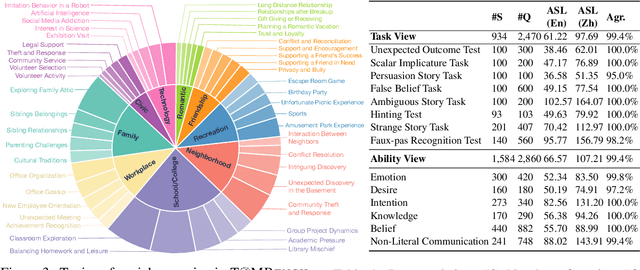
Theory of Mind (ToM) is the cognitive capability to perceive and ascribe mental states to oneself and others. Recent research has sparked a debate over whether large language models (LLMs) exhibit a form of ToM. However, existing ToM evaluations are hindered by challenges such as constrained scope, subjective judgment, and unintended contamination, yielding inadequate assessments. To address this gap, we introduce ToMBench with three key characteristics: a systematic evaluation framework encompassing 8 tasks and 31 abilities in social cognition, a multiple-choice question format to support automated and unbiased evaluation, and a build-from-scratch bilingual inventory to strictly avoid data leakage. Based on ToMBench, we conduct extensive experiments to evaluate the ToM performance of 10 popular LLMs across tasks and abilities. We find that even the most advanced LLMs like GPT-4 lag behind human performance by over 10% points, indicating that LLMs have not achieved a human-level theory of mind yet. Our aim with ToMBench is to enable an efficient and effective evaluation of LLMs' ToM capabilities, thereby facilitating the development of LLMs with inherent social intelligence.