 Add to Chrome
 Add to Firefox
 Add to Edge
More Than Sum of Its Parts: Deciphering Intent Shifts in Multimodal Hate Speech Detection
Mar 22, 2026
Combating hate speech on social media is critical for securing cyberspace, yet relies heavily on the efficacy of automated detection systems. As content formats evolve, hate speech is transitioning from solely plain text to complex multimodal expressions, making implicit attacks harder to spot. Current systems, however, often falter on these subtle cases, as they struggle with multimodal content where the emergent meaning transcends the aggregation of individual modalities. To bridge this gap, we move beyond binary classification to characterize semantic intent shifts where modalities interact to construct implicit hate from benign cues or neutralize toxicity through semantic inversion. Guided by this fine-grained formulation, we curate the Hate via Vision-Language Interplay (H-VLI) benchmark where the true intent hinges on the intricate interplay of modalities rather than overt visual or textual slurs. To effectively decipher these complex cues, we further propose the Asymmetric Reasoning via Courtroom Agent DEbate (ARCADE) framework. By simulating a judicial process where agents actively argue for accusation and defense, ARCADE forces the model to scrutinize deep semantic cues before reaching a verdict. Extensive experiments demonstrate that ARCADE significantly outperforms state-of-the-art baselines on H-VLI, particularly for challenging implicit cases, while maintaining competitive performance on established benchmarks. Our code and data are available at: https://github.com/Sayur1n/H-VLI

ToMBench: Benchmarking Theory of Mind in Large Language Models
Feb 23, 2024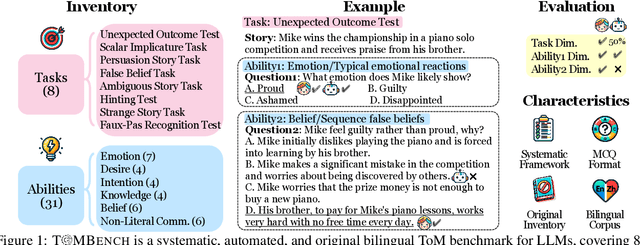
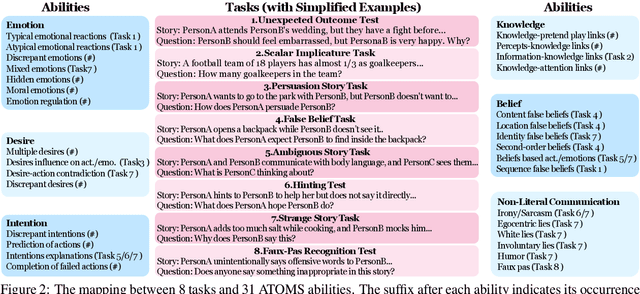
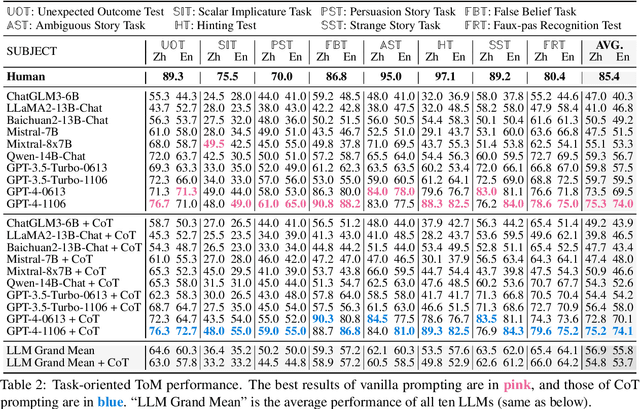
Theory of Mind (ToM) is the cognitive capability to perceive and ascribe mental states to oneself and others. Recent research has sparked a debate over whether large language models (LLMs) exhibit a form of ToM. However, existing ToM evaluations are hindered by challenges such as constrained scope, subjective judgment, and unintended contamination, yielding inadequate assessments. To address this gap, we introduce ToMBench with three key characteristics: a systematic evaluation framework encompassing 8 tasks and 31 abilities in social cognition, a multiple-choice question format to support automated and unbiased evaluation, and a build-from-scratch bilingual inventory to strictly avoid data leakage. Based on ToMBench, we conduct extensive experiments to evaluate the ToM performance of 10 popular LLMs across tasks and abilities. We find that even the most advanced LLMs like GPT-4 lag behind human performance by over 10% points, indicating that LLMs have not achieved a human-level theory of mind yet. Our aim with ToMBench is to enable an efficient and effective evaluation of LLMs' ToM capabilities, thereby facilitating the development of LLMs with inherent social intelligence.