 Add to Chrome
 Add to Firefox
 Add to Edge
DetailFusion: A Dual-branch Framework with Detail Enhancement for Composed Image Retrieval
May 23, 2025
Composed Image Retrieval (CIR) aims to retrieve target images from a gallery based on a reference image and modification text as a combined query. Recent approaches focus on balancing global information from two modalities and encode the query into a unified feature for retrieval. However, due to insufficient attention to fine-grained details, these coarse fusion methods often struggle with handling subtle visual alterations or intricate textual instructions. In this work, we propose DetailFusion, a novel dual-branch framework that effectively coordinates information across global and detailed granularities, thereby enabling detail-enhanced CIR. Our approach leverages atomic detail variation priors derived from an image editing dataset, supplemented by a detail-oriented optimization strategy to develop a Detail-oriented Inference Branch. Furthermore, we design an Adaptive Feature Compositor that dynamically fuses global and detailed features based on fine-grained information of each unique multimodal query. Extensive experiments and ablation analyses not only demonstrate that our method achieves state-of-the-art performance on both CIRR and FashionIQ datasets but also validate the effectiveness and cross-domain adaptability of detail enhancement for CIR.

Rethinking Agent Design: From Top-Down Workflows to Bottom-Up Skill Evolution
May 23, 2025Most LLM-based agent frameworks adopt a top-down philosophy: humans decompose tasks, define workflows, and assign agents to execute each step. While effective on benchmark-style tasks, such systems rely on designer updates and overlook agents' potential to learn from experience. Recently, Silver and Sutton(2025) envision a shift into a new era, where agents could progress from a stream of experiences. In this paper, we instantiate this vision of experience-driven learning by introducing a bottom-up agent paradigm that mirrors the human learning process. Agents acquire competence through a trial-and-reasoning mechanism-exploring, reflecting on outcomes, and abstracting skills over time. Once acquired, skills can be rapidly shared and extended, enabling continual evolution rather than static replication. As more agents are deployed, their diverse experiences accelerate this collective process, making bottom-up design especially suited for open-ended environments. We evaluate this paradigm in Slay the Spire and Civilization V, where agents perceive through raw visual inputs and act via mouse outputs, the same as human players. Using a unified, game-agnostic codebase without any game-specific prompts or privileged APIs, our bottom-up agents acquire skills entirely through autonomous interaction, demonstrating the potential of the bottom-up paradigm in complex, real-world environments. Our code is available at https://github.com/AngusDujw/Bottom-Up-Agent.
NTIRE 2025 challenge on Text to Image Generation Model Quality Assessment
May 22, 2025This paper reports on the NTIRE 2025 challenge on Text to Image (T2I) generation model quality assessment, which will be held in conjunction with the New Trends in Image Restoration and Enhancement Workshop (NTIRE) at CVPR 2025. The aim of this challenge is to address the fine-grained quality assessment of text-to-image generation models. This challenge evaluates text-to-image models from two aspects: image-text alignment and image structural distortion detection, and is divided into the alignment track and the structural track. The alignment track uses the EvalMuse-40K, which contains around 40K AI-Generated Images (AIGIs) generated by 20 popular generative models. The alignment track has a total of 371 registered participants. A total of 1,883 submissions are received in the development phase, and 507 submissions are received in the test phase. Finally, 12 participating teams submitted their models and fact sheets. The structure track uses the EvalMuse-Structure, which contains 10,000 AI-Generated Images (AIGIs) with corresponding structural distortion mask. A total of 211 participants have registered in the structure track. A total of 1155 submissions are received in the development phase, and 487 submissions are received in the test phase. Finally, 8 participating teams submitted their models and fact sheets. Almost all methods have achieved better results than baseline methods, and the winning methods in both tracks have demonstrated superior prediction performance on T2I model quality assessment.
Bronchovascular Tree-Guided Weakly Supervised Learning Method for Pulmonary Segment Segmentation
May 20, 2025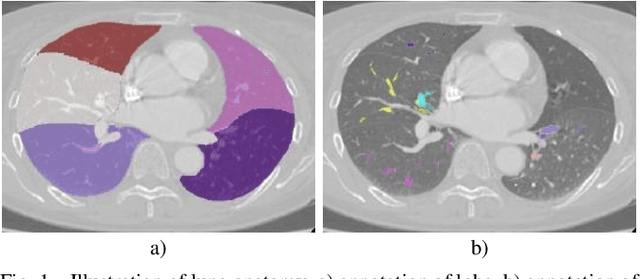
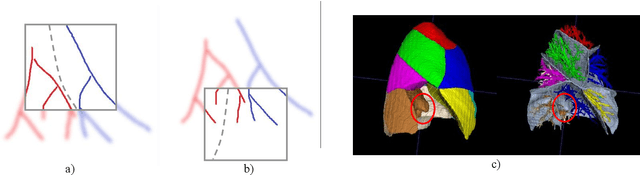
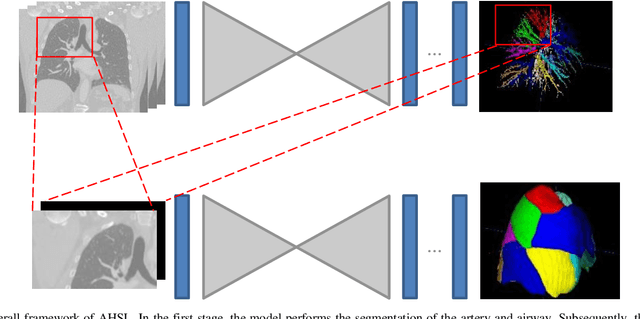
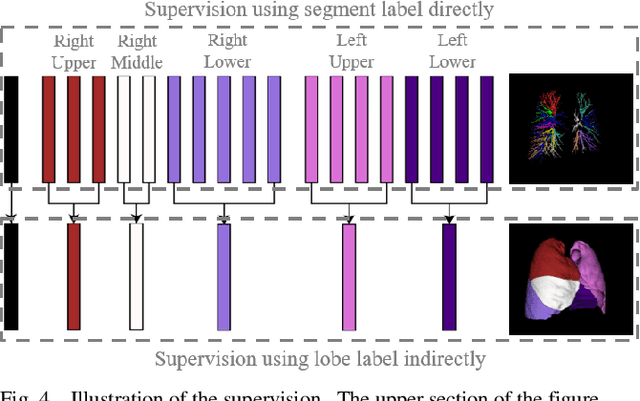
Pulmonary segment segmentation is crucial for cancer localization and surgical planning. However, the pixel-wise annotation of pulmonary segments is laborious, as the boundaries between segments are indistinguishable in medical images. To this end, we propose a weakly supervised learning (WSL) method, termed Anatomy-Hierarchy Supervised Learning (AHSL), which consults the precise clinical anatomical definition of pulmonary segments to perform pulmonary segment segmentation. Since pulmonary segments reside within the lobes and are determined by the bronchovascular tree, i.e., artery, airway and vein, the design of the loss function is founded on two principles. First, segment-level labels are utilized to directly supervise the output of the pulmonary segments, ensuring that they accurately encompass the appropriate bronchovascular tree. Second, lobe-level supervision indirectly oversees the pulmonary segment, ensuring their inclusion within the corresponding lobe. Besides, we introduce a two-stage segmentation strategy that incorporates bronchovascular priori information. Furthermore, a consistency loss is proposed to enhance the smoothness of segment boundaries, along with an evaluation metric designed to measure the smoothness of pulmonary segment boundaries. Visual inspection and evaluation metrics from experiments conducted on a private dataset demonstrate the effectiveness of our method.
Safety2Drive: Safety-Critical Scenario Benchmark for the Evaluation of Autonomous Driving
May 20, 2025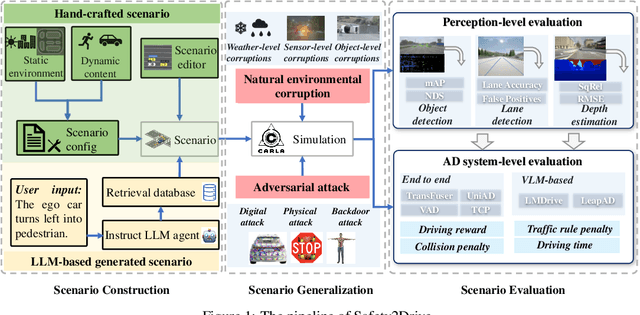

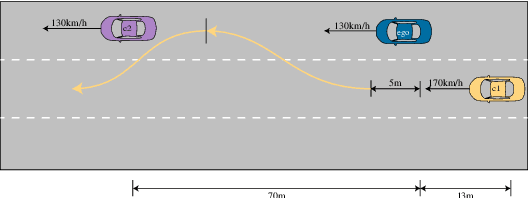
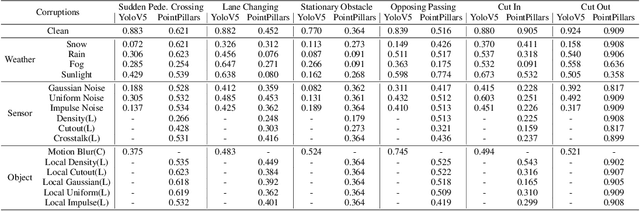
Autonomous Driving (AD) systems demand the high levels of safety assurance. Despite significant advancements in AD demonstrated on open-source benchmarks like Longest6 and Bench2Drive, existing datasets still lack regulatory-compliant scenario libraries for closed-loop testing to comprehensively evaluate the functional safety of AD. Meanwhile, real-world AD accidents are underrepresented in current driving datasets. This scarcity leads to inadequate evaluation of AD performance, posing risks to safety validation and practical deployment. To address these challenges, we propose Safety2Drive, a safety-critical scenario library designed to evaluate AD systems. Safety2Drive offers three key contributions. (1) Safety2Drive comprehensively covers the test items required by standard regulations and contains 70 AD function test items. (2) Safety2Drive supports the safety-critical scenario generalization. It has the ability to inject safety threats such as natural environment corruptions and adversarial attacks cross camera and LiDAR sensors. (3) Safety2Drive supports multi-dimensional evaluation. In addition to the evaluation of AD systems, it also supports the evaluation of various perception tasks, such as object detection and lane detection. Safety2Drive provides a paradigm from scenario construction to validation, establishing a standardized test framework for the safe deployment of AD.
Agent-as-a-Service based on Agent Network
May 13, 2025The rise of large model-based AI agents has spurred interest in Multi-Agent Systems (MAS) for their capabilities in decision-making, collaboration, and adaptability. While the Model Context Protocol (MCP) addresses tool invocation and data exchange challenges via a unified protocol, it lacks support for organizing agent-level collaboration. To bridge this gap, we propose Agent-as-a-Service based on Agent Network (AaaS-AN), a service-oriented paradigm grounded in the Role-Goal-Process-Service (RGPS) standard. AaaS-AN unifies the entire agent lifecycle, including construction, integration, interoperability, and networked collaboration, through two core components: (1) a dynamic Agent Network, which models agents and agent groups as vertexes that self-organize within the network based on task and role dependencies; (2) service-oriented agents, incorporating service discovery, registration, and interoperability protocols. These are orchestrated by a Service Scheduler, which leverages an Execution Graph to enable distributed coordination, context tracking, and runtime task management. We validate AaaS-AN on mathematical reasoning and application-level code generation tasks, which outperforms state-of-the-art baselines. Notably, we constructed a MAS based on AaaS-AN containing agent groups, Robotic Process Automation (RPA) workflows, and MCP servers over 100 agent services. We also release a dataset containing 10,000 long-horizon multi-agent workflows to facilitate future research on long-chain collaboration in MAS.
On relative universality, regression operator, and conditional independence
Apr 15, 2025The notion of relative universality with respect to a {\sigma}-field was introduced to establish the unbiasedness and Fisher consistency of an estimator in nonlinear sufficient dimension reduction. However, there is a gap in the proof of this result in the existing literature. The existing definition of relative universality seems to be too strong for the proof to be valid. In this note we modify the definition of relative universality using the concept of \k{o}-measurability, and rigorously establish the mentioned unbiasedness and Fisher consistency. The significance of this result is beyond its original context of sufficient dimension reduction, because relative universality allows us to use the regression operator to fully characterize conditional independence, a crucially important statistical relation that sits at the core of many areas and methodologies in statistics and machine learning, such as dimension reduction, graphical models, probability embedding, causal inference, and Bayesian estimation.
CLEAR-KGQA: Clarification-Enhanced Ambiguity Resolution for Knowledge Graph Question Answering
Apr 13, 2025This study addresses the challenge of ambiguity in knowledge graph question answering (KGQA). While recent KGQA systems have made significant progress, particularly with the integration of large language models (LLMs), they typically assume user queries are unambiguous, which is an assumption that rarely holds in real-world applications. To address these limitations, we propose a novel framework that dynamically handles both entity ambiguity (e.g., distinguishing between entities with similar names) and intent ambiguity (e.g., clarifying different interpretations of user queries) through interactive clarification. Our approach employs a Bayesian inference mechanism to quantify query ambiguity and guide LLMs in determining when and how to request clarification from users within a multi-turn dialogue framework. We further develop a two-agent interaction framework where an LLM-based user simulator enables iterative refinement of logical forms through simulated user feedback. Experimental results on the WebQSP and CWQ dataset demonstrate that our method significantly improves performance by effectively resolving semantic ambiguities. Additionally, we contribute a refined dataset of disambiguated queries, derived from interaction histories, to facilitate future research in this direction.
NuWa: Deriving Lightweight Task-Specific Vision Transformers for Edge Devices
Apr 04, 2025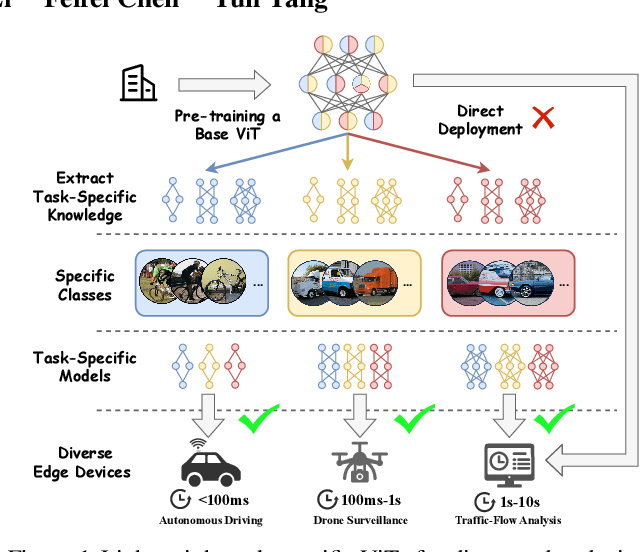
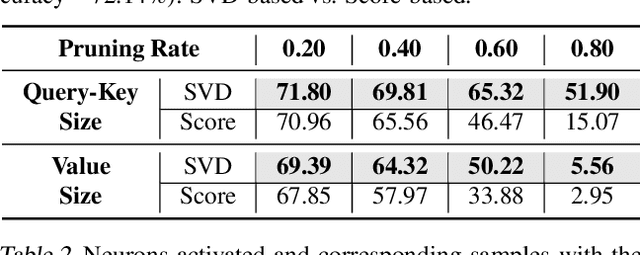
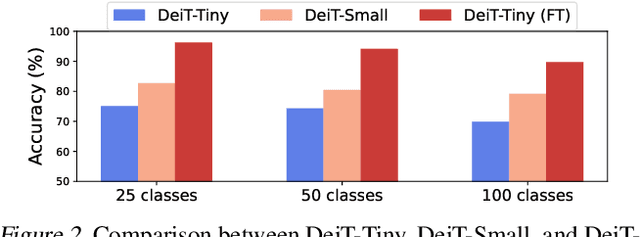
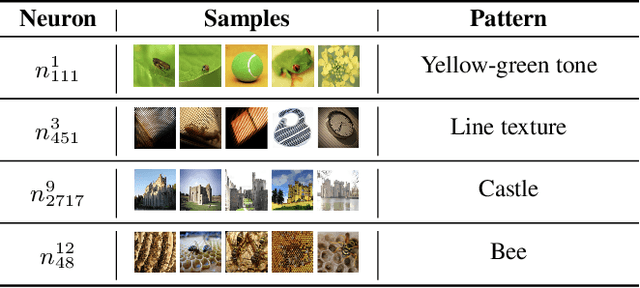
Vision Transformers (ViTs) excel in computer vision tasks but lack flexibility for edge devices' diverse needs. A vital issue is that ViTs pre-trained to cover a broad range of tasks are \textit{over-qualified} for edge devices that usually demand only part of a ViT's knowledge for specific tasks. Their task-specific accuracy on these edge devices is suboptimal. We discovered that small ViTs that focus on device-specific tasks can improve model accuracy and in the meantime, accelerate model inference. This paper presents NuWa, an approach that derives small ViTs from the base ViT for edge devices with specific task requirements. NuWa can transfer task-specific knowledge extracted from the base ViT into small ViTs that fully leverage constrained resources on edge devices to maximize model accuracy with inference latency assurance. Experiments with three base ViTs on three public datasets demonstrate that compared with state-of-the-art solutions, NuWa improves model accuracy by up to $\text{11.83}\%$ and accelerates model inference by 1.29$\times$ - 2.79$\times$. Code for reproduction is available at https://anonymous.4open.science/r/Task_Specific-3A5E.
Towards Benchmarking and Assessing the Safety and Robustness of Autonomous Driving on Safety-critical Scenarios
Mar 31, 2025Autonomous driving has made significant progress in both academia and industry, including performance improvements in perception task and the development of end-to-end autonomous driving systems. However, the safety and robustness assessment of autonomous driving has not received sufficient attention. Current evaluations of autonomous driving are typically conducted in natural driving scenarios. However, many accidents often occur in edge cases, also known as safety-critical scenarios. These safety-critical scenarios are difficult to collect, and there is currently no clear definition of what constitutes a safety-critical scenario. In this work, we explore the safety and robustness of autonomous driving in safety-critical scenarios. First, we provide a definition of safety-critical scenarios, including static traffic scenarios such as adversarial attack scenarios and natural distribution shifts, as well as dynamic traffic scenarios such as accident scenarios. Then, we develop an autonomous driving safety testing platform to comprehensively evaluate autonomous driving systems, encompassing not only the assessment of perception modules but also system-level evaluations. Our work systematically constructs a safety verification process for autonomous driving, providing technical support for the industry to establish standardized test framework and reduce risks in real-world road deployment.