 Add to Chrome
 Add to Firefox
 Add to Edge
ZeroPur: Succinct Training-Free Adversarial Purification
Jun 05, 2024
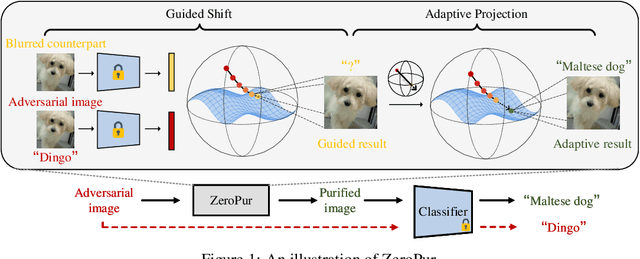
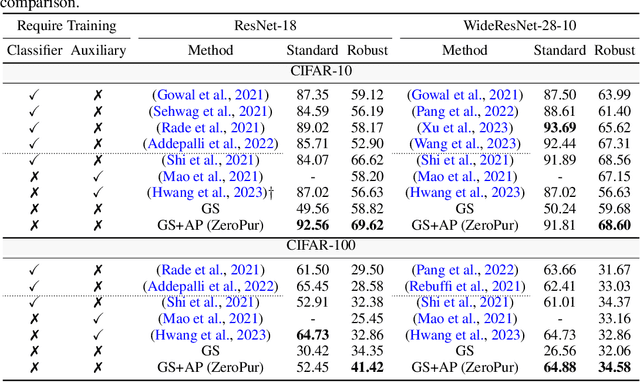
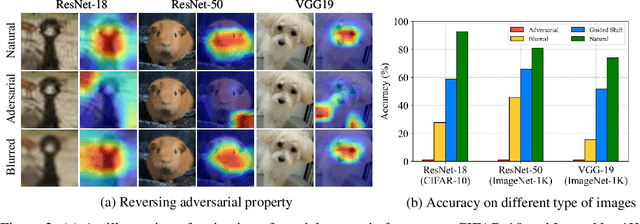

Adversarial purification is a kind of defense technique that can defend various unseen adversarial attacks without modifying the victim classifier. Existing methods often depend on external generative models or cooperation between auxiliary functions and victim classifiers. However, retraining generative models, auxiliary functions, or victim classifiers relies on the domain of the fine-tuned dataset and is computation-consuming. In this work, we suppose that adversarial images are outliers of the natural image manifold and the purification process can be considered as returning them to this manifold. Following this assumption, we present a simple adversarial purification method without further training to purify adversarial images, called ZeroPur. ZeroPur contains two steps: given an adversarial example, Guided Shift obtains the shifted embedding of the adversarial example by the guidance of its blurred counterparts; after that, Adaptive Projection constructs a directional vector by this shifted embedding to provide momentum, projecting adversarial images onto the manifold adaptively. ZeroPur is independent of external models and requires no retraining of victim classifiers or auxiliary functions, relying solely on victim classifiers themselves to achieve purification. Extensive experiments on three datasets (CIFAR-10, CIFAR-100, and ImageNet-1K) using various classifier architectures (ResNet, WideResNet) demonstrate that our method achieves state-of-the-art robust performance. The code will be publicly available.

Clover: Regressive Lightweight Speculative Decoding with Sequential Knowledge
May 01, 2024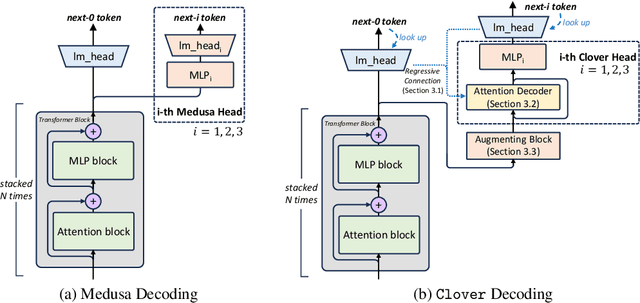
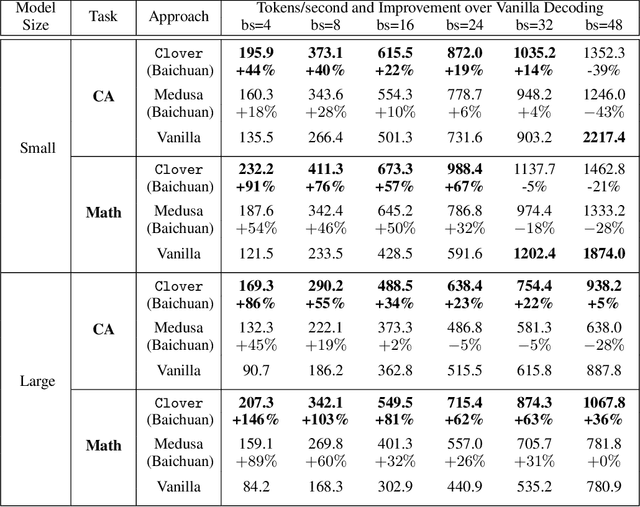
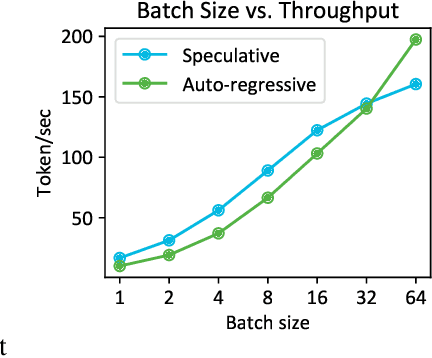
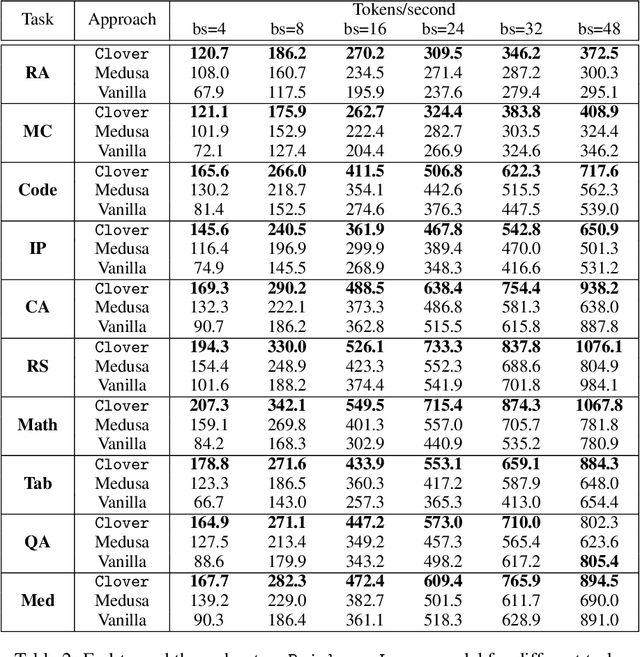
Large language models (LLMs) suffer from low efficiency as the mismatch between the requirement of auto-regressive decoding and the design of most contemporary GPUs. Specifically, billions to trillions of parameters must be loaded to the GPU cache through its limited memory bandwidth for computation, but only a small batch of tokens is actually computed. Consequently, the GPU spends most of its time on memory transfer instead of computation. Recently, parallel decoding, a type of speculative decoding algorithms, is becoming more popular and has demonstrated impressive efficiency improvement in generation. It introduces extra decoding heads to large models, enabling them to predict multiple subsequent tokens simultaneously and verify these candidate continuations in a single decoding step. However, this approach deviates from the training objective of next token prediction used during pre-training, resulting in a low hit rate for candidate tokens. In this paper, we propose a new speculative decoding algorithm, Clover, which integrates sequential knowledge into the parallel decoding process. This enhancement improves the hit rate of speculators and thus boosts the overall efficiency. Clover transmits the sequential knowledge from pre-speculated tokens via the Regressive Connection, then employs an Attention Decoder to integrate these speculated tokens. Additionally, Clover incorporates an Augmenting Block that modifies the hidden states to better align with the purpose of speculative generation rather than next token prediction. The experiment results demonstrate that Clover outperforms the baseline by up to 91% on Baichuan-Small and 146% on Baichuan-Large, respectively, and exceeds the performance of the previously top-performing method, Medusa, by up to 37% on Baichuan-Small and 57% on Baichuan-Large, respectively.
Efficient Modulation for Vision Networks
Mar 29, 2024In this work, we present efficient modulation, a novel design for efficient vision networks. We revisit the modulation mechanism, which operates input through convolutional context modeling and feature projection layers, and fuses features via element-wise multiplication and an MLP block. We demonstrate that the modulation mechanism is particularly well suited for efficient networks and further tailor the modulation design by proposing the efficient modulation (EfficientMod) block, which is considered the essential building block for our networks. Benefiting from the prominent representational ability of modulation mechanism and the proposed efficient design, our network can accomplish better trade-offs between accuracy and efficiency and set new state-of-the-art performance in the zoo of efficient networks. When integrating EfficientMod with the vanilla self-attention block, we obtain the hybrid architecture which further improves the performance without loss of efficiency. We carry out comprehensive experiments to verify EfficientMod's performance. With fewer parameters, our EfficientMod-s performs 0.6 top-1 accuracy better than EfficientFormerV2-s2 and is 25% faster on GPU, and 2.9 better than MobileViTv2-1.0 at the same GPU latency. Additionally, our method presents a notable improvement in downstream tasks, outperforming EfficientFormerV2-s by 3.6 mIoU on the ADE20K benchmark. Code and checkpoints are available at https://github.com/ma-xu/EfficientMod.
Real-Time Image Segmentation via Hybrid Convolutional-Transformer Architecture Search
Mar 15, 2024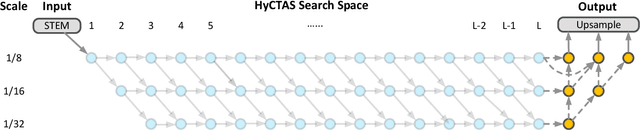
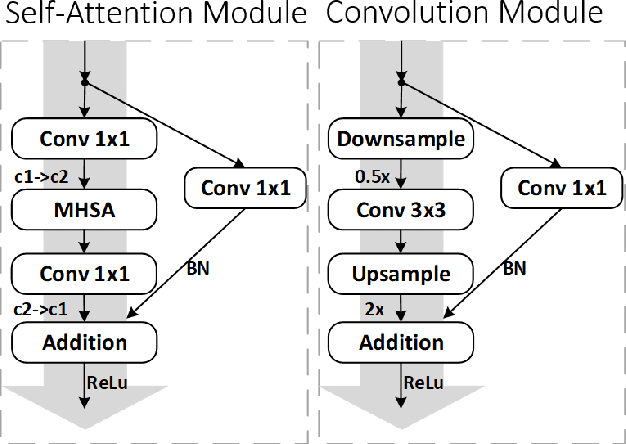
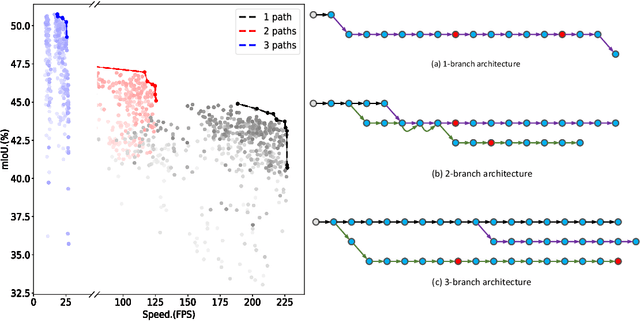
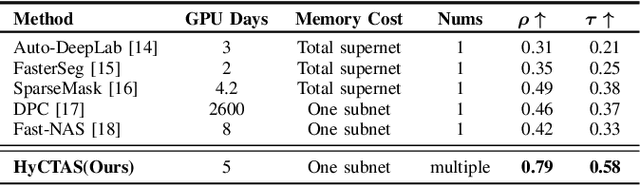
Image segmentation is one of the most fundamental problems in computer vision and has drawn a lot of attentions due to its vast applications in image understanding and autonomous driving. However, designing effective and efficient segmentation neural architectures is a labor-intensive process that may require lots of trials by human experts. In this paper, we address the challenge of integrating multi-head self-attention into high resolution representation CNNs efficiently, by leveraging architecture search. Manually replacing convolution layers with multi-head self-attention is non-trivial due to the costly overhead in memory to maintain high resolution. By contrast, we develop a multi-target multi-branch supernet method, which not only fully utilizes the advantages of high-resolution features, but also finds the proper location for placing multi-head self-attention module. Our search algorithm is optimized towards multiple objective s (e.g., latency and mIoU) and capable of finding architectures on Pareto frontier with arbitrary number of branches in a single search. We further present a series of model via Hybrid Convolutional-Transformer Architecture Search (HyCTAS) method that searched for the best hybrid combination of light-weight convolution layers and memory-efficient self-attention layers between branches from different resolutions and fuse to high resolution for both efficiency and effectiveness. Extensive experiments demonstrate that HyCTAS outperforms previous methods on semantic segmentation task. Code and models are available at \url{https://github.com/MarvinYu1995/HyCTAS}.
Rethinking Detection Based Table Structure Recognition for Visually Rich Documents
Dec 01, 2023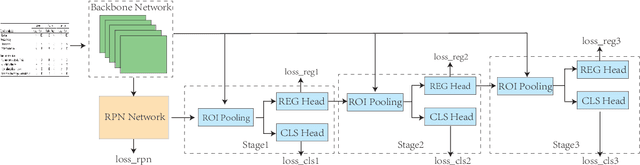
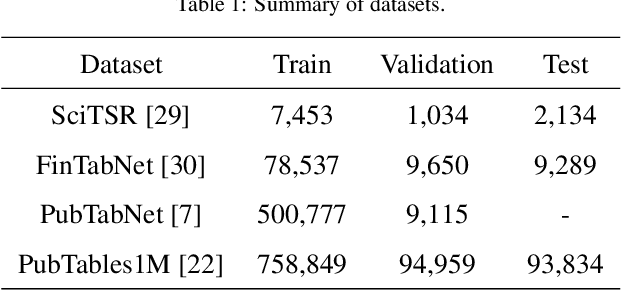
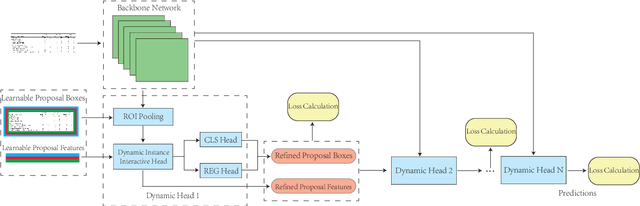

Table Structure Recognition (TSR) aims at transforming unstructured table images into structured formats, such as HTML sequences. One type of popular solution is using detection models to detect components of a table, such as columns and rows, then applying a rule-based post-processing method to convert detection results into HTML sequences. However, existing detection-based studies often have the following limitations. First, these studies usually pay more attention to improving the detection performance, which does not necessarily lead to better performance regarding cell-level metrics, such as TEDS. Second, some solutions over-simplify the problem and can miss some critical information. Lastly, even though some studies defined the problem to detect more components to provide as much information as other types of solutions, these studies ignore the fact this problem definition is a multi-label detection because row, projected row header and column header can share identical bounding boxes. Besides, there is often a performance gap between two-stage and transformer-based detection models regarding the structure-only TEDS, even though they have similar performance regarding the COCO metrics. Therefore, we revisit the limitations of existing detection-based solutions, compare two-stage and transformer-based detection models, and identify the key design aspects for the success of a two-stage detection model for the TSR task, including the multi-class problem definition, the aspect ratio for anchor box generation, and the feature generation of the backbone network. We applied simple methods to improve these aspects of the Cascade R-CNN model, achieved state-of-the-art performance, and improved the baseline Cascade R-CNN model by 19.32%, 11.56% and 14.77% regarding the structure-only TEDS on SciTSR, FinTabNet, and PubTables1M datasets.
Florence-2: Advancing a Unified Representation for a Variety of Vision Tasks
Nov 10, 2023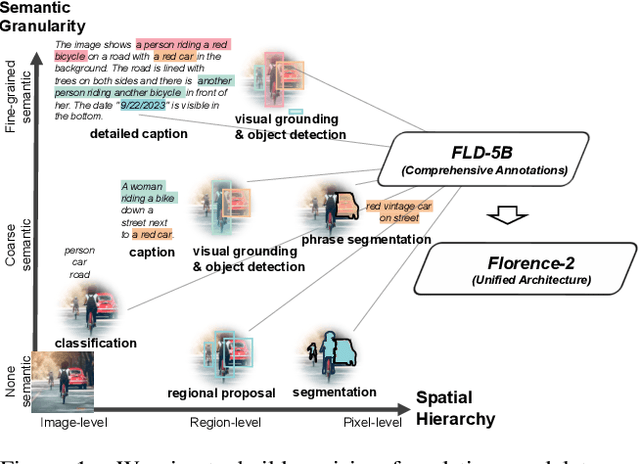
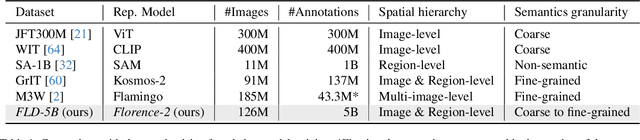
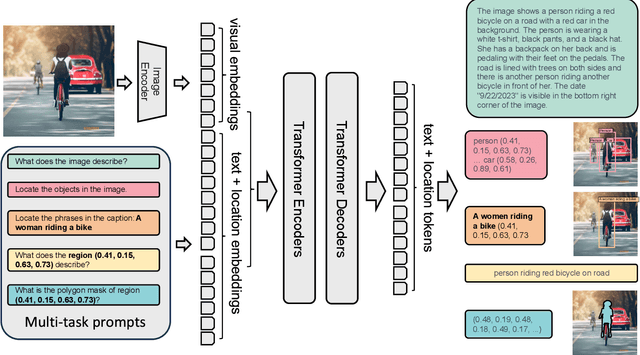
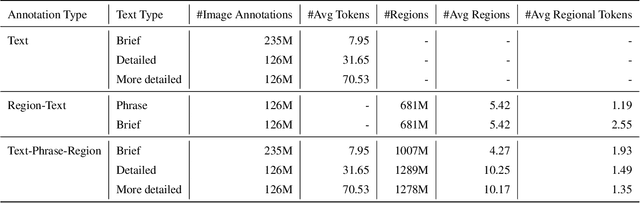
We introduce Florence-2, a novel vision foundation model with a unified, prompt-based representation for a variety of computer vision and vision-language tasks. While existing large vision models excel in transfer learning, they struggle to perform a diversity of tasks with simple instructions, a capability that implies handling the complexity of various spatial hierarchy and semantic granularity. Florence-2 was designed to take text-prompt as task instructions and generate desirable results in text forms, whether it be captioning, object detection, grounding or segmentation. This multi-task learning setup demands large-scale, high-quality annotated data. To this end, we co-developed FLD-5B that consists of 5.4 billion comprehensive visual annotations on 126 million images, using an iterative strategy of automated image annotation and model refinement. We adopted a sequence-to-sequence structure to train Florence-2 to perform versatile and comprehensive vision tasks. Extensive evaluations on numerous tasks demonstrated Florence-2 to be a strong vision foundation model contender with unprecedented zero-shot and fine-tuning capabilities.
Detecting Generated Images by Real Images Only
Nov 02, 2023
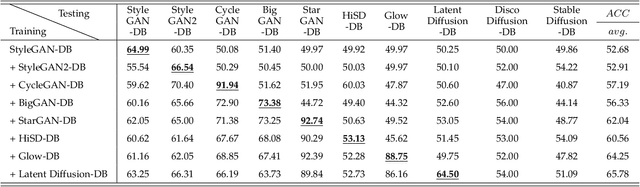
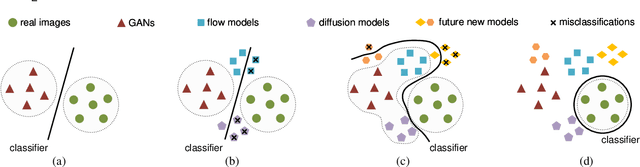
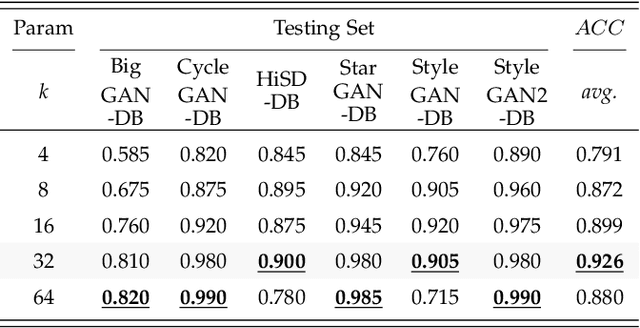
As deep learning technology continues to evolve, the images yielded by generative models are becoming more and more realistic, triggering people to question the authenticity of images. Existing generated image detection methods detect visual artifacts in generated images or learn discriminative features from both real and generated images by massive training. This learning paradigm will result in efficiency and generalization issues, making detection methods always lag behind generation methods. This paper approaches the generated image detection problem from a new perspective: Start from real images. By finding the commonality of real images and mapping them to a dense subspace in feature space, the goal is that generated images, regardless of their generative model, are then projected outside the subspace. As a result, images from different generative models can be detected, solving some long-existing problems in the field. Experimental results show that although our method was trained only by real images and uses 99.9\% less training data than other deep learning-based methods, it can compete with state-of-the-art methods and shows excellent performance in detecting emerging generative models with high inference efficiency. Moreover, the proposed method shows robustness against various post-processing. These advantages allow the method to be used in real-world scenarios.
A Survey of Robustness and Safety of 2D and 3D Deep Learning Models Against Adversarial Attacks
Oct 01, 2023Benefiting from the rapid development of deep learning, 2D and 3D computer vision applications are deployed in many safe-critical systems, such as autopilot and identity authentication. However, deep learning models are not trustworthy enough because of their limited robustness against adversarial attacks. The physically realizable adversarial attacks further pose fatal threats to the application and human safety. Lots of papers have emerged to investigate the robustness and safety of deep learning models against adversarial attacks. To lead to trustworthy AI, we first construct a general threat model from different perspectives and then comprehensively review the latest progress of both 2D and 3D adversarial attacks. We extend the concept of adversarial examples beyond imperceptive perturbations and collate over 170 papers to give an overview of deep learning model robustness against various adversarial attacks. To the best of our knowledge, we are the first to systematically investigate adversarial attacks for 3D models, a flourishing field applied to many real-world applications. In addition, we examine physical adversarial attacks that lead to safety violations. Last but not least, we summarize present popular topics, give insights on challenges, and shed light on future research on trustworthy AI.
TinyCLIP: CLIP Distillation via Affinity Mimicking and Weight Inheritance
Sep 21, 2023In this paper, we propose a novel cross-modal distillation method, called TinyCLIP, for large-scale language-image pre-trained models. The method introduces two core techniques: affinity mimicking and weight inheritance. Affinity mimicking explores the interaction between modalities during distillation, enabling student models to mimic teachers' behavior of learning cross-modal feature alignment in a visual-linguistic affinity space. Weight inheritance transmits the pre-trained weights from the teacher models to their student counterparts to improve distillation efficiency. Moreover, we extend the method into a multi-stage progressive distillation to mitigate the loss of informative weights during extreme compression. Comprehensive experiments demonstrate the efficacy of TinyCLIP, showing that it can reduce the size of the pre-trained CLIP ViT-B/32 by 50%, while maintaining comparable zero-shot performance. While aiming for comparable performance, distillation with weight inheritance can speed up the training by 1.4 - 7.8 $\times$ compared to training from scratch. Moreover, our TinyCLIP ViT-8M/16, trained on YFCC-15M, achieves an impressive zero-shot top-1 accuracy of 41.1% on ImageNet, surpassing the original CLIP ViT-B/16 by 3.5% while utilizing only 8.9% parameters. Finally, we demonstrate the good transferability of TinyCLIP in various downstream tasks. Code and models will be open-sourced at https://aka.ms/tinyclip.
Baichuan 2: Open Large-scale Language Models
Sep 20, 2023Large language models (LLMs) have demonstrated remarkable performance on a variety of natural language tasks based on just a few examples of natural language instructions, reducing the need for extensive feature engineering. However, most powerful LLMs are closed-source or limited in their capability for languages other than English. In this technical report, we present Baichuan 2, a series of large-scale multilingual language models containing 7 billion and 13 billion parameters, trained from scratch, on 2.6 trillion tokens. Baichuan 2 matches or outperforms other open-source models of similar size on public benchmarks like MMLU, CMMLU, GSM8K, and HumanEval. Furthermore, Baichuan 2 excels in vertical domains such as medicine and law. We will release all pre-training model checkpoints to benefit the research community in better understanding the training dynamics of Baichuan 2.