 Add to Chrome
 Add to Firefox
 Add to Edge
Zone of Proximal Policy Optimization: Teacher in Prompts, Not Gradients
Jun 16, 2026
Knowledge distillation transfers a teacher's competence to a small student but is brittle in the small-student regime: forcing the student to imitate logits from a much larger teacher concentrates it on the teacher's sharpest modes, hurting generalization on benchmark families beyond the training corpus. Reinforcement learning (RL) avoids logit imitation by training on the student's own rollouts. However, on questions where every rollout fails-yielding zero advantage and being silently discarded-injecting a stronger teacher's response into the policy gradient breaks the on-policy assumption and induces drift. We introduce Zone of Proximal Policy Optimization (ZPPO), inspired by Vygotsky's zone of proximal development, which keeps the teacher inside the prompt rather than the policy gradient. On hard questions, ZPPO constructs two reformulated prompts: a Binary Candidate-included Question (BCQ) pairs one correct teacher response with one incorrect student response as anonymized candidates the student must discriminate, and a Negative Candidate-included Question (NCQ) aggregates the student's wrong rollouts into a single prompt to surface their shared failure modes. A prompt replay buffer recirculates each hard question until it either graduates-the student's mean rollout accuracy on it reaches half- or is FIFO-evicted under finite capacity, amplifying BCQ and NCQ inside the student's current zone of proximal development. On the Qwen3.5 family at four student scales (0.8B-9B) with a 27B teacher, post-trained as vision-language models and evaluated on a 31-benchmark suite (16 VLM, 10 LLM, 5 Video), ZPPO outperforms off/on-policy distillation and GRPO, with the largest gains at the smallest scale.

ProCUA-SFT Technical Report
Jun 15, 2026Training computer-use agents (CUAs) -- models that interact with graphical desktops through screenshots and keyboard/mouse actions -- requires large-scale, diverse trajectory data collected in full desktop environments. The largest public resource, AgentNet (22.5K human trajectories), leads to negative transfer when used for supervised fine-tuning (SFT): continuing training UI-TARS 7B on AgentNet causes OSWorld success rate to fall from 26.3% to 8-10%. We present ProCUA-SFT, a dataset of 3.1M step-level SFT samples distilled from 93K synthetic trajectories across 2,484 application combinations. The dataset is produced by a fully automated pipeline that (i) synthesizes grounded tasks on live desktops seeded with real-world content -- 912 spreadsheets from SpreadsheetBench, approximately 10K permissively-licensed presentations from Zenodo10K, and multi-application OSWorld configs -- and (ii) verifies each task's feasibility through binary precondition checking before rollout. A single VLM (Kimi-K2.5) serves as goal generator, precondition judge, and trajectory executor, eliminating planner-actor capability gaps. Each trajectory is expanded into step-prefix samples that exactly reproduce the context layout seen at inference time. Fine-tuning UI-TARS 7B on ProCUA-SFT for one epoch yields 45.0% on OSWorld -- an 18.7 percentage-point improvement over the base model and over 35% above AgentNet-trained counterparts. A subset of ProCUA was incorporated into the training data for the Nemotron 3 Nano Omni model, contributing to its computer-use capabilities.
Nemotron 3 Nano Omni: Efficient and Open Multimodal Intelligence
Apr 27, 2026We introduce Nemotron 3 Nano Omni, the latest model in the Nemotron multimodal series and the first to natively support audio inputs alongside text, images, and video. Nemotron 3 Nano Omni delivers consistent accuracy improvements over its predecessor, Nemotron Nano V2 VL, across all modalities, enabled by advances in architecture, training data and recipes. In particular, Nemotron 3 delivers leading results in real-world document understanding, long audio-video comprehension, and agentic computer use. Built on the highly efficient Nemotron 3 Nano 30B-A3B backbone, Nemotron 3 Nano Omni further incorporates innovative multimodal token-reduction techniques to deliver substantially lower inference latency and higher throughput than other models of similar size. We are releasing model checkpoints in BF16, FP8, and FP4 formats, along with portions of the training data and codebase to facilitate further research and development.
MMOU: A Massive Multi-Task Omni Understanding and Reasoning Benchmark for Long and Complex Real-World Videos
Mar 14, 2026Multimodal Large Language Models (MLLMs) have shown strong performance in visual and audio understanding when evaluated in isolation. However, their ability to jointly reason over omni-modal (visual, audio, and textual) signals in long and complex videos remains largely unexplored. We introduce MMOU, a new benchmark designed to systematically evaluate multimodal understanding and reasoning under these challenging, real-world conditions. MMOU consists of 15,000 carefully curated questions paired with 9038 web-collected videos of varying length, spanning diverse domains and exhibiting rich, tightly coupled audio-visual content. The benchmark covers 13 fundamental skill categories, all of which require integrating evidence across modalities and time. All questions are manually annotated across multiple turns by professional annotators, ensuring high quality and reasoning fidelity. We evaluate 20+ state-of-the-art open-source and proprietary multimodal models on MMOU. The results expose substantial performance gaps: the best closed-source model achieves only 64.2% accuracy, while the strongest open-source model reaches just 46.8%. Our results highlight the challenges of long-form omni-modal understanding, revealing that current models frequently fail to apply even fundamental skills in long videos. Through detailed analysis, we further identify systematic failure modes and provide insights into where and why current models break.
Towards Multimodal Lifelong Understanding: A Dataset and Agentic Baseline
Mar 05, 2026While datasets for video understanding have scaled to hour-long durations, they typically consist of densely concatenated clips that differ from natural, unscripted daily life. To bridge this gap, we introduce MM-Lifelong, a dataset designed for Multimodal Lifelong Understanding. Comprising 181.1 hours of footage, it is structured across Day, Week, and Month scales to capture varying temporal densities. Extensive evaluations reveal two critical failure modes in current paradigms: end-to-end MLLMs suffer from a Working Memory Bottleneck due to context saturation, while representative agentic baselines experience Global Localization Collapse when navigating sparse, month-long timelines. To address this, we propose the Recursive Multimodal Agent (ReMA), which employs dynamic memory management to iteratively update a recursive belief state, significantly outperforming existing methods. Finally, we establish dataset splits designed to isolate temporal and domain biases, providing a rigorous foundation for future research in supervised learning and out-of-distribution generalization.
Stateful Token Reduction for Long-Video Hybrid VLMs
Feb 27, 2026Token reduction is an effective way to accelerate long-video vision-language models (VLMs), but most existing methods are designed for dense Transformers and do not directly account for hybrid architectures that interleave attention with linear-time state-space blocks (e.g., Mamba). We study query-conditioned token reduction for hybrid video VLMs and analyze reduction behavior through two properties: layerwise sparsity (how many tokens capture query-relevant information) and importance stability (whether token-importance rankings persist across depth). Although token importance is sparse within each layer, the set of important tokens changes across layers, so aggressive early pruning is unreliable. Motivated by this, we propose a low-to-high progressive reduction schedule and a unified language-aware scoring mechanism for both attention and Mamba blocks (using an implicit-attention proxy for Mamba), enabling all-layer token reduction in hybrids. Under an aggressive compression setting (retaining 25% of visual tokens), our approach delivers substantial prefilling speedups (3.8--4.2x) with near-baseline accuracy at test time, and light finetuning under reduction further improves performance on long-context video benchmarks.
NVIDIA Nemotron Nano V2 VL
Nov 07, 2025We introduce Nemotron Nano V2 VL, the latest model of the Nemotron vision-language series designed for strong real-world document understanding, long video comprehension, and reasoning tasks. Nemotron Nano V2 VL delivers significant improvements over our previous model, Llama-3.1-Nemotron-Nano-VL-8B, across all vision and text domains through major enhancements in model architecture, datasets, and training recipes. Nemotron Nano V2 VL builds on Nemotron Nano V2, a hybrid Mamba-Transformer LLM, and innovative token reduction techniques to achieve higher inference throughput in long document and video scenarios. We are releasing model checkpoints in BF16, FP8, and FP4 formats and sharing large parts of our datasets, recipes and training code.
Nemotron-H: A Family of Accurate and Efficient Hybrid Mamba-Transformer Models
Apr 10, 2025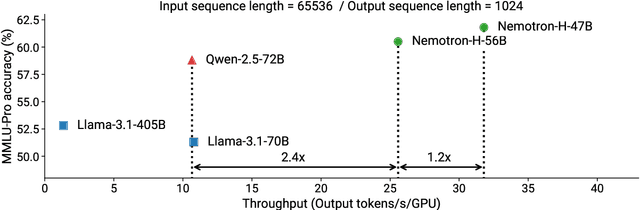

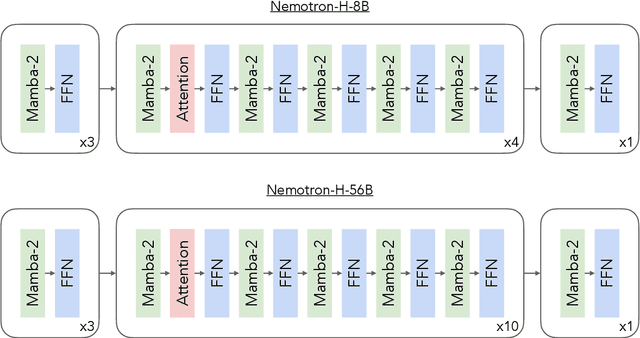
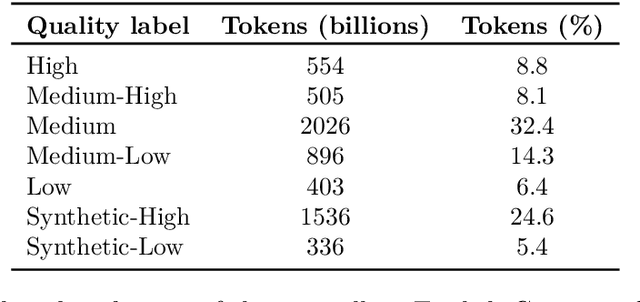
As inference-time scaling becomes critical for enhanced reasoning capabilities, it is increasingly becoming important to build models that are efficient to infer. We introduce Nemotron-H, a family of 8B and 56B/47B hybrid Mamba-Transformer models designed to reduce inference cost for a given accuracy level. To achieve this goal, we replace the majority of self-attention layers in the common Transformer model architecture with Mamba layers that perform constant computation and require constant memory per generated token. We show that Nemotron-H models offer either better or on-par accuracy compared to other similarly-sized state-of-the-art open-sourced Transformer models (e.g., Qwen-2.5-7B/72B and Llama-3.1-8B/70B), while being up to 3$\times$ faster at inference. To further increase inference speed and reduce the memory required at inference time, we created Nemotron-H-47B-Base from the 56B model using a new compression via pruning and distillation technique called MiniPuzzle. Nemotron-H-47B-Base achieves similar accuracy to the 56B model, but is 20% faster to infer. In addition, we introduce an FP8-based training recipe and show that it can achieve on par results with BF16-based training. This recipe is used to train the 56B model. All Nemotron-H models will be released, with support in Hugging Face, NeMo, and Megatron-LM.
AIDE: Agentically Improve Visual Language Model with Domain Experts
Feb 13, 2025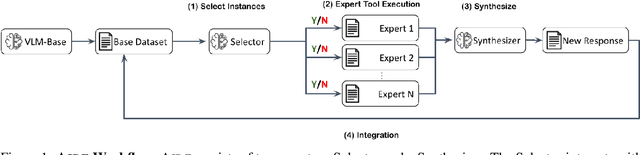
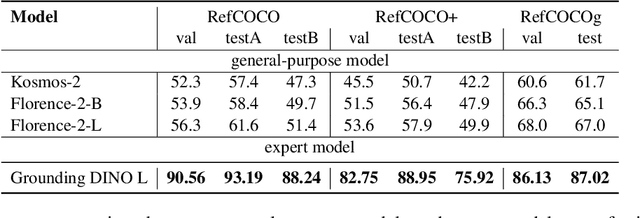

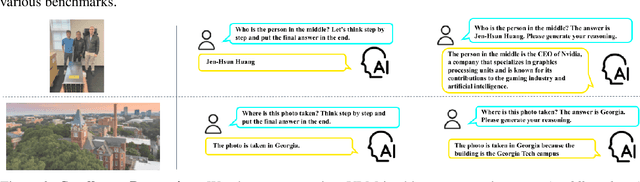
The enhancement of Visual Language Models (VLMs) has traditionally relied on knowledge distillation from larger, more capable models. This dependence creates a fundamental bottleneck for improving state-of-the-art systems, particularly when no superior models exist. We introduce AIDE (Agentic Improvement through Domain Experts), a novel framework that enables VLMs to autonomously enhance their capabilities by leveraging specialized domain expert models. AIDE operates through a four-stage process: (1) identifying instances for refinement, (2) engaging domain experts for targeted analysis, (3) synthesizing expert outputs with existing data, and (4) integrating enhanced instances into the training pipeline. Experiments on multiple benchmarks, including MMMU, MME, MMBench, etc., demonstrate AIDE's ability to achieve notable performance gains without relying on larger VLMs nor human supervision. Our framework provides a scalable, resource-efficient approach to continuous VLM improvement, addressing critical limitations in current methodologies, particularly valuable when larger models are unavailable to access.
Éclair -- Extracting Content and Layout with Integrated Reading Order for Documents
Feb 06, 2025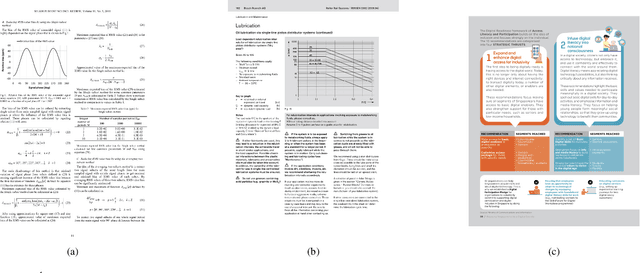

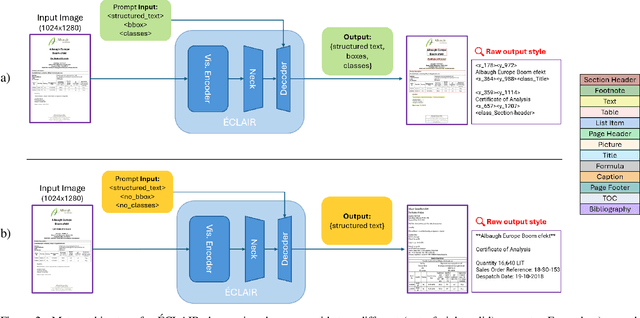

Optical Character Recognition (OCR) technology is widely used to extract text from images of documents, facilitating efficient digitization and data retrieval. However, merely extracting text is insufficient when dealing with complex documents. Fully comprehending such documents requires an understanding of their structure -- including formatting, formulas, tables, and the reading order of multiple blocks and columns across multiple pages -- as well as semantic information for detecting elements like footnotes and image captions. This comprehensive understanding is crucial for downstream tasks such as retrieval, document question answering, and data curation for training Large Language Models (LLMs) and Vision Language Models (VLMs). To address this, we introduce \'Eclair, a general-purpose text-extraction tool specifically designed to process a wide range of document types. Given an image, \'Eclair is able to extract formatted text in reading order, along with bounding boxes and their corresponding semantic classes. To thoroughly evaluate these novel capabilities, we introduce our diverse human-annotated benchmark for document-level OCR and semantic classification. \'Eclair achieves state-of-the-art accuracy on this benchmark, outperforming other methods across key metrics. Additionally, we evaluate \'Eclair on established benchmarks, demonstrating its versatility and strength across several evaluation standards.