 Add to Chrome
 Add to Firefox
 Add to Edge
Image Matting
Image matting is the process of extracting the foreground object from an image and creating a transparent background.
Papers and Code
ReFlow6D: Refraction-Guided Transparent Object 6D Pose Estimation via Intermediate Representation Learning
Dec 30, 2024
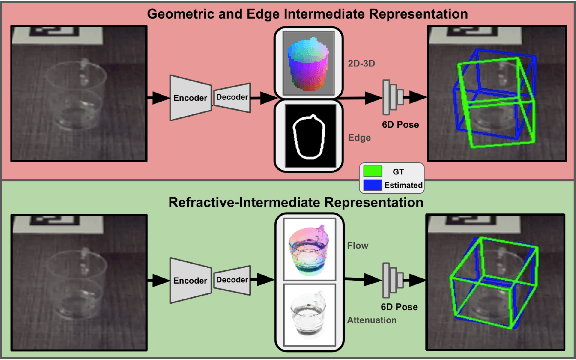
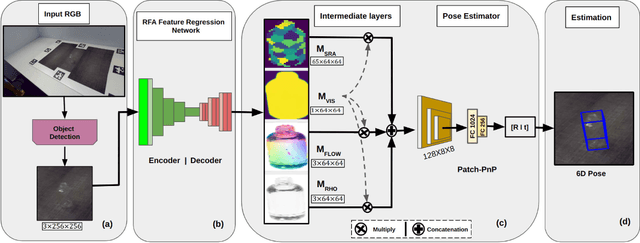
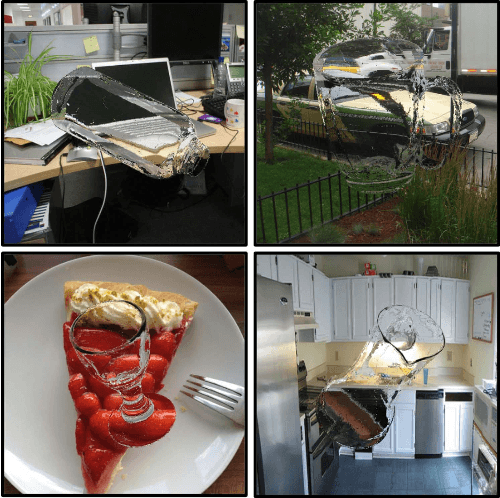
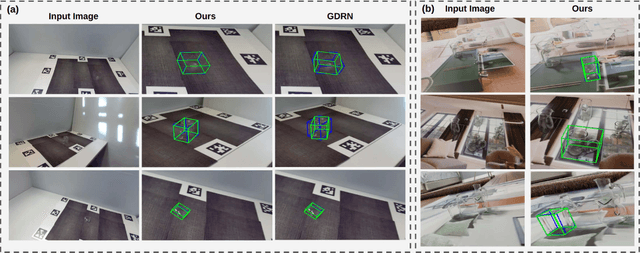
Transparent objects are ubiquitous in daily life, making their perception and robotics manipulation important. However, they present a major challenge due to their distinct refractive and reflective properties when it comes to accurately estimating the 6D pose. To solve this, we present ReFlow6D, a novel method for transparent object 6D pose estimation that harnesses the refractive-intermediate representation. Unlike conventional approaches, our method leverages a feature space impervious to changes in RGB image space and independent of depth information. Drawing inspiration from image matting, we model the deformation of the light path through transparent objects, yielding a unique object-specific intermediate representation guided by light refraction that is independent of the environment in which objects are observed. By integrating these intermediate features into the pose estimation network, we show that ReFlow6D achieves precise 6D pose estimation of transparent objects, using only RGB images as input. Our method further introduces a novel transparent object compositing loss, fostering the generation of superior refractive-intermediate features. Empirical evaluations show that our approach significantly outperforms state-of-the-art methods on TOD and Trans32K-6D datasets. Robot grasping experiments further demonstrate that ReFlow6D's pose estimation accuracy effectively translates to real-world robotics task. The source code is available at: https://github.com/StoicGilgamesh/ReFlow6D and https://github.com/StoicGilgamesh/matting_rendering.

ZIM: Zero-Shot Image Matting for Anything
Nov 01, 2024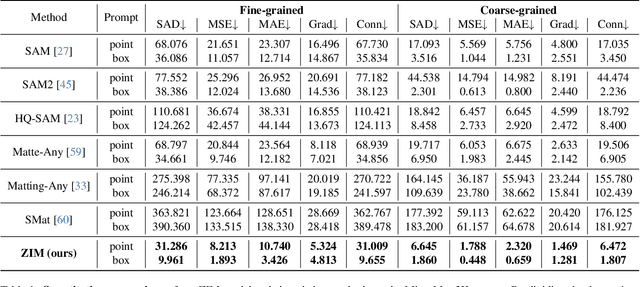
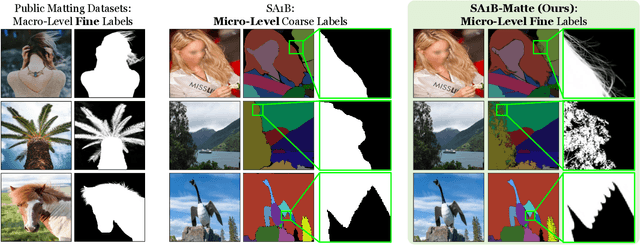
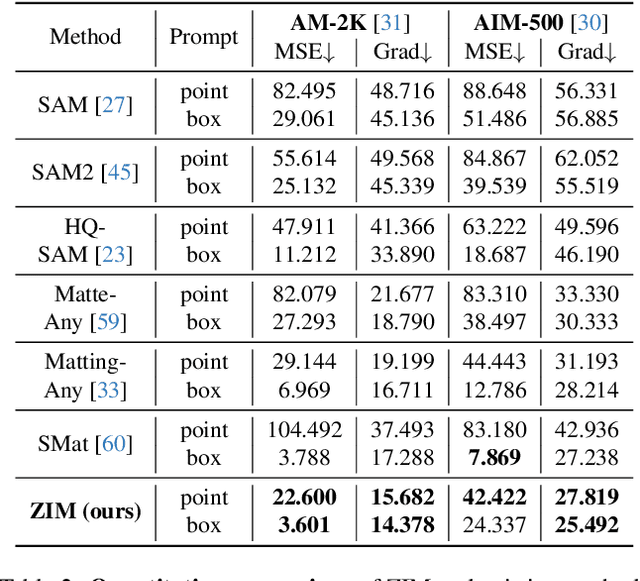
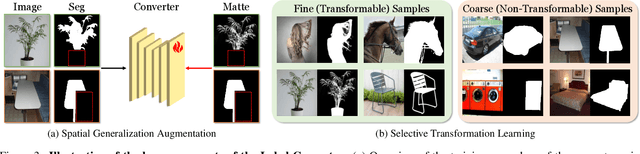
The recent segmentation foundation model, Segment Anything Model (SAM), exhibits strong zero-shot segmentation capabilities, but it falls short in generating fine-grained precise masks. To address this limitation, we propose a novel zero-shot image matting model, called ZIM, with two key contributions: First, we develop a label converter that transforms segmentation labels into detailed matte labels, constructing the new SA1B-Matte dataset without costly manual annotations. Training SAM with this dataset enables it to generate precise matte masks while maintaining its zero-shot capability. Second, we design the zero-shot matting model equipped with a hierarchical pixel decoder to enhance mask representation, along with a prompt-aware masked attention mechanism to improve performance by enabling the model to focus on regions specified by visual prompts. We evaluate ZIM using the newly introduced MicroMat-3K test set, which contains high-quality micro-level matte labels. Experimental results show that ZIM outperforms existing methods in fine-grained mask generation and zero-shot generalization. Furthermore, we demonstrate the versatility of ZIM in various downstream tasks requiring precise masks, such as image inpainting and 3D NeRF. Our contributions provide a robust foundation for advancing zero-shot matting and its downstream applications across a wide range of computer vision tasks. The code is available at \url{https://github.com/naver-ai/ZIM}.
Towards Natural Image Matting in the Wild via Real-Scenario Prior
Oct 09, 2024


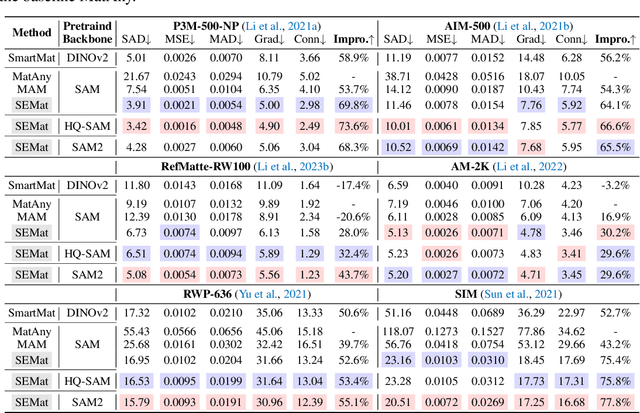
Recent approaches attempt to adapt powerful interactive segmentation models, such as SAM, to interactive matting and fine-tune the models based on synthetic matting datasets. However, models trained on synthetic data fail to generalize to complex and occlusion scenes. We address this challenge by proposing a new matting dataset based on the COCO dataset, namely COCO-Matting. Specifically, the construction of our COCO-Matting includes accessory fusion and mask-to-matte, which selects real-world complex images from COCO and converts semantic segmentation masks to matting labels. The built COCO-Matting comprises an extensive collection of 38,251 human instance-level alpha mattes in complex natural scenarios. Furthermore, existing SAM-based matting methods extract intermediate features and masks from a frozen SAM and only train a lightweight matting decoder by end-to-end matting losses, which do not fully exploit the potential of the pre-trained SAM. Thus, we propose SEMat which revamps the network architecture and training objectives. For network architecture, the proposed feature-aligned transformer learns to extract fine-grained edge and transparency features. The proposed matte-aligned decoder aims to segment matting-specific objects and convert coarse masks into high-precision mattes. For training objectives, the proposed regularization and trimap loss aim to retain the prior from the pre-trained model and push the matting logits extracted from the mask decoder to contain trimap-based semantic information. Extensive experiments across seven diverse datasets demonstrate the superior performance of our method, proving its efficacy in interactive natural image matting. We open-source our code, models, and dataset at https://github.com/XiaRho/SEMat.
MAT: Multi-Range Attention Transformer for Efficient Image Super-Resolution
Nov 26, 2024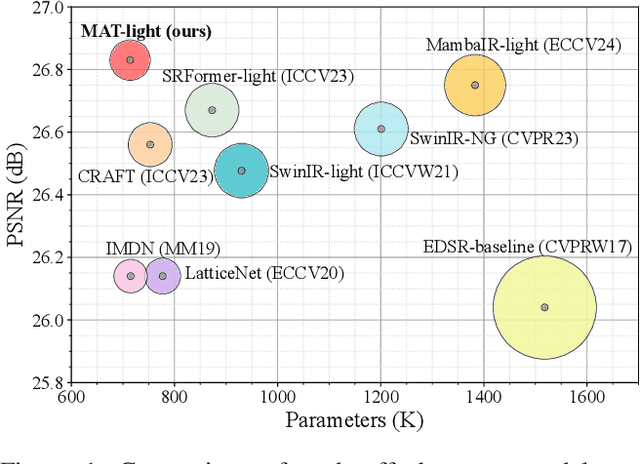
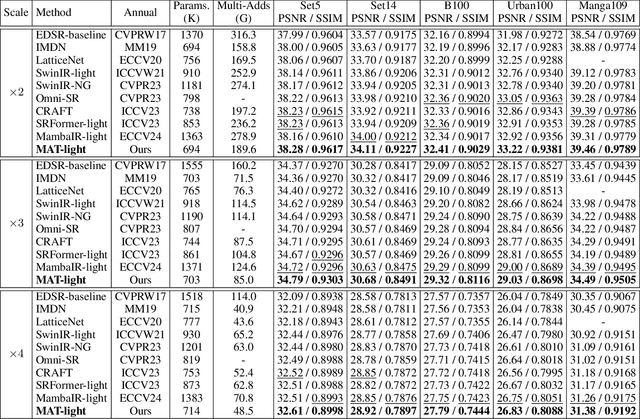
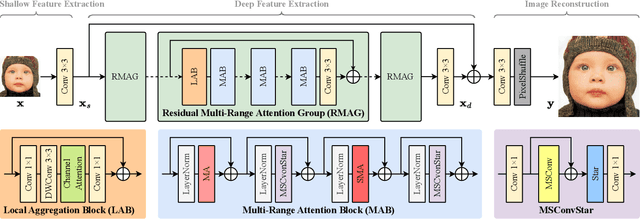

Recent advances in image super-resolution (SR) have significantly benefited from the incorporation of Transformer architectures. However, conventional techniques aimed at enlarging the self-attention window to capture broader contexts come with inherent drawbacks, especially the significantly increased computational demands. Moreover, the feature perception within a fixed-size window of existing models restricts the effective receptive fields and the intermediate feature diversity. This study demonstrates that a flexible integration of attention across diverse spatial extents can yield significant performance enhancements. In line with this insight, we introduce Multi-Range Attention Transformer (MAT) tailored for SR tasks. MAT leverages the computational advantages inherent in dilation operation, in conjunction with self-attention mechanism, to facilitate both multi-range attention (MA) and sparse multi-range attention (SMA), enabling efficient capture of both regional and sparse global features. Further coupled with local feature extraction, MAT adeptly capture dependencies across various spatial ranges, improving the diversity and efficacy of its feature representations. We also introduce the MSConvStar module, which augments the model's ability for multi-range representation learning. Comprehensive experiments show that our MAT exhibits superior performance to existing state-of-the-art SR models with remarkable efficiency (~3.3 faster than SRFormer-light).
On the Compositional Generalization of Multimodal LLMs for Medical Imaging
Dec 28, 2024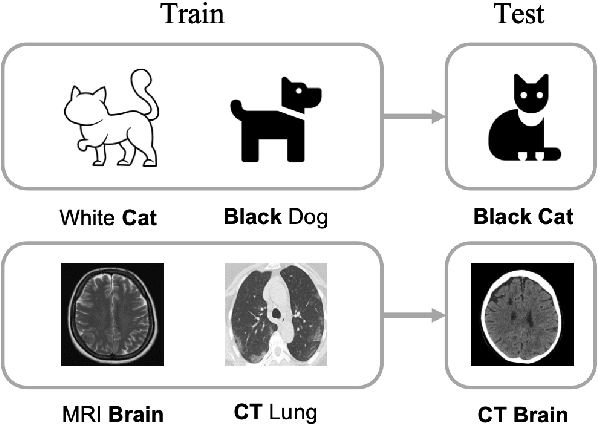

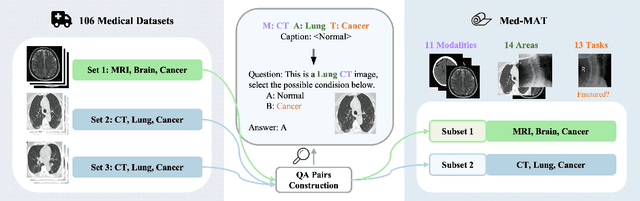

Multimodal large language models (MLLMs) hold significant potential in the medical field, but their capabilities are often limited by insufficient data in certain medical domains, highlighting the need for understanding what kinds of images can be used by MLLMs for generalization. Current research suggests that multi-task training outperforms single-task as different tasks can benefit each other, but they often overlook the internal relationships within these tasks, providing limited guidance on selecting datasets to enhance specific tasks. To analyze this phenomenon, we attempted to employ compositional generalization (CG)-the ability of models to understand novel combinations by recombining learned elements-as a guiding framework. Since medical images can be precisely defined by Modality, Anatomical area, and Task, naturally providing an environment for exploring CG. Therefore, we assembled 106 medical datasets to create Med-MAT for comprehensive experiments. The experiments confirmed that MLLMs can use CG to understand unseen medical images and identified CG as one of the main drivers of the generalization observed in multi-task training. Additionally, further studies demonstrated that CG effectively supports datasets with limited data and delivers consistent performance across different backbones, highlighting its versatility and broad applicability. Med-MAT is publicly available at https://github.com/FreedomIntelligence/Med-MAT.
Training Matting Models without Alpha Labels
Aug 20, 2024

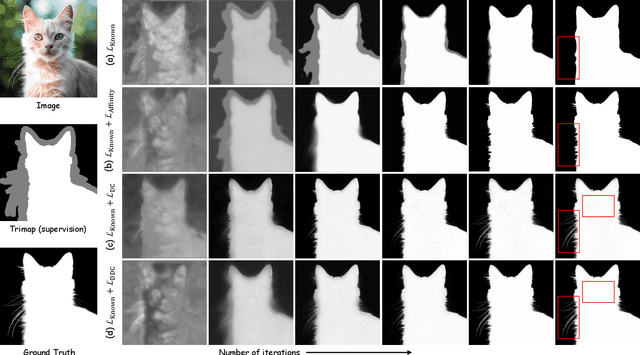
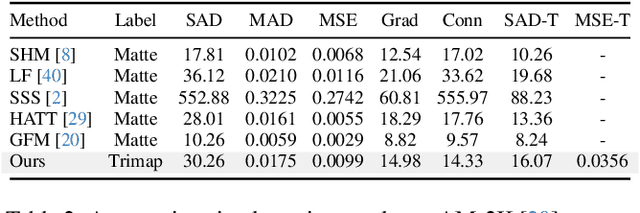
The labelling difficulty has been a longstanding problem in deep image matting. To escape from fine labels, this work explores using rough annotations such as trimaps coarsely indicating the foreground/background as supervision. We present that the cooperation between learned semantics from indicated known regions and proper assumed matting rules can help infer alpha values at transition areas. Inspired by the nonlocal principle in traditional image matting, we build a directional distance consistency loss (DDC loss) at each pixel neighborhood to constrain the alpha values conditioned on the input image. DDC loss forces the distance of similar pairs on the alpha matte and on its corresponding image to be consistent. In this way, the alpha values can be propagated from learned known regions to unknown transition areas. With only images and trimaps, a matting model can be trained under the supervision of a known loss and the proposed DDC loss. Experiments on AM-2K and P3M-10K dataset show that our paradigm achieves comparable performance with the fine-label-supervised baseline, while sometimes offers even more satisfying results than human-labelled ground truth. Code is available at \url{https://github.com/poppuppy/alpha-free-matting}.
Matting by Generation
Jul 30, 2024

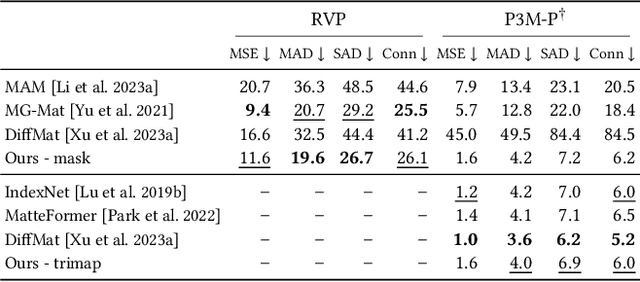

This paper introduces an innovative approach for image matting that redefines the traditional regression-based task as a generative modeling challenge. Our method harnesses the capabilities of latent diffusion models, enriched with extensive pre-trained knowledge, to regularize the matting process. We present novel architectural innovations that empower our model to produce mattes with superior resolution and detail. The proposed method is versatile and can perform both guidance-free and guidance-based image matting, accommodating a variety of additional cues. Our comprehensive evaluation across three benchmark datasets demonstrates the superior performance of our approach, both quantitatively and qualitatively. The results not only reflect our method's robust effectiveness but also highlight its ability to generate visually compelling mattes that approach photorealistic quality. The project page for this paper is available at https://lightchaserx.github.io/matting-by-generation/
ILDiff: Generate Transparent Animated Stickers by Implicit Layout Distillation
Dec 30, 2024
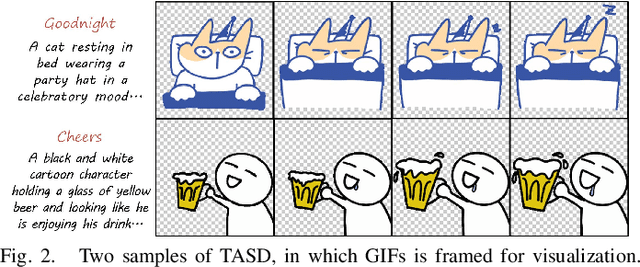
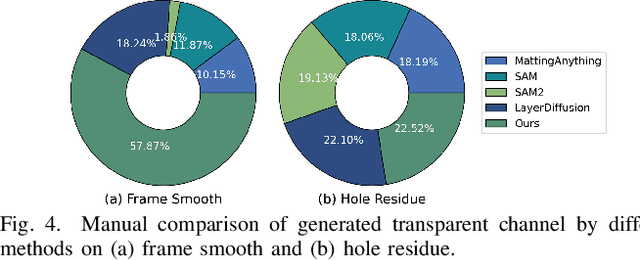
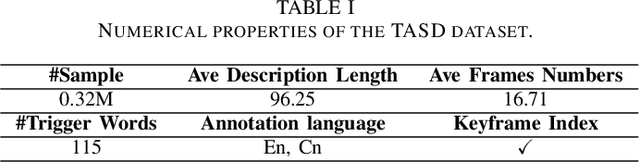
High-quality animated stickers usually contain transparent channels, which are often ignored by current video generation models. To generate fine-grained animated transparency channels, existing methods can be roughly divided into video matting algorithms and diffusion-based algorithms. The methods based on video matting have poor performance in dealing with semi-open areas in stickers, while diffusion-based methods are often used to model a single image, which will lead to local flicker when modeling animated stickers. In this paper, we firstly propose an ILDiff method to generate animated transparent channels through implicit layout distillation, which solves the problems of semi-open area collapse and no consideration of temporal information in existing methods. Secondly, we create the Transparent Animated Sticker Dataset (TASD), which contains 0.32M high-quality samples with transparent channel, to provide data support for related fields. Extensive experiments demonstrate that ILDiff can produce finer and smoother transparent channels compared to other methods such as Matting Anything and Layer Diffusion. Our code and dataset will be released at link https://xiaoyuan1996.github.io.
Alfie: Democratising RGBA Image Generation With No $$$
Aug 27, 2024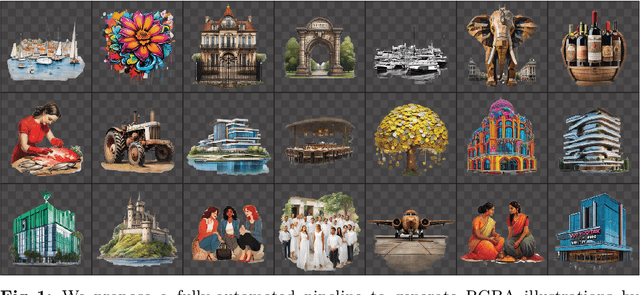

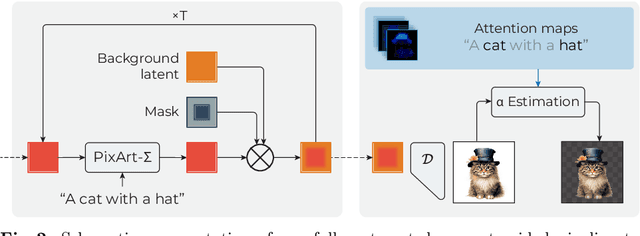
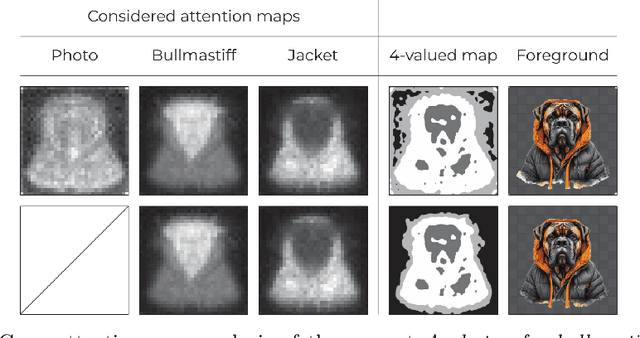
Designs and artworks are ubiquitous across various creative fields, requiring graphic design skills and dedicated software to create compositions that include many graphical elements, such as logos, icons, symbols, and art scenes, which are integral to visual storytelling. Automating the generation of such visual elements improves graphic designers' productivity, democratizes and innovates the creative industry, and helps generate more realistic synthetic data for related tasks. These illustration elements are mostly RGBA images with irregular shapes and cutouts, facilitating blending and scene composition. However, most image generation models are incapable of generating such images and achieving this capability requires expensive computational resources, specific training recipes, or post-processing solutions. In this work, we propose a fully-automated approach for obtaining RGBA illustrations by modifying the inference-time behavior of a pre-trained Diffusion Transformer model, exploiting the prompt-guided controllability and visual quality offered by such models with no additional computational cost. We force the generation of entire subjects without sharp croppings, whose background is easily removed for seamless integration into design projects or artistic scenes. We show with a user study that, in most cases, users prefer our solution over generating and then matting an image, and we show that our generated illustrations yield good results when used as inputs for composite scene generation pipelines. We release the code at https://github.com/aimagelab/Alfie.
FADE: A Task-Agnostic Upsampling Operator for Encoder-Decoder Architectures
Jul 18, 2024The goal of this work is to develop a task-agnostic feature upsampling operator for dense prediction where the operator is required to facilitate not only region-sensitive tasks like semantic segmentation but also detail-sensitive tasks such as image matting. Prior upsampling operators often can work well in either type of the tasks, but not both. We argue that task-agnostic upsampling should dynamically trade off between semantic preservation and detail delineation, instead of having a bias between the two properties. In this paper, we present FADE, a novel, plug-and-play, lightweight, and task-agnostic upsampling operator by fusing the assets of decoder and encoder features at three levels: i) considering both the encoder and decoder feature in upsampling kernel generation; ii) controlling the per-point contribution of the encoder/decoder feature in upsampling kernels with an efficient semi-shift convolutional operator; and iii) enabling the selective pass of encoder features with a decoder-dependent gating mechanism for compensating details. To improve the practicality of FADE, we additionally study parameter- and memory-efficient implementations of semi-shift convolution. We analyze the upsampling behavior of FADE on toy data and show through large-scale experiments that FADE is task-agnostic with consistent performance improvement on a number of dense prediction tasks with little extra cost. For the first time, we demonstrate robust feature upsampling on both region- and detail-sensitive tasks successfully. Code is made available at: https://github.com/poppinace/fade