 Add to Chrome
 Add to Firefox
 Add to Edge
Sudoku
Papers and Code
Parallelism and Generation Order in Masked Diffusion Language Models: Limits Today, Potential Tomorrow
Jan 22, 2026
Masked Diffusion Language Models (MDLMs) promise parallel token generation and arbitrary-order decoding, yet it remains unclear to what extent current models truly realize these capabilities. We characterize MDLM behavior along two dimensions -- parallelism strength and generation order -- using Average Finalization Parallelism (AFP) and Kendall's tau. We evaluate eight mainstream MDLMs (up to 100B parameters) on 58 benchmarks spanning knowledge, reasoning, and programming. The results show that MDLMs still lag behind comparably sized autoregressive models, mainly because parallel probabilistic modeling weakens inter-token dependencies. Meanwhile, MDLMs exhibit adaptive decoding behavior: their parallelism and generation order vary significantly with the task domain, the stage of reasoning, and whether the output is correct. On tasks that require "backward information" (e.g., Sudoku), MDLMs adopt a solution order that tends to fill easier Sudoku blanks first, highlighting their advantages. Finally, we provide theoretical motivation and design insights supporting a Generate-then-Edit paradigm, which mitigates dependency loss while retaining the efficiency of parallel decoding.

Are Your Reasoning Models Reasoning or Guessing? A Mechanistic Analysis of Hierarchical Reasoning Models
Jan 15, 2026Hierarchical reasoning model (HRM) achieves extraordinary performance on various reasoning tasks, significantly outperforming large language model-based reasoners. To understand the strengths and potential failure modes of HRM, we conduct a mechanistic study on its reasoning patterns and find three surprising facts: (a) Failure of extremely simple puzzles, e.g., HRM can fail on a puzzle with only one unknown cell. We attribute this failure to the violation of the fixed point property, a fundamental assumption of HRM. (b) "Grokking" dynamics in reasoning steps, i.e., the answer is not improved uniformly, but instead there is a critical reasoning step that suddenly makes the answer correct; (c) Existence of multiple fixed points. HRM "guesses" the first fixed point, which could be incorrect, and gets trapped there for a while or forever. All facts imply that HRM appears to be "guessing" instead of "reasoning". Leveraging this "guessing" picture, we propose three strategies to scale HRM's guesses: data augmentation (scaling the quality of guesses), input perturbation (scaling the number of guesses by leveraging inference randomness), and model bootstrapping (scaling the number of guesses by leveraging training randomness). On the practical side, by combining all methods, we develop Augmented HRM, boosting accuracy on Sudoku-Extreme from 54.5% to 96.9%. On the scientific side, our analysis provides new insights into how reasoning models "reason".
Universal Reasoning Model
Dec 24, 2025Universal transformers (UTs) have been widely used for complex reasoning tasks such as ARC-AGI and Sudoku, yet the specific sources of their performance gains remain underexplored. In this work, we systematically analyze UTs variants and show that improvements on ARC-AGI primarily arise from the recurrent inductive bias and strong nonlinear components of Transformer, rather than from elaborate architectural designs. Motivated by this finding, we propose the Universal Reasoning Model (URM), which enhances the UT with short convolution and truncated backpropagation. Our approach substantially improves reasoning performance, achieving state-of-the-art 53.8% pass@1 on ARC-AGI 1 and 16.0% pass@1 on ARC-AGI 2. Our code is avaliable at https://github.com/UbiquantAI/URM.
MMGR: Multi-Modal Generative Reasoning
Dec 17, 2025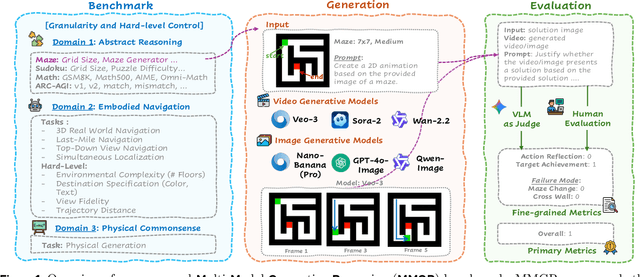
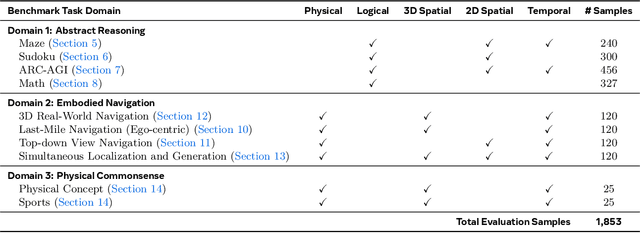
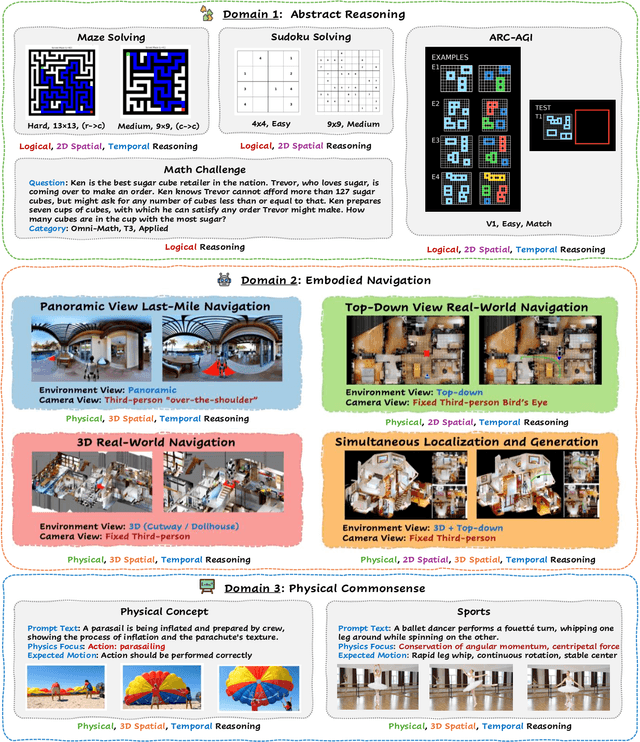
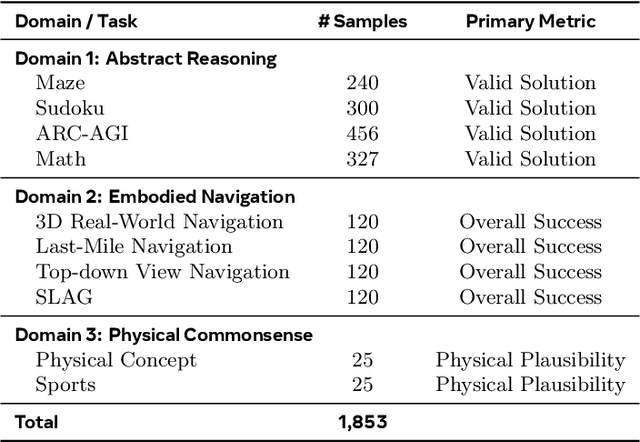
Video foundation models generate visually realistic and temporally coherent content, but their reliability as world simulators depends on whether they capture physical, logical, and spatial constraints. Existing metrics such as Frechet Video Distance (FVD) emphasize perceptual quality and overlook reasoning failures, including violations of causality, physics, and global consistency. We introduce MMGR (Multi-Modal Generative Reasoning Evaluation and Benchmark), a principled evaluation framework based on five reasoning abilities: Physical, Logical, 3D Spatial, 2D Spatial, and Temporal. MMGR evaluates generative reasoning across three domains: Abstract Reasoning (ARC-AGI, Sudoku), Embodied Navigation (real-world 3D navigation and localization), and Physical Commonsense (sports and compositional interactions). MMGR applies fine-grained metrics that require holistic correctness across both video and image generation. We benchmark leading video models (Veo-3, Sora-2, Wan-2.2) and image models (Nano-banana, Nano-banana Pro, GPT-4o-image, Qwen-image), revealing strong performance gaps across domains. Models show moderate success on Physical Commonsense tasks but perform poorly on Abstract Reasoning (below 10 percent accuracy on ARC-AGI) and struggle with long-horizon spatial planning in embodied settings. Our analysis highlights key limitations in current models, including overreliance on perceptual data, weak global state consistency, and objectives that reward visual plausibility over causal correctness. MMGR offers a unified diagnostic benchmark and a path toward reasoning-aware generative world models.
Guided Discrete Diffusion for Constraint Satisfaction Problems
Dec 16, 2025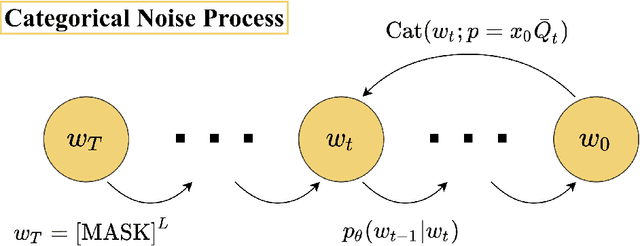
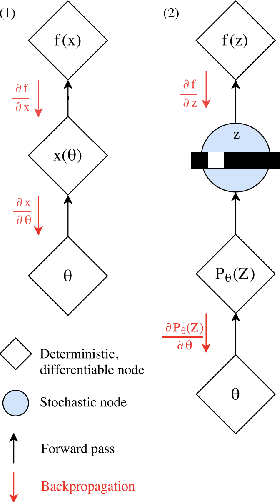
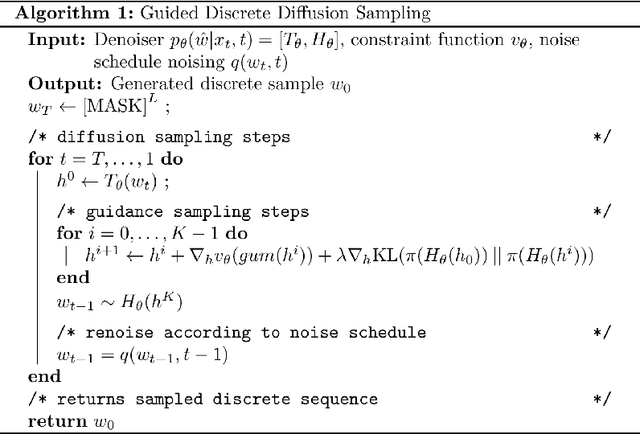
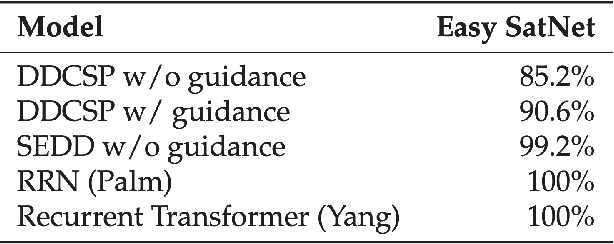
We propose discrete diffusion guidance for constraint satisfaction problems (CSPs) and demonstrate its ability to solve Sudoku puzzles without supervision.
Liquid Reasoning Transformers: A Sudoku-Based Prototype for Chess-Scale Algorithmic Tasks
Dec 14, 2025The Liquid Reasoning Transformer (LRT) is a transformer architecture designed for inference with adaptive depths using iterative changes, discard-based correction, and a learned stopping mechanism. Instead of relying on a single feedforward pass, the model updates a recurrent reasoning token across multiple internal steps, allowing it to correct early errors and allocate computation based on input difficulty. We evaluate the LRT on Sudoku as a controlled testbed for structured reasoning and show that it achieves strong performance, reaching 98.68% digit accuracy and 36.30% full-puzzle accuracy without using symbolic rules or search. Analyzing internal patterns shows that the discard and stop gates play different, important roles in stabilizing inferences and adjusting computational depth. We discuss how these mechanisms extend naturally to chess-scale reasoning tasks and outline extensions for multi-token reasoning and larger domains.
d-TreeRPO: Towards More Reliable Policy Optimization for Diffusion Language Models
Dec 10, 2025Reliable reinforcement learning (RL) for diffusion large language models (dLLMs) requires both accurate advantage estimation and precise estimation of prediction probabilities. Existing RL methods for dLLMs fall short in both aspects: they rely on coarse or unverifiable reward signals, and they estimate prediction probabilities without accounting for the bias relative to the true, unbiased expected prediction probability that properly integrates over all possible decoding orders. To mitigate these issues, we propose \emph{d}-TreeRPO, a reliable RL framework for dLLMs that leverages tree-structured rollouts and bottom-up advantage computation based on verifiable outcome rewards to provide fine-grained and verifiable step-wise reward signals. When estimating the conditional transition probability from a parent node to a child node, we theoretically analyze the estimation error between the unbiased expected prediction probability and the estimate obtained via a single forward pass, and find that higher prediction confidence leads to lower estimation error. Guided by this analysis, we introduce a time-scheduled self-distillation loss during training that enhances prediction confidence in later training stages, thereby enabling more accurate probability estimation and improved convergence. Experiments show that \emph{d}-TreeRPO outperforms existing baselines and achieves significant gains on multiple reasoning benchmarks, including +86.2 on Sudoku, +51.6 on Countdown, +4.5 on GSM8K, and +5.3 on Math500. Ablation studies and computational cost analyses further demonstrate the effectiveness and practicality of our design choices.
Accelerating Training Speed of Tiny Recursive Models via Curriculum Guided Adaptive Recursion
Nov 11, 2025Recursive reasoning models achieve remarkable performance on complex reasoning tasks through iterative refinement, enabling tiny networks to match large language models thousands of times their size. However, training remains computationally expensive, prior work reporting approximately 36 GPU-hours per dataset, limiting broader adoption and research. We propose CGAR, a novel training methodology that applies curriculum learning to architectural depth rather than traditional data ordering. CGAR introduces two synergistic components: Progressive Depth Curriculum dynamically adjusts recursion depth from shallow to deep configurations during training, preventing early overfitting while reducing computational cost, and Hierarchical Supervision Weighting applies exponentially decaying importance to supervision steps, aligning loss weighting with observed gradient magnitude decay. On Sudoku-Extreme with 423,168 test puzzles, CGAR achieves 1.71x training speedup (10.93 to 6.38 hours, 42% cost reduction) with only 0.63% accuracy drop (86.65% to 86.02%). Systematic ablations reveal Progressive Depth Curriculum alone achieves 2.26x speedup with 85.47% accuracy, demonstrating a rare Pareto improvement where architectural curriculum simultaneously enhances training efficiency and solution quality. CGAR-trained models exhibit superior inference efficiency with 100% halting accuracy and 11% fewer reasoning steps. Our work demonstrates that principled curriculum on architectural depth enables efficient training of recursive reasoning models on modest hardware. Code and models: https://github.com/Kaleemullahqasim/CGAR and https://huggingface.co/Kaleemullah/trm-cgar-sudoku
Can Agent Conquer Web? Exploring the Frontiers of ChatGPT Atlas Agent in Web Games
Oct 30, 2025OpenAI's ChatGPT Atlas introduces new capabilities for web interaction, enabling the model to analyze webpages, process user intents, and execute cursor and keyboard inputs directly within the browser. While its capacity for information retrieval tasks has been demonstrated, its performance in dynamic, interactive environments remains less explored. In this study, we conduct an early evaluation of Atlas's web interaction capabilities using browser-based games as test scenarios, including Google's T-Rex Runner, Sudoku, Flappy Bird, and Stein.world. We employ in-game performance scores as quantitative metrics to assess performance across different task types. Our results show that Atlas performs strongly in logical reasoning tasks like Sudoku, completing puzzles significantly faster than human baselines, but struggles substantially in real-time games requiring precise timing and motor control, often failing to progress beyond initial obstacles. These findings suggest that while Atlas demonstrates capable analytical processing, there remain notable limitations in dynamic web environments requiring real-time interaction. The website of our project can be found at https://atlas-game-eval.github.io.
HardcoreLogic: Challenging Large Reasoning Models with Long-tail Logic Puzzle Games
Oct 14, 2025Large Reasoning Models (LRMs) have demonstrated impressive performance on complex tasks, including logical puzzle games that require deriving solutions satisfying all constraints. However, whether they can flexibly apply appropriate rules to varying conditions, particularly when faced with non-canonical game variants, remains an open question. Existing corpora focus on popular puzzles like 9x9 Sudoku, risking overfitting to canonical formats and memorization of solution patterns, which can mask deficiencies in understanding novel rules or adapting strategies to new variants. To address this, we introduce HardcoreLogic, a challenging benchmark of over 5,000 puzzles across 10 games, designed to test the robustness of LRMs on the "long-tail" of logical games. HardcoreLogic systematically transforms canonical puzzles through three dimensions: Increased Complexity (IC), Uncommon Elements (UE), and Unsolvable Puzzles (UP), reducing reliance on shortcut memorization. Evaluations on a diverse set of LRMs reveal significant performance drops, even for models achieving top scores on existing benchmarks, indicating heavy reliance on memorized stereotypes. While increased complexity is the dominant source of difficulty, models also struggle with subtle rule variations that do not necessarily increase puzzle difficulty. Our systematic error analysis on solvable and unsolvable puzzles further highlights gaps in genuine reasoning. Overall, HardcoreLogic exposes the limitations of current LRMs and establishes a benchmark for advancing high-level logical reasoning.