 Add to Chrome
 Add to Firefox
 Add to Edge
One-Forcing: Towards Stable One-Step Autoregressive Video Generation
May 22, 2026
Recent advances have substantially improved real-time interactive video generation in the autoregressive regime. However, most existing few-step autoregressive video generation methods, often distilled from a corresponding many-step teacher, default to a 4-step sampling configuration, which still incurs considerable latency during deployment and suffers from severe quality degradation when the number of sampling steps is further reduced, particularly in the one-step setting. Trajectory-style consistency distillation methods often produce videos with weak dynamics, while DMD-based approaches, such as Self-Forcing, tend to yield blurry frames. To address this challenge, we propose One-Forcing, a simple yet effective approach which augments the DMD objective with an auxiliary GAN loss for high-quality and efficient one-step video generation. Experiments on VBench show that One-Forcing achieves a total score of 83.76, establishing state-of-the-art performance among one-step causal video generation methods and remaining competitive with strong many-step approaches. We further demonstrate that one-step framewise autoregressive generation can be achieved stably with merely one-third of the training cost of the chunkwise model, a setting that prior methods have failed to achieve successfully.

ViPO: Visual Preference Optimization at Scale
Apr 27, 2026While preference optimization is crucial for improving visual generative models, how to effectively scale this paradigm remains largely unexplored. Current open-source preference datasets contain conflicting preference patterns, where winners excel in some dimensions but underperform in others. Naively optimizing on such noisy datasets fails to learn preferences, hindering effective scaling. To enhance robustness against noise, we propose Poly-DPO, which extends the DPO objective with an additional polynomial term that dynamically adjusts model confidence based on dataset characteristics, enabling effective learning across diverse data distributions. Beyond biased patterns, existing datasets suffer from low resolution, limited prompt diversity, and imbalanced distributions. To facilitate large-scale visual preference optimization by tackling data bottlenecks, we construct ViPO, a massive-scale preference dataset with 1M image pairs at 1024px across five categories and 300K video pairs at 720p+ across three categories. State-of-the-art generative models and diverse prompts ensure reliable preference signals with balanced distributions. Remarkably, when applying Poly-DPO to our high-quality dataset, the optimal configuration converges to standard DPO. This convergence validates dataset quality and Poly-DPO's adaptive nature: sophisticated optimization becomes unnecessary with sufficient data quality, yet remains valuable for imperfect datasets. We validate our approach across visual generation models. On noisy datasets like Pick-a-Pic V2, Poly-DPO achieves 6.87 and 2.32 gains over Diffusion-DPO on GenEval for SD1.5 and SDXL, respectively. For ViPO, models achieve performance far exceeding those trained on existing open-source preference datasets. These results confirm that addressing both algorithmic adaptability and data quality is essential for scaling visual preference optimization.
Bayesian Active Learning with Gaussian Processes Guided by LLM Relevance Scoring for Dense Passage Retrieval
Apr 20, 2026While Large Language Models (LLMs) exhibit exceptional zero-shot relevance modeling, their high computational cost necessitates framing passage retrieval as a budget-constrained global optimization problem. Existing approaches passively rely on first-stage dense retrievers, which leads to two limitations: (1) failing to retrieve relevant passages in semantically distinct clusters, and (2) failing to propagate relevance signals to the broader corpus. To address these limitations, we propose Bayesian Active Learning with Gaussian Processes guided by LLM relevance scoring (BAGEL), a novel framework that propagates sparse LLM relevance signals across the embedding space to guide global exploration. BAGEL models the multimodal relevance distribution across the entire embedding space with a query-specific Gaussian Process (GP) based on LLM relevance scores. Subsequently, it iteratively selects passages for scoring by strategically balancing the exploitation of high-confidence regions with the exploration of uncertain areas. Extensive experiments across four benchmark datasets and two LLM backbones demonstrate that BAGEL effectively explores and captures complex relevance distributions and outperforms LLM reranking methods under the same LLM budget on all four datasets.
LoL: Longer than Longer, Scaling Video Generation to Hour
Jan 23, 2026Recent research in long-form video generation has shifted from bidirectional to autoregressive models, yet these methods commonly suffer from error accumulation and a loss of long-term coherence. While attention sink frames have been introduced to mitigate this performance decay, they often induce a critical failure mode we term sink-collapse: the generated content repeatedly reverts to the sink frame, resulting in abrupt scene resets and cyclic motion patterns. Our analysis reveals that sink-collapse originates from an inherent conflict between the periodic structure of Rotary Position Embedding (RoPE) and the multi-head attention mechanisms prevalent in current generative models. To address it, we propose a lightweight, training-free approach that effectively suppresses this behavior by introducing multi-head RoPE jitter that breaks inter-head attention homogenization and mitigates long-horizon collapse. Extensive experiments show that our method successfully alleviates sink-collapse while preserving generation quality. To the best of our knowledge, this work achieves the first demonstration of real-time, streaming, and infinite-length video generation with little quality decay. As an illustration of this robustness, we generate continuous videos up to 12 hours in length, which, to our knowledge, is among the longest publicly demonstrated results in streaming video generation.
Reward-Forcing: Autoregressive Video Generation with Reward Feedback
Jan 23, 2026While most prior work in video generation relies on bidirectional architectures, recent efforts have sought to adapt these models into autoregressive variants to support near real-time generation. However, such adaptations often depend heavily on teacher models, which can limit performance, particularly in the absence of a strong autoregressive teacher, resulting in output quality that typically lags behind their bidirectional counterparts. In this paper, we explore an alternative approach that uses reward signals to guide the generation process, enabling more efficient and scalable autoregressive generation. By using reward signals to guide the model, our method simplifies training while preserving high visual fidelity and temporal consistency. Through extensive experiments on standard benchmarks, we find that our approach performs comparably to existing autoregressive models and, in some cases, surpasses similarly sized bidirectional models by avoiding constraints imposed by teacher architectures. For example, on VBench, our method achieves a total score of 84.92, closely matching state-of-the-art autoregressive methods that score 84.31 but require significant heterogeneous distillation.
Can Agent Conquer Web? Exploring the Frontiers of ChatGPT Atlas Agent in Web Games
Oct 30, 2025OpenAI's ChatGPT Atlas introduces new capabilities for web interaction, enabling the model to analyze webpages, process user intents, and execute cursor and keyboard inputs directly within the browser. While its capacity for information retrieval tasks has been demonstrated, its performance in dynamic, interactive environments remains less explored. In this study, we conduct an early evaluation of Atlas's web interaction capabilities using browser-based games as test scenarios, including Google's T-Rex Runner, Sudoku, Flappy Bird, and Stein.world. We employ in-game performance scores as quantitative metrics to assess performance across different task types. Our results show that Atlas performs strongly in logical reasoning tasks like Sudoku, completing puzzles significantly faster than human baselines, but struggles substantially in real-time games requiring precise timing and motor control, often failing to progress beyond initial obstacles. These findings suggest that while Atlas demonstrates capable analytical processing, there remain notable limitations in dynamic web environments requiring real-time interaction. The website of our project can be found at https://atlas-game-eval.github.io.
Self-Forcing++: Towards Minute-Scale High-Quality Video Generation
Oct 02, 2025Diffusion models have revolutionized image and video generation, achieving unprecedented visual quality. However, their reliance on transformer architectures incurs prohibitively high computational costs, particularly when extending generation to long videos. Recent work has explored autoregressive formulations for long video generation, typically by distilling from short-horizon bidirectional teachers. Nevertheless, given that teacher models cannot synthesize long videos, the extrapolation of student models beyond their training horizon often leads to pronounced quality degradation, arising from the compounding of errors within the continuous latent space. In this paper, we propose a simple yet effective approach to mitigate quality degradation in long-horizon video generation without requiring supervision from long-video teachers or retraining on long video datasets. Our approach centers on exploiting the rich knowledge of teacher models to provide guidance for the student model through sampled segments drawn from self-generated long videos. Our method maintains temporal consistency while scaling video length by up to 20x beyond teacher's capability, avoiding common issues such as over-exposure and error-accumulation without recomputing overlapping frames like previous methods. When scaling up the computation, our method shows the capability of generating videos up to 4 minutes and 15 seconds, equivalent to 99.9% of the maximum span supported by our base model's position embedding and more than 50x longer than that of our baseline model. Experiments on standard benchmarks and our proposed improved benchmark demonstrate that our approach substantially outperforms baseline methods in both fidelity and consistency. Our long-horizon videos demo can be found at https://self-forcing-plus-plus.github.io/
Concepts or Skills? Rethinking Instruction Selection for Multi-modal Models
Aug 14, 2025Vision-language instruction tuning achieves two main purposes: learning visual concepts and learning visual skills. In this paper, we found that vision-language benchmarks fall into the dichotomy of mainly benefiting from training on instructions with similar skills or visual concepts. Inspired by the discovery, we designed a simple targeted training data selection method to optimize the performance of a given benchmark. We first extract the concepts/skills from the benchmark, determine whether the benchmark predominantly benefits from similar concepts or skills, and finally select instructions with the most matching concepts/skills. Experiments on 10+ benchmarks validate the effectiveness of our targeted data selection method, showing +0.9\% over the best existing baseline averaged over all benchmarks and +1.5\% on the skill-focused subset. Our findings underscore the importance of recognizing the inherent trade-off within instruction selection, which requires balancing the acquisition of conceptual knowledge against visual skill.
DD-Ranking: Rethinking the Evaluation of Dataset Distillation
May 19, 2025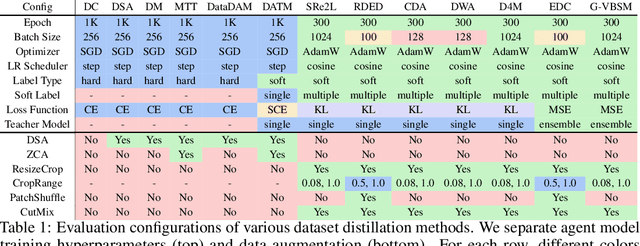
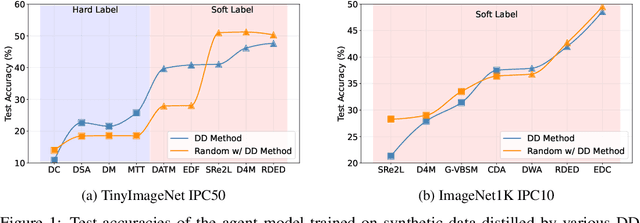
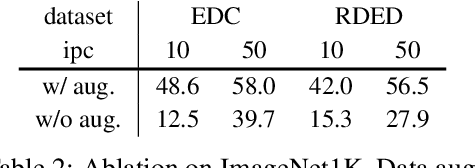
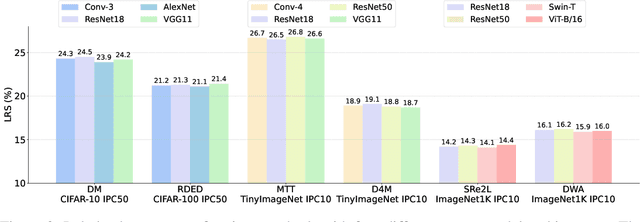
In recent years, dataset distillation has provided a reliable solution for data compression, where models trained on the resulting smaller synthetic datasets achieve performance comparable to those trained on the original datasets. To further improve the performance of synthetic datasets, various training pipelines and optimization objectives have been proposed, greatly advancing the field of dataset distillation. Recent decoupled dataset distillation methods introduce soft labels and stronger data augmentation during the post-evaluation phase and scale dataset distillation up to larger datasets (e.g., ImageNet-1K). However, this raises a question: Is accuracy still a reliable metric to fairly evaluate dataset distillation methods? Our empirical findings suggest that the performance improvements of these methods often stem from additional techniques rather than the inherent quality of the images themselves, with even randomly sampled images achieving superior results. Such misaligned evaluation settings severely hinder the development of DD. Therefore, we propose DD-Ranking, a unified evaluation framework, along with new general evaluation metrics to uncover the true performance improvements achieved by different methods. By refocusing on the actual information enhancement of distilled datasets, DD-Ranking provides a more comprehensive and fair evaluation standard for future research advancements.
Latent Video Dataset Distillation
Apr 23, 2025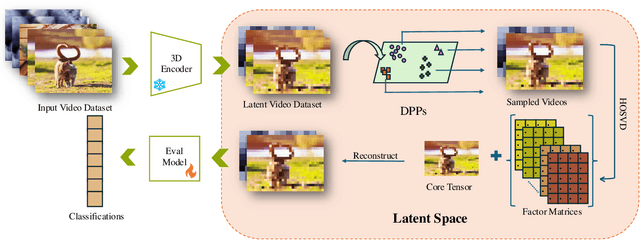
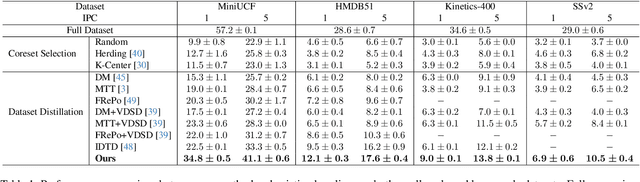
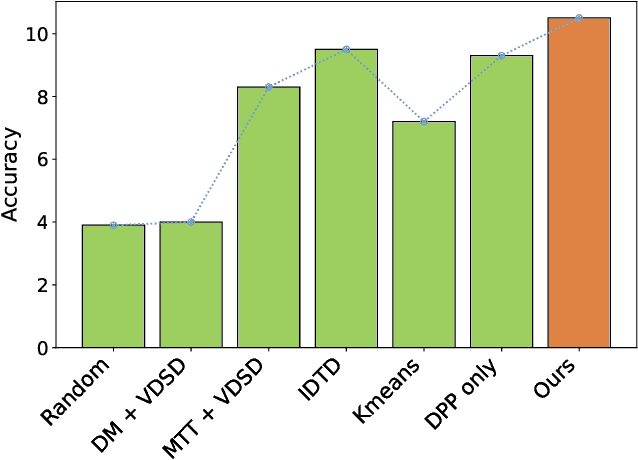
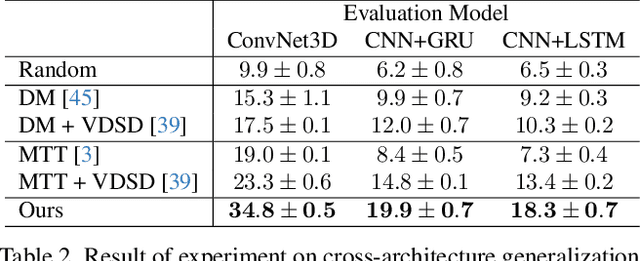
Dataset distillation has demonstrated remarkable effectiveness in high-compression scenarios for image datasets. While video datasets inherently contain greater redundancy, existing video dataset distillation methods primarily focus on compression in the pixel space, overlooking advances in the latent space that have been widely adopted in modern text-to-image and text-to-video models. In this work, we bridge this gap by introducing a novel video dataset distillation approach that operates in the latent space using a state-of-the-art variational encoder. Furthermore, we employ a diversity-aware data selection strategy to select both representative and diverse samples. Additionally, we introduce a simple, training-free method to further compress the distilled latent dataset. By combining these techniques, our approach achieves a new state-of-the-art performance in dataset distillation, outperforming prior methods on all datasets, e.g. on HMDB51 IPC 1, we achieve a 2.6% performance increase; on MiniUCF IPC 5, we achieve a 7.8% performance increase.