 Add to Chrome
 Add to Firefox
 Add to Edge
Universal Reasoning Model
Dec 24, 2025
Universal transformers (UTs) have been widely used for complex reasoning tasks such as ARC-AGI and Sudoku, yet the specific sources of their performance gains remain underexplored. In this work, we systematically analyze UTs variants and show that improvements on ARC-AGI primarily arise from the recurrent inductive bias and strong nonlinear components of Transformer, rather than from elaborate architectural designs. Motivated by this finding, we propose the Universal Reasoning Model (URM), which enhances the UT with short convolution and truncated backpropagation. Our approach substantially improves reasoning performance, achieving state-of-the-art 53.8% pass@1 on ARC-AGI 1 and 16.0% pass@1 on ARC-AGI 2. Our code is avaliable at https://github.com/UbiquantAI/URM.

One-shot Entropy Minimization
May 27, 2025We trained 13,440 large language models and found that entropy minimization requires only a single unlabeled data and 10 steps optimization to achieve performance improvements comparable to or even greater than those obtained using thousands of data and carefully designed rewards in rule-based reinforcement learning. This striking result may prompt a rethinking of post-training paradigms for large language models. Our code is avaliable at https://github.com/zitian-gao/one-shot-em.
Logic-RL: Unleashing LLM Reasoning with Rule-Based Reinforcement Learning
Feb 20, 2025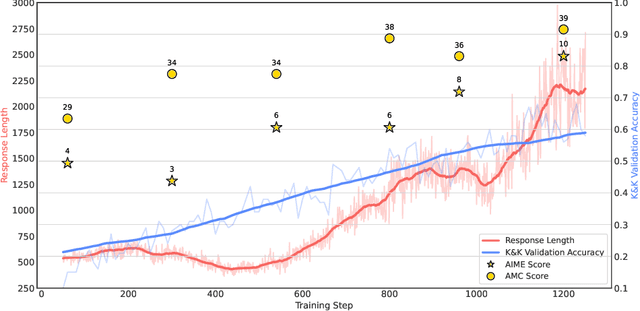

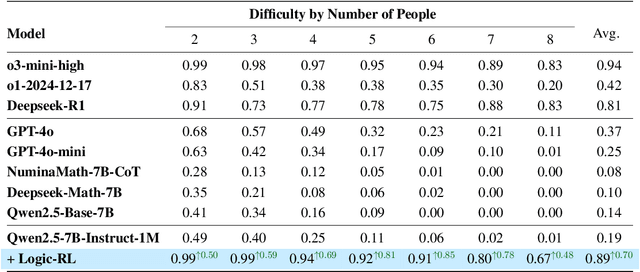
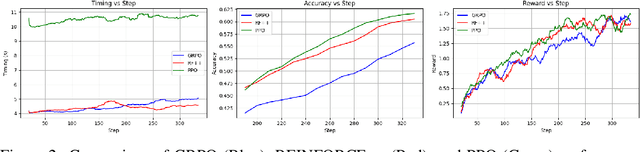
Inspired by the success of DeepSeek-R1, we explore the potential of rule-based reinforcement learning (RL) in large reasoning models. To analyze reasoning dynamics, we use synthetic logic puzzles as training data due to their controllable complexity and straightforward answer verification. We make some key technical contributions that lead to effective and stable RL training: a system prompt that emphasizes the thinking and answering process, a stringent format reward function that penalizes outputs for taking shortcuts, and a straightforward training recipe that achieves stable convergence. Our 7B model develops advanced reasoning skills-such as reflection, verification, and summarization-that are absent from the logic corpus. Remarkably, after training on just 5K logic problems, it demonstrates generalization abilities to the challenging math benchmarks AIME and AMC.