 Add to Chrome
 Add to Firefox
 Add to Edge
music
Papers and Code
MUSIC: MUlti-Step Instruction Contrast for Multi-Turn Reward Models
Dec 31, 2025
Evaluating the quality of multi-turn conversations is crucial for developing capable Large Language Models (LLMs), yet remains a significant challenge, often requiring costly human evaluation. Multi-turn reward models (RMs) offer a scalable alternative and can provide valuable signals for guiding LLM training. While recent work has advanced multi-turn \textit{training} techniques, effective automated \textit{evaluation} specifically for multi-turn interactions lags behind. We observe that standard preference datasets, typically contrasting responses based only on the final conversational turn, provide insufficient signal to capture the nuances of multi-turn interactions. Instead, we find that incorporating contrasts spanning \textit{multiple} turns is critical for building robust multi-turn RMs. Motivated by this finding, we propose \textbf{MU}lti-\textbf{S}tep \textbf{I}nstruction \textbf{C}ontrast (MUSIC), an unsupervised data augmentation strategy that synthesizes contrastive conversation pairs exhibiting differences across multiple turns. Leveraging MUSIC on the Skywork preference dataset, we train a multi-turn RM based on the Gemma-2-9B-Instruct model. Empirical results demonstrate that our MUSIC-augmented RM outperforms baseline methods, achieving higher alignment with judgments from advanced proprietary LLM judges on multi-turn conversations, crucially, without compromising performance on standard single-turn RM benchmarks.

UniAct: Unified Motion Generation and Action Streaming for Humanoid Robots
Dec 30, 2025A long-standing objective in humanoid robotics is the realization of versatile agents capable of following diverse multimodal instructions with human-level flexibility. Despite advances in humanoid control, bridging high-level multimodal perception with whole-body execution remains a significant bottleneck. Existing methods often struggle to translate heterogeneous instructions -- such as language, music, and trajectories -- into stable, real-time actions. Here we show that UniAct, a two-stage framework integrating a fine-tuned MLLM with a causal streaming pipeline, enables humanoid robots to execute multimodal instructions with sub-500 ms latency. By unifying inputs through a shared discrete codebook via FSQ, UniAct ensures cross-modal alignment while constraining motions to a physically grounded manifold. This approach yields a 19% improvement in the success rate of zero-shot tracking of imperfect reference motions. We validate UniAct on UniMoCap, our 20-hour humanoid motion benchmark, demonstrating robust generalization across diverse real-world scenarios. Our results mark a critical step toward responsive, general-purpose humanoid assistants capable of seamless interaction through unified perception and control.
Selective Imperfection as a Generative Framework for Analysis, Creativity and Discovery
Dec 30, 2025We introduce materiomusic as a generative framework linking the hierarchical structures of matter with the compositional logic of music. Across proteins, spider webs and flame dynamics, vibrational and architectural principles recur as tonal hierarchies, harmonic progressions, and long-range musical form. Using reversible mappings, from molecular spectra to musical tones and from three-dimensional networks to playable instruments, we show how sound functions as a scientific probe, an epistemic inversion where listening becomes a mode of seeing and musical composition becomes a blueprint for matter. These mappings excavate deep time: patterns originating in femtosecond molecular vibrations or billion-year evolutionary histories become audible. We posit that novelty in science and art emerges when constraints cannot be satisfied within existing degrees of freedom, forcing expansion of the space of viable configurations. Selective imperfection provides the mechanism restoring balance between coherence and adaptability. Quantitative support comes from exhaustive enumeration of all 2^12 musical scales, revealing that culturally significant systems cluster in a mid-entropy, mid-defect corridor, directly paralleling the Hall-Petch optimum where intermediate defect densities maximize material strength. Iterating these mappings creates productive collisions between human creativity and physics, generating new information as musical structures encounter evolutionary constraints. We show how swarm-based AI models compose music exhibiting human-like structural signatures such as small-world connectivity, modular integration, long-range coherence, suggesting a route beyond interpolation toward invention. We show that science and art are generative acts of world-building under constraint, with vibration as a shared grammar organizing structure across scales.
PhyAVBench: A Challenging Audio Physics-Sensitivity Benchmark for Physically Grounded Text-to-Audio-Video Generation
Dec 30, 2025Text-to-audio-video (T2AV) generation underpins a wide range of applications demanding realistic audio-visual content, including virtual reality, world modeling, gaming, and filmmaking. However, existing T2AV models remain incapable of generating physically plausible sounds, primarily due to their limited understanding of physical principles. To situate current research progress, we present PhyAVBench, a challenging audio physics-sensitivity benchmark designed to systematically evaluate the audio physics grounding capabilities of existing T2AV models. PhyAVBench comprises 1,000 groups of paired text prompts with controlled physical variables that implicitly induce sound variations, enabling a fine-grained assessment of models' sensitivity to changes in underlying acoustic conditions. We term this evaluation paradigm the Audio-Physics Sensitivity Test (APST). Unlike prior benchmarks that primarily focus on audio-video synchronization, PhyAVBench explicitly evaluates models' understanding of the physical mechanisms underlying sound generation, covering 6 major audio physics dimensions, 4 daily scenarios (music, sound effects, speech, and their mix), and 50 fine-grained test points, ranging from fundamental aspects such as sound diffraction to more complex phenomena, e.g., Helmholtz resonance. Each test point consists of multiple groups of paired prompts, where each prompt is grounded by at least 20 newly recorded or collected real-world videos, thereby minimizing the risk of data leakage during model pre-training. Both prompts and videos are iteratively refined through rigorous human-involved error correction and quality control to ensure high quality. We argue that only models with a genuine grasp of audio-related physical principles can generate physically consistent audio-visual content. We hope PhyAVBench will stimulate future progress in this critical yet largely unexplored domain.
Do You Have Freestyle? Expressive Humanoid Locomotion via Audio Control
Dec 29, 2025Humans intuitively move to sound, but current humanoid robots lack expressive improvisational capabilities, confined to predefined motions or sparse commands. Generating motion from audio and then retargeting it to robots relies on explicit motion reconstruction, leading to cascaded errors, high latency, and disjointed acoustic-actuation mapping. We propose RoboPerform, the first unified audio-to-locomotion framework that can directly generate music-driven dance and speech-driven co-speech gestures from audio. Guided by the core principle of "motion = content + style", the framework treats audio as implicit style signals and eliminates the need for explicit motion reconstruction. RoboPerform integrates a ResMoE teacher policy for adapting to diverse motion patterns and a diffusion-based student policy for audio style injection. This retargeting-free design ensures low latency and high fidelity. Experimental validation shows that RoboPerform achieves promising results in physical plausibility and audio alignment, successfully transforming robots into responsive performers capable of reacting to audio.
Learning Coupled System Dynamics under Incomplete Physical Constraints and Missing Data
Dec 28, 2025Advances in data acquisition and computational methods have accelerated the use of differential equation based modelling for complex systems. Such systems are often described by coupled (or more) variables, yet governing equation is typically available for one variable, while the remaining variable can be accessed only through data. This mismatch between known physics and observed data poses a fundamental challenge for existing physics-informed machine learning approaches, which generally assume either complete knowledge of the governing equations or full data availability across all variables. In this paper, we introduce MUSIC (Multitask Learning Under Sparse and Incomplete Constraints), a sparsity induced multitask neural network framework that integrates partial physical constraints with data-driven learning to recover full-dimensional solutions of coupled systems when physics-constrained and data-informed variables are mutually exclusive. MUSIC employs mesh-free (random) sampling of training data and sparsity regularization, yielding highly compressed models with improved training and evaluation efficiency. We demonstrate that MUSIC accurately learns solutions (shock wave solutions, discontinuous solutions, pattern formation solutions) to complex coupled systems under data-scarce and noisy conditions, consistently outperforming non-sparse formulations. These results highlight MUSIC as a flexible and effective approach for modeling partially observed systems with incomplete physical knowledge.
Direction Finding with Sparse Arrays Based on Variable Window Size Spatial Smoothing
Dec 26, 2025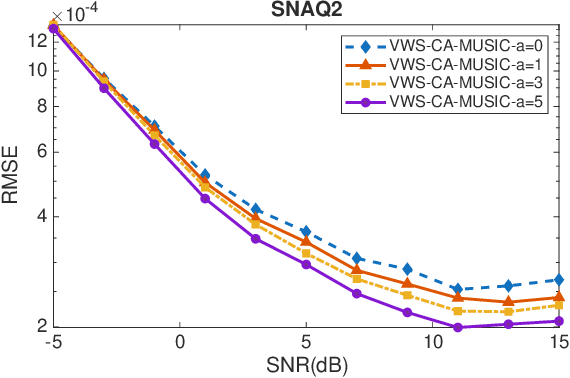
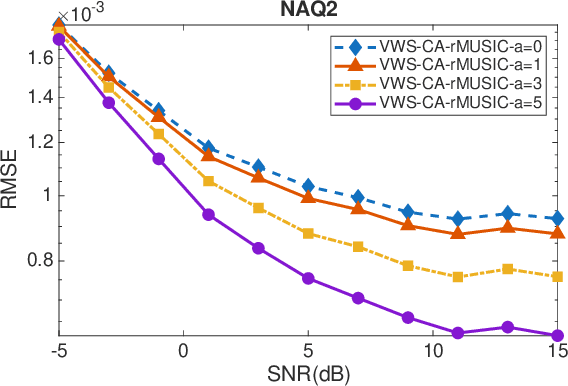
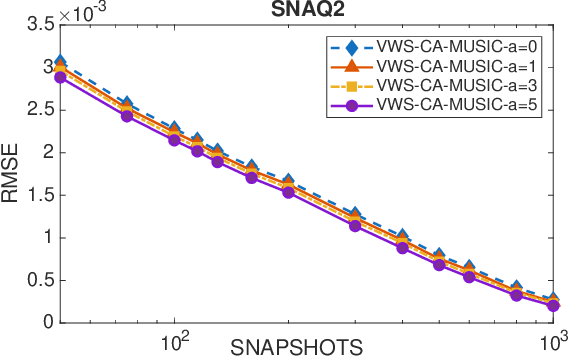
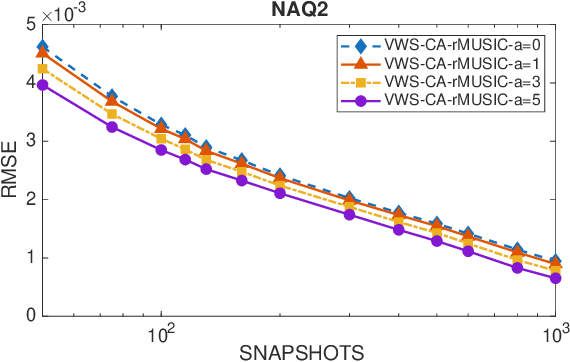
In this work, we introduce a variable window size (VWS) spatial smoothing framework that enhances coarray-based direction of arrival (DOA) estimation for sparse linear arrays. By compressing the smoothing aperture, the proposed VWS Coarray MUSIC (VWS-CA-MUSIC) and VWS Coarray root-MUSIC (VWS-CA-rMUSIC) algorithms replace part of the perturbed rank-one outer products in the smoothed coarray data with unperturbed low-rank additional terms, increasing the separation between signal and noise subspaces, while preserving the signal subspace span. We also derive the bounds that guarantees identifiability, by limiting the values that can be assumed by the compression parameter. Simulations with sparse geometries reveal significant performance improvements and complexity savings relative to the fixed-window coarray MUSIC method.
Predictive Controlled Music
Dec 26, 2025This paper presents a new approach to algorithmic composition, called predictive controlled music (PCM), which combines model predictive control (MPC) with music generation. PCM uses dynamic models to predict and optimize the music generation process, where musical notes are computed in a manner similar to an MPC problem by optimizing a performance measure. A feedforward neural network-based assessment function is used to evaluate the generated musical score, which serves as the objective function of the PCM optimization problem. Furthermore, a recurrent neural network model is employed to capture the relationships among the variables in the musical notes, and this model is then used to define the constraints in the PCM. Similar to MPC, the proposed PCM computes musical notes in a receding-horizon manner, leading to feedback controlled prediction. Numerical examples are presented to illustrate the PCM generation method.
Bridging the Copyright Gap: Do Large Vision-Language Models Recognize and Respect Copyrighted Content?
Dec 26, 2025Large vision-language models (LVLMs) have achieved remarkable advancements in multimodal reasoning tasks. However, their widespread accessibility raises critical concerns about potential copyright infringement. Will LVLMs accurately recognize and comply with copyright regulations when encountering copyrighted content (i.e., user input, retrieved documents) in the context? Failure to comply with copyright regulations may lead to serious legal and ethical consequences, particularly when LVLMs generate responses based on copyrighted materials (e.g., retrieved book experts, news reports). In this paper, we present a comprehensive evaluation of various LVLMs, examining how they handle copyrighted content -- such as book excerpts, news articles, music lyrics, and code documentation when they are presented as visual inputs. To systematically measure copyright compliance, we introduce a large-scale benchmark dataset comprising 50,000 multimodal query-content pairs designed to evaluate how effectively LVLMs handle queries that could lead to copyright infringement. Given that real-world copyrighted content may or may not include a copyright notice, the dataset includes query-content pairs in two distinct scenarios: with and without a copyright notice. For the former, we extensively cover four types of copyright notices to account for different cases. Our evaluation reveals that even state-of-the-art closed-source LVLMs exhibit significant deficiencies in recognizing and respecting the copyrighted content, even when presented with the copyright notice. To solve this limitation, we introduce a novel tool-augmented defense framework for copyright compliance, which reduces infringement risks in all scenarios. Our findings underscore the importance of developing copyright-aware LVLMs to ensure the responsible and lawful use of copyrighted content.
From Imitation to Innovation: The Divergent Paths of Techno in Germany and the USA
Dec 26, 2025Many documentaries on early house and techno music exist. Here, protagonists from the scenes describe key elements and events that affected the evolution of the music. In the research community, there is consensus that such descriptions have to be examined critically. Yet, there have not been attempts to validate such statements on the basis of audio analyses. In this study, over 9,000 early house and techno tracks from Germany and the United States of America are analyzed using recording studio features, machine learning and inferential statistics. Three observations can be made: 1.) German and US house/techno music are distinct, 2.) US styles are much more alike, and 3.) scarcely evolved over time compared to German house/techno regarding the recording studio features. These findings are in agreement with documented statements and thus provide an audio-based perspective on why techno became a mass phenomenon in Germany but remained a fringe phenomenon in the USA. Observations like these can help the music industry estimate whether new trends will experience a breakthrough or disappear.